How to Write a Resume for a Career Change
Your experience is real but it is in the wrong industry. This guide shows you how to reframe what you have done so it makes sense for where you are going.

Laddro

You're not starting over. You're redirecting.
That's the mindset shift that makes career change resumes work. You have years of experience, real skills, and proven results. The problem is that your resume currently tells the wrong story. It says "experienced retail manager" when you need it to say "operations professional ready for a logistics coordinator role."
This guide shows you how to rewrite your resume so your past experience makes sense for your new direction. No gimmicks. No "transferable skills" fluff. Just practical restructuring that makes recruiters see you as a real candidate, not a random applicant from another industry.
The real problem with career change resumes
Recruiters spend about 7 seconds on a first scan. In those 7 seconds, they're pattern matching: does this person's background fit what I'm hiring for?
When your job titles don't match, you lose that pattern match immediately. A recruiter hiring a project manager sees "Restaurant General Manager" and moves on. Even though you managed a team of 25, handled a EUR 1.2M annual budget, and coordinated schedules across three locations. That's project management. But the title doesn't say it.
Your resume needs to do the translation work that the recruiter won't do for you.
Use a combination or functional format
A chronological resume leads with job titles and company names. For a career changer, that's leading with the wrong information.
Use a combination format instead. It starts with a summary and a skills section, then lists your employment history. This lets you control what the recruiter sees first.
When you build your resume in Laddro, you can drag sections into any order. Put your skills and summary at the top. Push your employment history further down.
Write a summary that bridges the gap
Your summary is the most important section on a career change resume. It's where you connect your past to your future in three or four sentences.
Weak: "Experienced professional looking to transition into the tech industry. Strong work ethic and excellent communication skills."
Strong: "Operations manager with 8 years of experience running teams of 15 to 30 people in hospitality. Built scheduling systems that cut overtime costs by 22% and reduced staff turnover from 45% to 28%. Now completing a data analytics certificate at Coursera and looking for an operations analyst role where I can apply process optimization skills to larger datasets."
The strong version does three things:
- States your real experience with numbers
- Shows a skill that transfers (process optimization)
- Proves you're actively building new skills (the certificate)
Laddro's AI writing help can refine your summary once you have a first draft. But the bridging work is yours. You know your story better than any AI does.
Reframe every bullet point
This is where most career changers fail. They describe what they did in their old industry's language instead of translating it into the new industry's language.
From teaching to corporate training:
Before: "Taught English literature to classes of 30 students, graded assignments, and organized parent-teacher conferences."
After: "Designed and delivered structured learning programs for groups of 30. Created assessment frameworks to measure knowledge retention. Managed stakeholder communication with scheduled reporting cycles."
Same work. Completely different framing.
From retail to marketing:
Before: "Managed the store's social media accounts and put up seasonal displays."
After: "Created and executed social media content strategy across Instagram and Facebook, growing the store's following from 800 to 3,400 in 12 months. Designed in-store visual merchandising campaigns aligned with seasonal marketing calendars."
The key is to remove industry-specific language and replace it with language your target industry uses. Read 10 job descriptions in your new field. Note the verbs, the metrics, the tools they mention. Mirror that language in your resume.
Build a skills section that works double duty
Your skills section needs to show two things: transferable skills from your current career and new skills you've built for your target career.
Structure it like this:
Transferable Skills: Project management, team leadership (15-30 people), budget management (up to EUR 500K), process optimization, vendor negotiation, scheduling and resource allocation
New Skills: SQL (completed Google Data Analytics Certificate), Python basics, Tableau, Excel (advanced: pivot tables, macros, Power Query), Google Analytics
Languages: German (native), English (C1), Spanish (B1)
The transferable skills prove you're not starting from zero. The new skills prove you're serious about the change. Together, they tell a complete story.
Address the skill gap head on
Recruiters hiring career changers have one question: "Can this person actually do the new job?" Your resume needs to answer it before they even ask.
Ways to prove you're building new skills:
- Certificates: Google, Coursera, edX, or industry-specific certifications. List the ones relevant to your target role.
- Projects: Built something? Analyzed a dataset? Created a portfolio? Add it. Real projects beat certificates every time.
- Freelance or volunteer work: Even one small project in your new field counts more than ten years in your old one for proving you can do the work.
- Relevant coursework: If you're doing a part-time degree or bootcamp, list specific courses that match the job requirements.
Don't hide these at the bottom. If a certificate or project is more relevant than your last three job titles, put it higher on the page.
What to cut from your old resume
Your current resume probably has five to ten bullet points per job. For a career change resume, keep only the ones that translate.
Cut:
- Industry-specific jargon that means nothing outside your field
- Responsibilities that are standard for your old role but irrelevant to the new one
- Outdated skills or tools that your target industry doesn't use
- Jobs from more than 10 to 15 years ago (unless they're more relevant to your new career than your recent work)
Keep:
- Anything involving numbers, budgets, team sizes, or measurable results
- Leadership, project management, and cross-functional coordination
- Client or stakeholder management
- Anything that maps to a requirement in your target job descriptions
Less is more. Three strong, reframed bullet points per job beat seven irrelevant ones.
Tailor more aggressively than everyone else
Regular job seekers should tailor their resume. Career changers must tailor their resume. Every single application needs a version that speaks directly to that job description.
Read the job posting. Identify the top five requirements. Make sure your resume addresses each one, even if indirectly.
If the job asks for "experience with data analysis" and you analyzed sales reports in retail, that counts. Frame it: "Analyzed weekly sales data across 4 product categories to optimize inventory allocation, reducing overstock by 18%."
You can paste any job description into Laddro's tailor tool and it will restructure your resume to match. For career changers, this is especially useful because the AI can identify transferable experience you might not see yourself.
The cover letter matters more for you
For most applicants, the cover letter is optional. For career changers, it's essential. Your resume shows what you've done. Your cover letter explains why you're changing and why it makes sense.
Three paragraphs:
- Why this specific company and role. Show you've done research. Mention something specific about the company that connects to your motivation.
- How your experience transfers. Pick your two strongest transferable achievements and connect them directly to requirements in the job posting.
- What you're doing to prepare. Mention the certificate, the course, the side project. End with a direct ask for a conversation.
Don't apologize for changing careers. Don't say "despite my unconventional background." You're not asking for a favor. You're presenting a case.
Laddro can generate a cover letter from your resume and the job description. Use it as a starting point, then add the personal story that no AI can write for you.
Common mistakes career changers make
Using your old job title as your resume headline. If you're leaving sales, don't put "Senior Sales Representative" at the top. Use a title that reflects where you're going: "Operations Analyst" or "Marketing Coordinator."
Listing every job you've ever had. Include the last 10 to 15 years, max. If your first job out of university was in your old field and you're 35, it doesn't help.
Not explaining the change anywhere. If your resume shows a teacher applying for a UX design role with no context, it looks like a mistake. Your summary and cover letter need to connect the dots.
Waiting until your career change is "complete." You don't need a new degree or three years in the new field before you start applying. Apply while you're building skills. Many employers value motivation and transferable experience over a perfect background.
Start building
Career changes take time. Your resume is the first step, not the last. Build one strong version, tailor it to your top three target roles, and start applying. You'll refine it as you get feedback from applications and interviews.
Open the Laddro resume builder and start with the guided flow. It asks questions about your experience and builds the resume as you answer. You can reorder sections, reframe bullet points, and tailor to specific jobs all in one place. It works in 14 languages, which matters if you're also changing countries along with careers.
Ready to build your resume?
Put this into practice. Open the builder and create your resume step by step.
Free to use. No account needed to start.
Related articles

AI Is Screening Your Resume Before Any Human Sees It
AI screens most resumes before a human ever reads them. 97% of companies use automated filters now. This is what that means for you and what you can do about it.

The Best Resume Builders in 2026, Compared Honestly
Resume.io, Zety, Enhancv, Kickresume, Teal, and Laddro compared honestly: real pricing, free tiers, mobile apps, and where each tool wins. All prices checked in September 2026.

Burnout Recovery: A Real Timeline, Not 'Take a Bubble Bath'
55% of the U.S. workforce is burned out. Recovery takes 3 to 12 months. Here's what that actually looks like, stage by stage.
Related resume examples
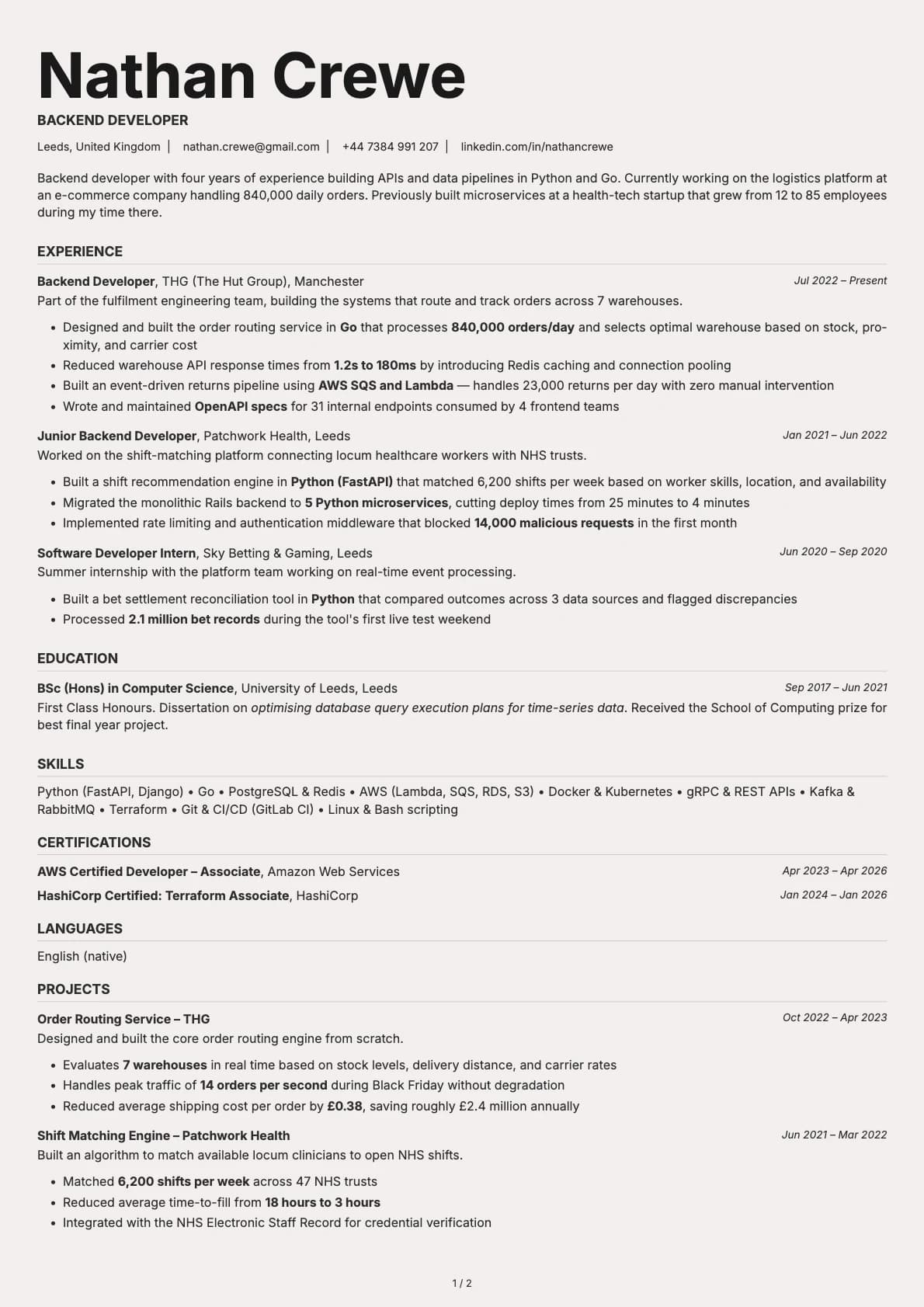
Backend Developer
A backend developer resume example with Go and Python experience, system throughput numbers, and infrastructure projects across e-commerce and health-tech.
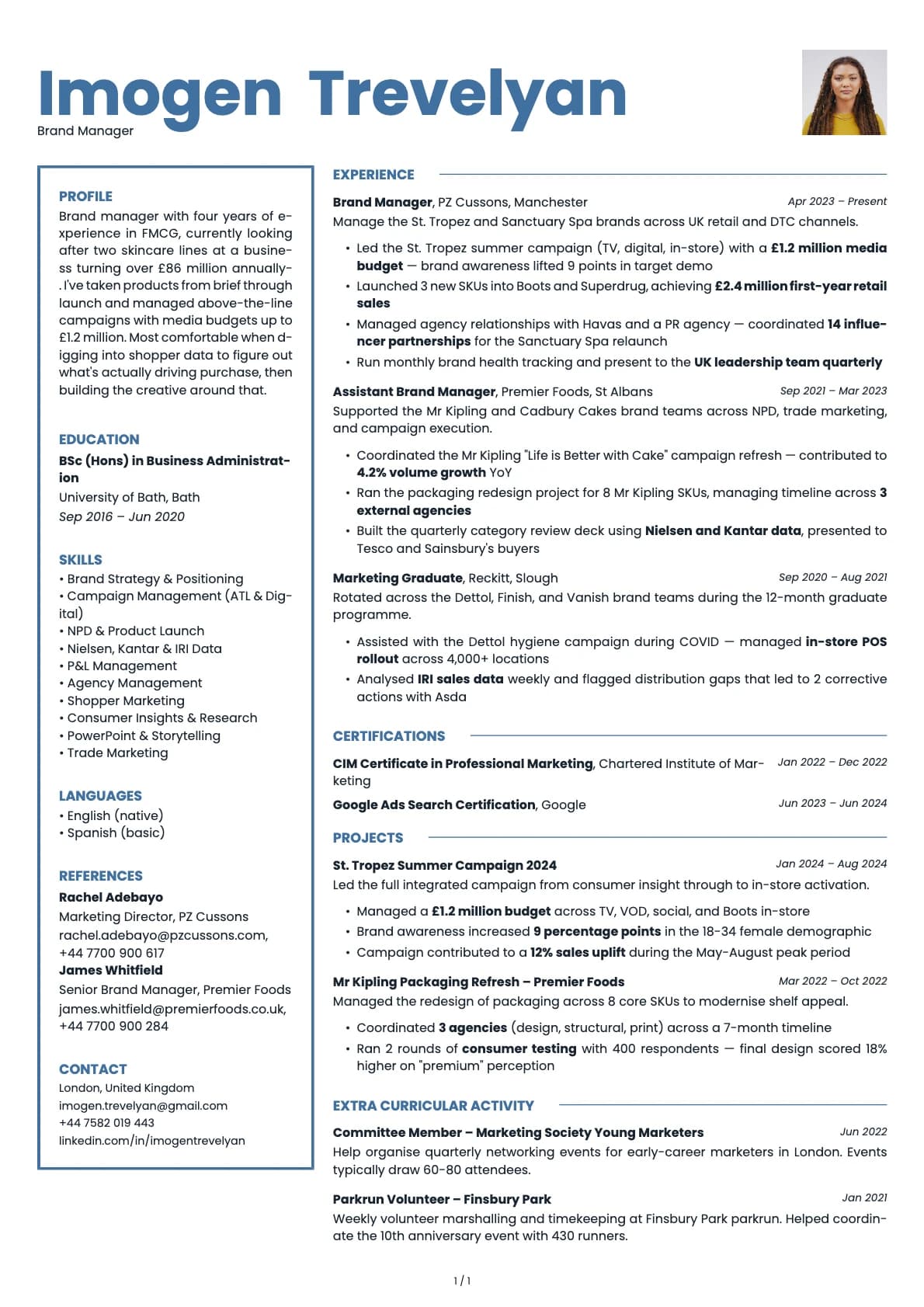
Brand Manager
A brand manager resume example from FMCG with campaign budgets, NPD launches, and Nielsen/Kantar data experience across PZ Cussons and Premier Foods.
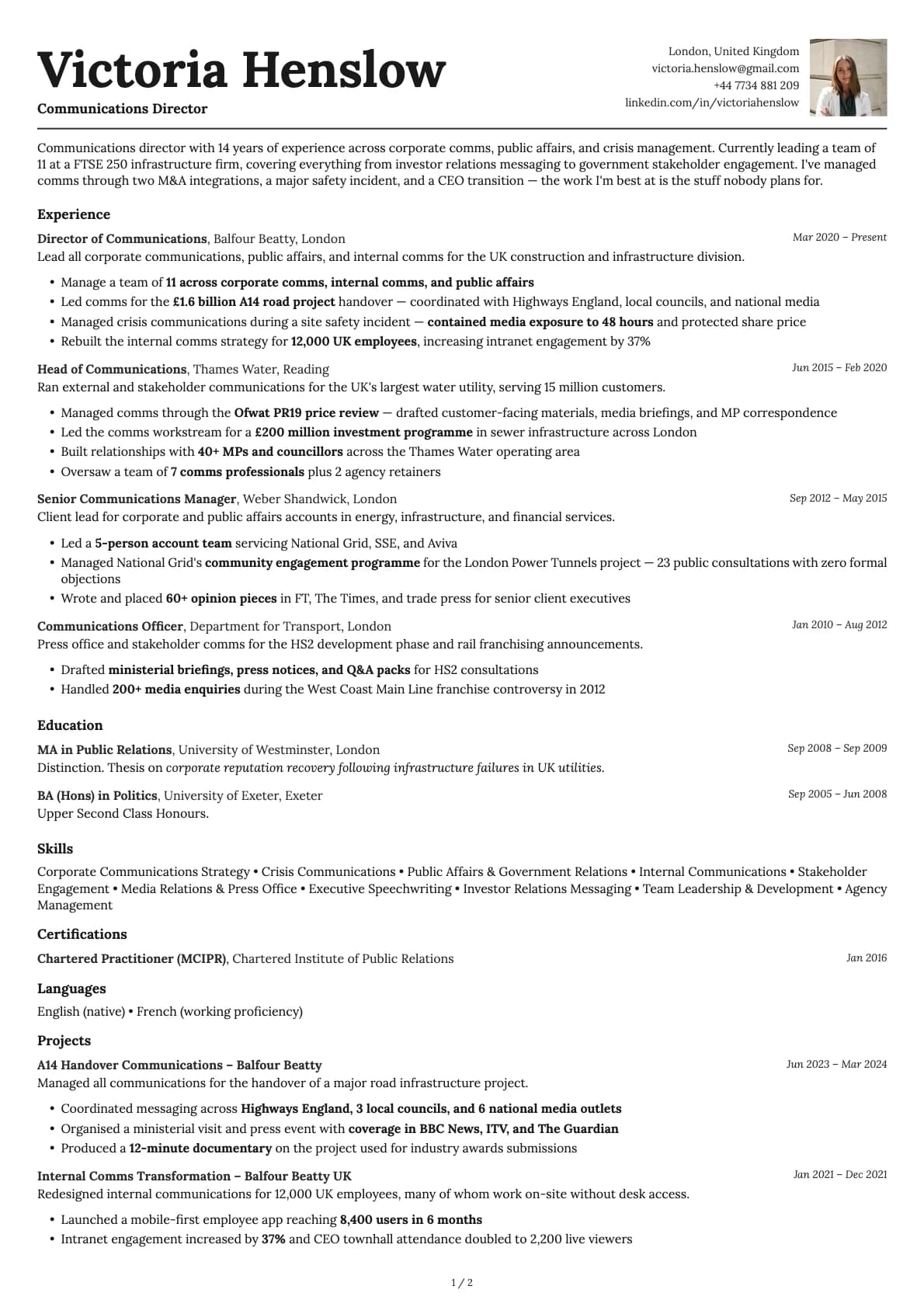
Communications Director
A communications director resume example with 14 years of experience across corporate comms, public affairs.