How to Write a Resume for Jobs in Another Country
Resume rules change at every border. Photo or no photo. One page or two. Personal details or none. This guide covers what actually matters when you apply abroad.

Laddro
A resume that gets interviews in Warsaw might get rejected in London. Not because of your experience, but because of the format, the photo, the personal details, or the length.
Every country has different expectations for how a resume should look. Some differences are obvious (the US says "resume," Europe says "CV"). Some will get your application silently filtered out if you get them wrong.
This guide covers the real differences that matter when you apply for jobs across borders, with a focus on European markets. No vague advice. Just specific rules for specific countries.
Why this matters more than you think
When a recruiter in Germany opens a resume without a photo, they notice. When a recruiter in the UK opens a resume with a photo, they notice. Neither is "wrong" in absolute terms. But in each market, doing the unexpected creates friction. And friction at the 7-second scan stage means your resume goes to the bottom of the pile.
You're already at a disadvantage as an international applicant. The recruiter has to consider visa requirements, language ability, and relocation logistics. Don't add "doesn't know our resume conventions" to that list.
Resume standards across Europe
Germany (Lebenslauf)
German resumes are formal and detailed.
- Photo: Expected. Professional headshot, business attire, white or neutral background. This is changing slowly, but most German employers still expect it.
- Length: 1 to 2 pages. Two pages is standard for anyone with more than 2 years of experience.
- Personal details: Include date of birth, nationality, and marital status. This feels unusual if you're coming from the UK or US, but it's standard practice in Germany.
- Format: Reverse chronological. Germans expect a gapless timeline. If you have gaps, address them explicitly (e.g., "Career break for family" or "Language course in preparation for relocation").
- Language: German strongly preferred, even at international companies. Write in German unless the job posting is explicitly in English.
- Certificates and references: Germans value formal qualifications. Include your degree certificates, training certificates, and reference letters (Arbeitszeugnisse) as attachments.
- Signature: Some traditional applications include a handwritten signature and date at the bottom of the CV. Less common now but still seen.
United Kingdom (CV)
British CVs are clean and understated.
- Photo: Do not include one. UK anti-discrimination norms mean photos are strongly discouraged.
- Length: 2 pages maximum. One page for early career.
- Personal details: Name, email, phone, LinkedIn. Do not include age, date of birth, marital status, nationality, or a photo.
- Format: Reverse chronological with a personal statement at the top.
- Language: English only. British English spelling (programme, organisation, centre).
- References: "References available upon request" is acceptable. Don't list referees on the CV itself.
France (CV)
French CVs share some similarities with German ones but are more concise.
- Photo: Common but increasingly optional, especially in larger companies and tech.
- Length: One page strongly preferred. Two pages only for senior roles.
- Personal details: Include nationality and sometimes date of birth. Address is common.
- Format: Reverse chronological. A personal interests section (Centres d'intérêt) is expected and taken seriously. French recruiters use it to assess cultural fit.
- Language: French, unless the posting is in English. Quality of written French matters enormously.
- Title: Put a clear title at the top of your CV matching the position you're applying for.
Netherlands (CV)
Dutch CVs are pragmatic and direct.
- Photo: Optional. More common in traditional industries, less common in tech and startups.
- Length: 1 to 2 pages.
- Personal details: Name, contact info, date of birth, nationality. Driving license if relevant.
- Format: Reverse chronological with a profile summary.
- Language: English is widely accepted, especially in Amsterdam, Rotterdam, and Eindhoven. For public sector or Dutch-only companies, write in Dutch.
- Tone: Direct and factual. Don't oversell. Dutch culture values straightforwardness.
Spain (Currículum Vitae)
Spanish CVs tend to be detailed.
- Photo: Expected in most industries.
- Length: 1 to 2 pages.
- Personal details: Include DNI/NIE number (tax ID), nationality, date of birth.
- Format: The Europass format is still commonly accepted, especially for public sector and larger companies.
- Language: Spanish. Regional languages (Catalan, Basque, Galician) are a plus for jobs in those regions.
- Cover letter: Often expected and should be formal in tone.
Italy (Curriculum Vitae)
Italian CVs are the most formal in Western Europe.
- Photo: Expected.
- Length: 2 pages is standard. Europass format is still widely used, especially in public sector and traditional companies.
- Personal details: Include date of birth, place of birth, nationality, and sometimes fiscal code (codice fiscale).
- Privacy disclaimer: Italian CVs traditionally include a privacy consent statement at the bottom, authorizing the processing of personal data under Italian privacy law. Something like: "Autorizzo il trattamento dei miei dati personali ai sensi del D.Lgs. 196/2003."
- Language: Italian for most roles. English acceptable at international companies.
Poland (CV / Życiorys zawodowy)
Polish CVs are moving toward Western European standards but keep some local conventions.
- Photo: Common, especially outside of tech.
- Length: 1 to 2 pages.
- Personal details: Date of birth, nationality, and sometimes marital status.
- Privacy clause: Required. Include a GDPR consent clause (Klauzula RODO) at the bottom of your CV. Without it, HR departments may legally be unable to process your application.
- Language: Polish for domestic companies. English for international roles.
- Format: Reverse chronological. A "Cel zawodowy" (professional objective) at the top is common for entry-level candidates.
Portugal (Currículo)
Portuguese CVs follow Southern European conventions.
- Photo: Common.
- Length: 1 to 2 pages.
- Personal details: Date of birth, nationality, address.
- Format: Reverse chronological. Europass is accepted but a clean custom format is preferred by modern companies, especially in Lisbon's tech scene.
- Language: Portuguese for domestic roles. English widely accepted in tech, tourism, and international companies.
Nordic countries (Sweden, Denmark, Norway, Finland)
Nordic CVs are minimal and egalitarian.
- Photo: Generally not included. Sweden especially discourages photos to prevent discrimination.
- Length: 1 to 2 pages.
- Personal details: Minimal. Name, contact info, LinkedIn. Personal number (personnummer) sometimes requested separately.
- Format: Reverse chronological with a brief profile.
- Language: English widely accepted, especially in tech, finance, and international companies. Local language is a significant advantage for non-tech roles.
- Tone: Understated. Don't oversell accomplishments. Present facts and let them speak.
Rules that apply everywhere
Regardless of which country you're targeting:
- Write in the language of the job posting. If the posting is in English, your CV should be in English. If it's in French, write in French. Don't guess.
- Research the company, not just the country. A German startup in Berlin has different expectations than a German bank in Frankfurt. Look at the company's career page and existing team to gauge formality.
- Match the local date format. Europeans use DD/MM/YYYY or written months (Jan 2024). Americans use MM/DD/YYYY. Getting this wrong signals that you didn't adapt.
- Convert your qualifications. If your degree is from another country, briefly explain its equivalent. "BSc Computer Science (equivalent to German Informatik Bachelor)" helps a recruiter who doesn't know your university system.
- Include your language skills. This is critical for cross-border applications. Use the CEFR scale (A1 to C2) that European employers understand. Be honest. Claiming C1 when you're B1 will be exposed in the first interview.
- Address visa and work authorization. If you already have the right to work in the target country, state it clearly: "EU citizen, no work permit required" or "Holder of Dutch residence permit (valid until 2028)." If you need sponsorship, be upfront about it.
Should you use Europass?
Europass is a standardized CV format created by the European Commission. It's recognized across all EU countries and is required for some government and academic positions.
Use Europass for: Public sector jobs, academic positions, Erasmus applications, jobs in Southern and Eastern Europe where it's still the default.
Skip Europass for: Tech companies, startups, creative industries, and most private sector roles in Western and Northern Europe. These employers prefer a modern, well-designed CV.
Laddro's 22+ templates are all ATS-compatible and work across European markets. They're more visually polished than Europass while maintaining the clean structure that ATS systems and recruiters need. And if the application does call for the Europass format, you can create a Europass style CV in the same editor.
Tailor your CV to each country
Applying to jobs in three different countries means three different versions of your CV. Not just translated, but adapted.
Your German version might include a photo and date of birth. Your UK version drops both. Your French version is one page with a hobbies section. These aren't small details. They determine whether your application is taken seriously.
Laddro works natively in 14 languages. You're not translating a template. You're building in the language and format that each market expects. And you can tailor each version to a specific job description so the content matches too, not just the format.
Cover letters for international applications
Cover letter expectations vary as much as CV formats:
- Germany: Formal. Address the hiring manager by name if possible. Explain why this company, why this role, and what you bring. One page.
- UK: Brief and professional. Less formal than Germany. Three to four paragraphs maximum.
- France: Formal. The "lettre de motivation" is taken seriously. Structure matters.
- Netherlands: Short and direct. Get to the point quickly.
- Nordics: Often optional. If you write one, keep it concise and genuine.
In all cases, your cover letter should address why you're applying from abroad. If you're already in the country, say so. If you're relocating, explain your timeline and that you understand the logistics.
Laddro can generate a cover letter matched to your resume and the job description. It handles structure and job matching. You add the personal context about your move.
Start building
Applying abroad takes more preparation than applying at home. But the European job market is more open to international talent than ever, especially in tech, finance, and engineering.
Open the Laddro resume builder and choose your target language. Build your CV in the format your target market expects, tailor it to specific job descriptions, and generate matching cover letters. All in one place, all in the language you need.
Ready to build your resume?
Put this into practice. Open the builder and create your resume step by step.
Free to use. No account needed to start.
Related articles

AI Is Screening Your Resume Before Any Human Sees It
AI screens most resumes before a human ever reads them. 97% of companies use automated filters now. This is what that means for you and what you can do about it.

The Best Resume Builders in 2026, Compared Honestly
Resume.io, Zety, Enhancv, Kickresume, Teal, and Laddro compared honestly: real pricing, free tiers, mobile apps, and where each tool wins. All prices checked in September 2026.

Burnout Recovery: A Real Timeline, Not 'Take a Bubble Bath'
55% of the U.S. workforce is burned out. Recovery takes 3 to 12 months. Here's what that actually looks like, stage by stage.
Related resume examples
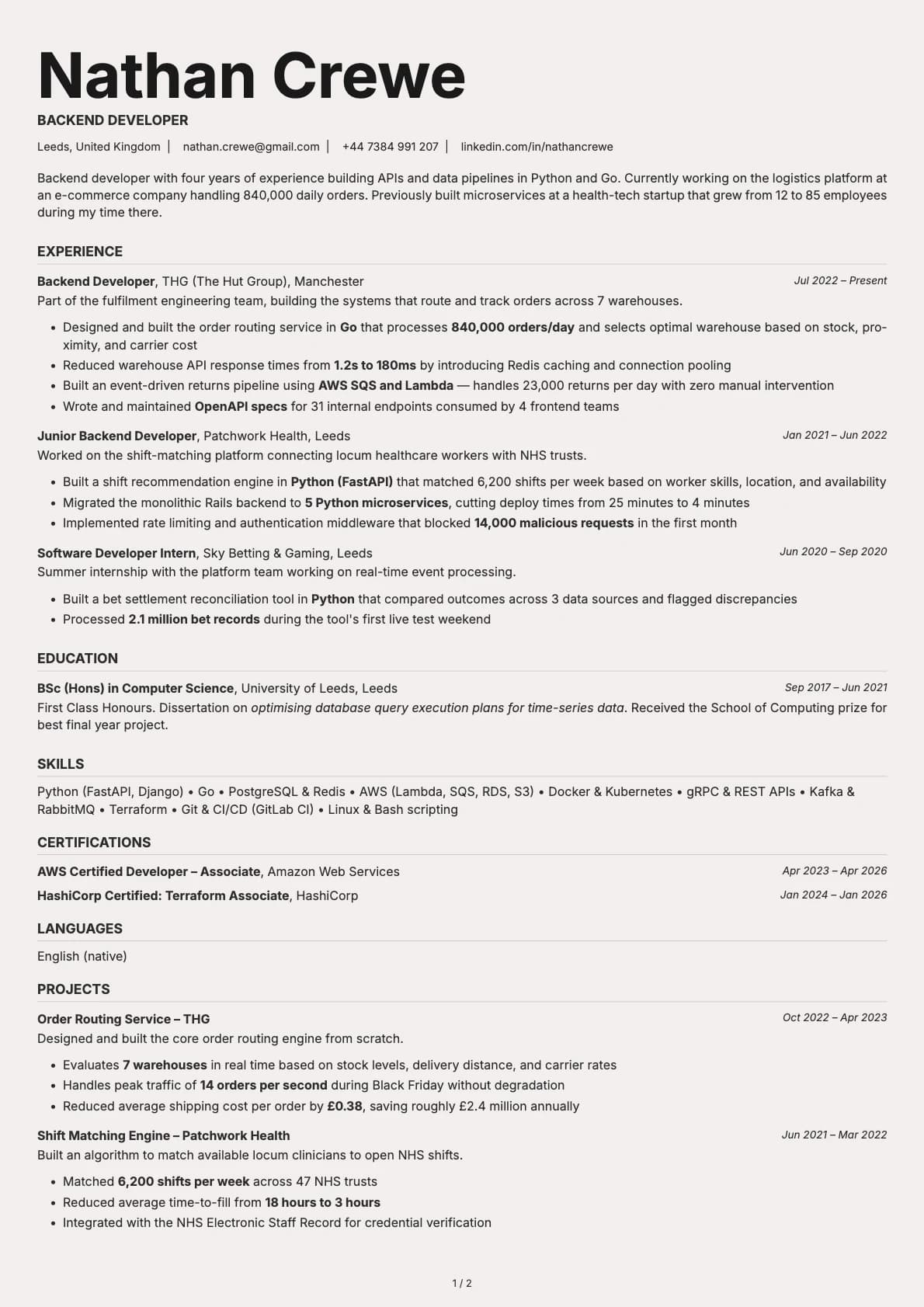
Backend Developer
A backend developer resume example with Go and Python experience, system throughput numbers, and infrastructure projects across e-commerce and health-tech.
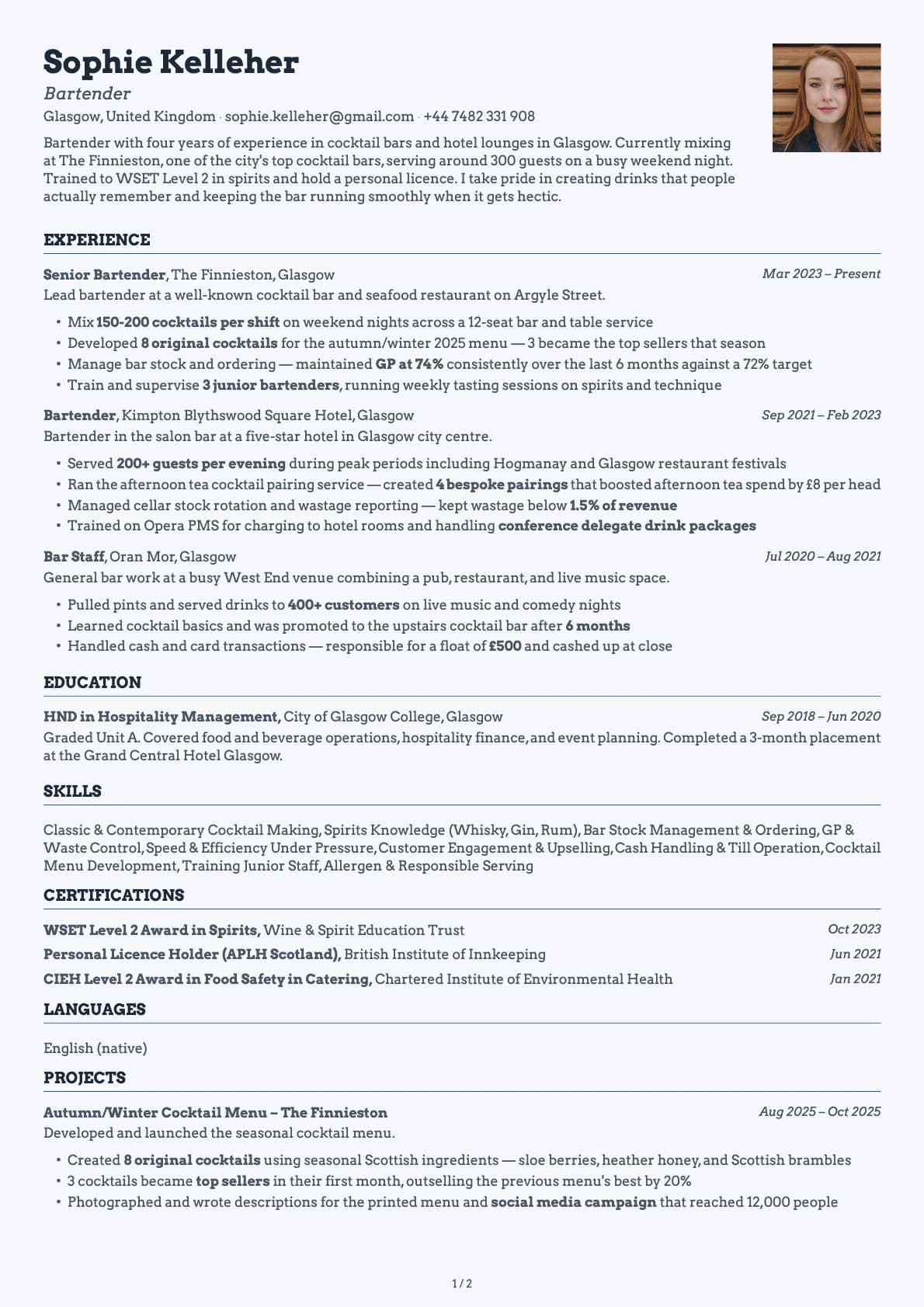
Bartender
A bartender resume example from a top Glasgow cocktail bar, covering drink volumes, GP targets, menu development, and how to present hospitality.
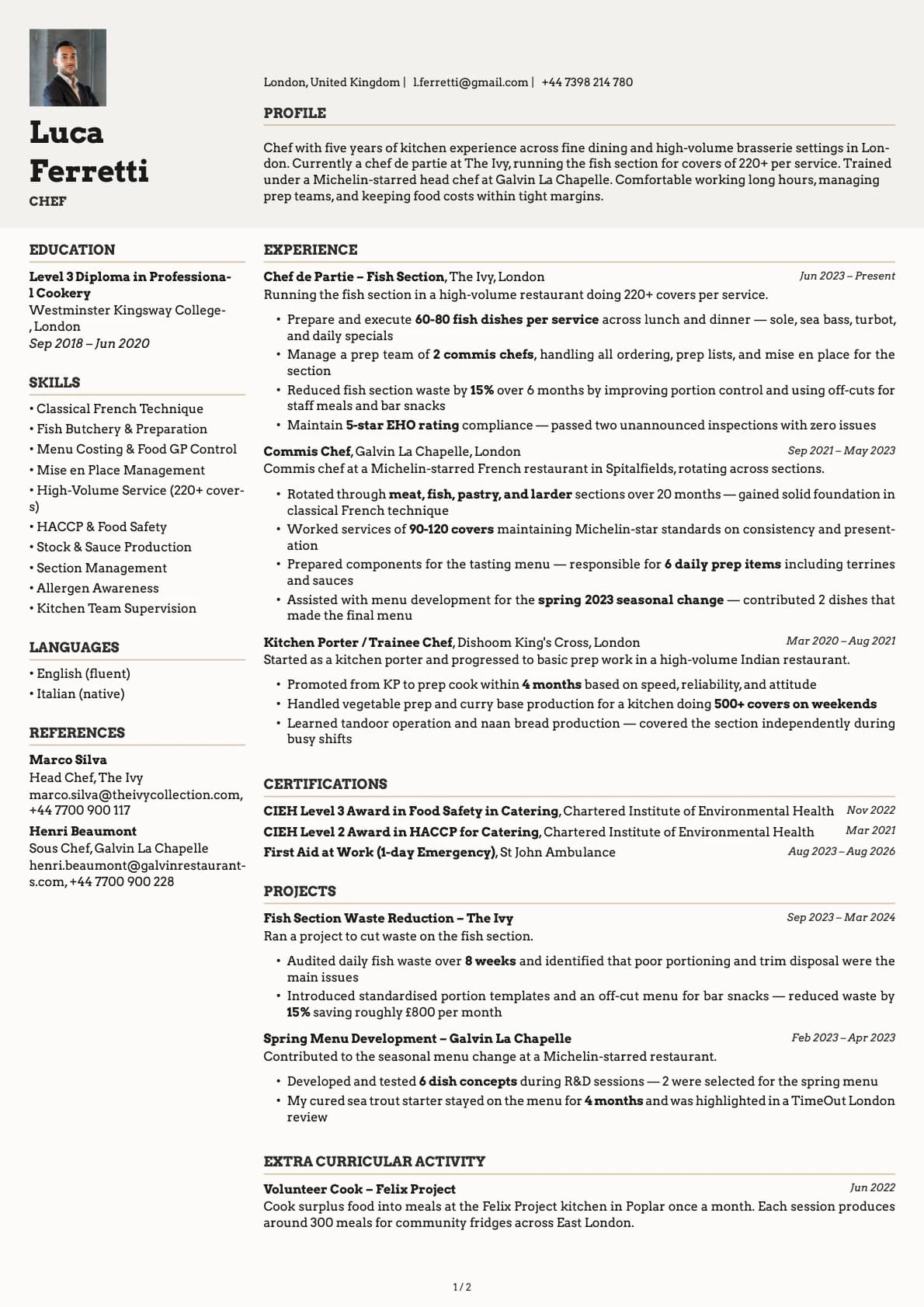
Chef
A chef resume example with fine dining and high-volume experience at The Ivy and Galvin La Chapelle.