How to Write a Resume After a Career Gap
You took time off. Now you need a resume that makes employers focus on what you can do, not when you last did it.

Laddro

You took time off. Maybe you raised children. Maybe you dealt with health issues. Maybe you relocated to another country. Maybe the job market collapsed and you couldn't find work. Maybe you just needed a break.
Whatever the reason, you're back. And now you need a resume that works despite the gap on your timeline.
Here's what most advice gets wrong: they tell you to hide the gap. Use a functional resume. Omit dates. Play tricks with formatting. That doesn't work. Recruiters know every trick. When they see a functional resume from someone with 10 years of experience, they assume there's something to hide.
Instead, this guide shows you how to address the gap honestly, rebuild your confidence on paper, and shift the focus to what you can do right now.
Career gaps are more normal than you think
According to a LinkedIn survey conducted in 2022, 62% of employees have taken a career break at some point. Among women, that number is higher. Among people over 40, it's the norm, not the exception.
The COVID-19 pandemic normalized career gaps in a way nothing else could. Millions of people worldwide had involuntary breaks between 2020 and 2022. Recruiters in 2026 understand this. A gap on your resume is not the disqualifier it was in 2015.
That said, you still need to handle it well. Not because gaps are shameful, but because a recruiter scanning your resume in 7 seconds needs to quickly understand your timeline and move on to your qualifications.
How long is "too long" for a gap?
Under 6 months: Most recruiters won't even ask about it. The space between jobs is normal.
6 to 12 months: Easy to address. One sentence in your summary or a line in your timeline is enough.
1 to 3 years: Needs a brief explanation and evidence that your skills are still current.
3+ years: Needs a clear strategy. You'll want to show recent activity: courses, certifications, volunteer work, freelance projects, or anything that proves you're not starting from 2019 knowledge.
The length of the gap matters less than what you did during it and how you present it.
Pick the right format
Use a combination format. Start with your summary and skills, then list employment history in reverse chronological order.
Don't use a purely functional resume (skills only, no timeline). Recruiters distrust them, and ATS systems often can't parse them properly.
In Laddro, you can reorder your resume sections by dragging them. Put your summary and skills at the top, then education or certifications if you've recently completed any, then employment history. This controls the narrative without hiding anything.
Address the gap in your summary
Your professional summary is where you control the story. Don't ignore the gap. Don't over-explain it either. One sentence is enough.
Weak: "Experienced marketing professional seeking to return to the workforce after a long absence."
Strong: "Marketing manager with 7 years of experience in B2B SaaS (2014 to 2021). Took a 4-year career break for family. Recently completed Google Digital Marketing Certificate and freelanced for two local businesses to rebuild hands-on experience. Looking for a marketing role in a mid-size company in the Netherlands."
The strong version:
- States the real experience and makes it count
- Acknowledges the gap in one clause (not a paragraph)
- Shows what you did to come back (certificate + freelance)
- States what you want next
Fill the gap with real things
Even if you weren't formally employed, you probably did things that translate to professional skills. Be honest, but don't undersell yourself.
Parenting: You managed a household, a budget, schedules, and logistics. You made hundreds of decisions daily. You don't need to put "Full-time Parent" on your resume (though you can). Instead, use the time to show any structured activities: volunteering at school, organizing community events, managing a neighborhood association.
Health or personal reasons: You don't owe anyone details. A simple "Career break for personal reasons" is enough. No recruiter worth working for will press further.
Relocation: If you moved countries, that's a story of adaptability. Learning a new language, navigating a new system, building a network from scratch.
Caregiving: Similar to parenting. You don't need to explain in detail. "Career break for family caregiving" covers it.
What you should add to your resume from the gap period:
- Online courses or certifications completed
- Volunteer work with specific responsibilities
- Freelance projects (even small ones)
- Language skills acquired
- Community involvement with measurable impact
Prove your skills are current
This is the biggest concern employers have about candidates with career gaps: are your skills still relevant?
If your gap was 1 to 2 years, your existing skills are probably fine. Update any tools or software versions that have changed.
If your gap was 3+ years, you need to actively demonstrate currency:
- Take one relevant certification. Google, HubSpot, Coursera, or any industry-recognized provider. Even a 40-hour course shows initiative.
- Do a project. Build a portfolio website. Analyze a public dataset. Write a case study. Something tangible that proves current ability.
- Freelance or volunteer. One real client or project is worth more than five certificates.
- Join professional communities. Being active in industry forums, attending meetups, or participating in online groups shows you're engaged.
List these under a "Professional Development" or "Recent Activity" section on your resume. Place it right after your summary.
Handle your employment history section
List your jobs in reverse chronological order with accurate dates. Don't fudge the timeline.
If your gap is between jobs, it will show as a natural space in the dates. That's fine. Your summary already explained it.
For the jobs you list, focus on achievements, not responsibilities. You need to remind the recruiter that you were good at your job before the break.
Weak:
Marketing Coordinator, TechCorp GmbH (2018-2021) Responsible for social media and email marketing. Worked with the sales team on campaigns.
Strong:
Marketing Coordinator, TechCorp GmbH (Jan 2018 to Mar 2021) Managed social media across LinkedIn, Instagram, and Twitter, growing combined following from 4,200 to 18,500 in 3 years. Launched bi-weekly email newsletter that reached 6,000 subscribers with a 34% average open rate. Collaborated with sales on 4 product launch campaigns generating EUR 280K in pipeline.
Numbers make your past experience feel present and real. "Grew from X to Y" is timeless.
Remove outdated skills, add current ones
If your last job used tools that are no longer industry standard, remove them. Listing outdated technology signals that you haven't kept up.
Remove: Flash, Internet Explorer compatibility, Dreamweaver, old CRM versions nobody uses
Keep: Skills that haven't changed (Excel, project management, client communication, financial analysis)
Add: Anything you've learned during or after your gap (current tools, updated methodologies, new certifications)
When you use Laddro's guided builder, the AI can suggest skills relevant to your target role based on current job market data.
Look for returner-friendly employers
Many large companies in Europe run "returner programs" designed specifically for people coming back after career gaps. Companies like Vodafone, Credit Suisse, Morgan Stanley, and Deloitte have structured re-entry programs.
When applying to these programs, your career gap is an expected part of your application. Don't downplay it. Instead, focus on why you're choosing to come back now and what you bring from your combined experience.
For other employers, tailoring your resume to the specific job description matters even more when you have a gap. You need every bullet point to count.
Use the cover letter strategically
Your resume shows the facts. Your cover letter tells the story. For returners, the cover letter is where you briefly explain the gap (one sentence), show what you did to prepare for your return (one to two sentences), and connect your past experience to this specific role (one paragraph).
Do not spend the entire cover letter explaining or justifying your gap. One or two sentences maximum. The rest should be about what you can do for this employer.
Laddro can generate a cover letter from your resume and a job description. It won't know your personal story, so add that part yourself. But it handles the structural work and the job matching, which saves you time when you're applying to multiple roles.
Final tips
- Be confident, not apologetic. You're explaining a gap, not defending one. Frame it as a chapter, not a problem.
- Apply even when you feel underqualified. Job descriptions are wish lists. If you match 60% to 70% of the requirements, apply.
- Network before you apply. Reach out to former colleagues, join LinkedIn groups in your industry, attend local meetups. Many returners find their first role through connections, not applications.
- Start with a realistic target. If you were a senior manager before your break, consider applying for mid-level roles to get back in. You can move up quickly once you prove yourself. Accepting a slight step down is not failure. It's strategy.
- Keep your resume to one or two pages. If your career before the gap was extensive, two pages is fine. If you're earlier in your career, stick to one.
Start building
You have more to offer than a gap on a timeline. The resume just needs to show that clearly.
Open the Laddro resume builder and use the guided flow. It walks you through each section, asks the right questions, and helps you frame your experience. You can reorder sections to lead with your strengths, tailor to specific jobs, and generate a matching cover letter. Works in 14 languages, free to start, no account needed until you want to save.
Ready to build your resume?
Put this into practice. Open the builder and create your resume step by step.
Free to use. No account needed to start.
Related articles

AI Is Screening Your Resume Before Any Human Sees It
AI screens most resumes before a human ever reads them. 97% of companies use automated filters now. This is what that means for you and what you can do about it.
The Best Resume Builders in 2026, Compared Honestly
Resume.io, Zety, Enhancv, Kickresume, Teal, and Laddro compared honestly: real pricing, free tiers, mobile apps, and where each tool wins. All prices checked in September 2026.

Burnout Recovery: A Real Timeline, Not 'Take a Bubble Bath'
55% of the U.S. workforce is burned out. Recovery takes 3 to 12 months. Here's what that actually looks like, stage by stage.
Related resume examples
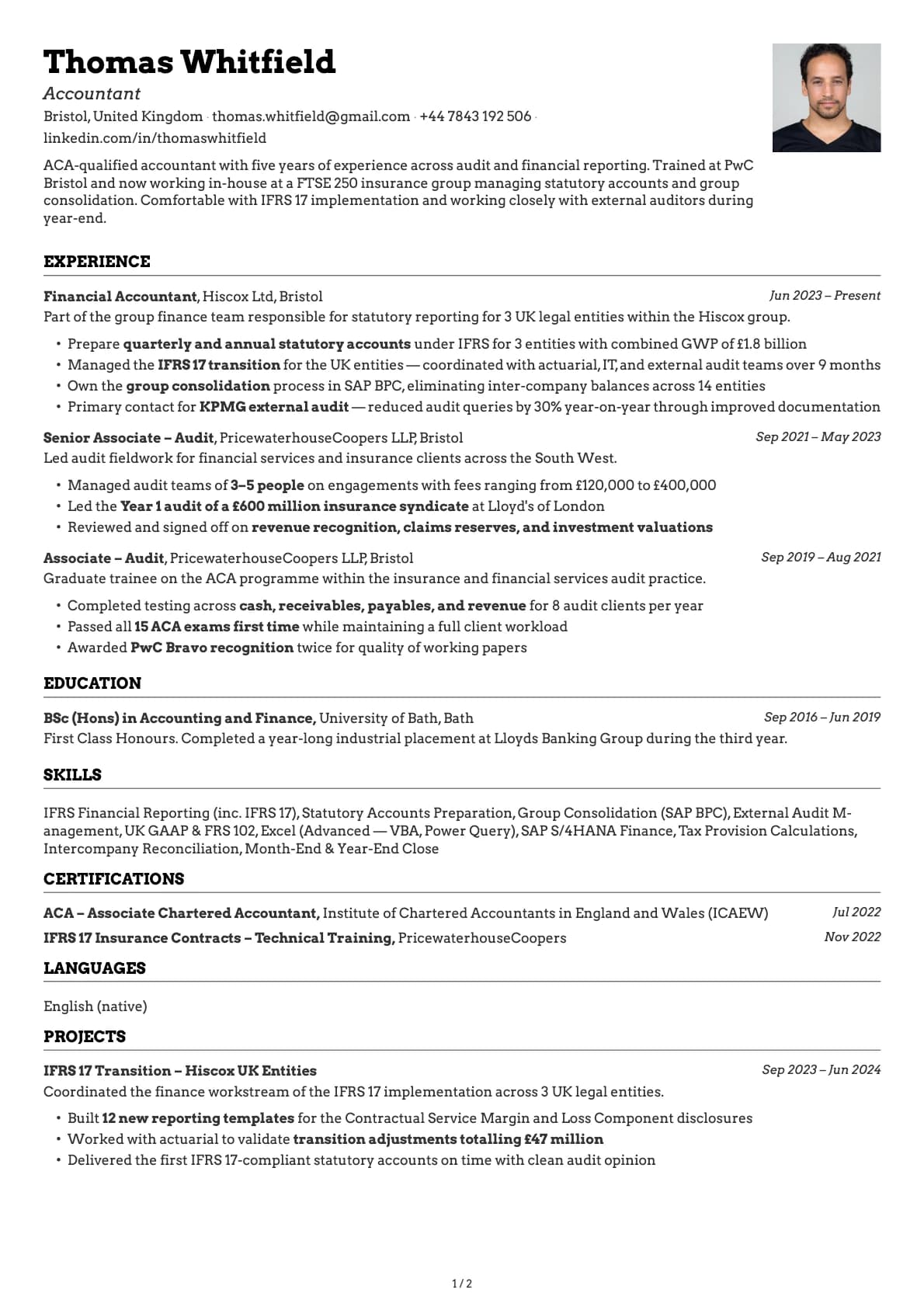
Accountant
An ACA-qualified accountant resume example with Big 4 audit experience and FTSE 250 in-house reporting.
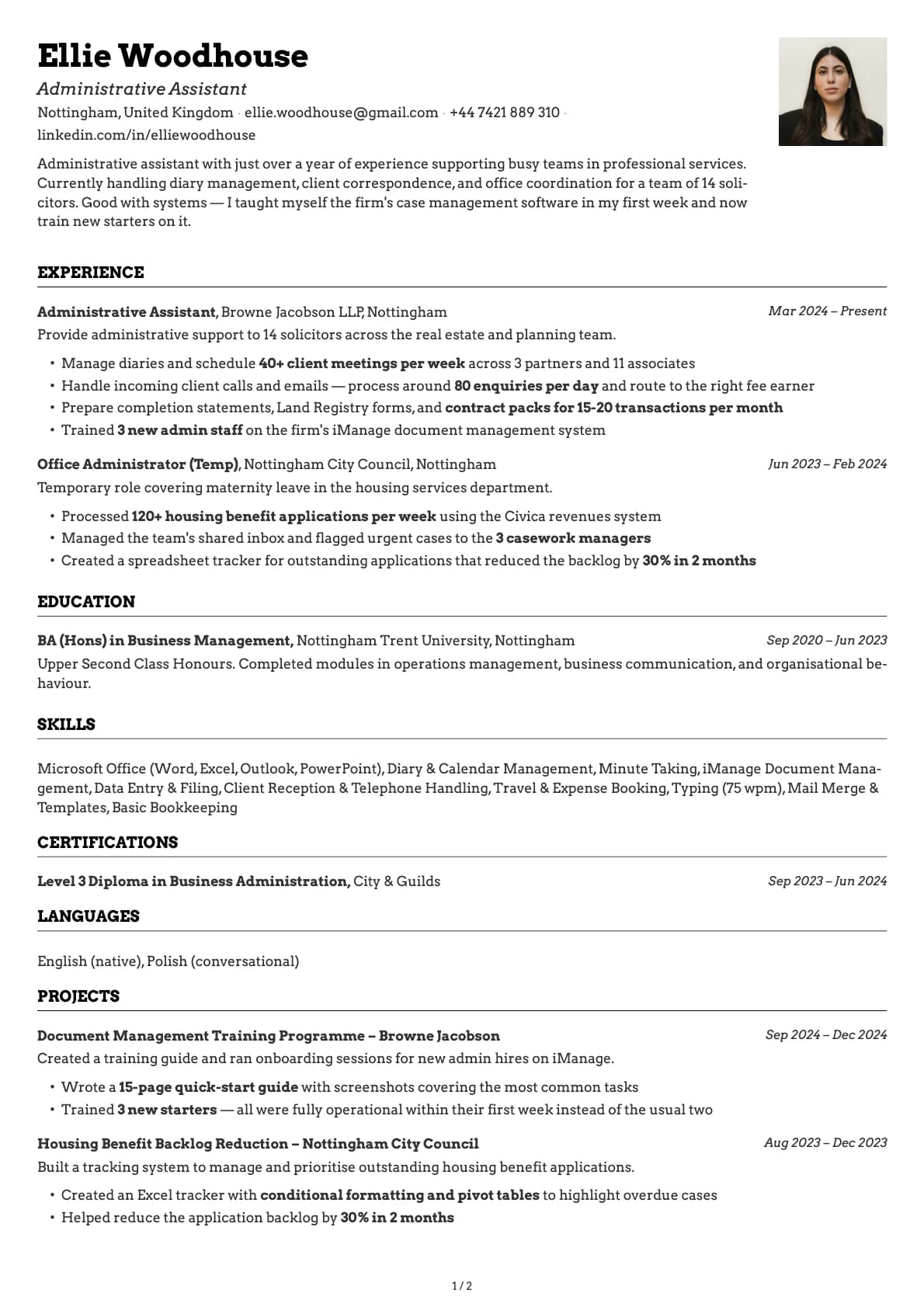
Administrative Assistant
An administrative assistant resume example with law firm experience, showing how to present volume of work, systems knowledge.
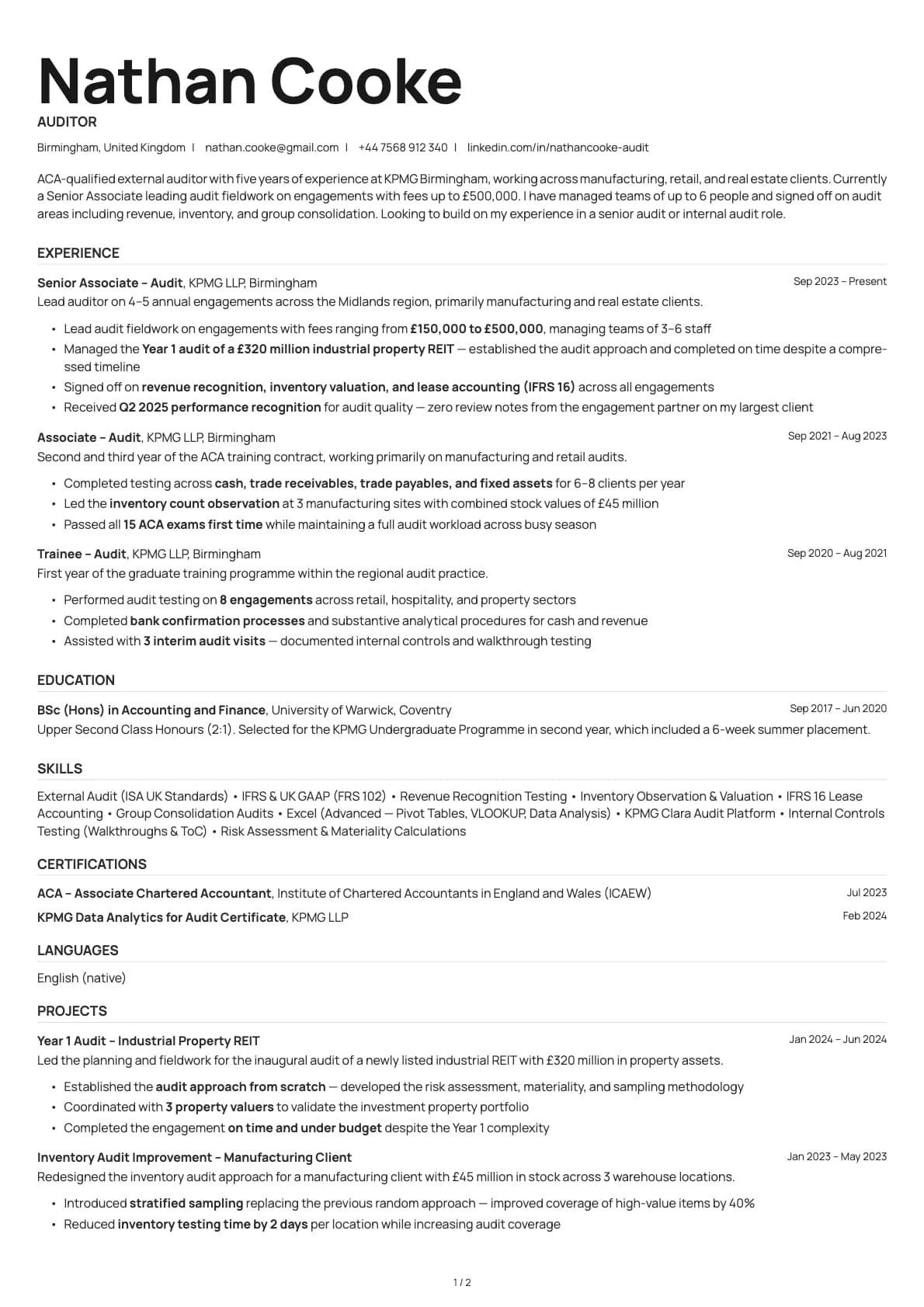
Auditor
An ACA-qualified auditor resume example from KPMG with engagement fee ranges, team management, and ISA Standards experience across manufacturing and real.