How to Write a Cover Letter That Gets You Interviews
A step-by-step guide to writing cover letters that actually work.'I am writing to express my interest' openings.

Laddro

Here's the truth about cover letters: most of them get skimmed in under 10 seconds. The ones that work are short, specific, and tell the hiring manager something they can't get from your resume alone.
This guide walks you through writing a cover letter that actually gets read. No filler, no corporate jargon, no five-paragraph essays about your "passion for excellence." Just a clear structure that works, with examples you can steal.
Why cover letters still matter
Not every job requires one. But here's what happens when a posting says "cover letter optional": about 70% of applicants skip it. That means sending one immediately puts you in the smaller group that made the effort.
Hiring managers notice. A short, well-written cover letter tells them three things before they even open your resume: you can write clearly, you actually read the job description, and you care enough about this specific role to spend 15 minutes on it.
Does that guarantee an interview? No. But it gets your resume read more carefully, and that's half the battle.
If you want to see what strong cover letters look like before writing yours, browse cover letter examples by industry for real templates you can use as a starting point.
The opening paragraph: don't blow it
The first sentence matters more than anything else you write. Most people open with some version of this:
Bad: "I am writing to express my interest in the Marketing Manager position at your company. With over five years of experience in marketing, I believe I would be a great fit for this role."
That tells the hiring manager nothing. It's the same sentence they've read 200 times this week. Here's what works instead:
Good: "Your job post mentions you're looking for someone to rebuild the content pipeline from scratch. I did exactly that at my last company, growing organic traffic from 8K to 67K monthly visits in 14 months."
See the difference? The second version references something specific from the job description and immediately proves you can do the thing they need. The hiring manager reads that and thinks, "Tell me more."
Your opening paragraph should do two things:
- Reference something specific about the role or the company
- Connect it to something you've actually done
That's it. Two or three sentences. No throat-clearing, no "I am writing to apply for..." openers.
The middle section: tell the story behind the numbers
This is where most cover letters turn into a copy-paste of the resume. Don't do that. The hiring manager already has your resume. If your cover letter just repeats the same bullet points, you've wasted their time.
Instead, pick one or two achievements from your resume that are most relevant to this specific job, and expand on them. Tell the story the resume doesn't have room for.
Resume bullet point: "Reduced customer onboarding time from 14 days to 3 days."
Cover letter version: "When I joined the CS team, new customers waited an average of 14 days before they could use the product. The problem wasn't the product. It was a manual onboarding process that involved three separate teams and a shared spreadsheet. I mapped out the bottlenecks, automated the handoffs between teams, and built a self-serve setup flow. Within four months, onboarding dropped to 3 days. Churn in the first 90 days fell by 23%."
The resume gives the result. The cover letter gives the context, the problem, and how you think. That's what hiring managers are really evaluating: not just what you achieved, but how you approach problems.
Keep this to one or two paragraphs. Pick the achievements that most closely match what the job description asks for. If the role emphasizes "cross-functional collaboration," tell a story about working across teams. If it mentions "scaling processes," talk about something you built from scratch.
The closing paragraph: be direct
Most closing paragraphs are painfully vague. "I look forward to the opportunity to discuss how my skills and experience align with your company's needs." That's not a close. That's a sentence that says nothing.
Be direct about what you want:
Bad: "I believe my background makes me an excellent candidate and I look forward to hearing from you at your earliest convenience."
Good: "I'd love to walk you through how I'd approach the first 90 days in this role. I'm available for a call anytime this week or next. You can reach me at [phone] or [email]."
The good version is specific, confident, and makes it easy for them to take the next step. You're not begging for an interview. You're suggesting a conversation and giving them a clear way to make it happen.
Formatting rules that actually matter
A cover letter should be one page. That's not a suggestion. If your cover letter is longer than one page, you're including too much.
The ideal structure:
- 3-4 paragraphs total (opening, one or two middle paragraphs, closing)
- 250-400 words (any longer and you're rambling)
- Same visual style as your resume (matching fonts, colours, and header design)
That last point trips people up. If your resume uses a clean, modern template with a dark header, and your cover letter is plain text in Times New Roman, your application looks disjointed. Hiring managers notice inconsistency, even subconsciously.
Laddro's cover letter builder automatically matches the template of your resume. If you built your resume with a specific design, your cover letter gets the same fonts, colours, and layout. Your application looks like one cohesive package instead of two documents that don't belong together.
Browse resume templates if you haven't picked a design yet. Your cover letter will inherit whichever template you choose.
The "optional" cover letter trap
When a job posting says "cover letter optional," they're testing something. They want to see who goes the extra mile and who does the minimum.
Think about it from the employer's perspective. They have 150 applications for one role. Half of them are qualified on paper. How do they narrow the list? They look for signals of genuine interest. A tailored cover letter is one of the strongest signals you can send.
"Optional" does not mean "not important." It means "we won't reject you for skipping it, but the people who send one will stand out."
Always send one. Even if it's short. Three paragraphs that show you've read the job description and can connect your experience to what they need. That's all it takes.
Using AI to write your cover letter (the right way)
Let's be honest: writing a unique cover letter for every job application is time-consuming. That's where AI helps, but only if you use it correctly.
The wrong way is to paste "write me a cover letter for a marketing manager role" into ChatGPT and send whatever comes back. Hiring managers can spot generic AI output instantly. It's vague, it's formulaic, and it doesn't reference your actual experience.
The right way is to use AI as a starting point that already knows your background.
Here's how it works with Laddro's cover letter builder:
- Paste the job description
- Select the resume you want to base the letter on
- The AI writes a draft that pulls from your real experience, your actual job titles, and your specific achievements
The output isn't a finished letter. It's a strong first draft that you edit and personalize. Add your own voice, adjust the tone, swap in a detail that only you would know. The AI handles the structure and matching. You handle the personality.
This takes about 5 minutes instead of 30. And because it's built on your actual resume data, the achievements it references are real, not hallucinated.
Tailoring your cover letter for each job
Every cover letter should be different. Not completely rewritten from scratch, but adjusted for the specific job you're applying to.
The easiest way to tailor a cover letter: find one specific thing in the job description that stands out and reference it directly. Maybe they mention a new market they're entering. Maybe they describe a specific challenge like "reducing churn in our enterprise segment." Whatever it is, weave it into your opening paragraph.
Generic: "I'm excited about the opportunity to join your growing team."
Tailored: "I noticed you're expanding into the DACH market this year. I spent the last two years building our go-to-market strategy for Germany and Austria, so I know exactly what that ramp-up looks like."
With Laddro's tailor feature, you get a cover letter generated alongside your tailored resume. Paste the job description once, and the AI adjusts both documents for that specific role. The cover letter references the same keywords and priorities as the tailored resume, so your entire application speaks to what the employer is looking for.
Final checklist before you send
Run through this before submitting any cover letter:
- Does the opening reference something specific about the company or role?
- Did you avoid starting with "I am writing to express my interest"?
- Are the achievements you mention relevant to this specific job?
- Did you expand on your resume instead of repeating it?
- Is the closing direct with a clear next step?
- Is it under one page and between 250-400 words?
- Does the design match your resume template?
- Did you spell the company name correctly?
- Is the right job title in the letter (not one from a previous application)?
- Have you read it out loud to catch awkward phrasing?
That last one matters more than you think. If a sentence sounds stiff when you say it out loud, rewrite it until it sounds like something you'd actually say in a conversation.
Start writing your cover letter
Build your cover letter for free with Laddro. Pick a template that matches your resume, paste the job description, and get an AI-generated draft based on your real experience. Edit it, download it, and send it alongside a resume that looks like it belongs together.
Want to see examples first? Check out cover letter examples by industry to see what works for your field.
Ready to build your resume?
Put this into practice. Open the builder and create your resume step by step.
Free to use. No account needed to start.
Related articles

Care Assistant CV (UK): How to Write One That Passes the Checks
A UK care CV has to survive the recruitment checks providers are legally required to make. The structure managers expect, plus a worked profile you can copy.

Career Gaps Don't Scare Recruiters Anymore. Bad Explanations Do.
84% of hiring managers look for growth stories, not perfect timelines. Career gaps aren't the problem. Leaving them unexplained is.
Career Pivots in 2026: How to Rewrite Your Story Without Starting Over
Changing careers doesn't mean starting over. Reframe your experience, highlight transferable skills, and build a resume that tells your new story.
Related resume examples
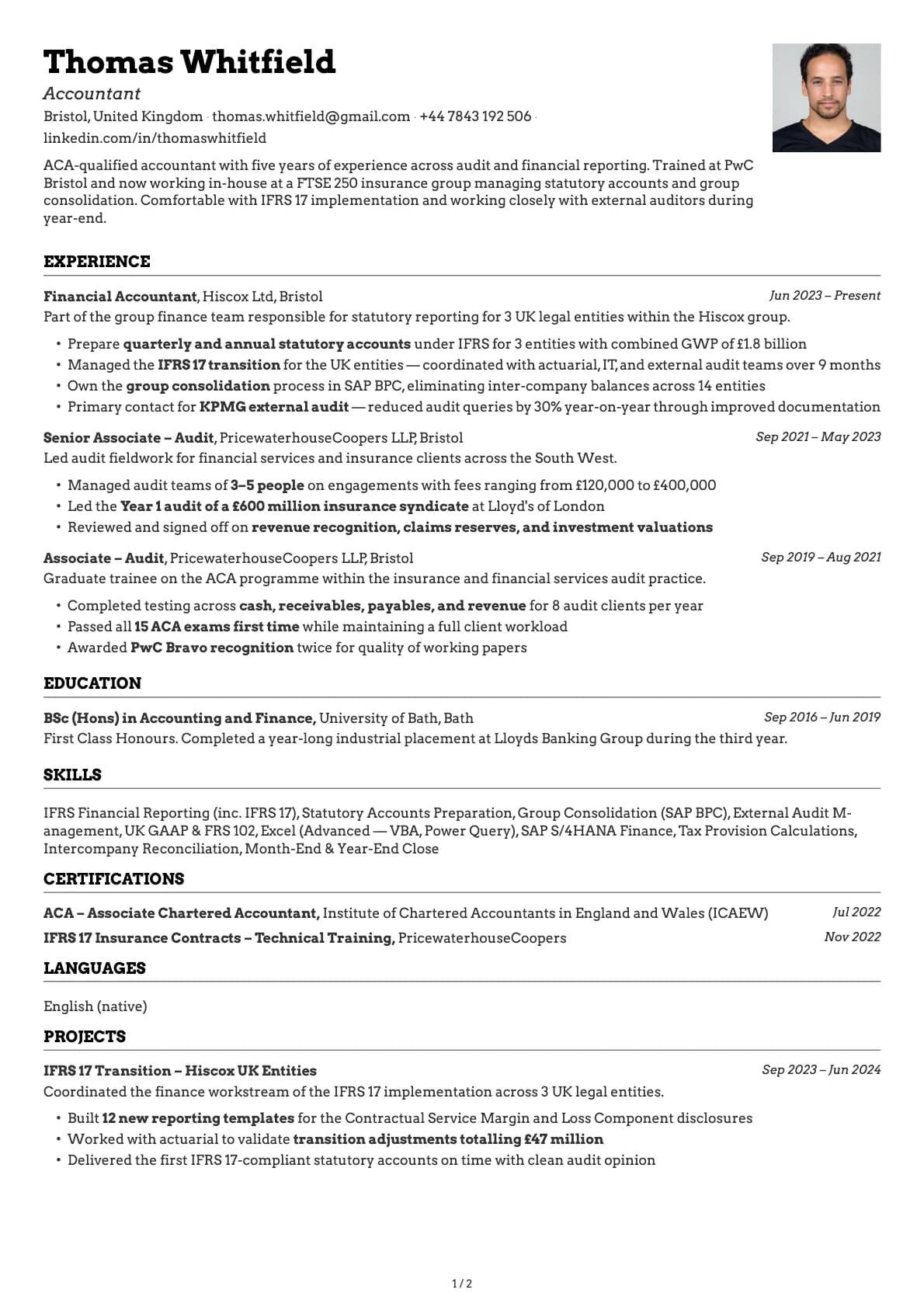
Accountant
An ACA-qualified accountant resume example with Big 4 audit experience and FTSE 250 in-house reporting.
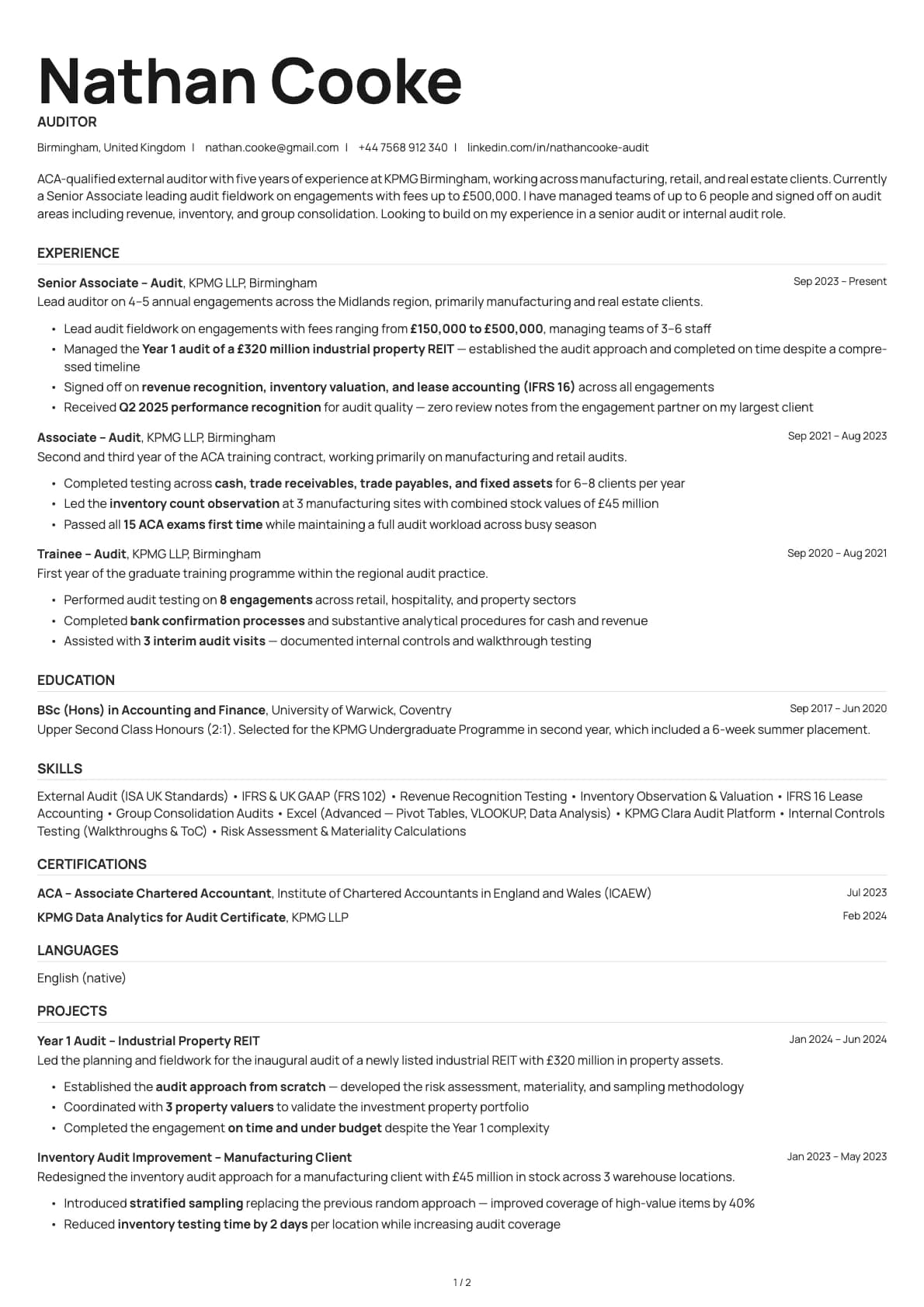
Auditor
An ACA-qualified auditor resume example from KPMG with engagement fee ranges, team management, and ISA Standards experience across manufacturing and real.
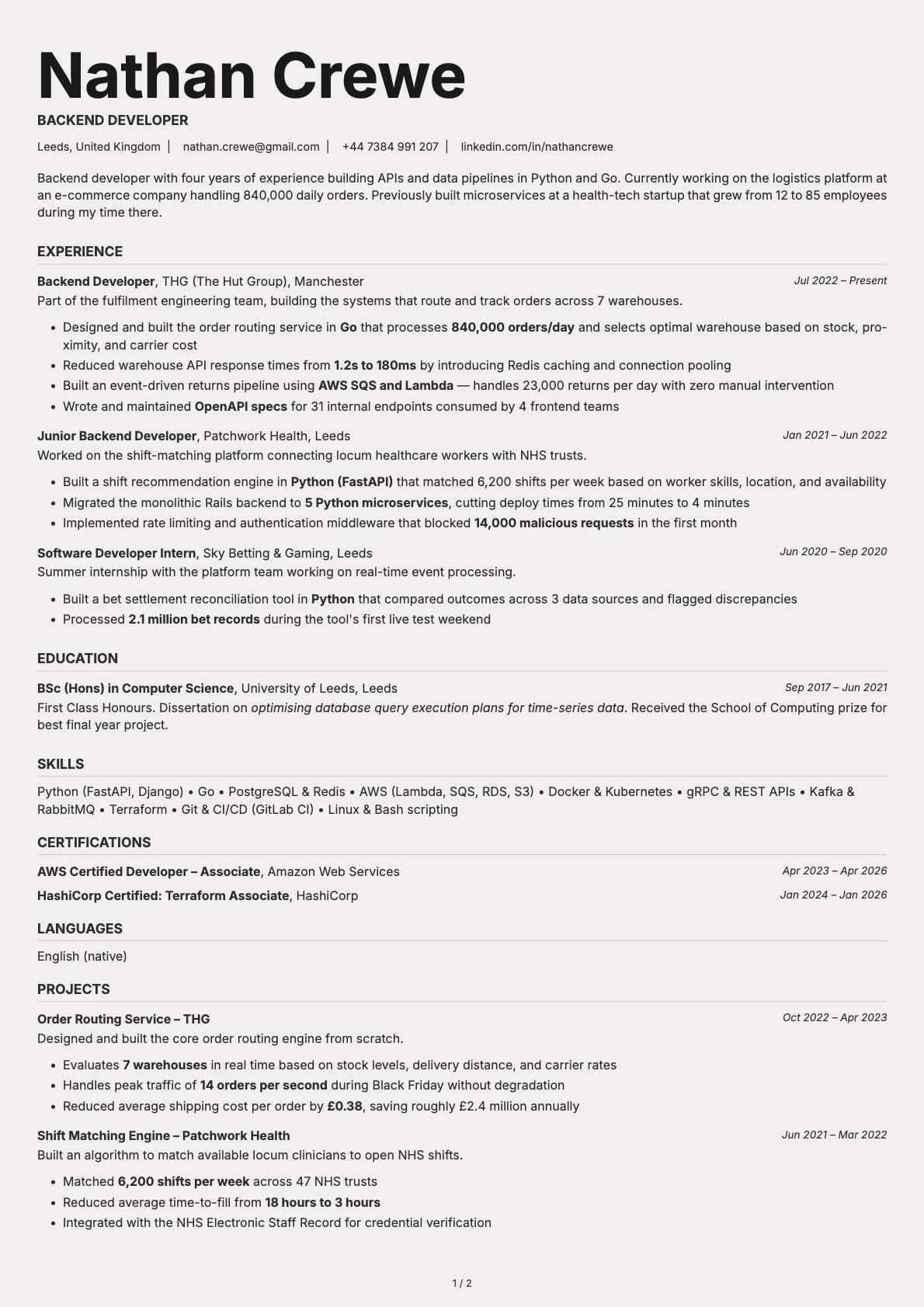
Backend Developer
A backend developer resume example with Go and Python experience, system throughput numbers, and infrastructure projects across e-commerce and health-tech.