How to Write a Resume After a Coding Bootcamp
You can build apps but your resume still looks like your old career. This guide shows you how to rewrite it so tech recruiters take you seriously.

Laddro

You just spent 3 to 6 months learning to code. You can build a full-stack application. You've completed projects, pushed code to GitHub, and maybe even deployed something live. But now you need a resume, and your work history says "retail manager" or "teacher" or "marketing coordinator."
The challenge isn't that you're unqualified. It's that your resume doesn't reflect who you are now. It still tells the story of your old career.
This guide shows you how to restructure your resume so tech recruiters see a developer, not a career changer who took a course.
The bootcamp resume problem
Tech recruiters see hundreds of bootcamp graduates. They know the drill: 12 to 16 weeks of intensive training, a capstone project, a GitHub full of tutorial code, and a resume that doesn't quite work.
The resumes that fail share the same mistakes:
- Leading with 10 years of non-tech experience
- Listing technologies without context ("React, Node.js, MongoDB, Express")
- Describing bootcamp projects like homework assignments
- Not having anything to show beyond the bootcamp curriculum
The resumes that get interviews do something different: they present bootcamp graduates as junior developers who happen to have additional professional experience, not as career changers who recently learned to code.
Lead with your technical identity
Your resume needs to say "developer" within the first 3 seconds of reading. That means restructuring the entire document.
Order your sections like this:
- Professional summary (stating your technical focus)
- Technical skills
- Projects
- Education (bootcamp + any prior degree)
- Professional experience (previous career)
When you build in Laddro, drag the sections into this order. Your previous work history shouldn't be the first thing a recruiter sees.
Write a developer summary
Your summary sets the frame. If it says "developer," the recruiter reads the rest as a developer resume. If it says "former teacher transitioning to tech," they read it as a career changer resume.
Weak: "Recent coding bootcamp graduate passionate about technology and eager to start a career in software development. Quick learner with a strong work ethic."
Strong: "Full-stack JavaScript developer with training from Le Wagon Berlin. Built 3 production-ready applications using React, Node.js, and PostgreSQL. Previous 6 years in operations management bring strong project coordination and stakeholder communication skills. Looking for a junior developer role in Berlin."
The strong version:
- Opens with a technical identity
- Proves it with specific tech and projects
- Reframes the old career as an asset
- States what you want and where
Technical skills section
List everything you can actually use. Organize by category so it's scannable.
Example:
Languages: JavaScript (ES6+), TypeScript, Python, HTML5, CSS3
Frontend: React, Next.js, Tailwind CSS, Bootstrap, responsive design
Backend: Node.js, Express, REST APIs, authentication (JWT, OAuth)
Databases: PostgreSQL, MongoDB, Firebase, Prisma ORM
Tools: Git, GitHub, VS Code, Postman, Docker basics, Vercel, Heroku
Testing: Jest, React Testing Library
Methods: Agile/Scrum, pair programming, code review, TDD basics
Two rules:
- Only list technologies you can discuss in an interview. If someone asks you to write a basic API endpoint in Express, can you do it without Googling the syntax? If yes, list it. If no, leave it off.
- Don't inflate your skill level. "Docker basics" is honest. "Docker" without qualification implies proficiency you might not have.
Projects are your work experience
For a bootcamp graduate, projects replace work experience. They're the proof that you can build things. Treat each project like a job entry.
Weak:
Bootcamp Final Project (2026) Built a web app using React and Node.js. Worked in a team of 4.
Strong:
FlatFinder Berlin (Capstone Project, Le Wagon Berlin, Feb 2026) https://github.com/username/flatfinder | https://flatfinder-demo.vercel.app Full-stack apartment search aggregator for the Berlin rental market. Built with React, Node.js, Express, and PostgreSQL. Scraped 3 listing platforms using Puppeteer, normalized data into a unified search interface, and implemented saved search alerts via email (SendGrid). My role: backend architecture, database design, and scraping pipeline. Team of 4, 2-week sprint. Technologies: React, Node.js, PostgreSQL, Puppeteer, SendGrid, Vercel, Railway
For each project, include:
- What it does in one sentence (not what technologies it uses)
- Live link and GitHub if available
- Your specific contribution if it was a team project
- Technical decisions you made and why
- Scale or impact if applicable (users, data processed, performance metrics)
How many projects do you need?
Three to four solid projects. Quality over quantity.
Ideal mix:
- Capstone/final project from your bootcamp (the most complex one)
- One personal project you built after the bootcamp (proves you didn't stop learning)
- One project that solves a real problem (even a small one: a tool for your partner's business, an automation for a friend, a utility you actually use)
- One open source contribution if you have it (even a documentation fix counts)
The personal project built after the bootcamp is the most important. It proves you can work independently without the structure and mentorship of the program.
How to list your bootcamp
List it in your education section. Be specific about what you learned and how intensive it was.
Weak:
Le Wagon, Web Development Bootcamp, 2026
Strong:
Le Wagon Berlin, Full-Stack Web Development (Jan to Mar 2026) 450+ hours of intensive training in JavaScript, React, Node.js, PostgreSQL, and deployment. Built 5 projects including a full-stack capstone. Daily pair programming, code review, and agile sprints.
If you have a prior degree in any field, include it too. A computer science degree plus a bootcamp is strong. But a psychology degree plus a bootcamp is also fine. The degree shows you can learn and complete things. The bootcamp shows you learned to code.
Your previous career is an asset, not a liability
Don't hide your pre-bootcamp experience. Reframe it.
Every industry teaches skills that matter in tech:
- Teaching: Explaining complex concepts, documentation, patience with debugging
- Sales: Understanding user needs, stakeholder communication, working with targets
- Operations: Process optimization, systems thinking, project management
- Healthcare: Attention to detail, working under pressure, data accuracy
- Finance: Analytical thinking, working with data, compliance awareness
How to reframe a previous role:
Before (teacher):
English Teacher, International School Barcelona (2019-2025) Taught English to classes of 25-30 students. Prepared lesson plans and graded assignments.
After (developer resume):
English Teacher, International School Barcelona (2019-2025) Designed structured curricula for 6 grade levels, adapting content to different skill levels (similar to writing documentation for different user personas). Introduced a digital grading system using Google Sheets automation, reducing admin time by 5 hours per week. Mentored 3 junior teachers through their first year.
Keep it to 2 to 3 bullet points per previous role. Focus on skills that transfer: communication, analytical work, process improvement, team coordination, data handling.
GitHub and LinkedIn matter
Your resume gets you the interview. Your GitHub and LinkedIn help you get noticed before you even apply.
GitHub:
- Pin your 3 to 4 best repositories
- Write clear READMEs with screenshots, installation instructions, and what you learned
- Make sure your commit history shows regular activity (not just bootcamp weeks)
- Contribute to one open source project, even a small documentation fix
LinkedIn:
- Update your headline to reflect your new identity: "Full-Stack Developer | React, Node.js, PostgreSQL" not "Career Changer" or "Bootcamp Graduate"
- Write a short About section that tells your story in 3 paragraphs
- List your projects with links
- Connect with bootcamp alumni, instructors, and developers in your target market
Laddro's LinkedIn profile optimizer can help you structure your LinkedIn to match your resume narrative.
ATS tips for tech resumes
Tech companies use ATS systems too, especially larger ones. Your resume needs to be both human-readable and machine-parseable.
- Use standard section headings: "Technical Skills" not "My Tech Stack"
- List technologies by name exactly as they appear in job descriptions (React, not ReactJS; Node.js, not NodeJS)
- Include keywords from the job description naturally in your project descriptions
- Use a clean, single-column template
All Laddro templates pass ATS filters. Pick one that gives enough space for your projects section.
Tailor for every application
Junior developer job descriptions vary more than you think. One company wants React experience. Another wants Vue. One emphasizes testing. Another wants DevOps basics.
For each application:
- Reorder your technical skills to put the most relevant ones first
- Adjust your project descriptions to highlight the technologies this job cares about
- Modify your summary to match the role title and key requirements
You can paste the job description into Laddro's tailor tool and it will restructure your resume for that specific role. When you're applying to 15 to 20 positions a week, this saves serious time.
Write a cover letter that tells the story
For bootcamp graduates, the cover letter answers the question the recruiter is thinking: "Why did you switch, and are you serious about this?"
Paragraph 1: What drew you to this specific company and role. Be specific. "I saw that your team is rebuilding the payment flow in React" beats "I am interested in software development."
Paragraph 2: Your strongest project and what it proves about your ability. Pick the one most relevant to this job. Include one transferable skill from your previous career.
Paragraph 3: What you're doing to keep learning (current project, open source contribution, course). Close with a direct ask for an interview.
Laddro can generate a cover letter from your resume and the job description. Add the personal story that makes you memorable.
Common mistakes bootcamp grads make
Applying only to "junior" titled roles. Many companies don't title their entry-level positions as "junior." Search for "developer," "engineer," or "software developer" without the junior prefix.
Listing every tutorial project. Skip the to-do app, the weather app, the calculator. Only include projects with real complexity or real users.
Not networking. Cold applications have low response rates for bootcamp grads. Attend meetups, contribute to communities, reach out to developers at companies you want to work at. Most bootcamp grads who land jobs quickly do it through connections, not applications.
Giving up after 50 applications. The first tech job is the hardest to get. After that, experience speaks for itself. Keep building, keep applying, keep improving your resume.
Start building
You learned to code in 3 months. You can build a strong resume in an afternoon.
Open the Laddro resume builder and use the guided flow. It asks the right questions for your situation and builds the resume as you answer. Reorder sections to lead with your tech skills, tailor to each job description, and generate matching cover letters. Works in 14 languages if you're targeting jobs across Europe. Free to start.
Ready to build your resume?
Put this into practice. Open the builder and create your resume step by step.
Free to use. No account needed to start.
Related articles

AI Is Screening Your Resume Before Any Human Sees It
AI screens most resumes before a human ever reads them. 97% of companies use automated filters now. This is what that means for you and what you can do about it.

The Best Resume Builders in 2026, Compared Honestly
Resume.io, Zety, Enhancv, Kickresume, Teal, and Laddro compared honestly: real pricing, free tiers, mobile apps, and where each tool wins. All prices checked in September 2026.

Burnout Recovery: A Real Timeline, Not 'Take a Bubble Bath'
55% of the U.S. workforce is burned out. Recovery takes 3 to 12 months. Here's what that actually looks like, stage by stage.
Related resume examples
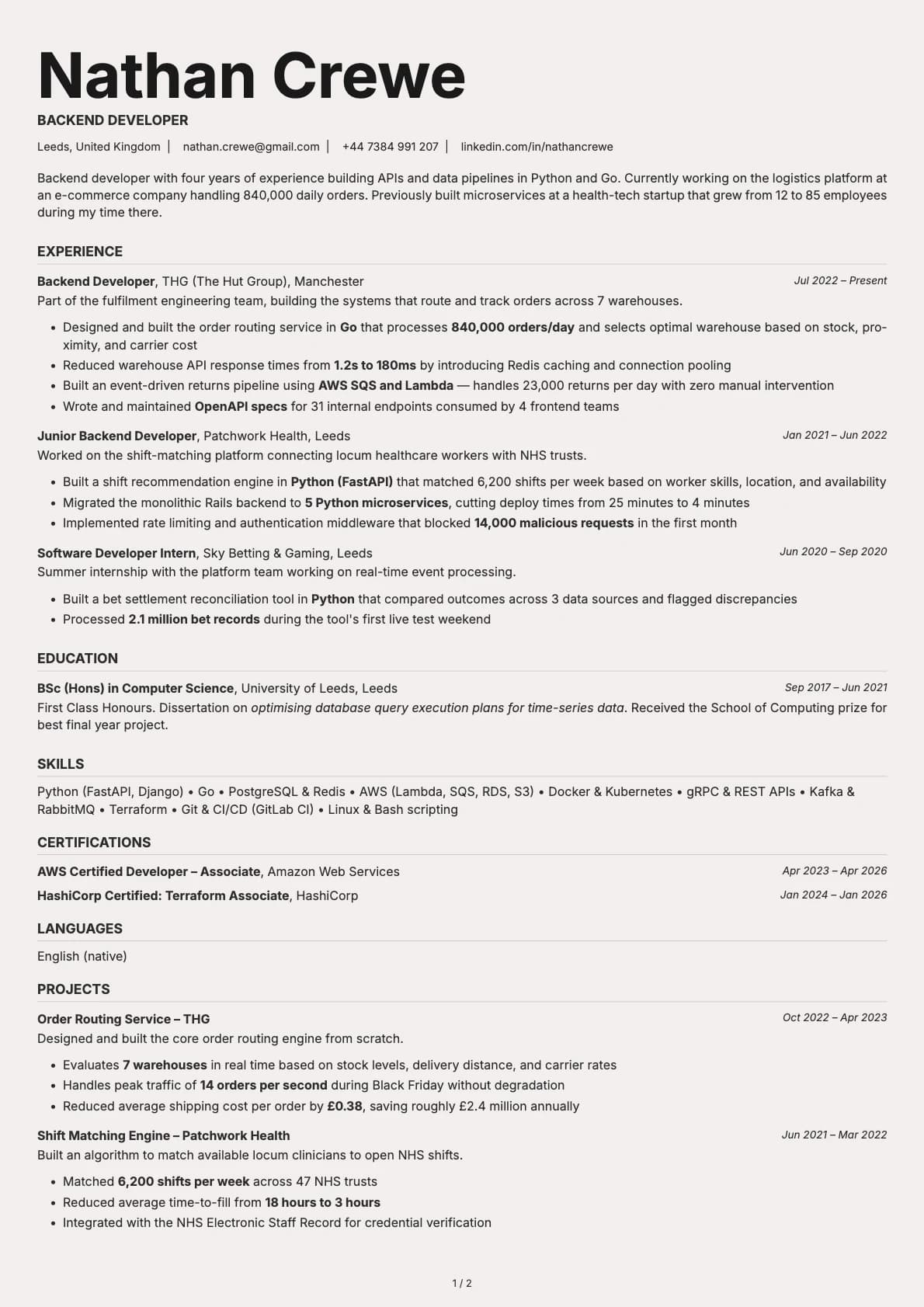
Backend Developer
A backend developer resume example with Go and Python experience, system throughput numbers, and infrastructure projects across e-commerce and health-tech.
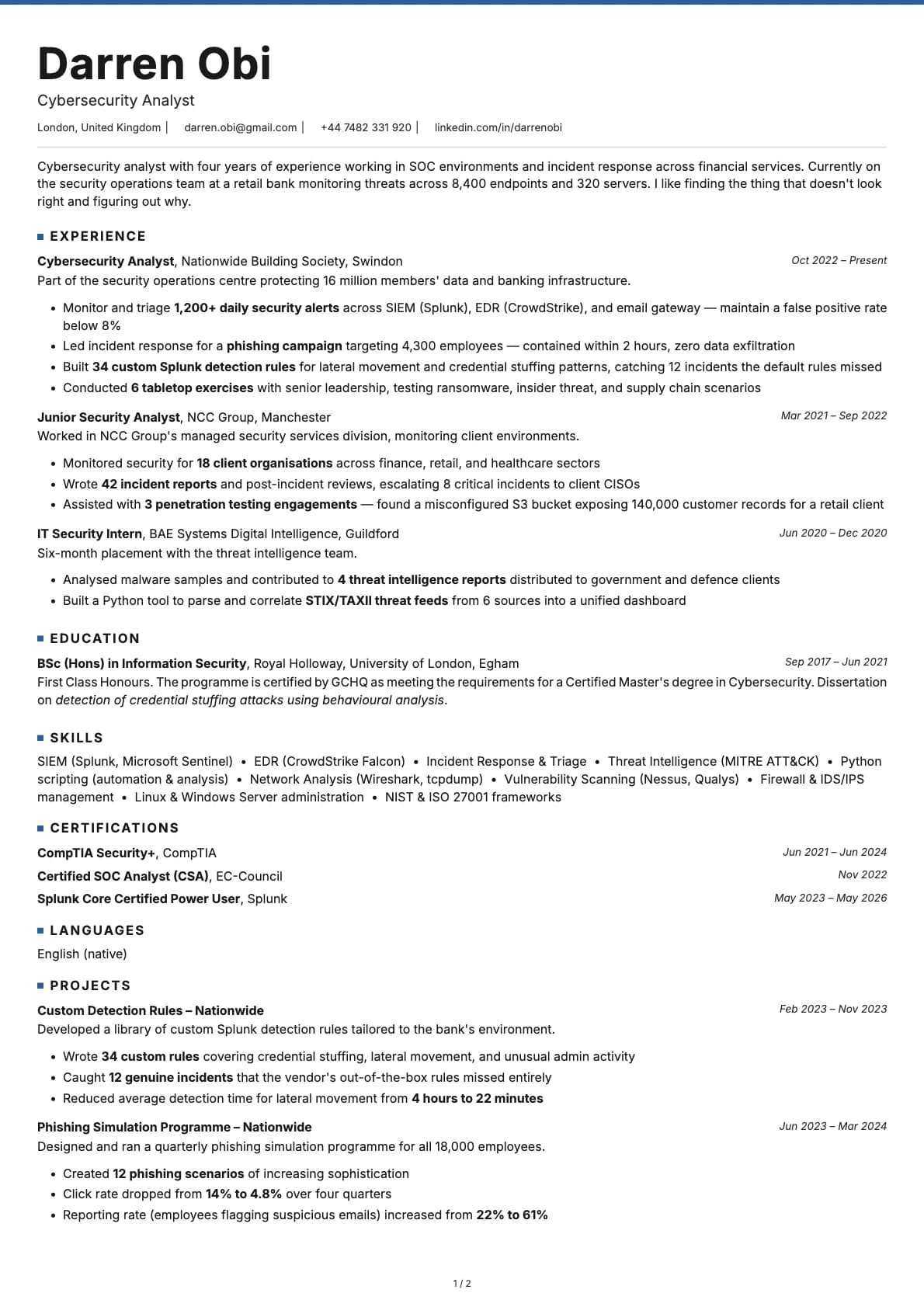
Cybersecurity Analyst
A cybersecurity analyst resume example with SOC experience at Nationwide and NCC Group.
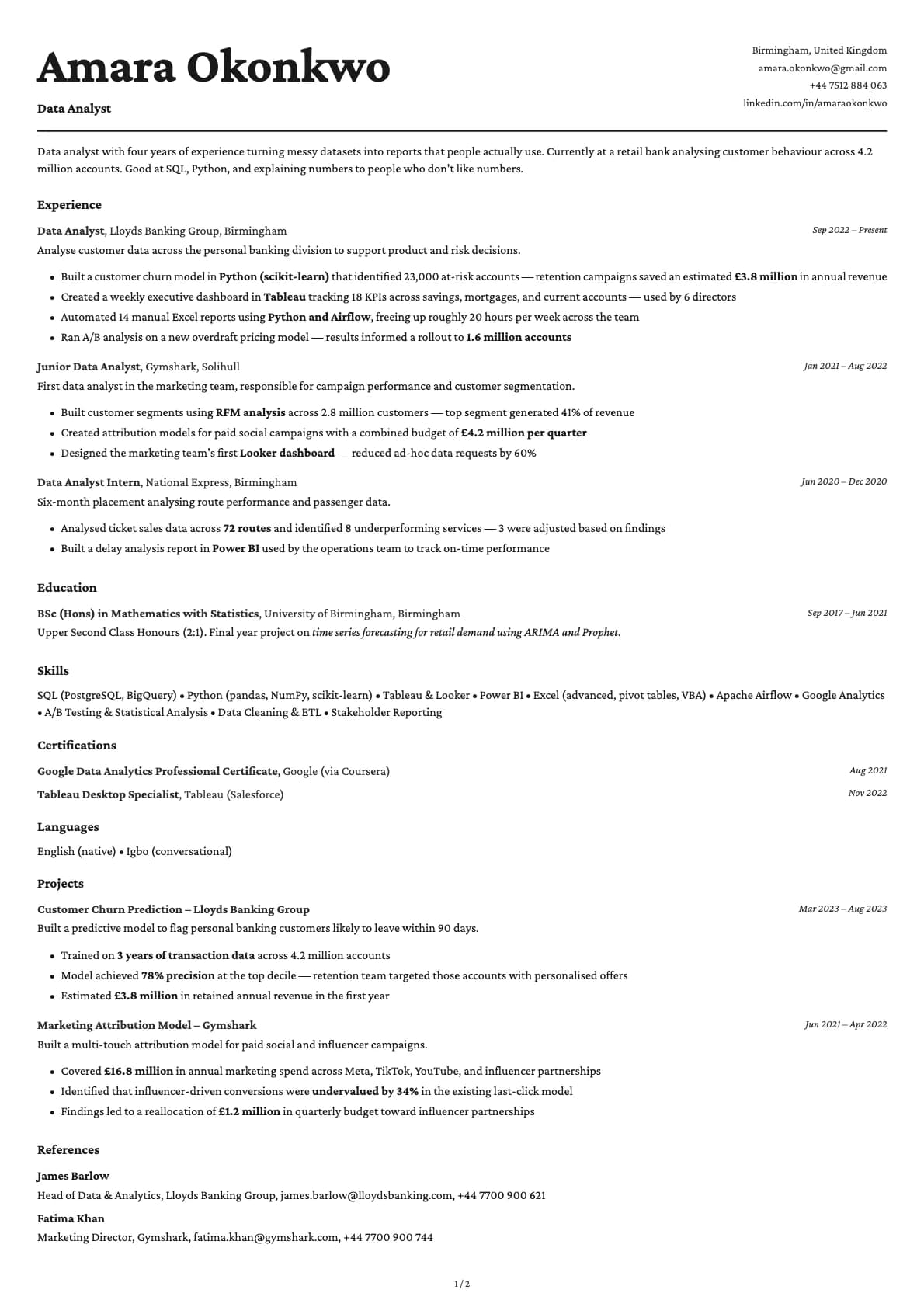
Data Analyst
A data analyst resume example with experience at Lloyds Banking Group and Gymshark.