How to Write Your First Resume When You Have No Experience
You have no work experience and a blank page. This guide walks you through what actually goes on your first resume and how to make it worth reading.

Laddro

Everyone starts with nothing. No job titles. No companies. No "5+ years of experience in..." to slap at the top of the page. And that blank resume template staring back at you feels impossible to fill.
Here's the thing: recruiters who hire for entry-level roles know you don't have ten years of experience. They're not looking for that. They're looking for signs that you can show up, learn fast, and do the work. Your first resume just needs to prove those three things.
This guide walks you through building a resume from zero. Not generic advice about action verbs. Actual sections, actual examples, actual decisions you need to make.
Pick the right format
You have three resume format options: chronological, functional, and combination. For your first resume, go with a combination format. It lets you lead with skills and education instead of an empty work history section.
A chronological resume puts employment history front and center. When that section is empty or thin, the whole resume looks empty. The combination format fixes this by giving equal weight to skills, projects, and education.
When you start building in Laddro, you can reorder sections with drag and drop. Put your strongest sections at the top.
Contact information
Keep it simple. Full name, city and country (no full address needed), email, phone number. Add your LinkedIn profile if you have one.
Weak: [email protected]
Strong: [email protected]
Your email address is the first thing a recruiter reads. If it looks unprofessional, some won't read further. Create a new email if yours doesn't work.
Do not include your date of birth, photo, marital status, or nationality unless the country you're applying in requires it. In most of Europe, a photo is common but not mandatory. In the UK, US, and Scandinavia, leave it off.
Write a summary (yes, even with no experience)
Most guides say skip the summary if you're entry level. They're wrong. The summary is your chance to frame the rest of the resume. Without it, the recruiter has to figure out who you are from scattered bullet points.
Weak: "Motivated and hardworking individual looking for an entry-level position where I can grow and develop my skills."
Strong: "Final-year business student at TU Munich with hands-on experience in social media management from a 3-month university project with a real client. Fluent in German and English, conversational in French. Looking for a marketing assistant role in the DACH region."
See the difference? The weak version could be anyone. The strong version is a specific person with specific things to offer.
If you're not sure what to write, Laddro's AI writing help can suggest a summary based on the rest of your resume. But write a first draft yourself. The AI works better when it has something to improve rather than starting from scratch.
Education goes first
When you have no work experience, education is your strongest section. Put it above employment history.
Include:
- Degree and field of study
- University or school name
- Expected graduation date (or actual graduation date)
- Relevant coursework (2 to 4 courses that relate to the job you want)
- GPA if it's strong (above 3.5 or equivalent in your country's system)
- Thesis topic if it's relevant to the role
Weak:
Bachelor of Business Administration, University of Amsterdam, 2023-2026
Strong:
Bachelor of Business Administration, University of Amsterdam (Expected June 2026) Relevant coursework: Digital Marketing Analytics, Consumer Behavior, Data Visualization with Python Thesis: "The Effect of Personalized Email Campaigns on Conversion Rates in European E-commerce" (Grade: 8.5/10)
The weak version is one line. The strong version tells the recruiter exactly what you studied and proves you've done real analytical work.
Skills: be specific, not generic
"Good communication skills" means nothing on a resume. Every applicant claims it. Instead, list concrete skills that someone could test you on.
Generic (skip these): Communication, teamwork, problem solving, time management, leadership, adaptability
Specific (use these): Python, Excel (pivot tables, VLOOKUP), Google Analytics, Canva, Figma, SQL basics, social media scheduling (Hootsuite), copywriting in German and English, Adobe Photoshop, SAP basics
Split your skills into categories. Technical skills, language skills, and software. This makes them scannable.
When you build your resume in Laddro, the AI can suggest skills relevant to your target role. But don't add skills you can't actually demonstrate. If the interviewer asks you to write a VLOOKUP and you can't, it's worse than not listing it.
Projects replace job experience
This is the section that makes or breaks a first resume. If you have no employment history, projects prove you can do things.
Projects can come from:
- University assignments or group projects
- Personal projects (a blog, a website, an app)
- Volunteer work
- Hackathons or competitions
- Freelance work (even if it was for a friend's business)
Write each project like a mini job entry:
Weak:
University Marketing Project (2025) Worked on a marketing plan for a local company.
Strong:
Social Media Strategy for Berlin Coffee Roasters (University Project, Fall 2025) Developed a 3-month Instagram content plan for a local coffee brand as part of a 4-person team. Created 24 posts, grew the account from 340 to 1,100 followers, and increased website traffic from Instagram by 45%. Presented results to the business owner and received a recommendation letter.
Notice the structure: what you did, how much of it you did, and what the result was. Numbers matter even in university projects.
Volunteer work and extracurriculars
These matter more than you think. Organizing a university event shows project management. Leading a student club shows initiative. Tutoring shows communication skills.
Weak:
Member of Student Council, 2024-2025
Strong:
Vice President, Student Council, University of Warsaw (2024-2025) Organized 3 campus events with 200+ attendees each. Managed a budget of PLN 8,000 for the spring semester. Coordinated with 12 student organizations and university administration.
Don't list memberships. List what you actually did.
Languages are a real advantage in Europe
If you speak more than one language, that's a genuine competitive advantage in the European job market. List every language you speak with an honest proficiency level.
Use standard levels: Native, Fluent (C1-C2), Advanced (B2), Intermediate (B1), Basic (A2). Don't inflate. Recruiters in multilingual companies will test you.
If you're applying for a job in a different country, leading with language skills shows you can actually work there.
What to leave out
Your first resume will be tempted to include everything to fill the page. Resist that.
Leave out:
- High school details (unless you just graduated from high school)
- Hobbies that don't relate to anything ("I enjoy traveling and reading")
- "References available upon request" (everyone knows this, it wastes a line)
- Objective statements ("Seeking a challenging position..." is from 2005)
- Irrelevant certifications (your first aid certificate doesn't help your marketing application)
One page is the target. If you can't fill one page with relevant content, that's OK. A clean half page beats a padded full page.
Make it pass ATS filters
Most companies, even small ones, use applicant tracking systems (ATS) to filter resumes before a human reads them. If your resume doesn't pass, nobody sees it.
The basics:
- Use a clean template with standard headings ("Education" not "My Academic Journey")
- Don't use tables, text boxes, headers/footers, or columns for critical information
- Save as PDF (not Word, not Pages)
- Use standard fonts
- Include keywords from the job description naturally in your content
All 22+ templates in Laddro are ATS tested. When you browse templates, you don't need to worry about formatting compatibility.
Tailor it for every application
Sending the same resume to 50 jobs is a waste of time. Each job description tells you exactly what they want. Your resume should reflect that.
Read the job posting carefully. Note the specific skills, tools, and qualifications they mention. Then adjust your resume so those same words appear naturally in your content.
You can do this manually, or you can paste the job description into Laddro's tailor tool and let the AI restructure your resume for that specific role. Either way, a tailored resume gets 2 to 3 times more callbacks than a generic one.
Add a cover letter
Some people say cover letters are dead. They're not. For entry-level roles especially, the cover letter is where you explain the gap between what they're asking for and what you have. It's your chance to say: "I haven't done this exact job before, but here's why I'll be good at it."
Keep it short. Three paragraphs: why this company, what you bring, and a direct ask for an interview. Laddro can generate a cover letter matched to your resume and the job description, but personalize it with something specific about the company that shows you actually researched them.
Final checklist before you send
- Is it one page?
- Does every bullet point show what you did, not just what you were responsible for?
- Are there numbers anywhere? (followers, budget, attendees, percentage improvements)
- Did you remove generic skills like "teamwork" and replace them with specific ones?
- Is your email professional?
- Did you proofread it in the language it's written in? (not just spell check)
- Did you tailor it to this specific job?
- Is the file name professional? (FirstName-LastName-Resume.pdf, not resume_final_v3_REAL.pdf)
Start building
Your first resume won't be perfect. That's fine. The goal is to get something solid enough to start applying. You'll improve it with every application, every interview, every piece of feedback.
Open the Laddro resume builder and pick a template. The guided builder will walk you through each section step by step, asking the right questions so you're not staring at a blank page. It's free, works in 14 languages, and you don't need to create an account to start.
Ready to build your resume?
Put this into practice. Open the builder and create your resume step by step.
Free to use. No account needed to start.
Related articles

AI Is Screening Your Resume Before Any Human Sees It
AI screens most resumes before a human ever reads them. 97% of companies use automated filters now. This is what that means for you and what you can do about it.
The Best Resume Builders in 2026, Compared Honestly
Resume.io, Zety, Enhancv, Kickresume, Teal, and Laddro compared honestly: real pricing, free tiers, mobile apps, and where each tool wins. All prices checked in September 2026.

Burnout Recovery: A Real Timeline, Not 'Take a Bubble Bath'
55% of the U.S. workforce is burned out. Recovery takes 3 to 12 months. Here's what that actually looks like, stage by stage.
Related resume examples
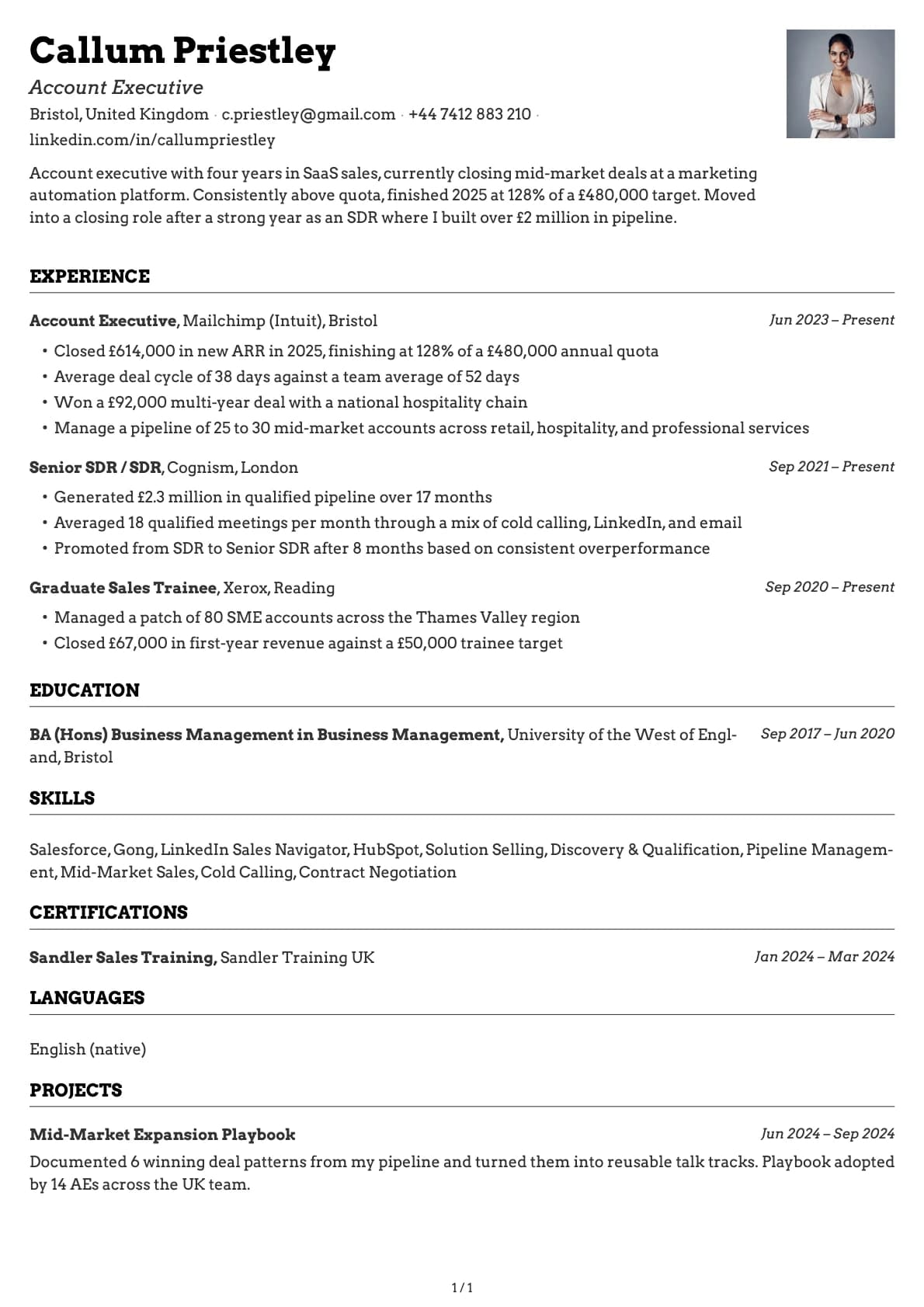
Account Executive
An account executive resume example with SaaS sales experience, quota attainment figures, and pipeline numbers that actually make hiring managers pick up.
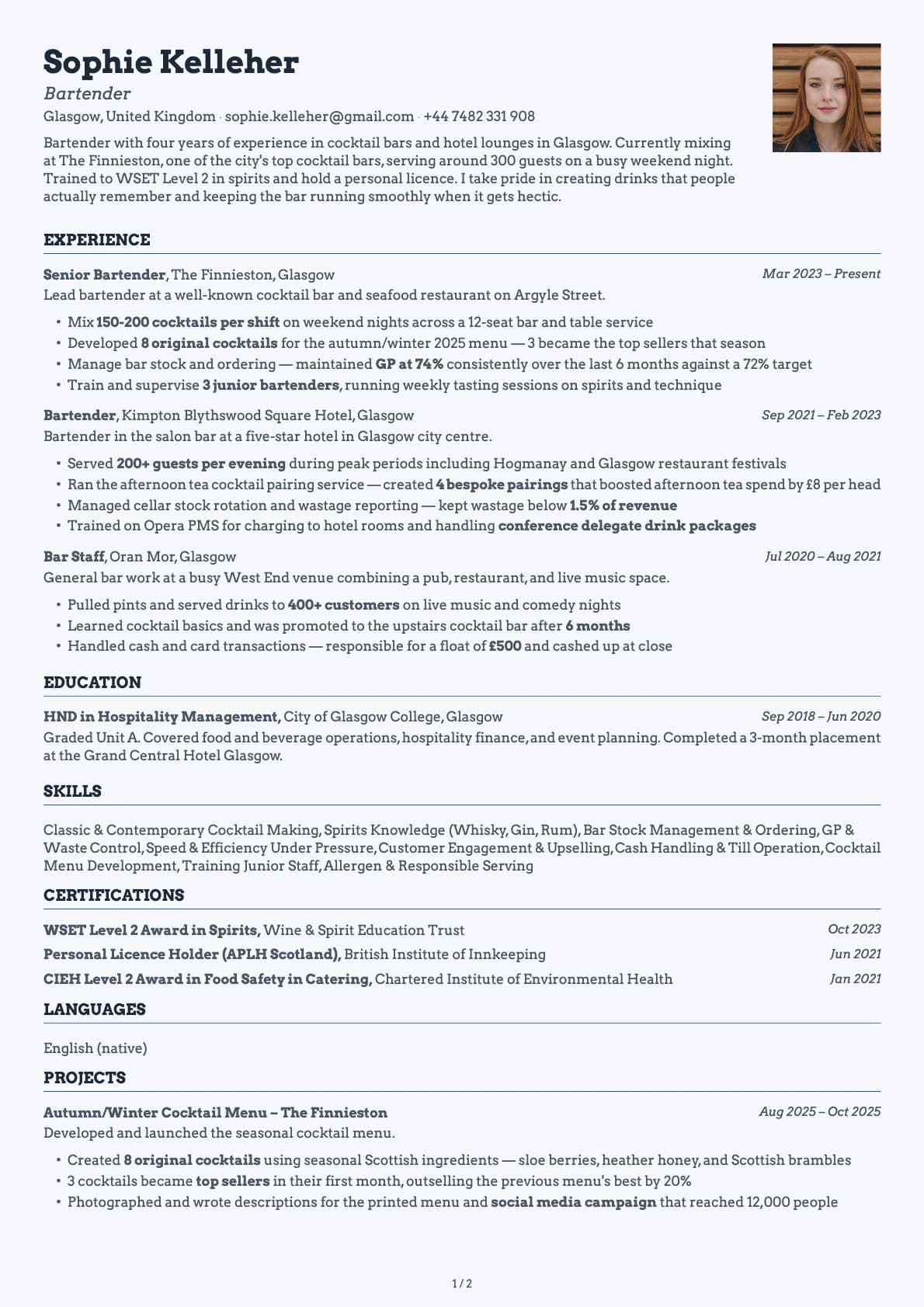
Bartender
A bartender resume example from a top Glasgow cocktail bar, covering drink volumes, GP targets, menu development, and how to present hospitality.
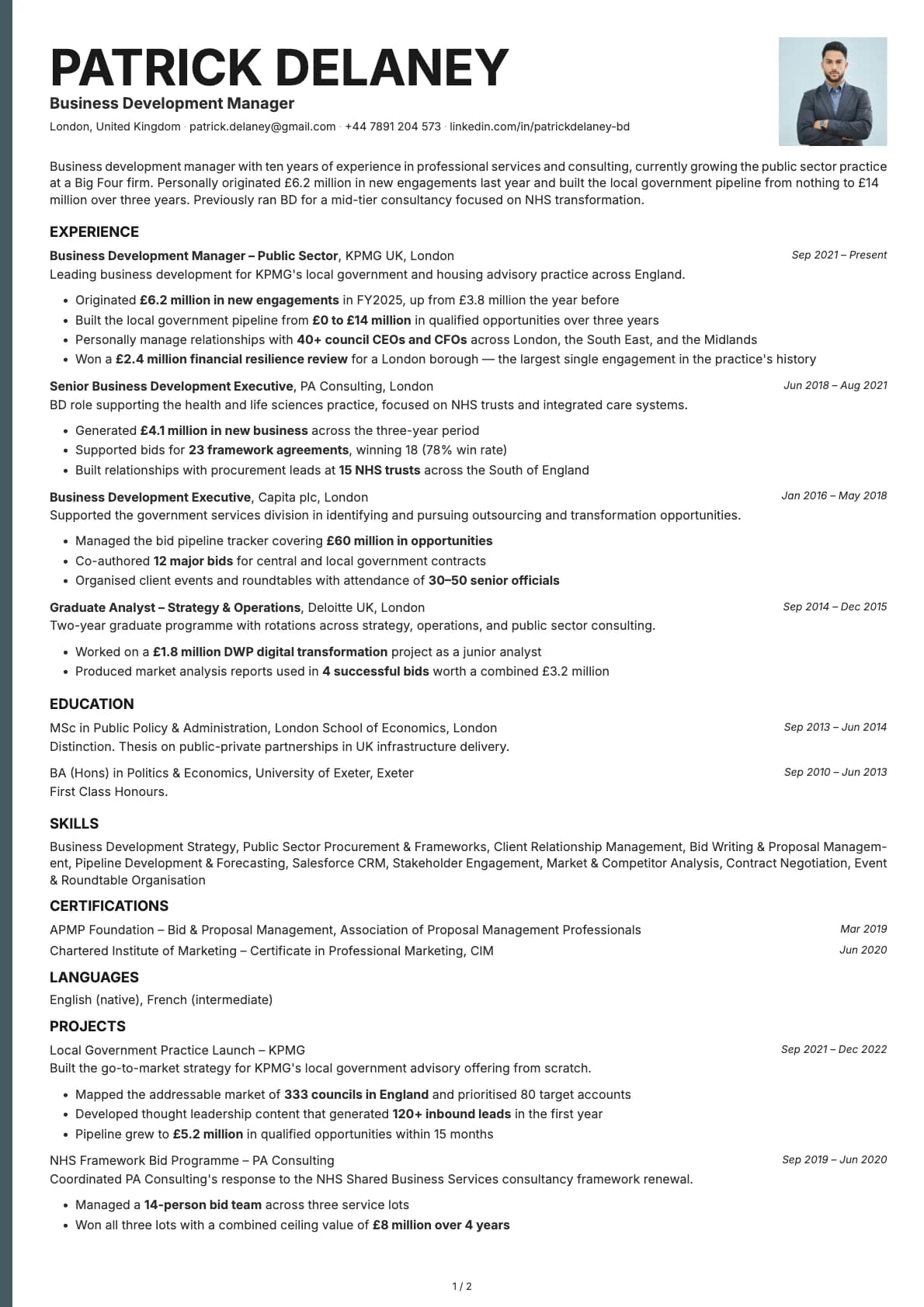
Business Development Manager
A business development manager resume example from professional services with £6.2 million in originated engagements, pipeline building, and public.