Cover Letter Examples (UK): A Full Letter You Can Copy, Plus Versions by Situation
UK cover letter examples that get read: the right length, a full letter you can copy, the Yours sincerely rule, and versions for career changers and graduates.

Laddro Team

Most cover letters get skimmed in under a minute and then forgotten. According to Resume Genius (2023), 36 percent of hiring managers spend less than 30 seconds on a cover letter, and 83 percent still read most of the ones they receive. So it matters, and you have almost no time to make it land. The good news is that a UK cover letter is a short, predictable document. Once you have seen a real one, you can write your own in twenty minutes.
This is a practical walkthrough for the British market: what employers on Reed, Indeed UK, CV-Library and Totaljobs actually expect, a full letter you can copy line by line, and shorter versions for a career change, a graduate with no experience, and a speculative approach.
What a UK cover letter actually is
A cover letter sits alongside your CV and does one job: it explains, in plain terms, why you are right for one specific role. It is not a summary of your CV in paragraph form. It is the argument your CV cannot make on its own.
Keep it to one side of A4. Prospects and Indeed UK both put the sweet spot at 250 to 400 words, roughly three or four short paragraphs. British hiring tends to be more reserved than the American style, so skip the breathless opening about how this is your dream company. State your case and back it up.
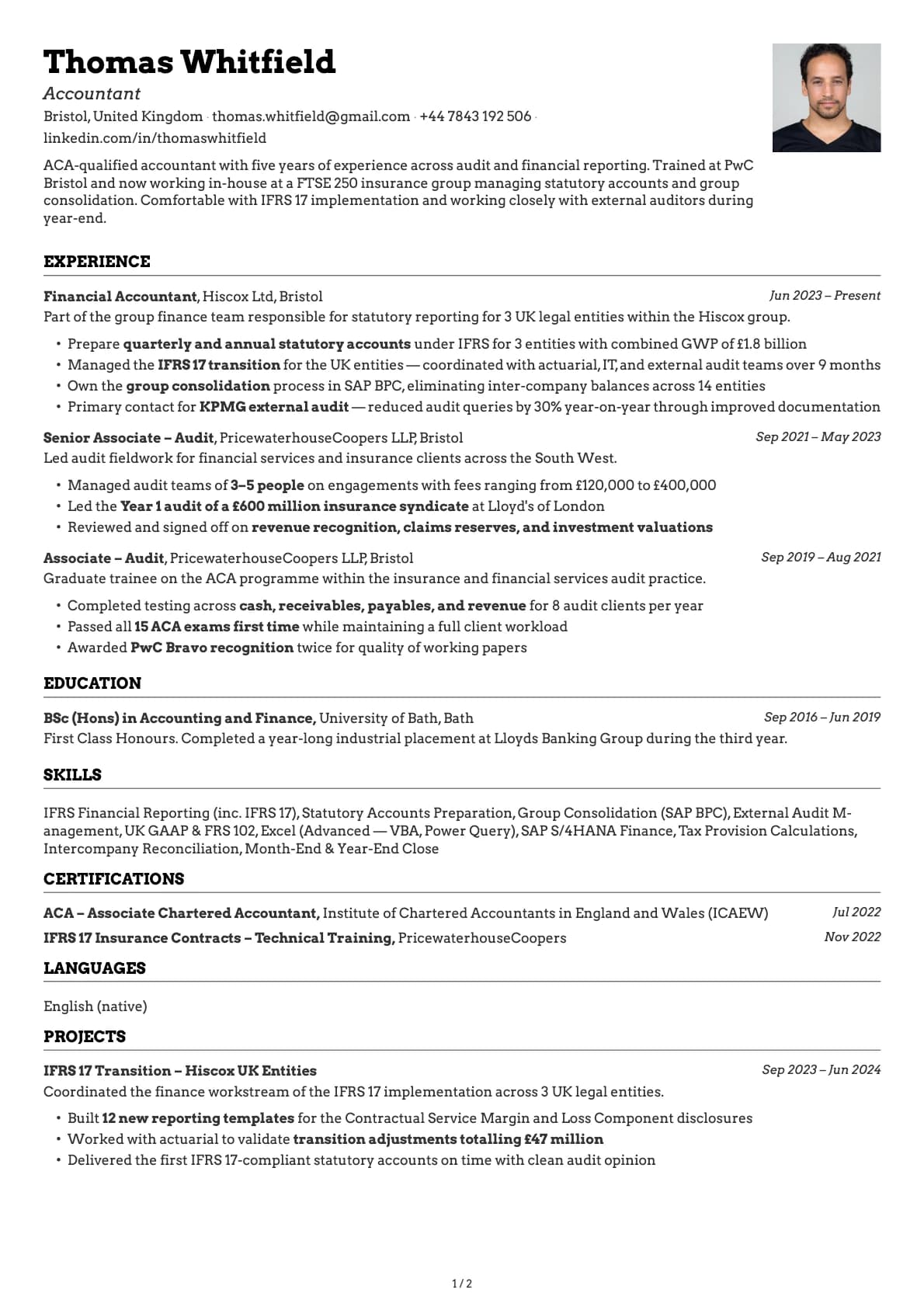
One more UK point worth naming early: your cover letter does not need a photo, and neither does your CV. British employers generally expect an anonymised, no-photo application, which is the opposite of the norm in Germany or France. If you have moved here from elsewhere in Europe, drop the headshot.
The structure that works
Three paragraphs carry almost every good UK cover letter.
The opening. Say which role you are applying for, where you saw it, and give one concrete reason to keep reading. Name the job title exactly as it appeared in the advert, because a hiring team may be filling five roles at once.
The middle. This is the argument. Take two or three requirements from the job advert and show, with evidence, that you meet them. Numbers beat adjectives. "Managed the social accounts" tells them nothing. "Grew the Instagram following from 4,000 to 11,000 in a year" tells them exactly what you can do.
The close. Thank them for their time, say you would welcome the chance to discuss the role, and sign off correctly. That last part trips people up more than you would think, so it gets its own section below.
A full cover letter you can copy
Here is a complete example for a real-feeling scenario: applying for a Marketing Coordinator role at a mid-sized company in Manchester, advertised on Reed. Swap in your own details and it holds up.
Dear Ms Okafor,
I am writing to apply for the Marketing Coordinator role at Brightwater Ltd, advertised on Reed on 3 August. I have spent the last three years running campaigns for a small e-commerce brand, and the mix of content, email and paid social in your advert is exactly the work I want to keep doing.
In my current role at Northgate Home, I took our monthly email programme from a single newsletter to a segmented set of six campaigns, which lifted email revenue by 34 percent over eighteen months. I also managed a £2,000 monthly paid social budget across Meta and TikTok, and cut our cost per acquisition by a fifth by rebuilding the audience targeting. Your advert asks for someone comfortable owning reporting, and I build the weekly performance dashboard my team now uses to plan spend.
I am drawn to Brightwater because you sell a considered product to a loyal customer base, which is the kind of marketing I do best: less shouting, more retention. I would welcome the chance to talk through how I could help. Thank you for taking the time to read my application.
Yours sincerely, Amara Silva
That is 210 words. It names the role, the source and the date, it answers three points from the advert with real numbers, and it explains why this company rather than any company. A hiring manager can read it in thirty seconds and know precisely what they are getting.
Before and after: the opening line
The first sentence is where most cover letters die. Compare these two.
Before: "I am a hard-working and passionate marketing professional looking for a new challenge in a dynamic company."
After: "I am writing to apply for the Marketing Coordinator role at Brightwater Ltd, advertised on Reed on 3 August, after spending three years growing an e-commerce brand's email and paid social channels."
The first could have been sent to any employer in the country, and it says nothing. The second is specific, dated and tied to real work. If a reader only sees your opening line before they decide to keep going, make it the second one.
The British sign-off nobody teaches you
There is a genuine rule here that a lot of applicants get wrong. If you know the person's name and you have addressed the letter to them, for example "Dear Ms Okafor", you close with "Yours sincerely". If you do not know their name and you opened with "Dear Sir or Madam", you close with "Yours faithfully". Prospects sets this out plainly, and older British hiring managers do notice when it is wrong.
The better move is to avoid "Dear Sir or Madam" altogether. Find the name. Check the advert, the company's LinkedIn, or the "our team" page on their website. A named recipient signals that you did the ten minutes of homework most applicants skip.
Cover letter examples by situation
The three-paragraph shape stays the same. What changes is the argument in the middle.
Career change. Your job is to connect the dots the reader will not connect for you. Lead with the transferable evidence, not an apology for switching. Middle paragraph, for someone moving from teaching into project coordination:
Seven years of teaching means I have planned complex timetables, managed competing priorities from thirty families at once, and hit non-negotiable deadlines every single term. When I ran the school's move to a new reporting system, I coordinated training for forty staff and kept the rollout on schedule. Those are project coordination skills, and I want to apply them full time.
Graduate with no experience. You have more than you think. Pull from your degree, part-time work, societies and volunteering, and match it to the advert. Opening and middle:
I am writing to apply for the Graduate Analyst scheme at Meridian, advertised on Indeed. My economics degree from the University of Leeds included a final-year project analysing regional housing data in R, which is the kind of hands-on analysis your advert describes. Alongside my studies I worked twenty hours a week in retail, where I was trusted to reconcile the till and train new starters, so I know how to be reliable under pressure and explain numbers to people who do not love spreadsheets.
Speculative application. Here nobody advertised a role, so you have to earn the reader's attention. Give a specific reason you are writing to this company now.
I read that Harbour Studios won the Leeds council regeneration contract in July, and I imagine you may soon need another junior architect to help deliver it. I have two years of experience on mixed-use housing schemes and I am RIBA Part 1 qualified. I would love to be considered if a role opens up.
Prospects notes that speculative letters work best when you have a concrete trigger, like hearing a company has won new work, rather than a generic "do you have any jobs" note.
Mistakes that get you binned
A few habits will sink an otherwise decent application.
Repeating your CV word for word. The reader already has your CV. Use the letter to interpret it, not echo it.
Writing to nobody. "To whom it may concern" reads as a mail merge. Find a name, or at least a team.
Going over one page. If it does not fit on a single side of A4, cut it. The 250 to 400 word range from Prospects and Indeed UK exists for a reason.
Leaving in the wrong company name. When you reuse a letter, the fastest way to get rejected is a stray reference to the last firm you applied to. Read it aloud before you send.
Being vague where you could be specific. "Improved sales" is weaker than "grew repeat orders by 18 percent". If you have a number, use it.
Before you send
Run through this quickly. Does the opening name the exact role and where you saw it? Does the middle answer at least two points from the advert with evidence? Is it one page and under 400 words? Is the recipient's name spelled correctly, with the matching sincerely or faithfully sign-off? Have you removed every trace of the previous company you applied to?
A cover letter will not rescue a CV that does not fit the job. But when two candidates look similar on paper, the one who wrote a specific, well-aimed letter is the one who gets the call. That is a low bar, and most people never clear it. Clear it, and you have already moved ahead of the pile.
If writing from a blank page is the part that stops you, Laddro builds your cover letter and CV side by side, so the tone matches and the details line up before you hit send.