Combination Resume Format: The Best of Both Layouts
A skills summary up top, work history below. The format for people with transferable skills that don't show in their job titles.

Laddro

You've probably heard of chronological resumes and functional resumes. The combination format takes the best parts of both and puts them together. Skills and highlights up front, followed by a proper chronological work history below.
It's the resume format for people whose job titles don't tell the full story. If your experience is richer than your titles suggest, or you've built skills across different roles that only make sense when you connect the dots, this is the format that lets you do that.
What is a combination resume?
A combination resume (also called a hybrid resume) has two main sections working together:
- A skills highlight section near the top that groups your key abilities with specific proof points
- A chronological work history below that shows where and when you built those skills
Unlike a functional resume, you're not hiding your timeline. And unlike a purely chronological resume, you're not relying on a recruiter to read between the lines of your job titles. You're doing the interpretation for them.
Think of it this way: the skills section says "Here's what I'm great at," and the work history says "Here's where I proved it."
Who should use a combination resume?
This format shines for several groups:
Mid-career professionals (10+ years of experience). When you've held multiple roles across different teams or companies, a chronological list alone can feel like a wall of text. The skills section at the top lets you distill 10-15 years into the themes that matter most for the job you're applying to.
Career changers with relevant transferable skills. If you've been a journalist for 8 years and you're applying for a content marketing role, the combination format lets you lead with "Content Strategy," "SEO Writing," and "Audience Growth" before showing that your experience comes from newsrooms rather than marketing departments. The skills speak for themselves.
People whose titles undersell their work. Were you technically an "Administrative Assistant" but actually ran the office, managed vendor relationships, and coordinated a 50-person company retreat? A chronological resume shows the title. A combination resume shows the work.
Senior professionals targeting leadership roles. If you're applying for a VP or Director position, the hiring committee cares less about what you did at each company and more about your leadership themes: team building, P&L management, strategic planning. The combination format lets you organize around those themes.
Freelancers moving to full-time roles. Your project list might be long and varied, but the skills you've built are consistent. Group them, prove them, and then list your client history below.
How it differs from the other formats
Here's a quick comparison:
| Chronological | Functional | Combination | |
|---|---|---|---|
| Leads with | Work history | Skills | Skills + proof |
| Work history | Detailed, most recent first | Brief list, minimal detail | Standard, with context |
| Best for | Clear career path | Career gaps, changers | Transferable skills, senior roles |
| ATS compatibility | Excellent | Risky | Good (if structured correctly) |
| Recruiter reception | Expected and welcomed | Often met with suspicion | Generally positive |
The combination format sits in a sweet spot. It gives recruiters the skills-first narrative they need to understand your fit, and the chronological timeline they need to verify your experience. Nobody has to guess.
How to structure a combination resume
1. Contact information
Name, phone, email, city, and LinkedIn. Same as always. If you're in a field where a portfolio matters (design, writing, development), include that link too.
Laddro's builder has fields for all of these, plus optional links for your website or portfolio.
2. Professional summary
Your summary should bridge your past experience and your target role. This is especially important for career changers and people whose titles don't reflect their skills.
Example for a career changer: "Former operations manager with 12 years in manufacturing, now focused on supply chain technology. Led the implementation of two ERP systems that reduced production delays by 30%. Combining hands-on operations experience with a growing technical skill set."
Example for a senior professional: "Finance leader with 15 years across retail and e-commerce. Managed teams of up to 40 across three countries. Delivered EUR 4M in cost savings through process automation and vendor renegotiation."
Notice that both examples include years of experience, a measurable result, and a clear direction. That's the formula. Laddro's AI writing tool can generate a first draft based on your experience, and you can refine it from there.
3. Skills highlight section (this is what makes it a combination resume)
This is the section that sets the combination format apart. You'll create 3-4 skill categories, each with 2-4 bullet points that reference specific achievements. Not just skills listed in a row. Proof.
Here's what a good skills section looks like for a marketing professional moving into product management:
Product Strategy & Market Research
- Identified and validated 3 new market segments through customer interviews and competitive analysis, leading to a product line that generated EUR 1.8M in first-year revenue
- Built and maintained a product roadmap used by engineering, sales, and executive teams to prioritize quarterly initiatives
- Conducted 40+ user interviews for a feature redesign that increased retention by 15%
Cross-Functional Leadership
- Coordinated launches across engineering, design, sales, and support teams for 5 major releases
- Established a weekly cross-team standup that reduced miscommunication-related delays by 60%
- Mentored 3 junior team members, two of whom were promoted within 18 months
Data-Driven Decision Making
- Built dashboards in Looker and Tableau that became the primary reporting tool for the marketing team
- Ran A/B tests on pricing pages that increased conversion by 22% over 6 months
- Presented monthly analytics reviews to C-level stakeholders, translating data into strategic recommendations
See the difference between this and a skills list that just says "Product Strategy, Leadership, Data Analysis"? Each bullet ties the skill to a specific outcome. That's what makes a combination resume persuasive rather than generic.
Choosing the right skill categories is the most important decision you'll make with this format. They need to match what the target role requires. This is where Laddro's tailor feature becomes genuinely useful. Paste in the job description and the AI will identify the key skills the employer is looking for. Use those as your category headers and build your bullet points around them.
4. Work history
After the skills section, include a standard chronological work history. For each role:
- Job title
- Company name
- Location
- Dates (month and year)
- 2-3 bullet points per role
You don't need to go as deep here as you would on a purely chronological resume, because your skills section already covers your major accomplishments. The work history is there to provide context, show your trajectory, and give recruiters the timeline they need.
Marketing Manager | TechCorp GmbH | Berlin, Germany | Mar 2021 - Present
- Led a 6-person marketing team responsible for brand, content, and demand generation
- Managed annual marketing budget of EUR 1.5M across digital and event channels
Senior Marketing Specialist | StartupXYZ | Munich, Germany | Jun 2018 - Feb 2021
- Owned content marketing strategy, publishing cadence, and SEO performance
- Grew blog traffic from 5K to 45K monthly sessions through an original content program
Marketing Coordinator | AgencyCo | Hamburg, Germany | Sep 2015 - May 2018
- Supported campaign execution for 8 clients across retail, SaaS, and healthcare
Earlier roles can be even shorter. One line is fine for anything more than 10 years old.
5. Education
Degree, institution, year. For a combination resume, education usually stays near the bottom unless you're in academia or a field where credentials come first (like law or medicine).
6. Additional sections
Languages, certifications, and technical tools belong here. Keep them relevant. If the job posting mentions specific tools or certifications, make sure yours are listed.
ATS considerations for combination resumes
Good news: the combination format works well with ATS when you structure it correctly. Here's why and how.
It includes a chronological work history. This is the section ATS systems rely on most. As long as your job titles, companies, and dates are clearly formatted, the software can parse them without issues.
Standard section headers help. Use headers like "Skills Summary," "Professional Experience," and "Education." Don't get creative with names like "My Expertise" or "Career Highlights." ATS systems look for standard labels.
Keywords land naturally. Because your skills section contains detailed bullet points (not just a keyword list), the relevant terms appear in natural sentences. ATS systems are getting better at understanding context, and full sentences with keywords perform well.
Clean templates matter. Avoid two-column layouts, text boxes, or graphics that ATS systems can't read. Laddro's resume templates are built to be both visually clean and ATS-compatible. Pick one and the formatting is handled for you.
One more thing: if you're applying to a large company that definitely uses ATS, run your resume through Laddro's tailor feature with the job description. It will catch missing keywords and suggest where to add them. That five minutes of tailoring can be the difference between getting screened out and getting an interview.
Common mistakes with combination resumes
Repeating yourself. If an accomplishment appears in your skills section, don't repeat it word-for-word in your work history. Reference it briefly if needed, but don't make the reader see the same bullet twice.
Making the skills section too vague. "Strong communication skills" is not a skills highlight. "Presented quarterly business reviews to a board of 8 directors, consistently receiving approval on proposed budgets" is. Every bullet should answer the question: "Can you prove it?"
Ignoring the work history. Some people treat the work history as an afterthought on a combination resume. It shouldn't be. Thin or sloppy work history sections undermine the credibility of your skills section. If a recruiter can't see where you built those skills, they'll question whether you actually have them.
Making it too long. A combination resume can run long if you're not careful. For most people, keep it to one page if you have under 10 years of experience, and two pages if you have more. Cut ruthlessly. Every line should earn its place.
Build your combination resume
You've got the structure. Now it's time to put it together.
Open the Laddro resume builder and start with a template. From there, you can add a custom skills section above your work history, drag sections into the right order, and use the AI tools to sharpen your bullet points.
If you want to see how real combination resumes look across different industries, browse the resume examples library. Pay attention to how the best ones connect their skills section to their work history without repeating content.
And once your resume is ready, don't send it alone. A cover letter gives you room to explain your career narrative in a way a resume can't. For career changers and people with non-linear paths, that narrative context can be the thing that gets you the interview.
The combination format takes a bit more thought than a straight chronological resume. But for the right person, in the right situation, it's the format that makes a recruiter stop and say: "This person actually gets it."
Ready to build your resume?
Put this into practice. Open the builder and create your resume step by step.
Free to use. No account needed to start.
Related articles

Care Assistant CV (UK): How to Write One That Passes the Checks
A UK care CV has to survive the recruitment checks providers are legally required to make. The structure managers expect, plus a worked profile you can copy.

Career Gaps Don't Scare Recruiters Anymore. Bad Explanations Do.
84% of hiring managers look for growth stories, not perfect timelines. Career gaps aren't the problem. Leaving them unexplained is.

Career Pivots in 2026: How to Rewrite Your Story Without Starting Over
Changing careers doesn't mean starting over. Reframe your experience, highlight transferable skills, and build a resume that tells your new story.
Related resume examples
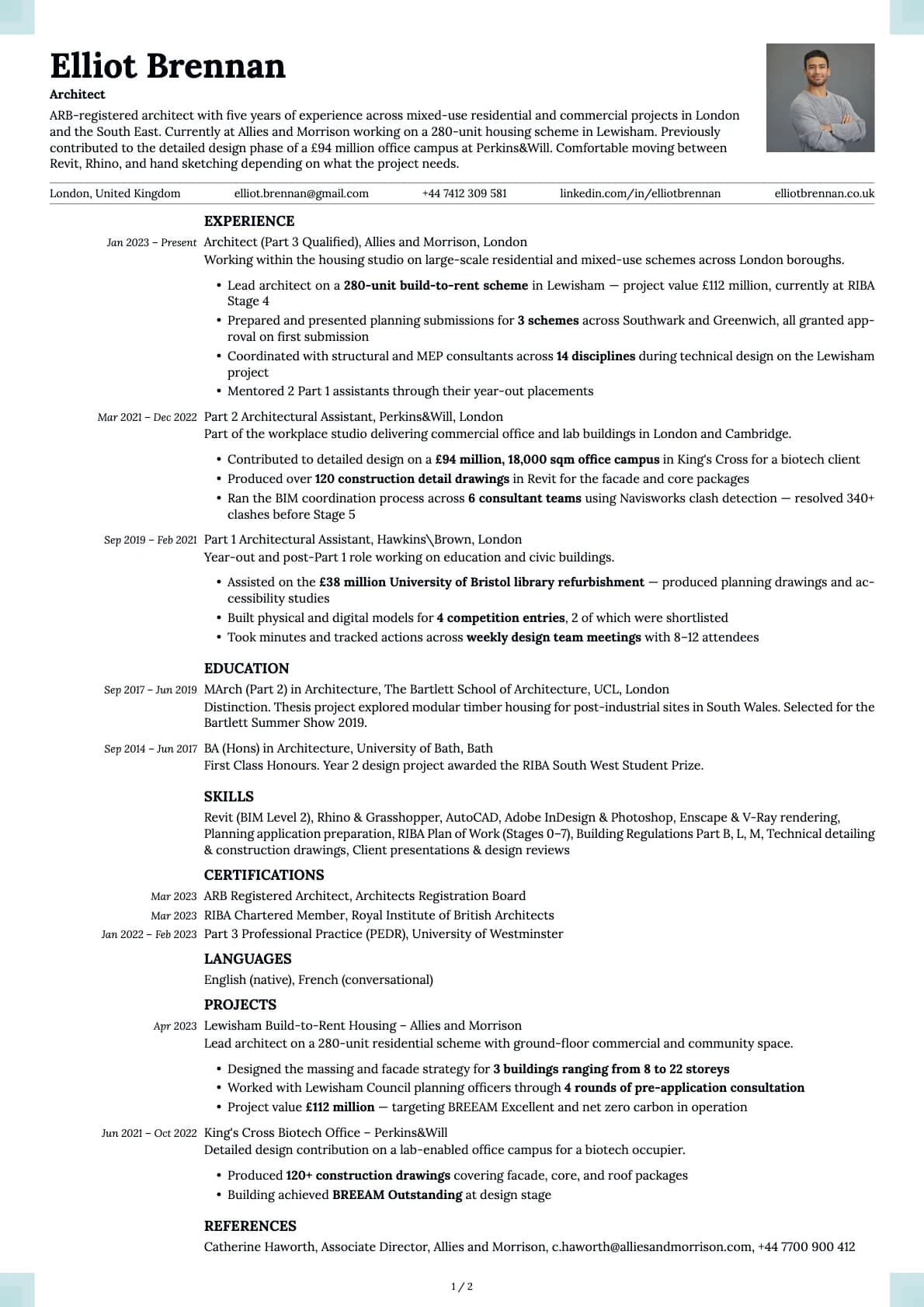
Architect
An ARB-registered architect resume example with RIBA Stage 4 project experience, BIM coordination.
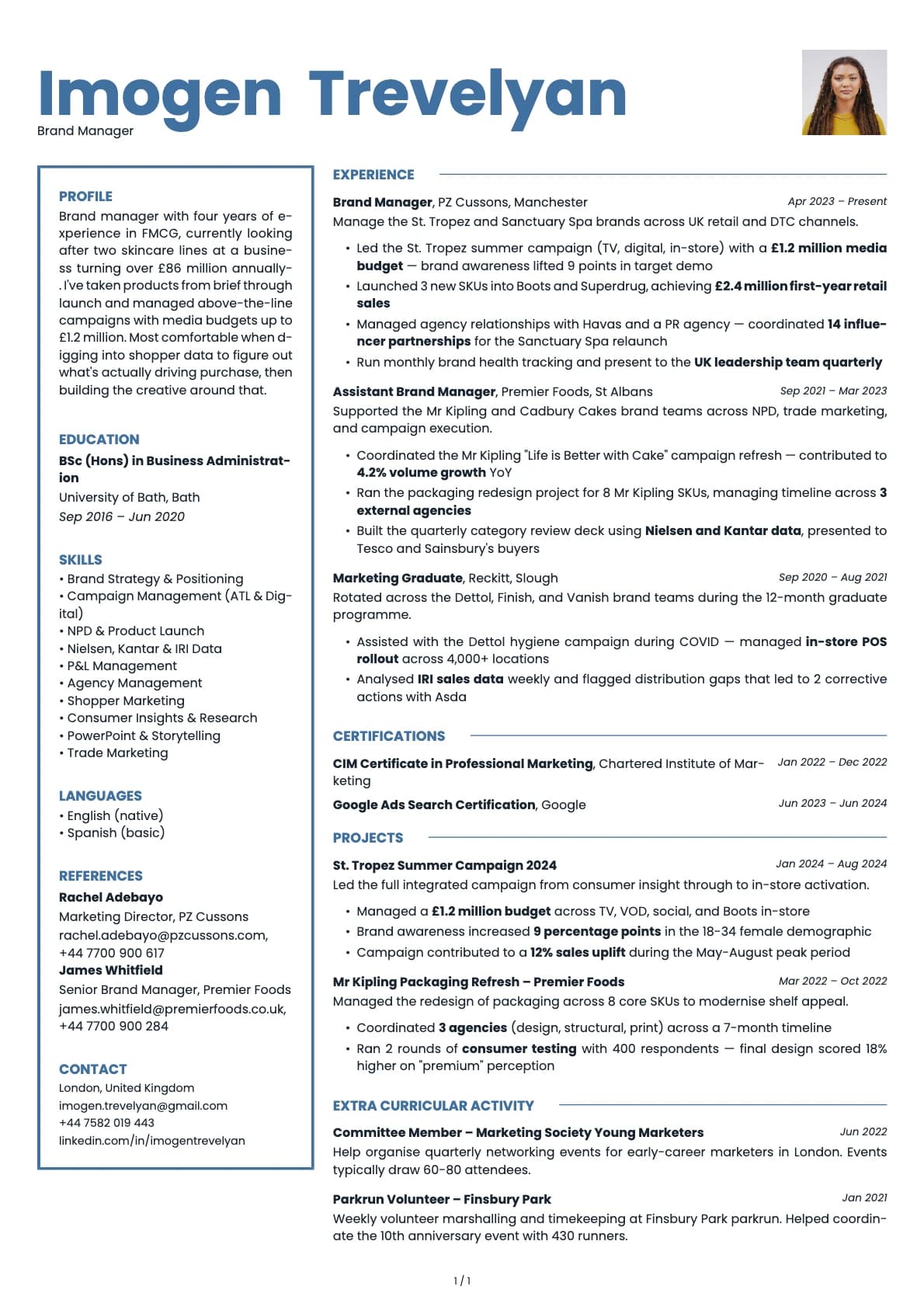
Brand Manager
A brand manager resume example from FMCG with campaign budgets, NPD launches, and Nielsen/Kantar data experience across PZ Cussons and Premier Foods.
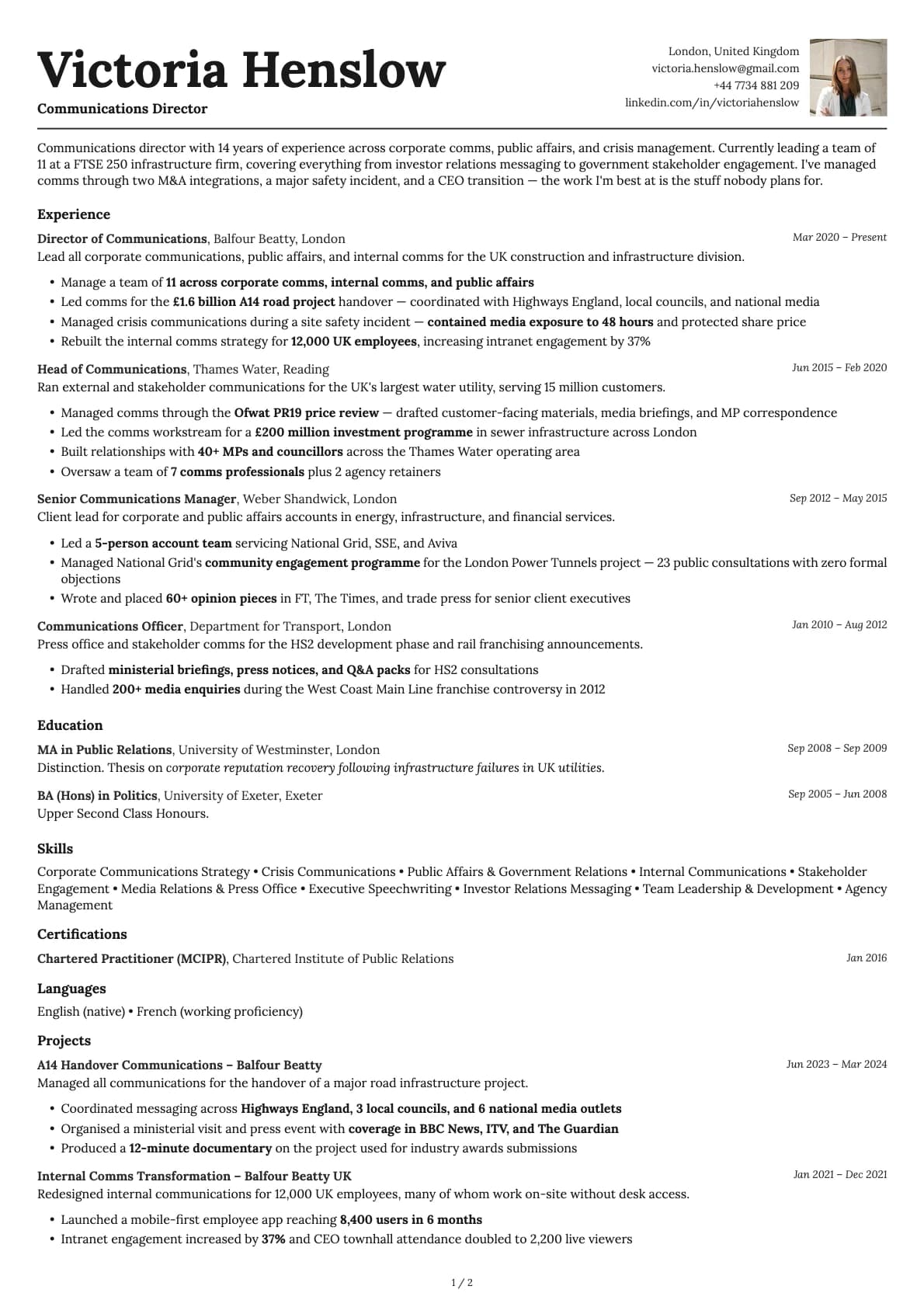
Communications Director
A communications director resume example with 14 years of experience across corporate comms, public affairs.