Functional Resume Format: Skills-Based Layout Explained
Groups your experience by skills, not by job. Useful in specific situations, risky in others. Here's the honest take.

Laddro

Let's be upfront about something: the functional resume is the most misunderstood format out there. Some career coaches swear by it. Many recruiters openly dislike it. The truth is somewhere in the middle, and whether it works for you depends entirely on your situation.
This guide will give you the honest version. When a functional resume makes sense, when it doesn't, and how to build one that doesn't shoot you in the foot.
What is a functional resume?
A functional resume organizes your experience by skill categories instead of by job. Rather than listing Company A, then Company B, then Company C, you create sections like "Project Management," "Client Relations," and "Technical Skills," and group your relevant accomplishments under each one.
Your actual employment history still appears, but it's usually a short list at the bottom with just job titles, company names, and dates. No bullet points under each role.
The idea is to put your abilities front and center so a reader sees what you can do before they see where you've been.
Who should use a functional resume?
This format works in a few specific situations:
Career changers. If you've been an English teacher for 8 years and you're moving into corporate training, a chronological resume will show 8 years of teaching. A functional resume lets you pull out the transferable skills (curriculum design, group facilitation, performance assessment) and present them as the main story.
People re-entering the workforce. If you took several years off for caregiving, health, travel, or anything else, a traditional timeline will have an obvious gap. A functional format shifts attention to what you know, not when you last clocked in.
Freelancers and consultants with diverse projects. If you've done 20 short-term contracts across different industries, listing them all chronologically creates a messy, hard-to-follow resume. Grouping your work by skill category makes the pattern clearer.
Recent graduates with more skills than experience. If your degree, internships, and side projects have given you solid skills but you don't have a long work history to show, the functional format can make the most of what you have.
If any of these sound like your situation, this format might be worth considering. But read the next section before you commit.
The honest downsides
Here's what nobody tells you on most resume advice sites:
Many recruiters are suspicious of functional resumes. This isn't a guess. It comes up in recruiter surveys consistently. When a recruiter sees a functional resume, their first thought is often "What are they hiding?" That might not be fair, but it's reality. Recruiters are trained to look for red flags, and an unusual format is one of them.
ATS systems can struggle with it. Applicant tracking systems are built to parse chronological resumes. They look for job titles, companies, and dates in a predictable structure. A functional resume breaks that structure. The software might not correctly match your accomplishments to your roles, or it might skip sections entirely.
It removes context from your achievements. When you say "Managed a EUR 500K project budget" in a skills section, the reader doesn't know if you did that at a Fortune 500 company or a 3-person startup. Context matters, and the functional format strips it away.
It can make you look less experienced than you are. Ironically, by hiding your timeline, you might accidentally hide your depth. A hiring manager who can't quickly see your 15-year career might underestimate you.
None of this means you should never use a functional resume. It means you should go in with your eyes open.
How to structure a functional resume
If you've decided this format is right for your situation, here's how to do it well.
1. Contact information
Same as any resume: name, phone, email, city, LinkedIn. Nothing special here.
2. Professional summary
This section is even more important on a functional resume than on a chronological one. Since the reader won't see a clear career timeline, your summary needs to anchor them. Tell them who you are, what you're good at, and what kind of role you're after.
Example: "Operations specialist with 10 years of experience in logistics, vendor management, and process improvement. Transitioning from military logistics to private-sector supply chain management. Reduced procurement costs by 22% across three deployments."
That summary gives a recruiter a clear picture before they even start reading the skills sections. When you're building in Laddro, the AI writing tool can help draft this based on your background and target role.
3. Skills sections (the core of the resume)
This is where functional resumes live or die. Create 3-4 skill categories that match what the job is asking for. Under each one, list 3-5 specific accomplishments that prove the skill.
Project Management
- Led cross-functional team of 12 to deliver a warehouse automation project 2 weeks ahead of schedule
- Created and maintained project timelines for 5 simultaneous initiatives with combined budgets over EUR 800K
- Introduced weekly status reporting that cut stakeholder escalations by 40%
Process Improvement
- Redesigned inventory tracking workflow, reducing stock discrepancies from 8% to under 1%
- Developed standard operating procedures adopted across 3 regional offices
- Trained 25+ staff on new ERP system with 95% adoption rate within first month
Notice that each bullet has a specific result, a number, or a concrete outcome. "Strong project management skills" means nothing. "Delivered a project 2 weeks early" means something.
If you're applying for different types of roles, you'll want different skill groupings for each. Laddro's tailor feature can analyze a job posting and tell you which skills to highlight, which helps you decide on the right categories.
4. Work history (brief)
This is the section most people get wrong on a functional resume. They either leave it out entirely (which looks evasive) or they bury it so deep that the recruiter has to hunt for it.
Include a simple list:
- Operations Coordinator | ABC Logistics | Berlin, Germany | 2019-2023
- Supply Chain Assistant | DEF Corp | Munich, Germany | 2016-2019
- Military Logistics Officer | German Armed Forces | Various | 2012-2016
No bullet points, no descriptions. Just enough for the recruiter to see that yes, you have a real work history, and yes, it covers a reasonable timeframe.
This section is critical for ATS. Even though your functional resume leads with skills, the ATS still needs job titles and dates to parse your profile correctly. Leaving this section out can tank your chances before a human ever sees your resume.
5. Education
Degree, institution, graduation year. If you have relevant certifications, list those here too. For career changers, certifications in your new field (like a PMP for project management) carry extra weight.
6. Additional skills
A short list of hard skills, tools, and languages. Keep it relevant to the target role.
Making a functional resume work with ATS
Here's the thing most guides skip: you can make a functional resume more ATS-friendly without turning it back into a chronological one.
Use standard section headers. "Professional Experience" or "Skills Summary" will be recognized by ATS. "My Journey" or "What I Bring" won't.
Include a chronological work history section. We covered this above, but it bears repeating. Even 3-4 lines of job titles with dates gives the ATS something to grab onto.
Mirror the job posting's language. If the posting says "stakeholder management," use that exact phrase. Don't write "working with stakeholders" instead. ATS systems often match on exact terms.
Use a clean template. Avoid columns, graphics, and unusual layouts. Laddro's resume templates are designed to be parsed correctly by ATS software while still looking professional. Pick one and let it handle the formatting.
When to use a combination format instead
Honestly? For most people who are considering a functional resume, the combination format is a better choice. It gives you a skills section at the top (so you still lead with your abilities) but follows it with a proper chronological work history (so recruiters and ATS systems get the timeline they want).
The combination format is less risky. It doesn't trigger the "What are they hiding?" reaction, and it plays nicely with ATS. If you're on the fence, read our combination resume format guide before making a decision.
Building a functional resume with Laddro
One of the advantages of Laddro's resume builder is that it doesn't lock you into a fixed structure. You can:
- Drag and drop sections into any order. Want skills above work history? Just move them.
- Add custom sections for your skill categories. Name them whatever fits your experience.
- Reorder within sections to put your strongest points first.
- Use AI suggestions to improve your bullet points and make them more specific.
This matters more for functional resumes than for any other format, because the structure isn't standardized. You need flexibility to build it your way.
If you're applying to multiple roles, you can duplicate your resume in Laddro and rearrange the skill categories for each application. The tailor feature will flag which skills each job posting prioritizes so you can adjust accordingly.
The bottom line
A functional resume is a tool for specific situations. If you're changing careers, re-entering the workforce, or consolidating a scattered freelance history, it can help you tell a clearer story. But go in knowing the trade-offs: some recruiters won't love it, ATS systems might struggle with it, and you'll need to work harder to prove your experience is real and recent.
If you decide it's the right move, make it count. Lead with your strongest skills, back them up with measurable results, and include a brief work history so nobody has to guess.
Ready to get started? Open the Laddro resume builder, choose a template, and start building your sections. If you want to see how skill-based resumes look in practice, browse the resume examples library. And don't forget to write a cover letter that explains your career story in a way a resume can't.
Ready to build your resume?
Put this into practice. Open the builder and create your resume step by step.
Free to use. No account needed to start.
Related articles

Care Assistant CV (UK): How to Write One That Passes the Checks
A UK care CV has to survive the recruitment checks providers are legally required to make. The structure managers expect, plus a worked profile you can copy.

Career Gaps Don't Scare Recruiters Anymore. Bad Explanations Do.
84% of hiring managers look for growth stories, not perfect timelines. Career gaps aren't the problem. Leaving them unexplained is.

Career Pivots in 2026: How to Rewrite Your Story Without Starting Over
Changing careers doesn't mean starting over. Reframe your experience, highlight transferable skills, and build a resume that tells your new story.
Related resume examples
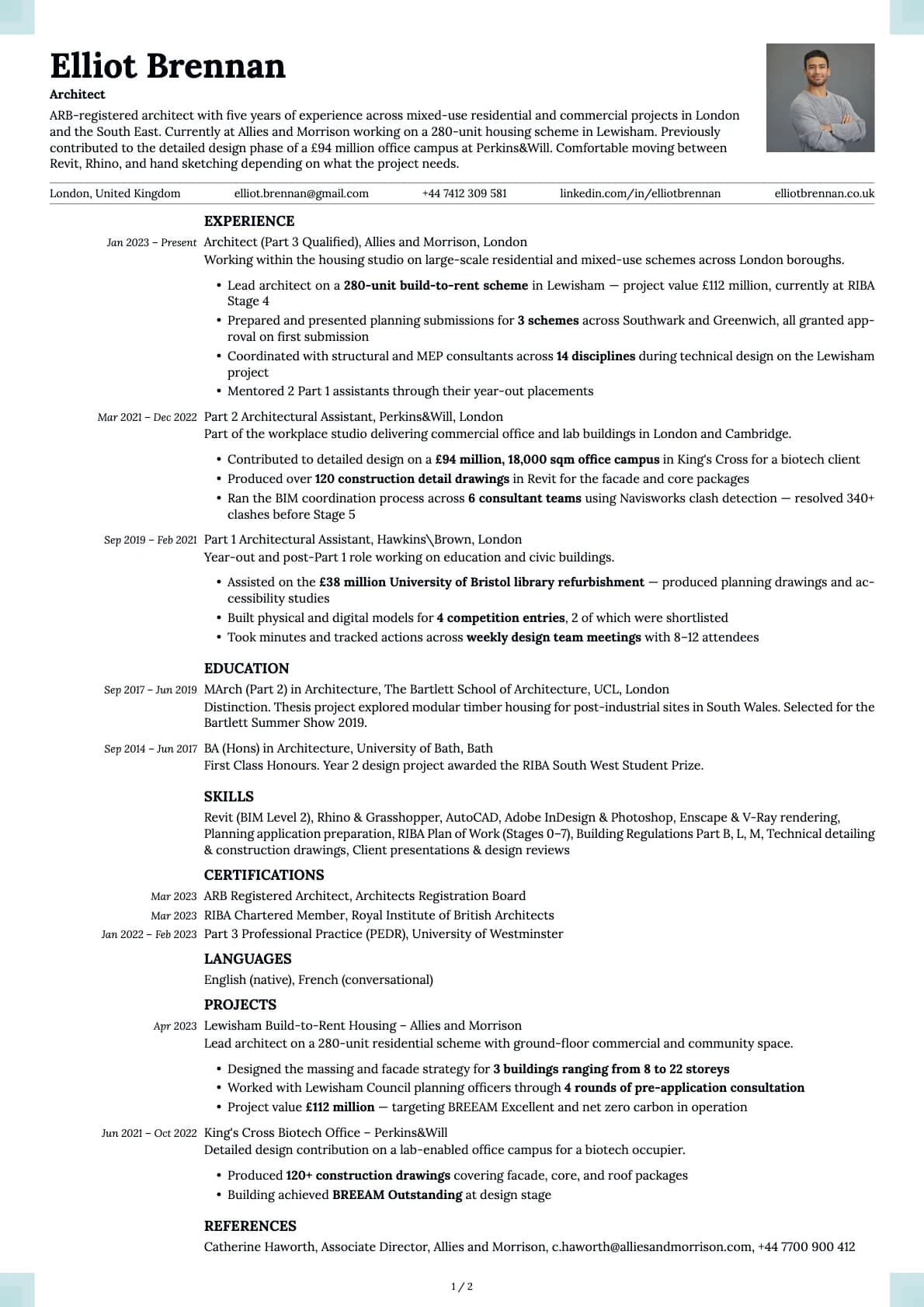
Architect
An ARB-registered architect resume example with RIBA Stage 4 project experience, BIM coordination.
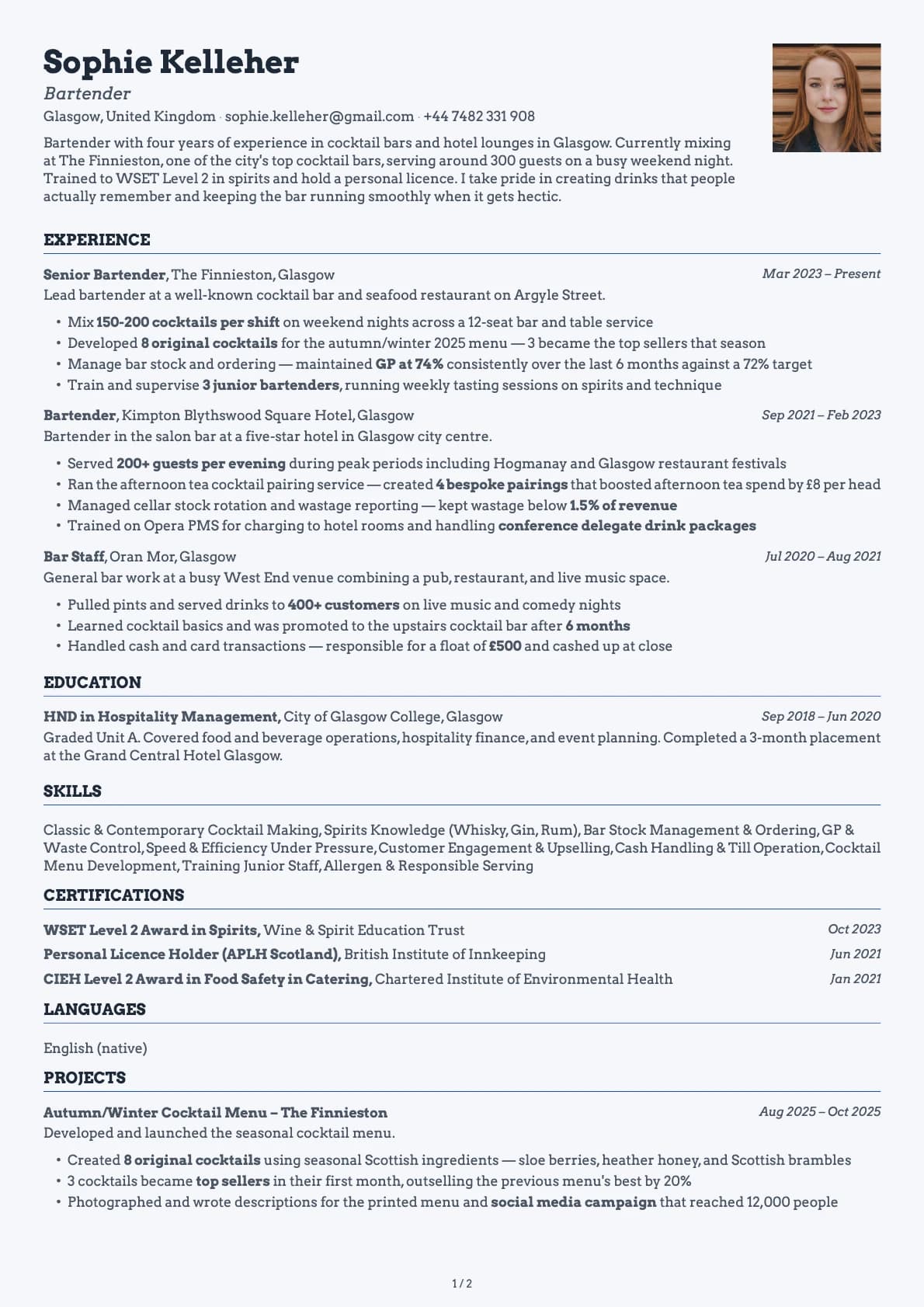
Bartender
A bartender resume example from a top Glasgow cocktail bar, covering drink volumes, GP targets, menu development, and how to present hospitality.
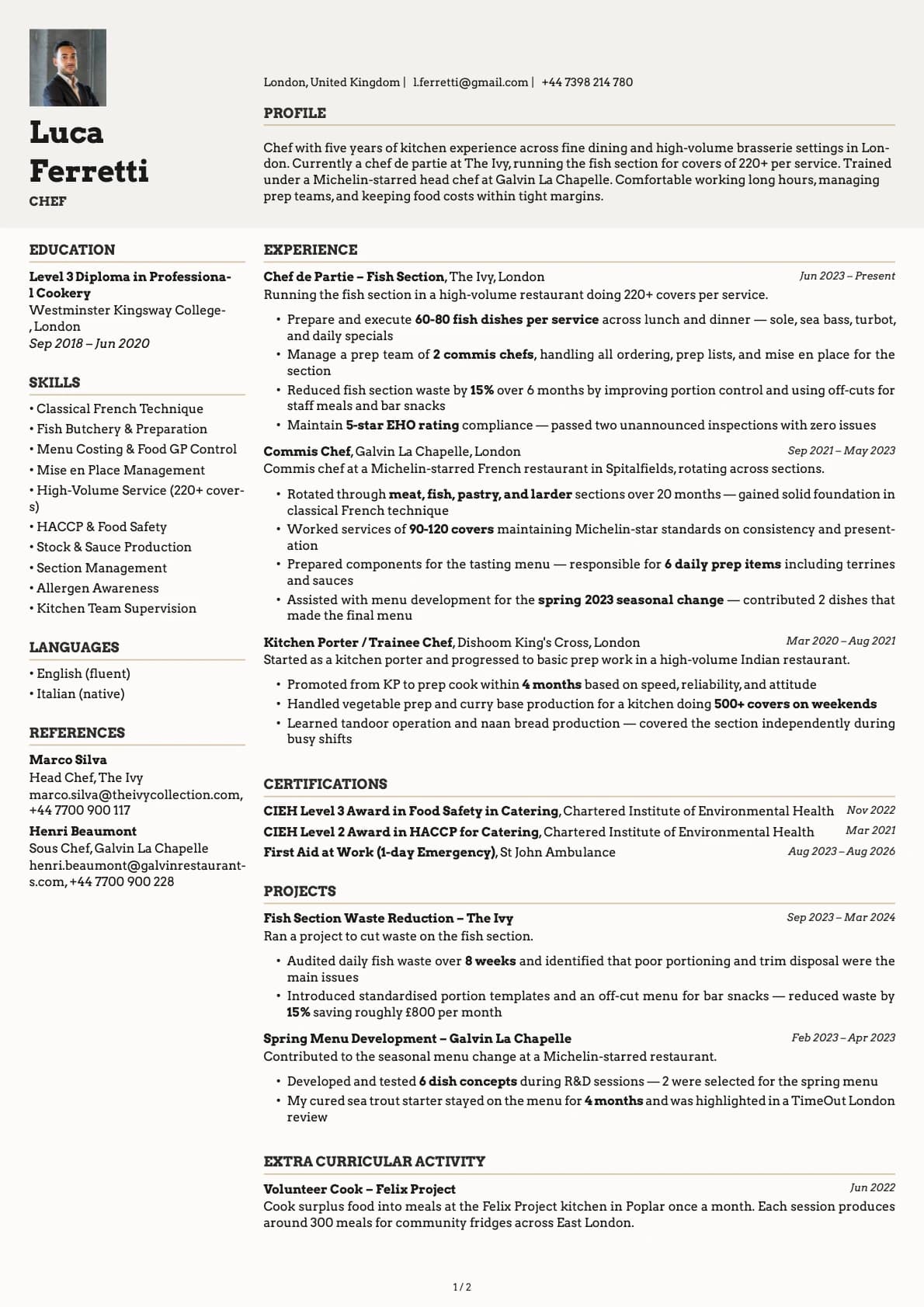
Chef
A chef resume example with fine dining and high-volume experience at The Ivy and Galvin La Chapelle.