Graduate CV With No Work Experience (UK): What to Put On It
Write a UK graduate CV with no work experience: the sections recruiters expect, what to leave off, a sample personal statement and a before and after bullet.

Laddro Team

You have a degree, a stack of coursework and precisely zero lines to put under "work experience". So the cursor sits there, blinking, while the panic sets in. Here is the thing almost nobody tells you when you leave the University of Leeds or Manchester Met with a fresh 2:1: the blank CV is not an experience problem. It is a positioning problem. The careers team at jobs.ac.uk puts it bluntly in their first-graduate-job guide: "Most graduates do have experience. It's just not positioned effectively."
This is a walk through exactly what goes on a UK graduate CV when you have never held a full-time job, what recruiters here actually expect, and what to leave off because the UK does things differently from a lot of Europe.
What a UK graduate CV actually contains
The National Careers Service, the government's own careers body, lists the sections every CV needs: contact details, an introduction, your education history, your work history and references. For a graduate, the order shifts. Because your degree is your strongest card, education climbs near the top, above whatever bits of work you have done.
A clean structure for a first-job CV, close to the one jobs.ac.uk recommends, looks like this:
- Header: name, phone number, email, and a link to your LinkedIn if it is up to date
- Personal statement: three or four lines, rewritten for each application
- Education: your degree unpacked with modules, projects and results, not just the title
- Experience: part-time jobs, placements, society roles, anything with responsibility
- Skills and achievements: kept short and relevant to the role
- References: the line "References available on request" is enough
Everything on that list should earn its place. If a section does not help the reader picture you doing the job, it comes off.
Leave these off (the UK is not the rest of Europe)
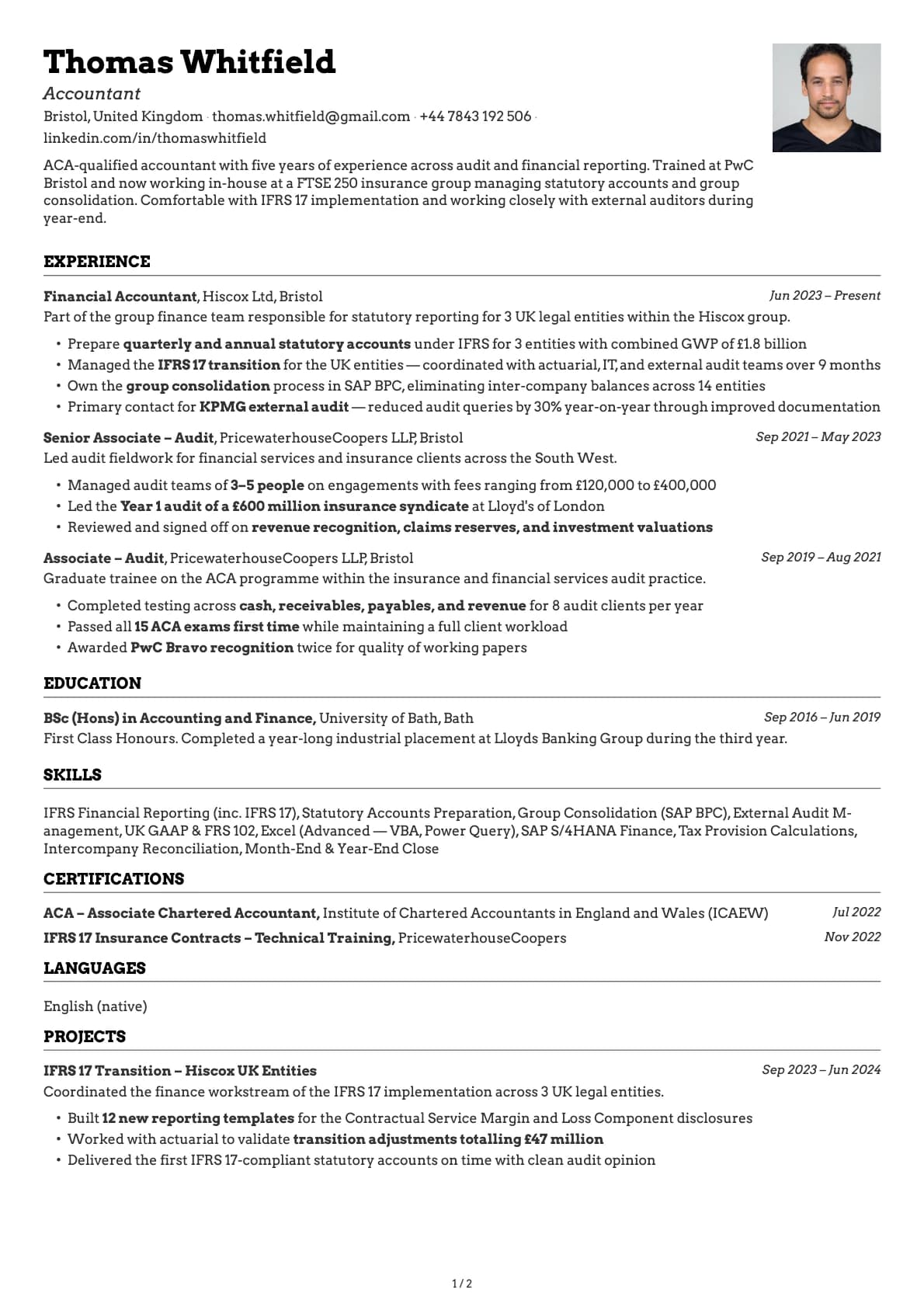
If you have looked at a German Lebenslauf or a French CV, you may have seen a photo, a date of birth, even a marital status. Do not copy that here. The National Careers Service is explicit that you should not include your age, your date of birth, whether you are married or your nationality. A UK CV carries no photo either. Recruiters in Britain are trained to screen those details out to avoid bias, and some applicant tracking systems flag CVs that include them.
So no headshot, no "Date of birth: 14/03/2004", no full home address (your town and a contactable email is plenty). What you gain by leaving them off is space, and space is the thing you are short of.
Your personal statement in three or four lines
The introduction, or personal statement, sits under your name and does one job: it tells the reader who you are and what you are aiming at. The National Careers Service describes it as a few short lines that sum up who you are and what you hope to do, written to sound like the right person for this role.
Here is a worked example for a business graduate applying to a marketing scheme, in the shape Prospects uses in its own graduate samples:
Business Management graduate (2:1, University of Leeds) with hands-on marketing experience from a summer internship and two years of part-time retail. Strong on communication, customer insight and turning data into decisions. Looking to start a career in graduate marketing where I can build commercial knowledge and contribute from day one.
Notice it names the degree, the classification and the target role. Swap in your own facts and rewrite it for every application. A statement that could belong to anyone belongs to no one.
Turn "no experience" into evidence
Now the part that unsticks the blank page. You have done more than you think. A weekend job at Boots, a summer at a warehouse, running the treasurer's accounts for a society, a dissertation you actually cared about: each of these is evidence of a skill an employer pays for. Prospects, the university-backed careers service, points out that part-time retail shows communication and commercial awareness, society roles show leadership and stakeholder management, and academic projects show research and the ability to deliver under pressure.
The trick is to describe the outcome, not the task. jobs.ac.uk recommends a simple formula for each bullet: a strong action verb, a number, and how you did it. So you lead with what changed because you were there.
A before and after bullet you can copy
Take a Saturday job in a shop. Most graduates write it like this:
Worked in a shop at weekends. Served customers and helped with stock.
That is a description of being present. Here is the same job written to the jobs.ac.uk formula:
Served 80+ customers per shift on the Saturday rush at a busy Leeds branch, running the till and click-and-collect together to keep queues under two minutes.
Same job, same person. The second version has a verb, a number and a method, and it quietly proves you can handle pressure and organise your work. Do the same for a society role: not "was treasurer of the debating society" but "managed a £2,400 annual budget for a 60-member society, cutting event costs by 15% by moving venue bookings in-house."
If you genuinely cannot attach a number, describe the result instead. "Rewrote the induction notes so new volunteers could start unsupervised in a day" tells a recruiter more than "helped train new volunteers."
Education is your headline section
With little work history, education carries the CV, so give it room. The National Careers Service says to list the names of your qualifications, the institution and the dates. For a graduate that means going a level deeper than the degree title. A filled-in entry looks like this:
BSc Business Management, University of Leeds, 2023 to 2026 Predicted 2:1. Modules: Marketing Analytics, Consumer Behaviour, Operations Management. Final-year project: a go-to-market plan for a local coffee roaster, presented to a panel and marked at 74.
Under the degree, list your A-levels and GCSEs briefly (grade in Maths and English matters most to a lot of employers). If a module, a placement or a dissertation lines up with the job, pull it out and give it a line of its own. That is where "no experience" turns into "relevant experience".
Keep the format boring on purpose
An applicant tracking system reads your CV before a human does, and it prefers plain. The National Careers Service recommends a clear font such as Arial, Times New Roman or Calibri at size 11 or bigger, used consistently, with headings and bullet points. Skip the two-column template with the photo and the skills dials: those often scramble when a machine parses them. A single column, real headings and standard section names get you further.
One to two pages, and one is fine
Prospects advises graduate CVs of one to two pages, and jobs.ac.uk warns that a CV running past two pages "loses impact fast." With no work history, one clean page is completely normal and often stronger than two padded ones. Relevance beats volume every time. Nobody has ever been rejected for a CV that was too easy to read.
Where to actually send it
Once it reads well, tailor it and put it in front of the right people. In the UK that means the government's own Find a job service on gov.uk, Prospects and TARGETjobs for graduate schemes, Milkround for entry-level roles, and Gradcracker if you are in engineering, science or tech. Indeed and LinkedIn carry the widest range, and your university careers service still runs employer events and keeps schemes that never reach the public boards. Applying through three or four of these, with the CV rewritten for each posting, beats firing one generic version at fifty listings.
The blank page felt like proof you had nothing to offer. It was just proof you had not written it down yet. Once you name the skills, attach the numbers and lead with your degree, a graduate CV with "no experience" reads like a CV with plenty. That is the version that gets you the interview, and Laddro's builder keeps the format clean so the software on the other end can actually read it.