How to Write a CV (UK): Format, Length and a Worked Example
How to write a UK CV that actually gets read: the right length, the sections recruiters expect, no photo, and a before and after bullet you can copy today.

Laddro Team

A recruiter in Manchester or Leeds is not reading your CV. They are scanning it. Reed puts the average first look at around seven seconds, which is barely enough time to check the top third of page one before deciding whether you make the shortlist. So the job of a CV is not to list everything you have ever done. It is to get someone to keep reading, and then to invite you in.
This is a plain guide to writing a CV for the UK market: how long it should be, what goes in it and in what order, what British employers expect you to leave off, and a before and after example you can copy straight into your own document.
What a UK CV actually is
First, the word. In the United States "CV" means a long academic document and the everyday job application is called a resume. In the UK and Ireland it is the other way round. Your CV is the two page document you send for almost any job, from a warehouse role in Bristol to a marketing post in Dublin. If a British advert asks for your CV, it wants the short, punchy version.
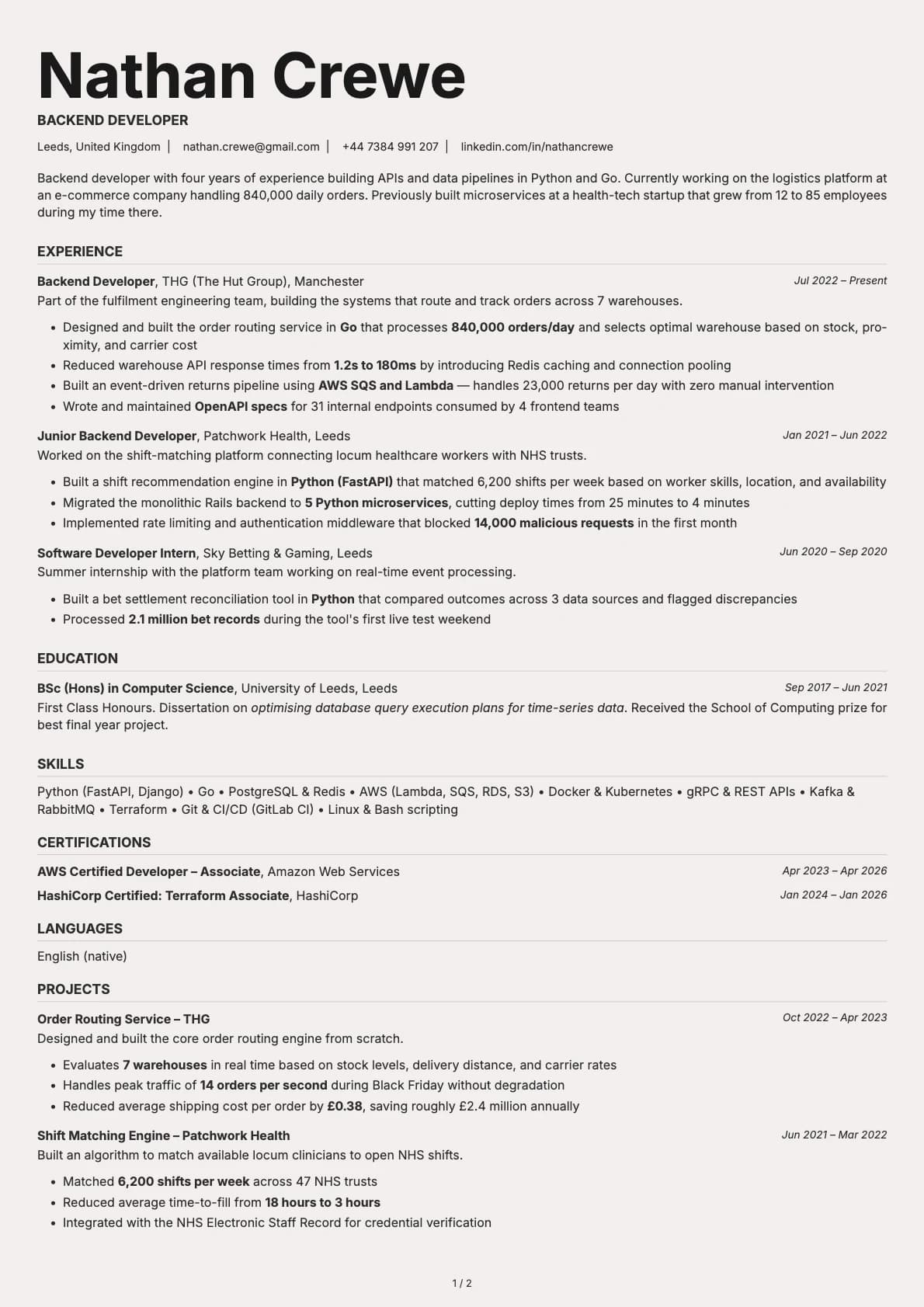
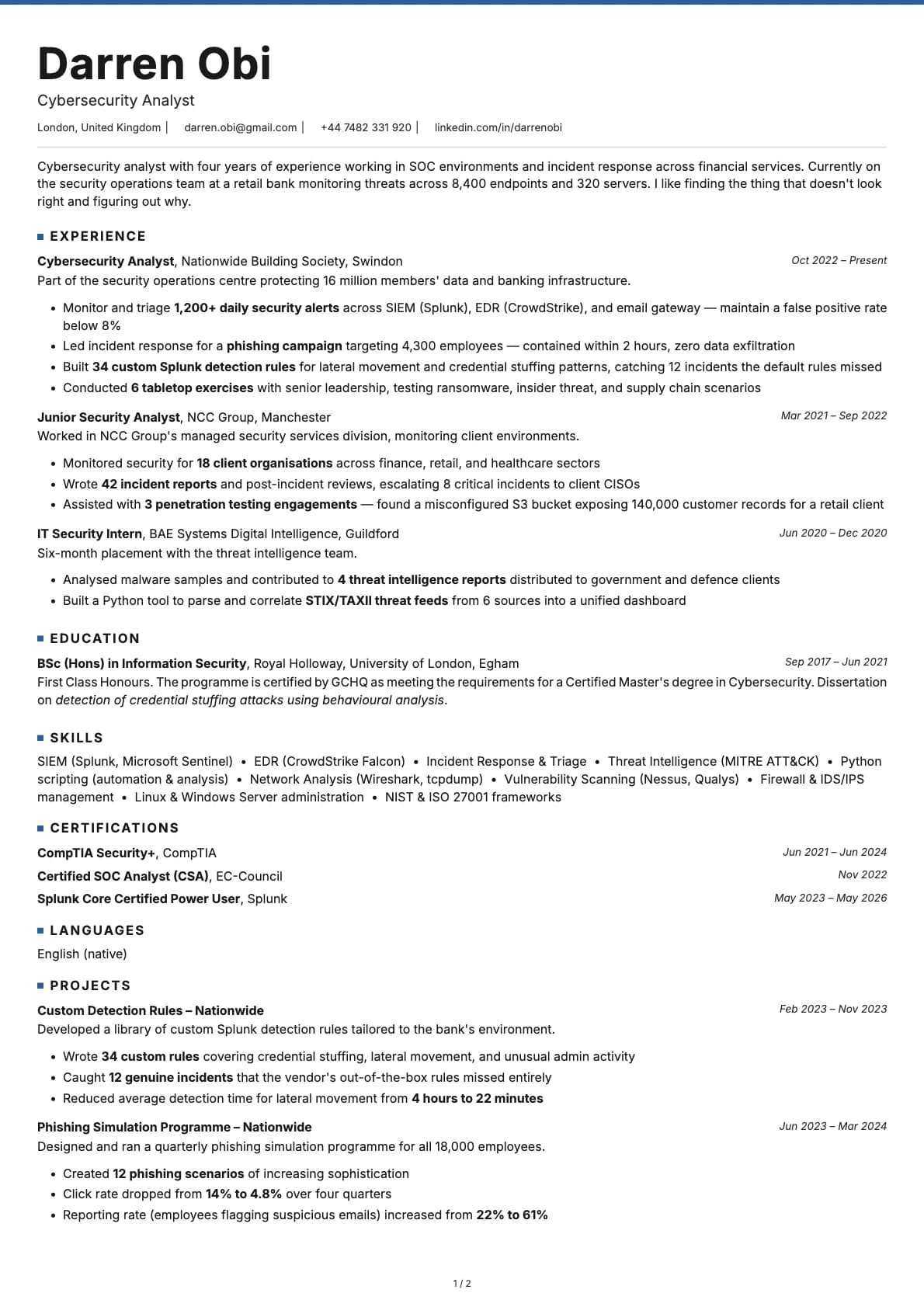
Length is the rule people break most. The National Careers Service, the UK government careers service, is clear that your finished CV should be no more than two sides of A4 unless it is an academic CV. If you are a graduate or have fewer than three years of experience, one page is perfectly normal and often stronger. Nobody in HR is disappointed by a CV that respects their time.
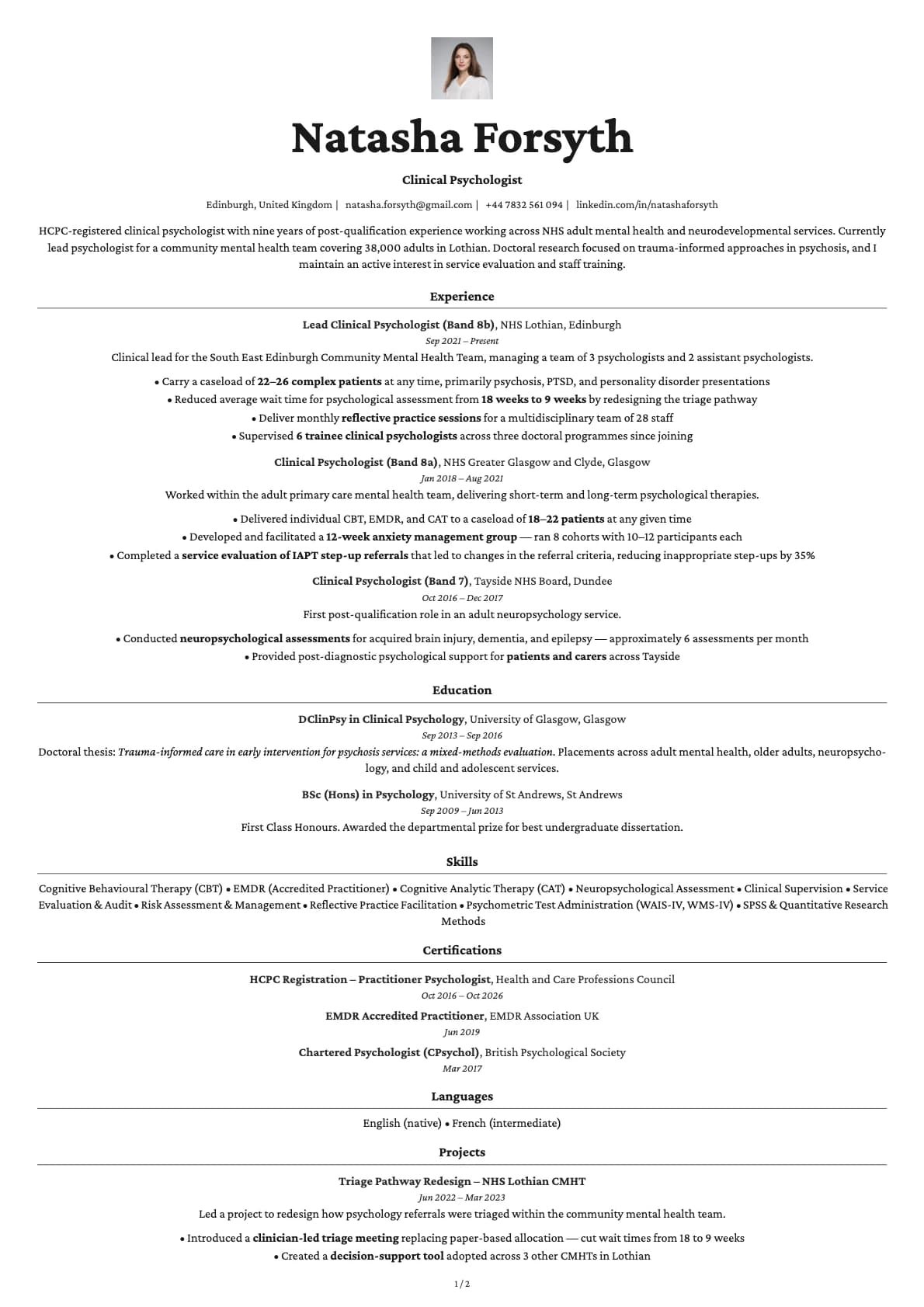
The other thing that trips people up is what to leave off. A UK CV has no photo, no date of birth, no marital status and no nationality unless a job genuinely needs it. This is not fussiness. Age, for example, is a protected characteristic under the Equality Act 2010, and British employers deliberately keep those details off the page to reduce bias in shortlisting. A photo on a UK CV reads as a mistake, not a nice touch. Save your face for LinkedIn.
The sections, in the order recruiters expect
The National Careers Service sets out a standard running order, and unless you have a good reason, follow it:
- Contact details. Your name, a mobile number, a professional email address and a link to your LinkedIn profile. City and postcode area are enough for your location. Your full street address is not needed.
- Personal statement. A few short lines that sum up who you are and what you are looking for. More on this below.
- Work history. Your most recent job first, then working backwards. This reverse order is the format most UK recruiters expect, and Indeed's guidance describes it as the timeline that tells your work story simply.
- Education. Your qualifications, most recent first, with the institution and dates. Put this above work history only if you are a recent graduate with little paid experience.
- Skills. The specific ones the job asks for, not a generic wish list.
- References. You do not list them. Write "References available on request" and keep your referees' details for when you are actually asked.
The National Careers Service also notes you can flip the order and lead with your work history if you have a lot of experience to show off. A graduate leads with education; a project manager with fifteen years behind them leads with the last three roles.
Write your personal statement last
The personal statement, sometimes called a profile, sits directly under your contact details and is the first thing that seven second scan actually lands on. Prospects, the UK graduate careers authority, suggests keeping it to around 100 words. Three or four lines is plenty. Say who you are, what you are strong at, and what you want next.
Write it last, once the rest of the CV exists, so you can pull the best bits up to the top. Here is one for a customer service assistant moving into an office role:
Reliable customer service assistant with three years on a busy shop floor in Leeds, used to handling 60 or more queries a day and calming difficult situations. Now looking to move into an administrative role where organisation and clear communication matter. Confident with Excel, Outlook and point of sale systems.
Notice it names a real number and a real place and points forwards. It does not say "hard working team player with excellent communication skills", which every second CV says and no recruiter believes.
Turn duties into achievements
This is the part that decides whether you get a call. Most people list what they were responsible for. Strong CVs show what changed because they were there. Both the National Careers Service and Reed push the same idea: give examples of your achievements rather than just listing duties, use active verbs, and put a number on it wherever you can.
A useful frame is the STAR method, which Indeed recommends for CV bullets: briefly set the Situation and Task, then spell out the Action you took and the Result. You do not write the letters out, you just make sure each bullet has an action and an outcome.
Here is a real rewrite you can adapt. Before:
Responsible for customer service and dealing with complaints at a retail store.
After:
Handled 60 or more customer queries a day on the shop floor at a Boots branch in Leeds, resolving complaints on the spot, which cut returns by roughly a fifth over six months.
The first version could belong to anyone. The second has a place, a volume, an action and a result. Reed makes the point plainly with its own example: "Increased sales by 15%" beats "responsible for sales growth" every time. Aim for two to three lines per role, and four to six bullets for your most recent job, tailing off for older ones.
If you do not have hard numbers, use scale instead: how many people, how often, how much money, how big the team. "Trained four new starters" and "managed a rota for a team of twelve" are numbers too.
Skills, education and the bits people get wrong
Keep the skills section tight. Reed suggests picking four or five that directly match the target role rather than listing everything you can do. Read the advert, note the exact words it uses for the skills it wants, and if those words are honestly true of you, use the same ones. That matters for the software as much as the human reader, because many UK employers filter CVs through an applicant tracking system before anyone sees them, and it looks for the terms from the job description.
For education, give grades where they help and leave them off where they do not. A recent graduate lists their degree class and relevant modules. Someone twenty years into their career can shorten school results to a single line. If you have gaps in your work history, the National Careers Service suggests a skills based CV that groups your experience by ability rather than by date, which stops a career break from dominating the page.
Hobbies are optional and usually the first thing to cut when you are fighting for space. Only keep an interest if it shows a skill the job wants, such as captaining a Sunday league team to show organisation and leadership.
Tailor it, then send it
One CV for every job is the slow way to job hunt. Keep a master version, then for each application adjust the personal statement and the top few bullets so they echo the advert. It takes ten minutes and it is the single biggest thing you can do to get past both the software and the seven second scan.
In the UK you will mostly apply through Reed, Indeed UK, Totaljobs, CV-Library and LinkedIn, plus NHS Jobs and Civil Service Jobs for the public sector. In Ireland the conventions are the same two page, no photo CV, and the main boards are IrishJobs, Jobs.ie and gradireland for new graduates. Whichever portal you use, upload a clean PDF unless the site asks for a Word file, and name the file with your own name rather than "cv final v3".
Get the length right, lead with a personal statement that points forward, turn every duty into an achievement with a number attached, and cut anything a recruiter does not need in the first seven seconds. Do that and your CV stops being a list and starts being the reason someone picks up the phone. When you are ready to build it, Laddro gives you UK ready templates that handle the formatting so you can spend your time on the words that matter.