Clinical Psychologist Resume Example
A clinical psychologist resume example with 9 years of NHS experience across community mental health and neuropsychology.

Laddro Team
Free to use. No account needed to start.
Free to use. No account needed to start.
Overview
Clinical psychologist resumes need to do something that most other resumes do not. They need to demonstrate clinical competence, research activity, and leadership all at once. NHS psychology posts are scored against a person specification, and the shortlisting panel is usually made up of other psychologists. They know the work. They can spot vague claims immediately.
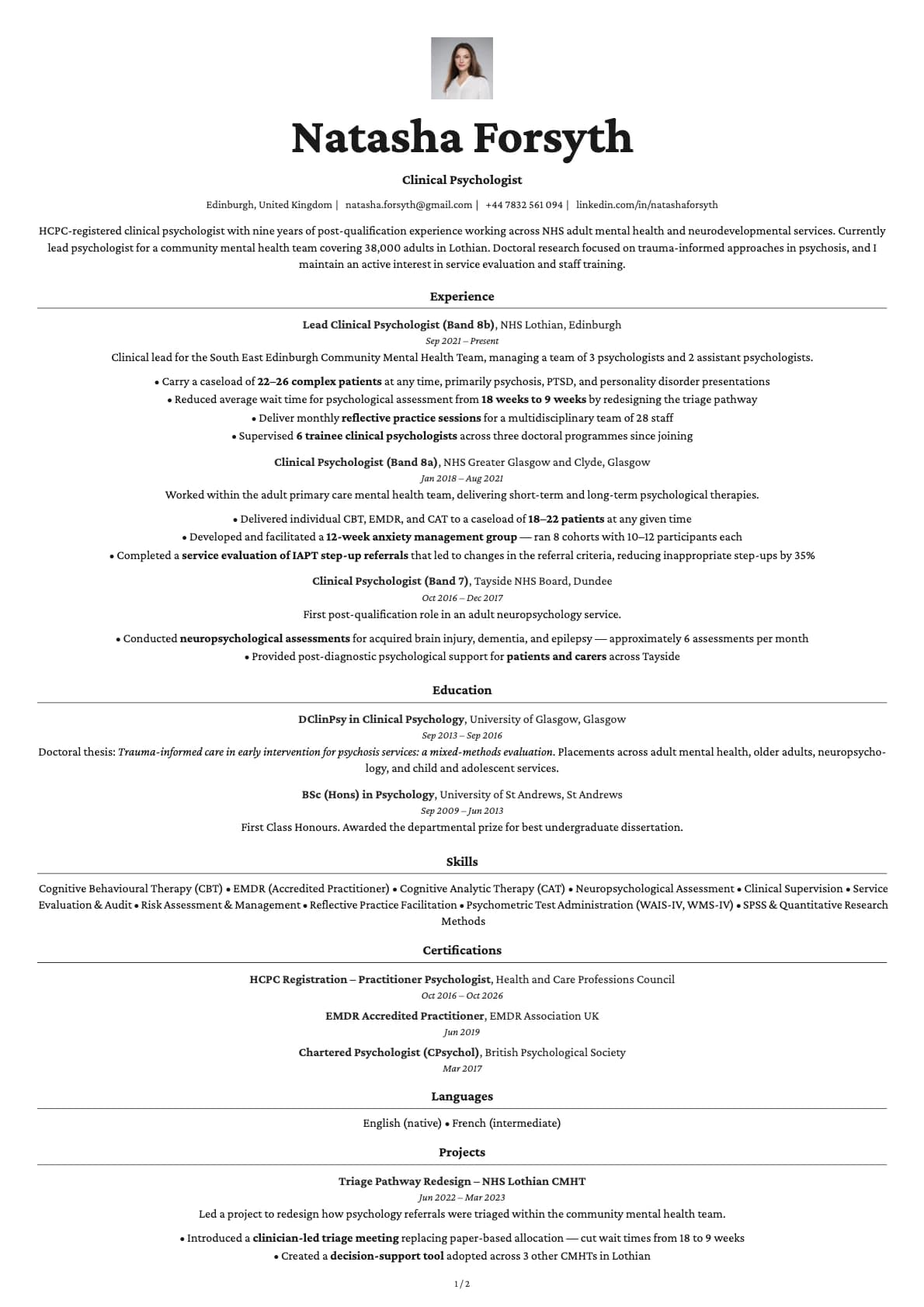
This resume belongs to Natasha Forsyth, a Band 8b Lead Clinical Psychologist with NHS Lothian in Edinburgh. She has nine years of post-qualification experience, holds HCPC registration and EMDR accreditation, and has worked across adult mental health, neuropsychology, and community settings. Her resume works because every bullet connects to something the person specification is likely to ask for: caseload complexity, wait time reduction, supervision, service development, and research output.
Let us break down what she does well and how you can apply it to your own application.
Lead with band, registration, and specialism
For NHS psychology posts, your band level and HCPC registration are the first things the panel checks. If they are not in your summary, you are making the reader hunt for basic eligibility information.
Here is the summary from this resume:
HCPC-registered clinical psychologist with nine years of post-qualification experience working across NHS adult mental health and neurodevelopmental services. Currently lead psychologist for a community mental health team covering 38,000 adults in Lothian.
Two sentences. HCPC status, years post-qualification, clinical areas, and current role including the population served. The population figure (38,000 adults) gives the panel context for the scale of the service.
For yours: Open with your HCPC registration status and years post-qualification. Name your specialism and current service. If you know the population your team covers, include it. Then mention your doctoral research area if it is relevant to the post you are applying for.
Experience: caseloads, modalities, and outcomes
The person specification for a Band 8a or 8b post will almost certainly ask for evidence of working with complex presentations, delivering specific therapeutic modalities, and contributing to service development. Your experience bullets need to hit all three.
Look at the current role:
"Carry a caseload of 22, 26 complex patients at any time, primarily psychosis, PTSD, and personality disorder presentations"
That gives the panel the caseload size and the complexity level. Psychosis, PTSD, and personality disorder are not straightforward presentations. Naming them shows this is genuinely complex work.
"Reduced average wait time for psychological assessment from 18 weeks to 9 weeks by redesigning the triage pathway"
This is a service development outcome with a clear before-and-after number. Wait times are a politically sensitive metric in NHS services. Cutting them in half is significant, and the panel will want to hear more about this at interview.
"Supervised 6 trainee clinical psychologists across three doctoral programmes since joining"
Supervision is typically essential criteria for Band 8a and above. Giving the number of trainees and the spread across programmes shows this is not occasional supervision. It is a regular part of her role.
The formula for NHS psychology bullets: Clinical activity (caseload size and type) + service improvement (with a measurable outcome) + leadership (supervision, training, team development).
Earlier roles: show your development pathway
The Band 8a role at NHS Greater Glasgow and Clyde shows a different clinical profile. Primary care mental health, group work, and service evaluation. The panel reading this can see a career that progressed from a generalist Band 7 neuropsychology role through primary care and into a community mental health leadership position.
One bullet worth noting:
"Developed and facilitated a 12-week anxiety management group, ran 8 cohorts with 10, 12 participants each"
Group facilitation is a skill that not all clinical psychologists develop. Running eight cohorts of the same programme shows consistency and refinement. If you have facilitated groups, state the programme name, the number of cohorts, and the group size.
The Band 7 entry at Tayside is brief but functional:
"Conducted neuropsychological assessments for acquired brain injury, dementia, and epilepsy, approximately 6 assessments per month"
For a first post-qualification role, this is enough. It names the clinical populations and gives a throughput figure. Six assessments per month in a neuropsychology service is a reasonable workload that tells the panel this was a substantive clinical role.
Certifications: HCPC first, always
Three certifications, in the right order.
HCPC Registration. This is non-negotiable. Without it, you cannot practise. List it first, with the renewal date.
EMDR Accredited Practitioner. This is a specialist accreditation through the EMDR Association UK. If you hold accreditation in a specific modality (EMDR, CBT through BABCP, or schema therapy), list it here. These are often desirable criteria on person specifications.
Chartered Psychologist (CPsychol). BPS chartership is separate from HCPC registration. Not all psychologists bother with it, but it adds another professional credential to your application.
If you are still in training or working towards accreditation in a modality, include it with "in progress" and your expected completion date. Panels appreciate seeing active professional development.
Projects and research: show your academic side
Clinical psychology is one of the few professions where the hiring panel expects to see research or service evaluation alongside clinical work. This resume includes two projects.
The triage pathway redesign at NHS Lothian is a service improvement project with a clear outcome (wait times halved) and broader adoption (decision-support tool used by three other CMHTs). This is exactly what Band 8b job descriptions mean when they ask for "evidence of service development at a strategic level."
The trauma-informed psychosis group at NHS GGC is a clinical research project:
"Pre-post outcome data showed a significant reduction in PTSD symptoms (IES-R mean decrease of 18 points)"
"Findings presented at the BPS Division of Clinical Psychology annual conference 2021"
Conference presentations matter. They show your work has been peer-reviewed and shared with the wider profession. If you have presented at BPS, BABCP, or any other relevant conference, include it. If you have published, definitely include it.
Mistakes that cost psychology applicants
Not matching the person specification. NHS shortlisting is done against the spec. If it asks for "experience of working with psychosis" and your resume does not contain that word, you may not be scored for it. Read the spec before you submit and adjust your wording to match theirs.
Vague supervision claims. "Provided clinical supervision" does not tell the panel anything useful. "Supervised 6 trainee clinical psychologists across three doctoral programmes" does. State the number, the level, and the training context.
Missing research or audit activity. For Band 8a and above, this is usually essential or desirable criteria. Even a small service audit counts. "Audited DNA rates for the anxiety management group and presented recommendations to the team" is better than nothing.
Using a creative template. NHS applications sometimes go through electronic systems. Sidebars and graphics can be stripped out or jumbled. This resume uses Topaz, a clean layout that formats correctly when uploaded or printed. Keep it simple.
One more thing
Clinical psychology applications in the NHS are almost always scored numerically against the person specification. Every bullet on your resume should map to a criterion on the spec. Read the essential and desirable criteria list before you write your resume. Then check that each criterion has at least one corresponding line on your resume. If there is a gap, fill it. If your experience genuinely does not cover a criterion, focus on the ones it does cover and make those as strong as possible.
Build your own version
Open this layout in the builder and swap in your own details. It takes a few minutes.
Free to use. No account needed to start.
Was this resume example helpful?
Rate this example to help us create better content for you.
4.9 average from 103 ratingsRelated resume examples
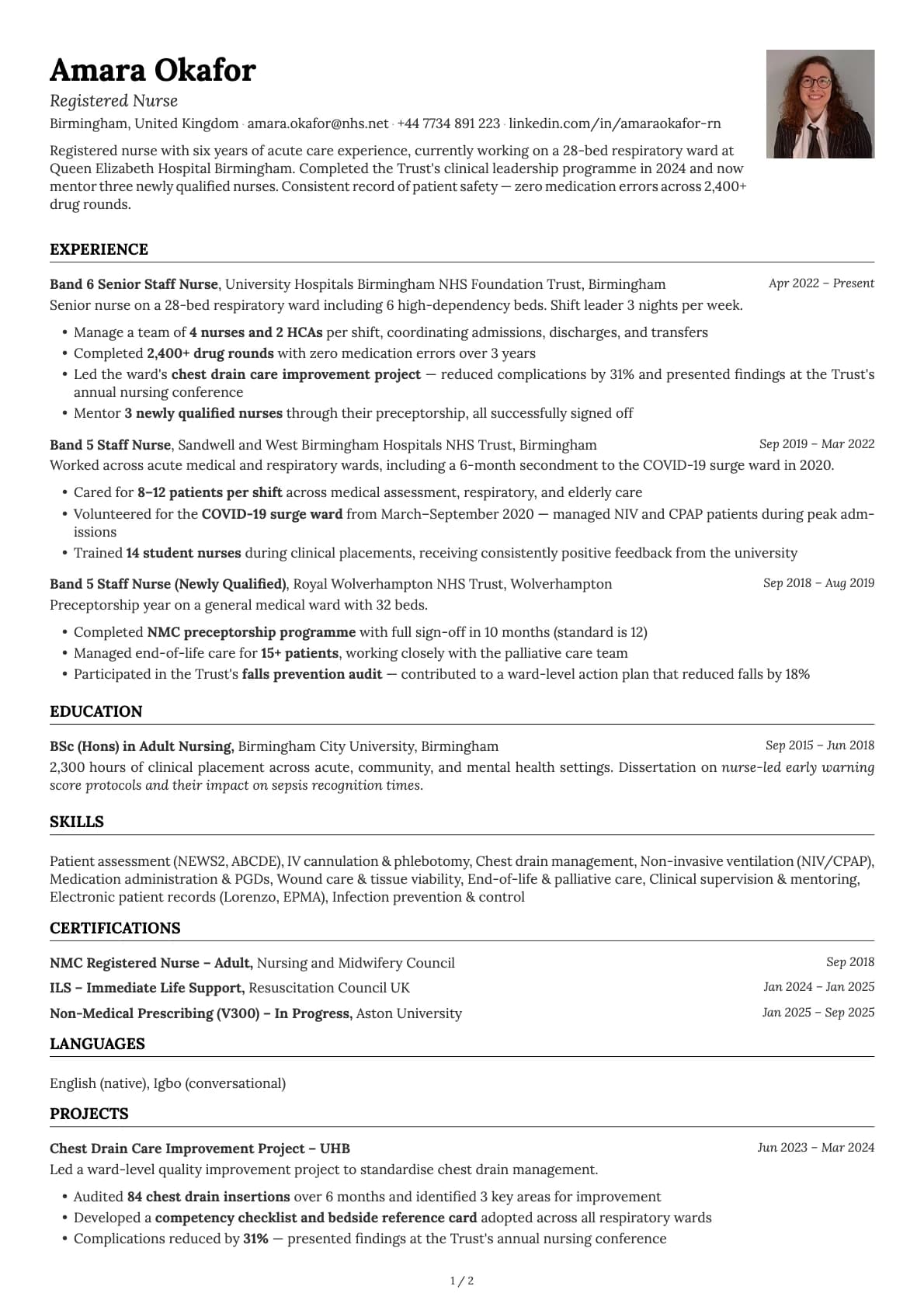
Registered Nurse
A registered nurse resume example with 6 years of acute care experience at NHS hospitals.
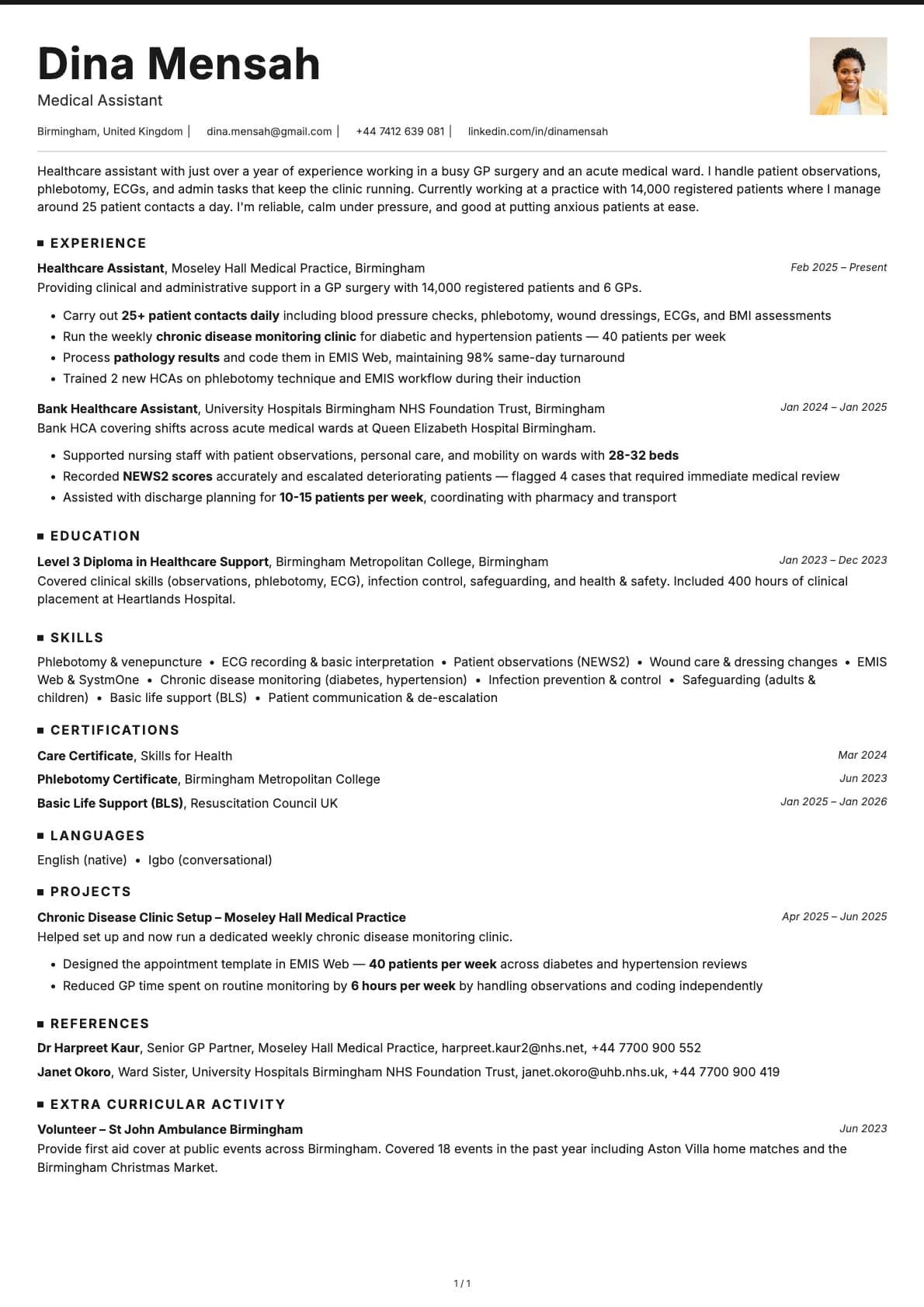
Medical Assistant
A medical assistant resume example with patient contact numbers, clinical skills, and GP surgery experience.
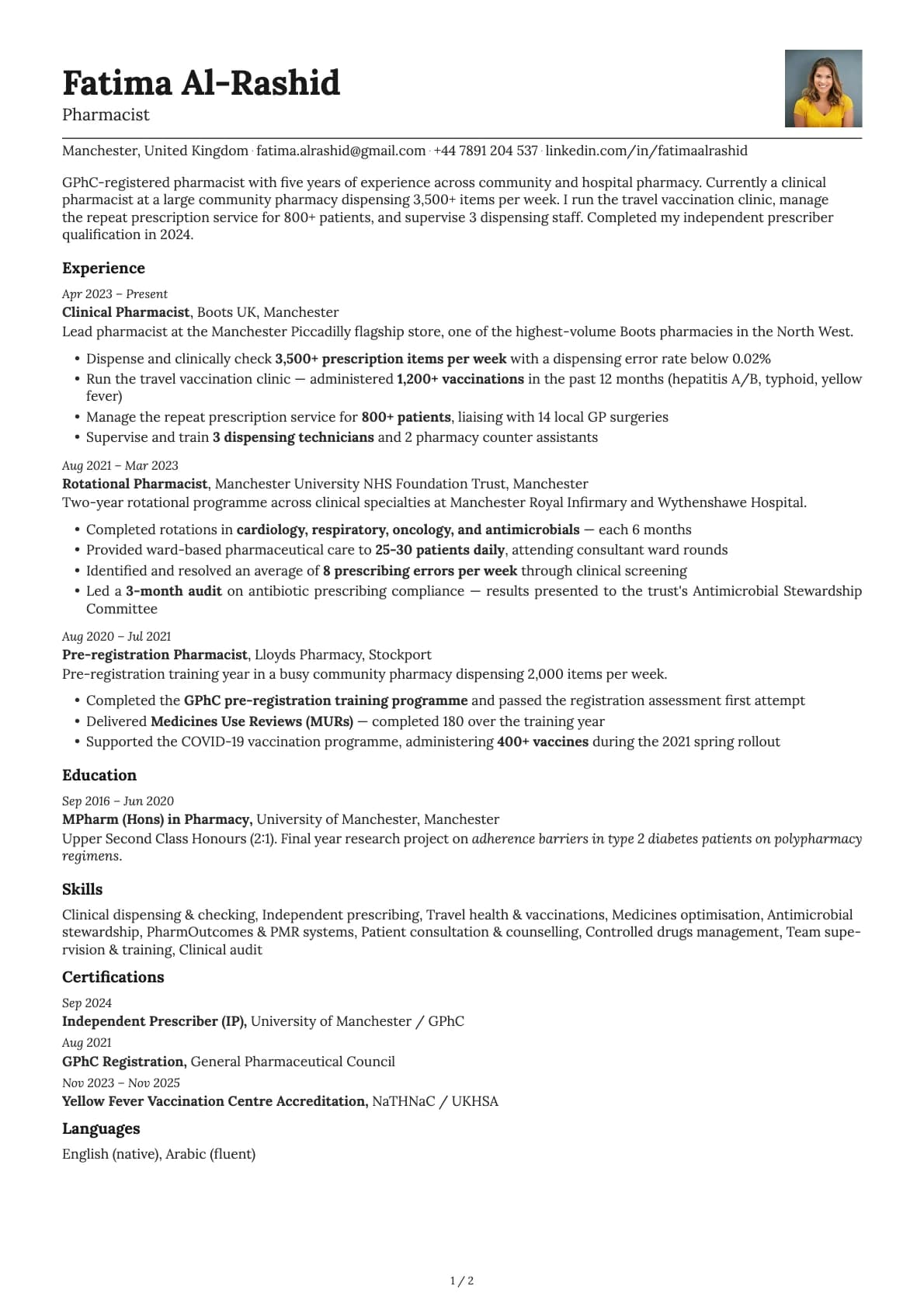
Pharmacist
A pharmacist resume example with community and hospital experience, clinical audit results, and vaccination clinic numbers.
Physician
A physician resume example from a consultant in acute medicine with quality improvement projects, publications, and clinical leadership.
Dentist
A dentist resume example with mixed NHS and private practice experience in London.
Occupational Therapist
An occupational therapist resume example with caseload details, OT assessment tools, and QI project outcomes.
Veterinarian
A veterinarian resume example with 5 years of small animal practice experience.
Speech & Language Therapist
A speech and language therapist resume example with paediatric and adult caseload experience across NHS trusts.
Paramedic
A paramedic resume example with call volumes, clinical competencies, and mentoring experience.
Dietitian / Nutritionist
A dietitian resume example with NHS clinical experience in gastroenterology and community nutrition.
Social Worker
A social worker resume example with caseload numbers, court work, and multi-agency experience.
Dental Hygienist
A dental hygienist resume example with NHS and private practice experience in Edinburgh.
Related articles

AI Is Screening Your Resume Before Any Human Sees It
AI screens most resumes before a human ever reads them. 97.4% of Fortune 500 companies run an ATS. This is what that means for you and what you can do about it.

The Best Resume Builders in 2026, Compared Honestly
Resume.io, Zety, Enhancv, Kickresume, Teal, and Laddro compared honestly: real pricing, free tiers, mobile apps, and where each tool wins. All prices checked in September 2026.

Burnout Recovery: A Real Timeline, Not 'Take a Bubble Bath'
55% of the U.S. workforce is burned out. Recovery takes 3 to 12 months. Here's what that actually looks like, stage by stage.