Retail CV (UK): Format, Profile and a Worked Example
How to write a retail CV for UK shops: the two page format, a personal profile you can copy, before and after bullets, and what to do with no experience.

Laddro Team

British shops are hiring fewer people than they used to. The British Retail Consortium reported on 18 June 2026, using ONS workforce jobs data, that retail employment on a four quarter average had fallen to 2.79 million jobs in the first quarter of 2026, which is 66,000 fewer than a year earlier and 398,000 fewer than a decade before. The same release put the split at 1.27 million full time jobs and 1.52 million part time.
None of that means the shops have stopped recruiting. Part time and flexible work is still the bigger half of the sector, rotas still need covering, and Christmas peak still happens. What it means is that the stack of CVs for a shop floor job in Leeds city centre or a retail park outside Bristol is deeper than it was, and a CV full of "responsible for serving customers" gets skimmed past before the manager reaches the second bullet.
Where a retail CV actually gets read
Worth knowing before you spend an evening on it: the big grocers usually do not start with a CV at all. Aldi's own recruitment site describes the store assistant route as an online application that asks which hours you want, then a possible video interview, then an interview with an Area Manager, and sometimes a session in store watching the job being done. There is no CV upload at the first step. Other large chains run their own online forms in much the same way.
Your CV does the work everywhere else, and that is most of retail: independents, department stores and their concessions, garden centres, pharmacies, franchised food shops, and the agencies that staff seasonal peaks. It is what you attach on Indeed, Reed and Totaljobs, what you upload to the government's Find a job service, and what you hand over the counter when a card goes up in the window. Write it for a busy store manager reading on a phone in the stockroom, because that is often literally who reads it.
The format UK shops expect
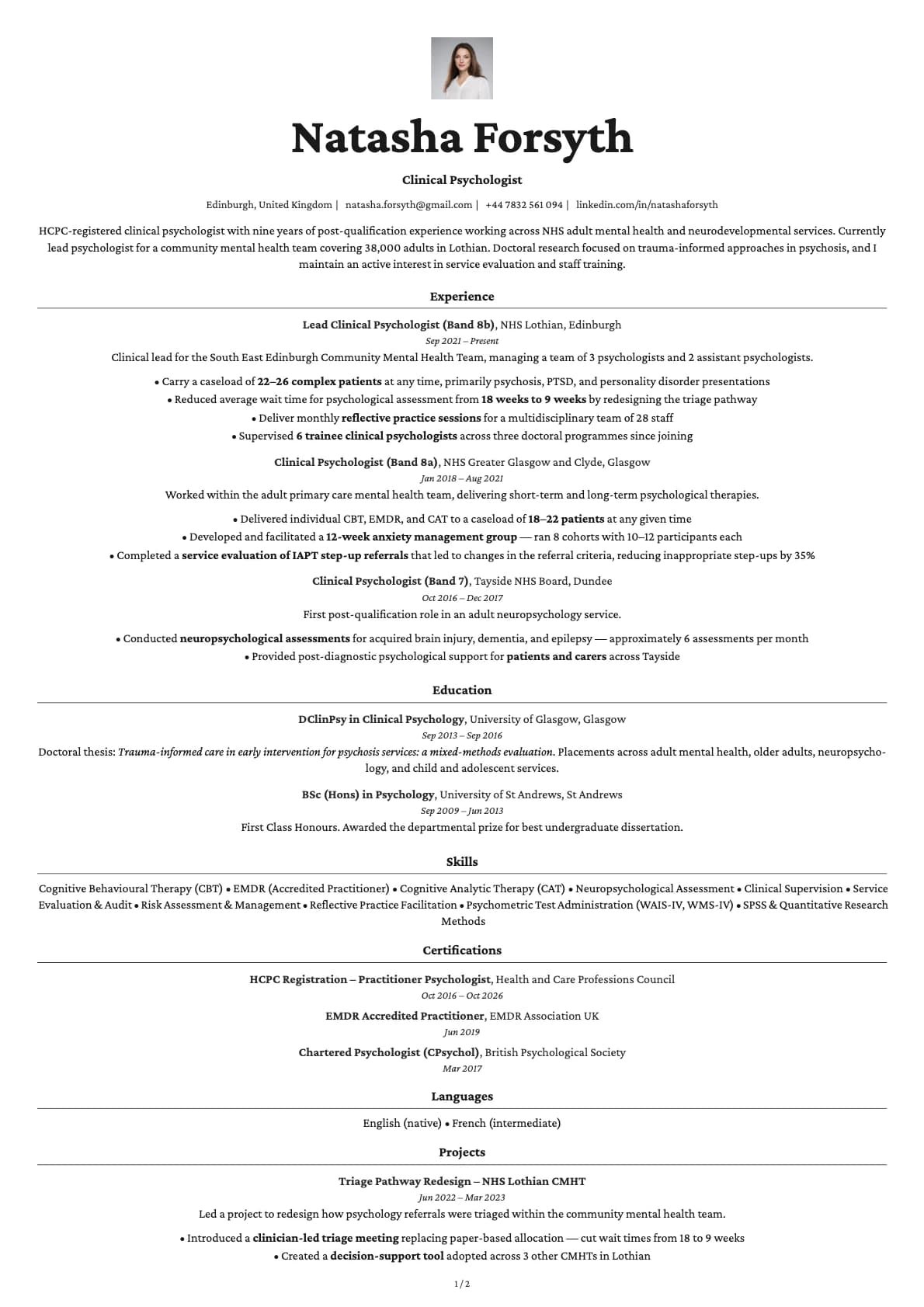
The National Careers Service, the government's own careers guidance, sets out the sections a UK CV needs: contact details, a short introduction, education, work history and references. It also lists what to leave off, and this is where a lot of first CVs go wrong. Do not put your age, date of birth, marital status or nationality on it, and do not print your referees' phone numbers. "References available on request" is the accepted line. A British CV also carries no photograph, which surprises people who have job hunted in Spain, Germany or France.
On length, Reed's retail CV guidance says two pages maximum suits most retail positions, and one clean page is perfectly respectable if you have a year or two behind you. The National Careers Service asks for a standard font such as Arial, Calibri or Times New Roman at size 11 or larger, with headings and bullet points rather than paragraphs.
For retail specifically, this running order works best:
- Name and contact details
- Personal profile, three or four lines
- Availability
- Key skills
- Work history, most recent first
- Education
- References line
The skills block is optional on a general CV. On a retail CV it earns its place, because the manager is scanning for till, stock and age restricted sales before anything else.
Your personal profile, before and after
The National Careers Service describes the introduction as a few short lines that sum up who you are and what you hope to do. Reed suggests three or four sentences covering who you are, what you offer and where you want to go. Most people write something that could belong to anyone.
Before:
Hard working and reliable individual with excellent communication skills, looking for a new challenge in a customer facing role.
That sentence appears on thousands of CVs and tells a manager nothing. Here is the same person, rewritten:
Sales assistant with two years on a busy convenience store floor in Nottingham, trained on till, stock rotation and Challenge 25. Comfortable holding a queue together single handed on a Saturday afternoon and happy to cover early starts and bank holidays. Looking for a permanent shop floor role with a route into supervising.
Same candidate, same job, but now the manager knows what shifts you can work, what you have been trained on and what you want next.
Turn shifts into things you did
The single biggest improvement to a retail CV is deleting the phrase "responsible for" and replacing every duty with something measurable.
Before:
Responsible for serving customers on the till and stocking shelves.
After:
Ran the main till through Saturday trade, serving roughly 300 customers a shift on cash and card, with any discrepancy logged and resolved before cashing up.
Before:
Helped with deliveries.
After:
Worked the 6am delivery three mornings a week, unloading and facing up around 40 cages so the shop was full before the doors opened.
Reed's retail template pushes the same approach, with examples such as achieving 110 percent of monthly sales targets for six consecutive months, or processing over 200 transactions a week at 99 percent accuracy. Use your own numbers, not those. You have more of them than you think: the rota tells you your hours, the till report tells you your transactions, the mystery shopper score gets read out at team briefs, and you know how many cages come off the lorry. If you genuinely never saw a figure, describe the scale honestly instead. A store doing city centre footfall on a December Saturday is a scale a manager understands.
Do not invent numbers. Retail interviews are short and practical, and "tell me about the 110 percent" is exactly the question you will get.
Say when you can work
Availability is not admin, it is a selling point, and in retail it is often the thing that decides between two similar CVs. The National Careers Service sales assistant profile puts typical hours at 37 to 42 a week and says the work involves evenings, weekends and bank holidays on a rota. Aldi's application asks how many hours you want before anything else, with store assistant contracts typically around 25 hours and flexibility from 10 to 40 depending on the store.
So put one line near the top:
Availability: Monday to Sunday including evenings and bank holidays, can start within one week.
If your availability is genuinely limited, say so anyway. Being turned down at CV stage costs you an hour. Being hired onto a rota you cannot work costs you the job.
If you have never worked in a shop
The National Careers Service lists five ways into a sales assistant role: a college course in retail skills or retail knowledge, a foundation or intermediate apprenticeship such as Retailer Level 2, joining as temporary staff during a peak period, volunteering in a charity shop, and applying directly to a retailer. It also states plainly that retail experience is useful but not required for direct applications.
That is your permission slip to lead with skills rather than job titles. Put the skills block above the work history, and mine whatever you have actually done for evidence of the same behaviours: handling money, standing up all day, dealing with someone who is annoyed, keeping a stock cupboard in order, showing up on time in bad weather.
Before:
Volunteered at a charity shop.
After:
Volunteered two Saturdays a month at a charity shop in Sheffield, sorting donations, pricing stock to the shop's guide and covering the till through the lunchtime rush.
School enterprise projects, a paper round, running a market stall, cash handling at a sports club and hospitality shifts all count. Write them as work, with dates.
The skills block, filled in
Name things, do not list adjectives. A useful retail skills section reads more like this:
Till and card payments, cashing up and float reconciliation. EPOS system used at previous store. Stock rotation and date checking. Challenge 25 and age restricted sales. Deliveries, replenishment and facing up. Click and collect, returns and exchanges. Manual handling trained. Conversational Polish.
Two notes on that list. The National Careers Service points out that you have to be over 18 to sell restricted goods such as alcohol, so if you are under 18 the manager needs to know how they will cover tills, and saying it up front is better than it emerging later. And a second language is a real asset in tourist trade areas, from Edinburgh's Princes Street to the West End.
What the job pays, so you can judge the advert
The National Careers Service puts sales assistant pay at around £19,000 a year for starters and £27,000 for experienced staff. The legal floor sits underneath that: from 1 April 2026, GOV.UK lists the National Living Wage at £12.71 an hour for workers aged 21 and over, £10.85 for 18 to 20 year olds and £8.00 for under 18s and apprentices.
Plenty of retailers pay above the floor and advertise it. Aldi's careers site lists store assistant pay at £13.50 an hour rising to £14.47, and £14.88 in London rising to £15.20. If an advert quotes the legal minimum and nothing else, that is useful information about the employer, not just about the job.
Check these before you send it
Reed's research on recruiter turn offs found that more than half named poor spelling and grammar as the number one problem with applications. So the last ten minutes matter as much as the first hour.
- Read the whole thing out loud. You will hear the typos your eyes skip.
- Tailor it. The National Careers Service advice is to pull the skills named in the job advert and make sure your CV shows them.
- Save it as a PDF named something like Aisha-Rahman-CV.pdf, not cv-final-v3.
- Two pages maximum, one is fine.
- No date of birth, no photo, no marital status, no referee phone numbers.
- Availability line present and honest.
- Every bullet starts with what you did.
Retail managers are not looking for a literary CV. They are looking for someone who will turn up, learn the till quickly and be pleasant to a customer at half past five on a Friday. Write the document that makes that obvious in the first ten lines, and the rest of it just has to be tidy.