Resume Builder for Accountants
Build an accounting resume that shows you can handle the numbers and the compliance.
Why Accounting Resumes Need Precision
Accountants deal in precision. Rounding errors, misclassified entries, and vague language are not tolerable in financial reporting, and they should not be tolerable on your resume either.
Hiring managers in finance and accounting are trained to spot inconsistencies. They will notice if your dates do not add up, if your job titles are inflated, or if your bullets are full of generic phrases that could apply to anyone with a calculator. They are also using ATS platforms that scan for very specific certifications, software tools, and regulatory knowledge.
Your resume needs to reflect the same attention to detail that you bring to a balance sheet. Precise credentials, quantified results, and clean formatting will get you further than any creative layout or clever summary statement.
Certifications That Matter
In accounting, your credentials are often the first filter. Many roles require specific certifications, and ATS systems are programmed to search for them. List every relevant certification with its full title and acronym.
- CPA (Certified Public Accountant) with state of licensure
- CMA (Certified Management Accountant)
- ACCA (Association of Chartered Certified Accountants)
- CFA (Chartered Financial Analyst) for roles that bridge accounting and finance
- EA (Enrolled Agent) for tax-focused roles
- CIA (Certified Internal Auditor) for audit positions
If you are working toward a certification, it is acceptable to note that. "CPA candidate, exam completion expected June 2026" shows progress and intent without overstating your credentials.
Place certifications prominently on your resume, either in a dedicated section near the top or immediately after your name in the header. Do not bury them in a bullet point halfway down the page.
Software and Technical Skills
Accounting has gone digital, and firms expect proficiency in specific tools. ATS systems scan for these, so list them explicitly.
Enterprise Systems
- SAP (specify modules: FI, CO, MM)
- Oracle Financials
- NetSuite
- Microsoft Dynamics 365
Accounting Software
- QuickBooks (Desktop and Online)
- Xero
- Sage (50, Intacct)
- FreshBooks
Spreadsheet and Analysis Tools
- Microsoft Excel (specify proficiency: pivot tables, VLOOKUP/XLOOKUP, macros, Power Query, financial modeling)
- Google Sheets
- Power BI or Tableau for reporting and visualization
- SQL for data extraction (increasingly valued)
Tax and Compliance
- TurboTax (for advisory roles)
- Drake Tax
- Thomson Reuters UltraTax
- CCH Axcess
Be specific about your Excel skills. "Proficient in Excel" means nothing to a hiring manager. "Built financial models in Excel using nested IF statements, pivot tables, and Power Query to automate monthly reporting" tells them exactly what you can do.
Quantifying Your Impact
Accountants work with numbers all day, but many forget to put numbers on their resumes. Here is how to translate your daily work into resume-worthy achievements:
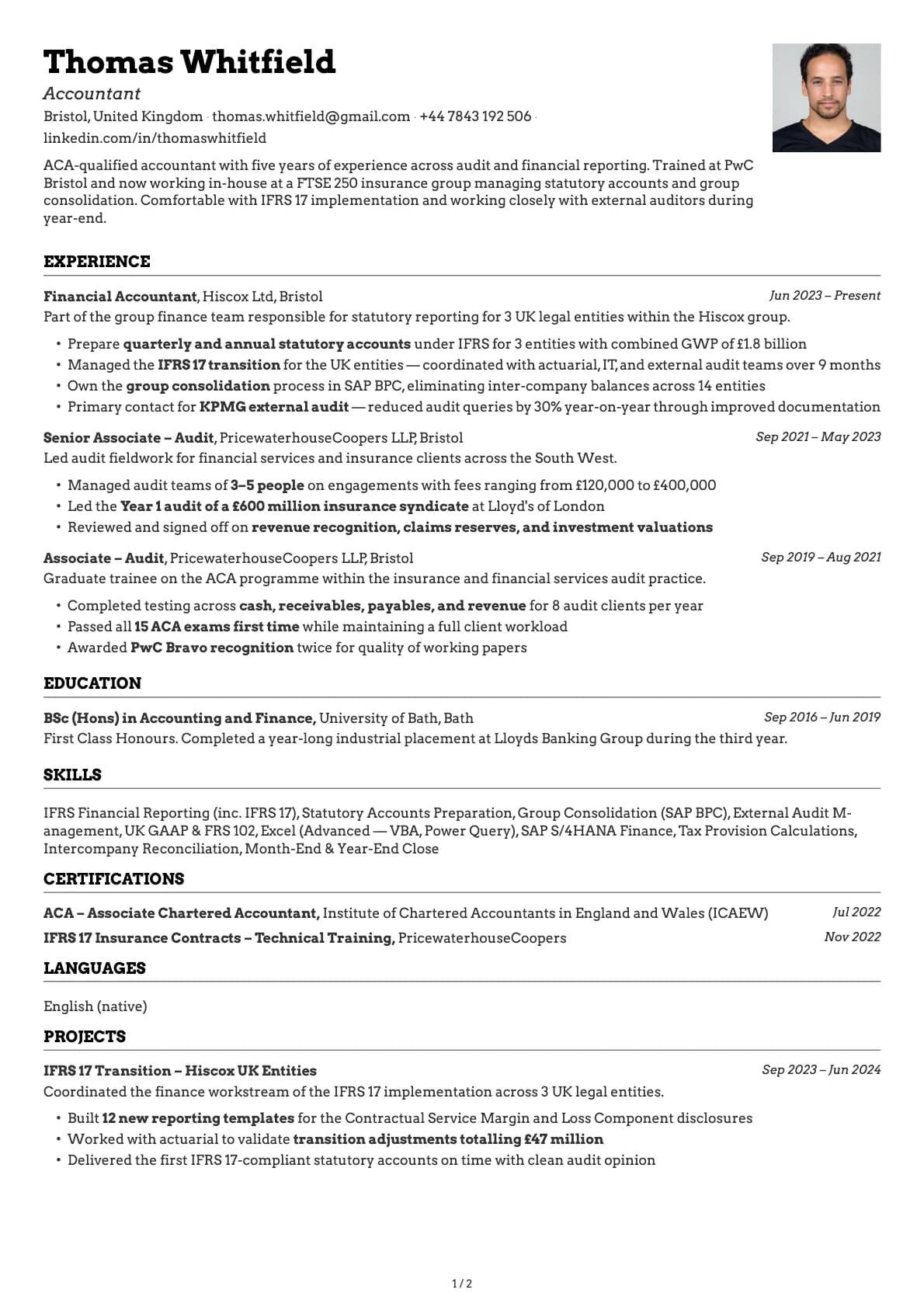
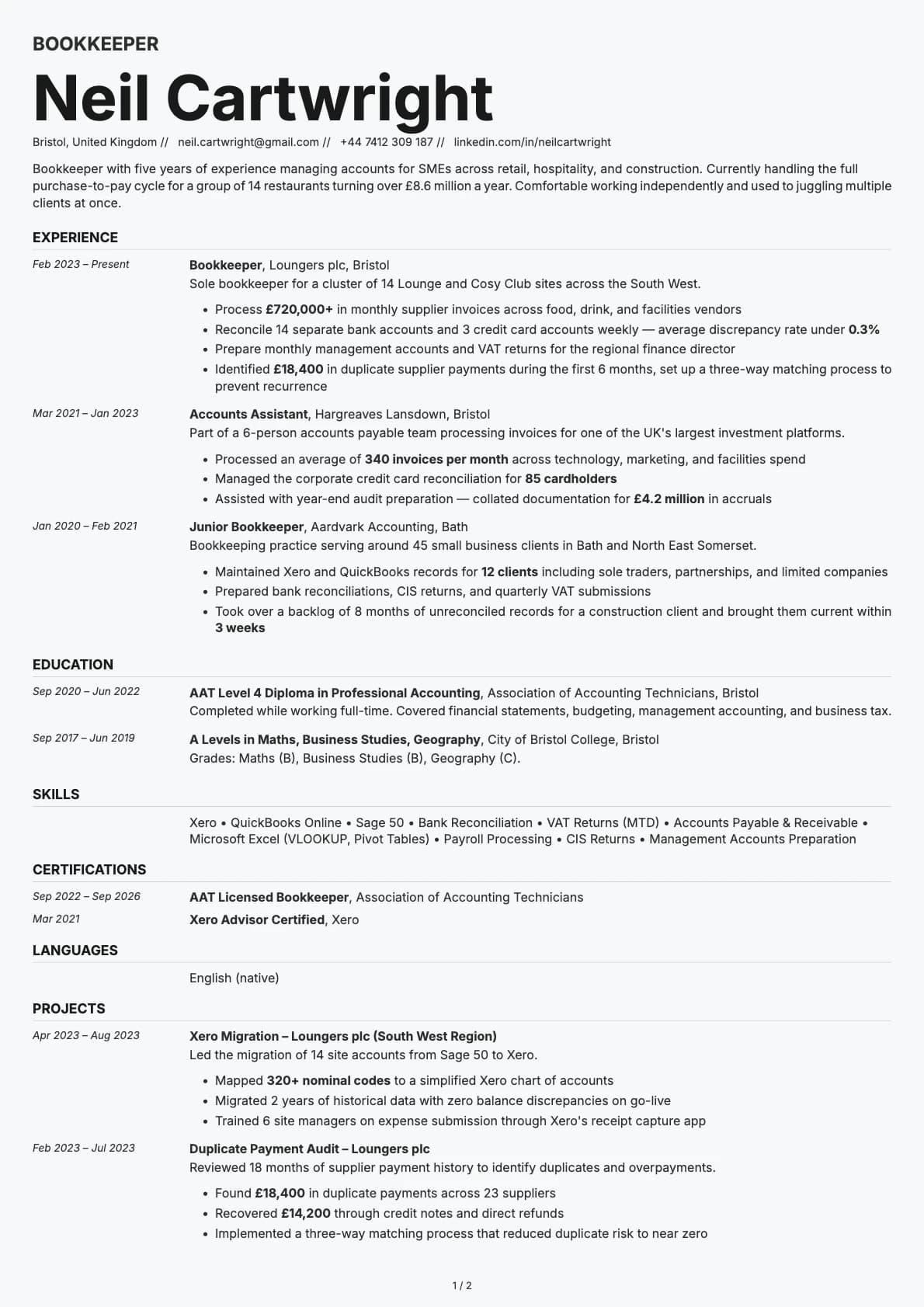
Instead of: "Managed accounts payable" Write: "Managed accounts payable for 200+ vendors, processing an average of $1.2M in monthly invoices with a 99.7% accuracy rate"
Instead of: "Prepared financial reports" Write: "Prepared monthly financial statements for 3 business entities with combined annual revenue of $18M, consistently meeting 5-day close deadlines"
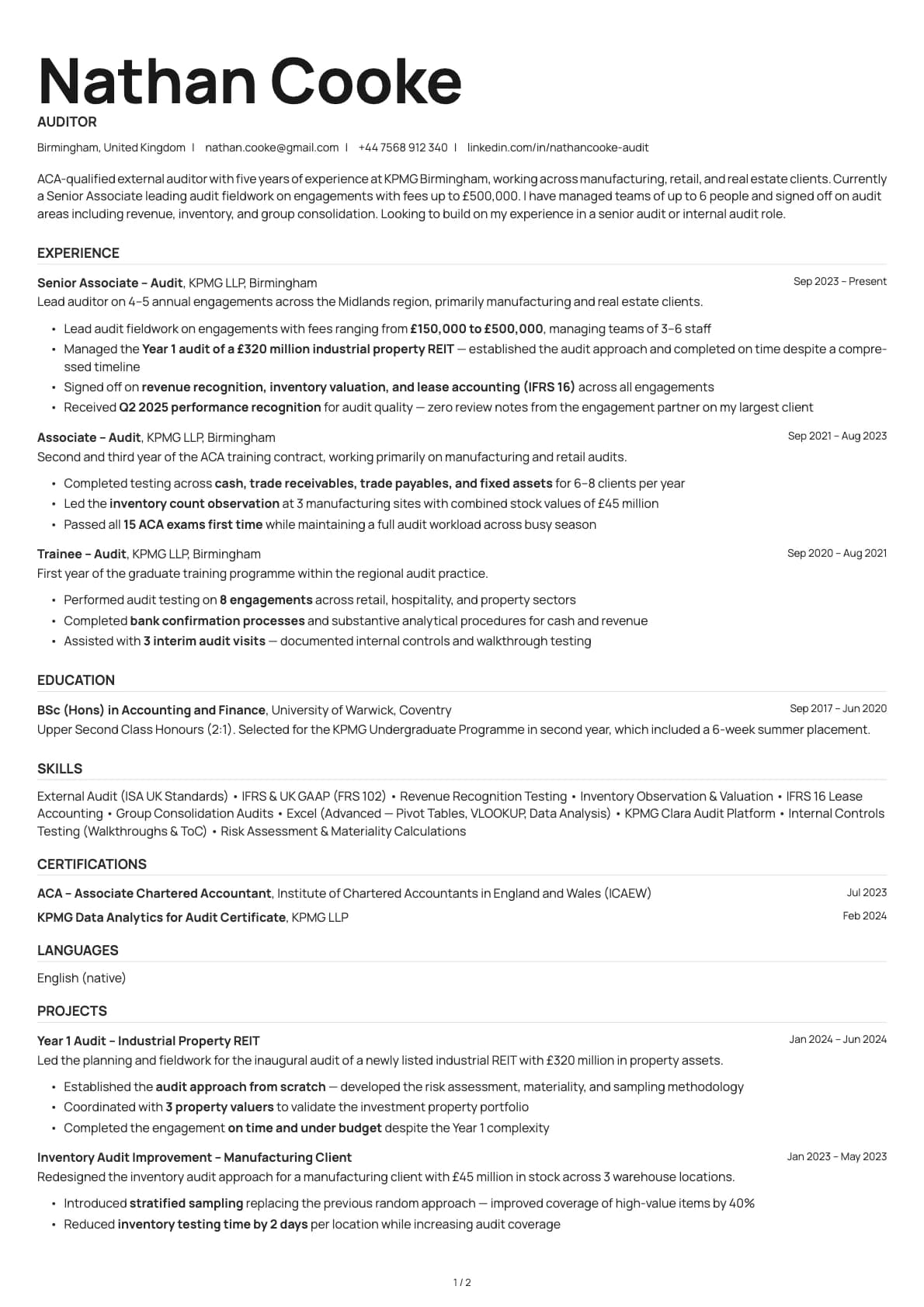
Instead of: "Assisted with audits" Write: "Coordinated external audit preparation for 2 consecutive years, reducing auditor requests by 40% through improved documentation and pre-audit reconciliations"
Instead of: "Handled tax filings" Write: "Prepared and filed federal and state tax returns for 85 clients, identifying an average of $12K in additional deductions per client"
The pattern: scope, scale, and result. How much did you manage, how big was it, and what happened because you did it well?
Regulatory and Compliance Knowledge
Accounting is a regulated profession, and hiring managers want to see that you understand the rules you are working within. Mention relevant standards and regulations:
- GAAP (Generally Accepted Accounting Principles)
- IFRS (International Financial Reporting Standards)
- SOX compliance (Sarbanes-Oxley Act)
- Tax codes relevant to your jurisdiction
- Revenue recognition standards (ASC 606)
- Lease accounting standards (ASC 842)
If you have experience implementing new standards or leading compliance initiatives, that deserves a full bullet point on your resume. "Led the ASC 842 implementation across 3 entities, transitioning 150+ leases to the new standard within 6 months" is a strong line.
Common Mistakes on Accounting Resumes
Vague descriptions of routine tasks. "Performed reconciliations" is the accounting equivalent of "did my job." Specify what you reconciled, how many accounts, and what the dollar values were.
Missing certifications or unclear status. If you have a CPA, say so clearly. If you are working toward one, state your timeline. Do not leave the reader guessing.
Overlooking soft skills. Accounting is not just about spreadsheets. Client communication, cross-departmental collaboration, and the ability to explain financial concepts to non-financial stakeholders are all valuable. Work these into your experience bullets naturally.
Generic formatting. Accounting resumes should be conservative and clean. Avoid flashy designs, colors, or unconventional layouts. A well-structured, traditional format signals professionalism and attention to detail, both qualities every employer values in an accountant.
Not mentioning industry experience. Accounting in healthcare is different from accounting in manufacturing or SaaS. If you have industry-specific experience, highlight it. Many firms and companies seek accountants who already understand their sector.
How Laddro Helps You Build an Accounting Resume
Laddro's resume builder takes the formatting work off your plate so you can focus on getting the content right.
ATS-tested templates. Every template is designed to pass through the ATS platforms used by accounting firms, financial institutions, and corporate finance departments. Your credentials will land where they should.
Smart prompts for quantification. Laddro's AI nudges you to add numbers and context to your experience bullets. It helps you move from "managed budgets" to "managed a $4.5M operating budget with 98% forecast accuracy."
Certification and skills sections built in. Laddro's templates include dedicated spaces for certifications, technical skills, and regulatory knowledge, so you do not have to restructure a generic template to fit accounting-specific content.
Easy version management. Applying to a Big Four firm and a corporate controller role at the same time? Duplicate your resume and adjust the emphasis for each. Laddro makes maintaining multiple tailored versions simple.
Ready to Build Your Accounting Resume?
Your work is built on precision. Your resume should be too. Start building your accounting resume with Laddro and create a document that reflects the same rigor you bring to your financial work.
Looking for ideas? Browse business and finance resume examples to see how other accountants and finance professionals have presented their experience, certifications, and results.