Bookkeeper Resume Example
A bookkeeper resume example with Xero, Sage, and QuickBooks experience across hospitality and retail SMEs.

Laddro Team
Free to use. No account needed to start.
Free to use. No account needed to start.
Overview
Bookkeeper resumes often undersell the role. "Maintained financial records" is technically accurate but makes the job sound like data entry. Good bookkeeping is about accuracy at scale, catching errors before they become problems, and keeping multiple sets of books running cleanly month after month.
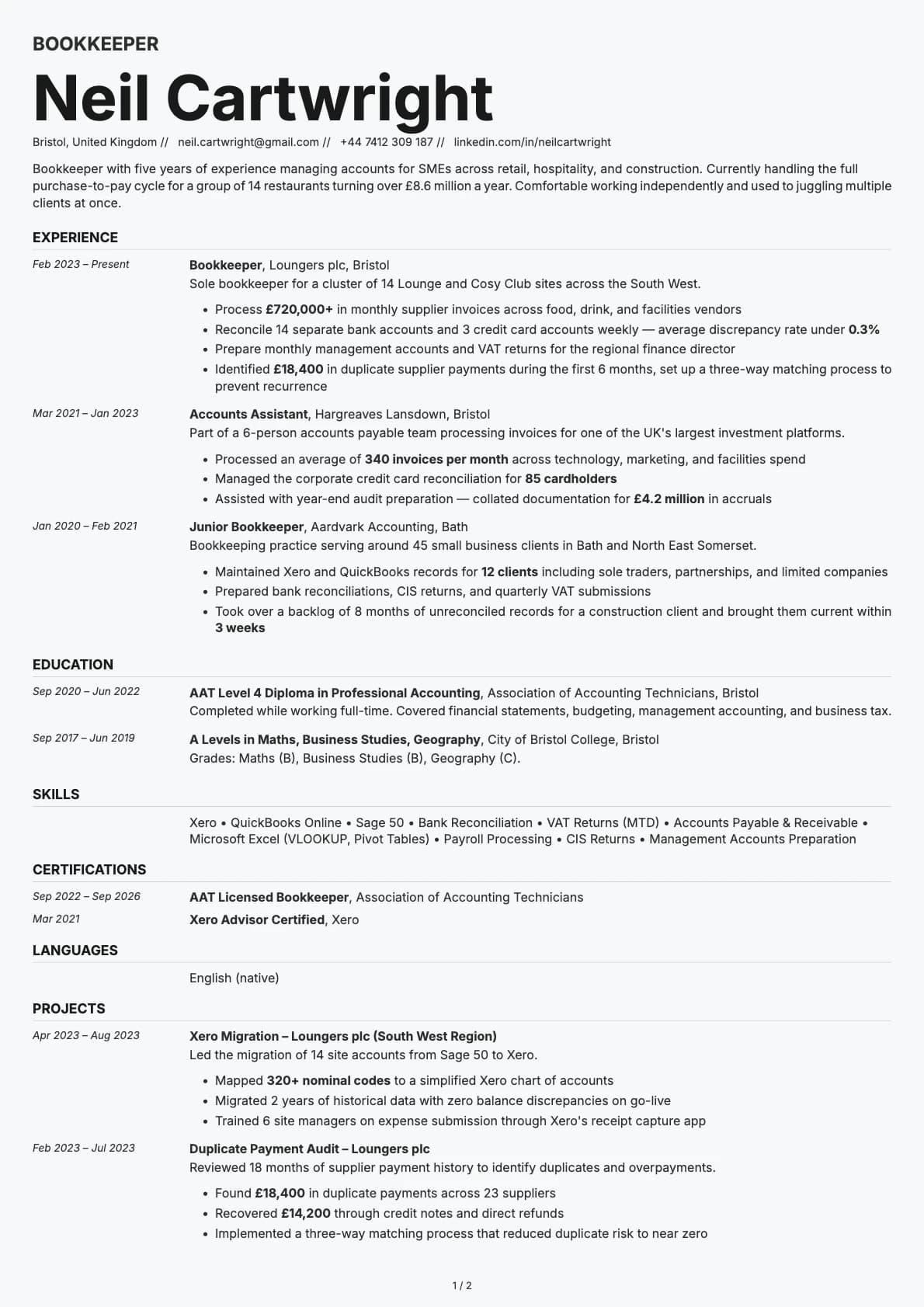
This resume belongs to Neil Cartwright, a bookkeeper with five years of experience across retail, hospitality, and construction clients. He currently manages the full purchase-to-pay cycle for a group of 14 restaurants at Loungers plc, handling £720,000+ in monthly supplier invoices. Before that, he worked at Hargreaves Lansdown processing invoices for one of the UK's largest investment platforms.
What makes this resume work is the numbers. Invoice volumes, bank account counts, discrepancy rates, and a £18,400 duplicate payment catch. Let us go through how you can present your bookkeeping experience the same way.
Summary: scope, scale, and independence
Bookkeeping hiring managers want to know: how many clients or entities do you manage? What software do you use? Can you work without constant supervision?
Neil's summary:
Bookkeeper with five years of experience managing accounts for SMEs across retail, hospitality, and construction. Currently handling the full purchase-to-pay cycle for a group of 14 restaurants turning over £8.6 million a year. Comfortable working independently and used to juggling multiple clients at once.
Short and direct. The "14 restaurants" and "£8.6 million" immediately communicate scale. The "working independently" line matters because many bookkeeping roles are sole-charge positions. If you work without a team of accountants sitting next to you, say so.
For yours: State your years of experience and sectors. Name the number of clients or entities you handle. Give a turnover or transaction volume figure.
Experience: volumes and accuracy
Bookkeeping is a precision role. The numbers that matter are transaction volumes, reconciliation accuracy, and how quickly you spot problems.
Neil's current role at Loungers:
Process £720,000+ in monthly supplier invoices across food, drink, and facilities vendors
Reconcile 14 separate bank accounts and 3 credit card accounts weekly, average discrepancy rate under 0.3%
Identified £18,400 in duplicate supplier payments during the first 6 months, set up a three-way matching process to prevent recurrence
The duplicate payment bullet is the standout. It shows Neil is not just processing what lands on his desk. He is checking the work that came before him and finding mistakes. That £18,400 figure is specific enough to be believable and large enough to be impressive.
The formula: What you process + How much of it + Your accuracy or error-catch rate.
"Processed invoices" becomes "Process £720,000+ in monthly supplier invoices across food, drink, and facilities vendors." "Did bank reconciliations" becomes "Reconcile 14 bank accounts and 3 credit card accounts weekly with a discrepancy rate under 0.3%."
Software: the most important section on a bookkeeper resume
This is not an exaggeration. The accounting software you know determines whether you get shortlisted. A small business running Xero wants someone who knows Xero. A construction firm on Sage wants Sage experience. If you do not name the software, you are invisible.
Neil lists Xero, QuickBooks Online, and Sage 50. Three platforms, three different client bases he can serve. He also has "Xero Advisor Certified" as a certification, which tells an employer he has passed Xero's own training programme.
If you are a bookkeeper, your skills section should lead with software. Name every accounting platform you have used in a real work environment (not just a training course). Then include related tools: Excel with specific functions (VLOOKUP, pivot tables), payroll software, MTD-compatible VAT software, and any ERP systems.
The AAT qualification and what it signals
Neil holds an AAT Level 4 Diploma and is an AAT Licensed Bookkeeper. In the UK bookkeeping world, AAT is the gold standard qualification. It tells an employer you have formal training, you are subject to a code of professional ethics, and you carry professional indemnity insurance.
If you have AAT Level 2, 3, or 4, list it prominently. If you are studying for it, list it as in progress with an expected completion date. Many bookkeeping job ads specifically ask for AAT, so having it (or working towards it) is a genuine advantage.
If you came into bookkeeping through a different route (like Neil's A-levels and then straight into a junior bookkeeping role), that is fine too. The practical experience and software knowledge often matter more than the academic path. But the AAT qualification on top of experience is a strong combination.
Projects: migrations and audits
Neil includes two projects: a Xero migration and a duplicate payment audit. Both are excellent examples of work that goes beyond daily bookkeeping.
The Xero migration:
Mapped 320+ nominal codes to a simplified Xero chart of accounts. Migrated 2 years of historical data with zero balance discrepancies on go-live. Trained 6 site managers on expense submission through Xero's receipt capture app.
Software migrations are one of the most valuable things a bookkeeper can do. If you have ever moved a client from Sage to Xero, or from spreadsheets to QuickBooks, that project deserves its own section. Include the number of records migrated, any accuracy checks you ran, and whether you trained the end users.
Mistakes bookkeepers make on their resume
Not naming the software. This is the single biggest mistake. "Used accounting software" is useless. "Maintained Xero and QuickBooks records for 12 clients" is useful. Name the platform every time.
Saying "maintained financial records" and nothing else. That describes every bookkeeper who ever lived. What records? For how many clients? With what turnover? How often did you reconcile? Add the details.
Forgetting VAT and payroll. If you prepare VAT returns (especially under Making Tax Digital), say so. If you run payroll, state how many employees. These are specific, in-demand skills. Many small businesses need a bookkeeper who can handle VAT and payroll without involving an accountant.
Ignoring the construction industry scheme. If you have prepared CIS returns (like Neil did at Aardvark Accounting), list it explicitly. CIS bookkeeping is a specialism. Construction companies actively seek bookkeepers who understand CIS deductions, and it is a keyword that will get you noticed.
Leaving out error-catch stories. Finding duplicate payments, catching a coding error, or clearing an 8-month backlog (as Neil did for a construction client) are the stories that make a bookkeeper resume memorable. If you saved someone money or fixed someone's mess, put it on the resume.
One more thought
Bookkeeping is a role where trust matters more than almost anything else. You are handling other people's money. Your resume should signal reliability through precision: accurate dates, specific numbers, named software, and clean formatting. Neil uses Zinc, a no-fuss single-column template. If your resume itself is tidy and error-free, it tells the hiring manager your books probably are too.
Build your own version
Open this layout in the builder and swap in your own details. It takes a few minutes.
Free to use. No account needed to start.
Was this resume example helpful?
Rate this example to help us create better content for you.
4.7 average from 108 ratingsRelated resume examples
Accountant
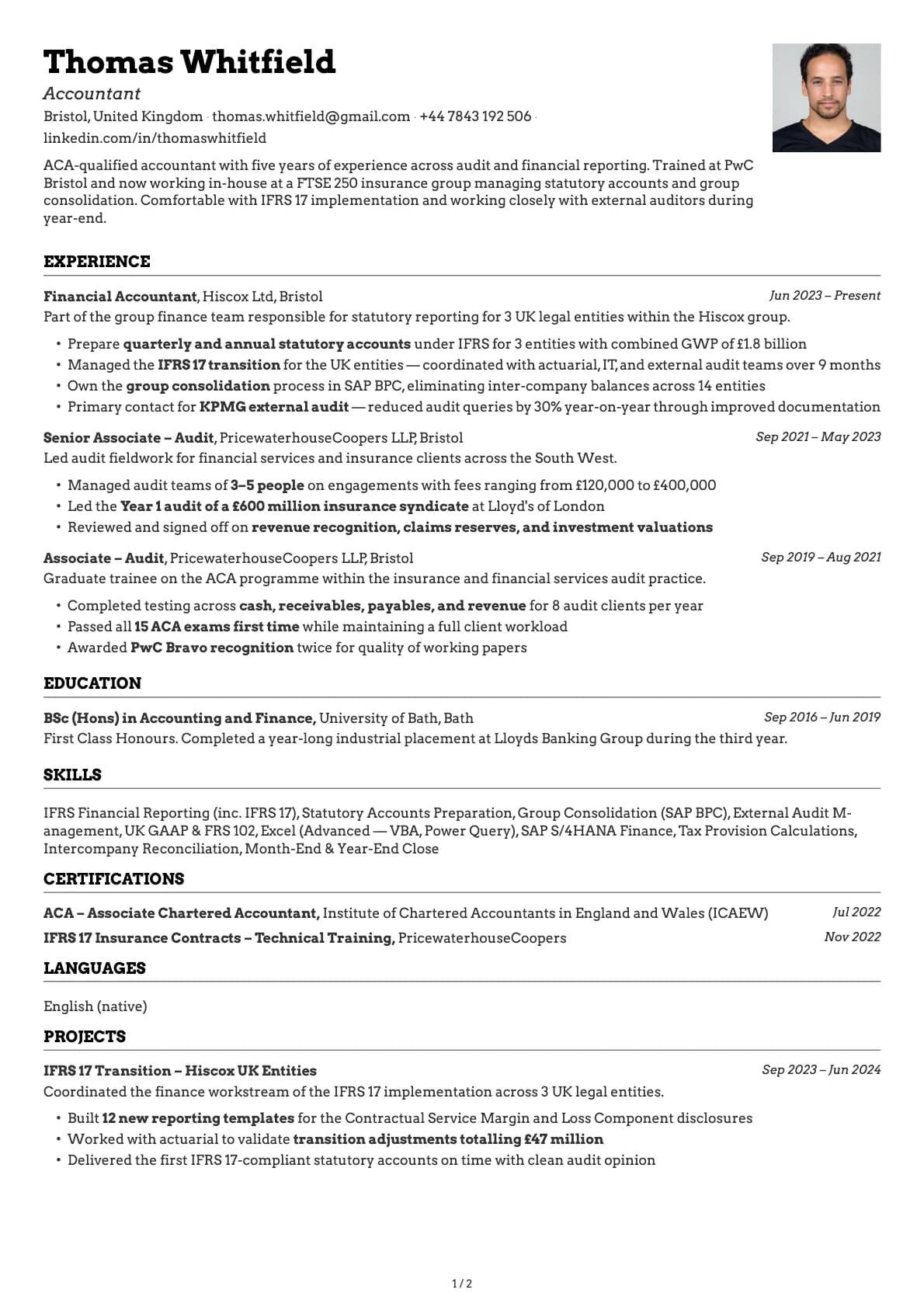
An ACA-qualified accountant resume example with Big 4 audit experience and FTSE 250 in-house reporting.
Financial Analyst
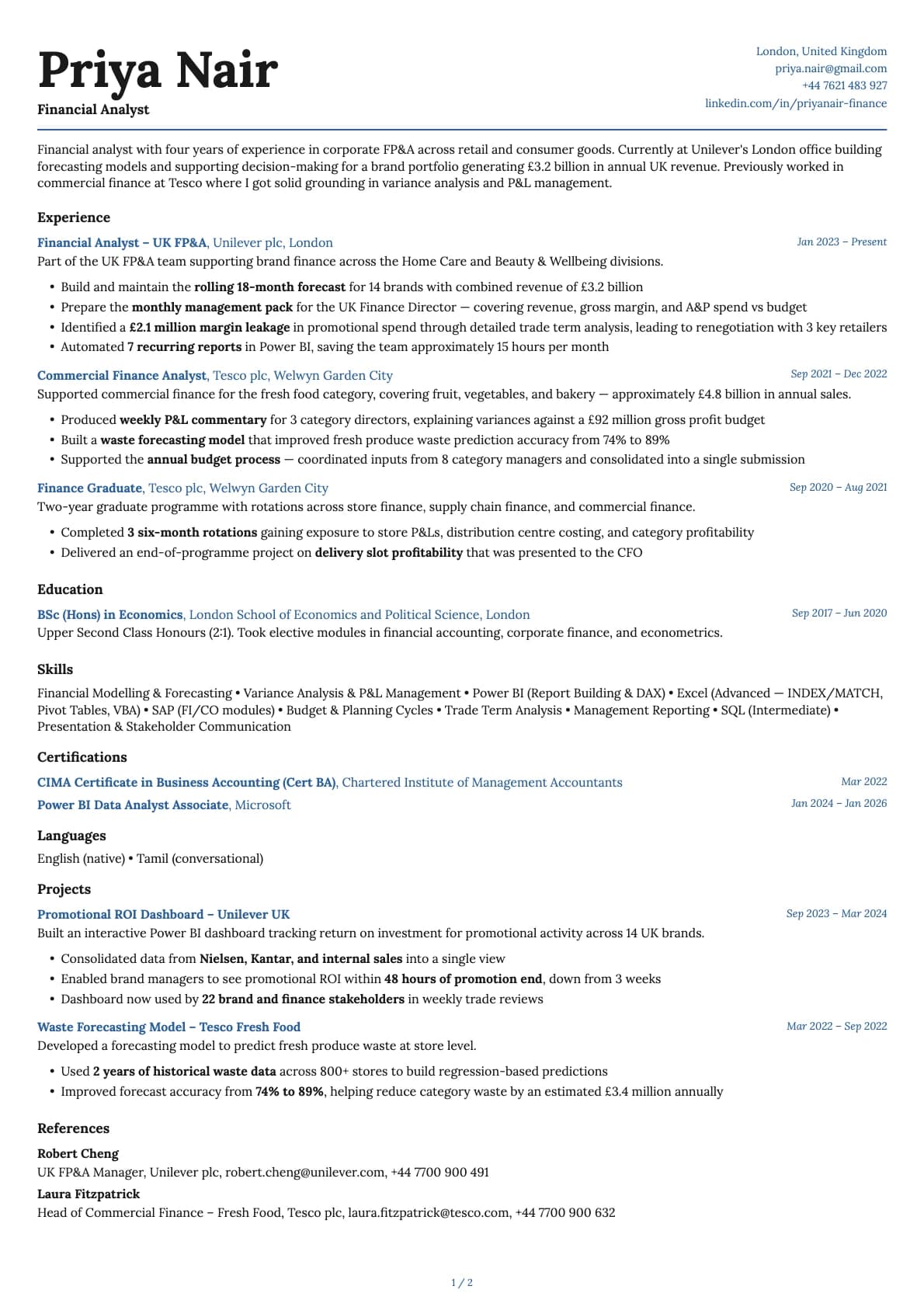
A financial analyst resume example from FP&A roles at Unilever and Tesco. Learn how to present forecasting models, variance analysis, and business impact.
Investment Banker
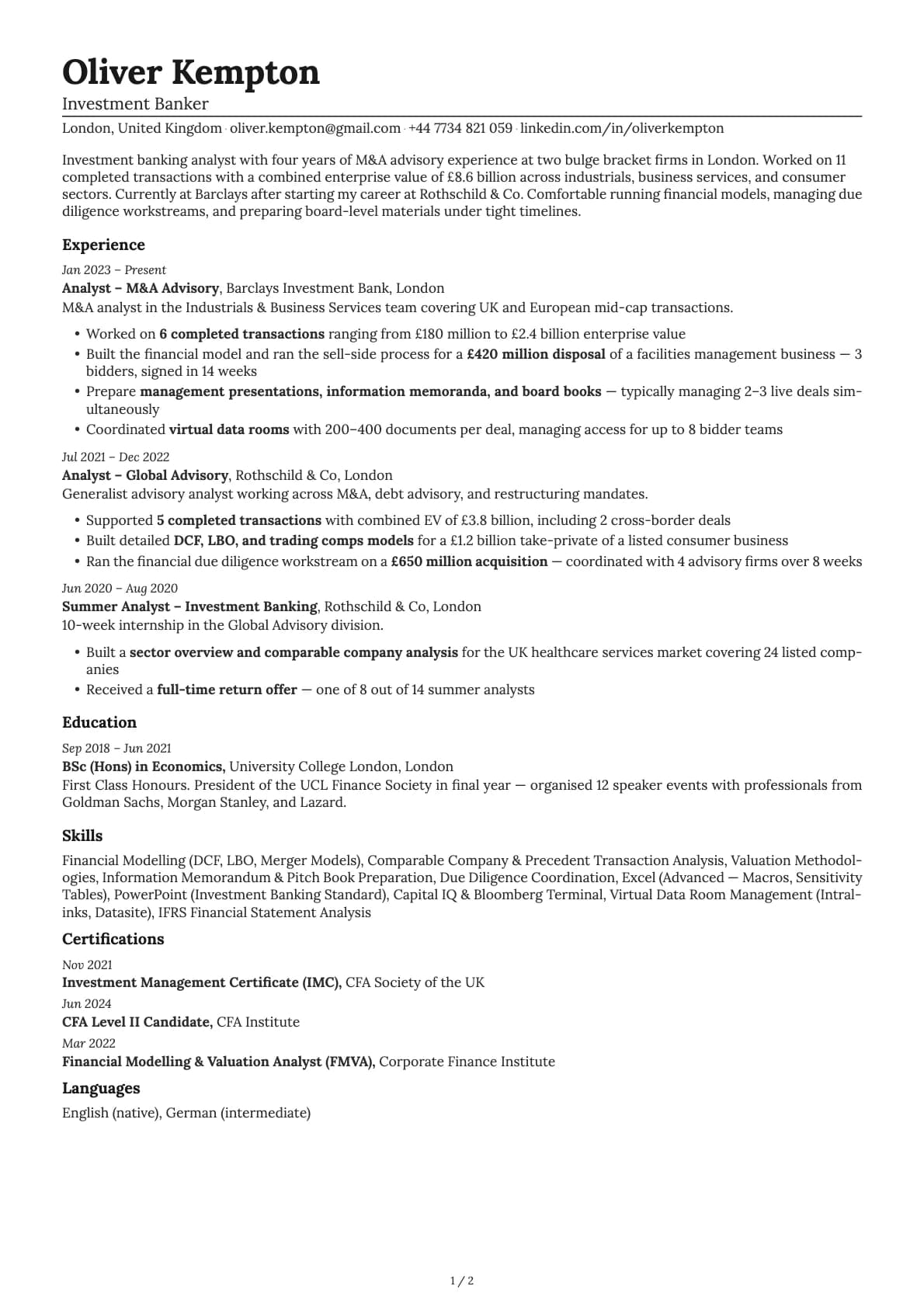
An investment banker resume example with M&A deal values, financial modelling, and bulge bracket experience.
Management Consultant
A management consultant resume example from McKinsey with client impact numbers, engagement details, and business development wins.
Business Analyst
A business analyst resume example with requirements documentation, stakeholder workshops, and process redesign experience across e-commerce and grocery.
Auditor
An ACA-qualified auditor resume example from KPMG with engagement fee ranges, team management, and ISA Standards experience across manufacturing and real.
Tax Advisor
A tax advisor resume example with CTA qualification and 9 years of corporate tax experience across Big Four and in-house roles.
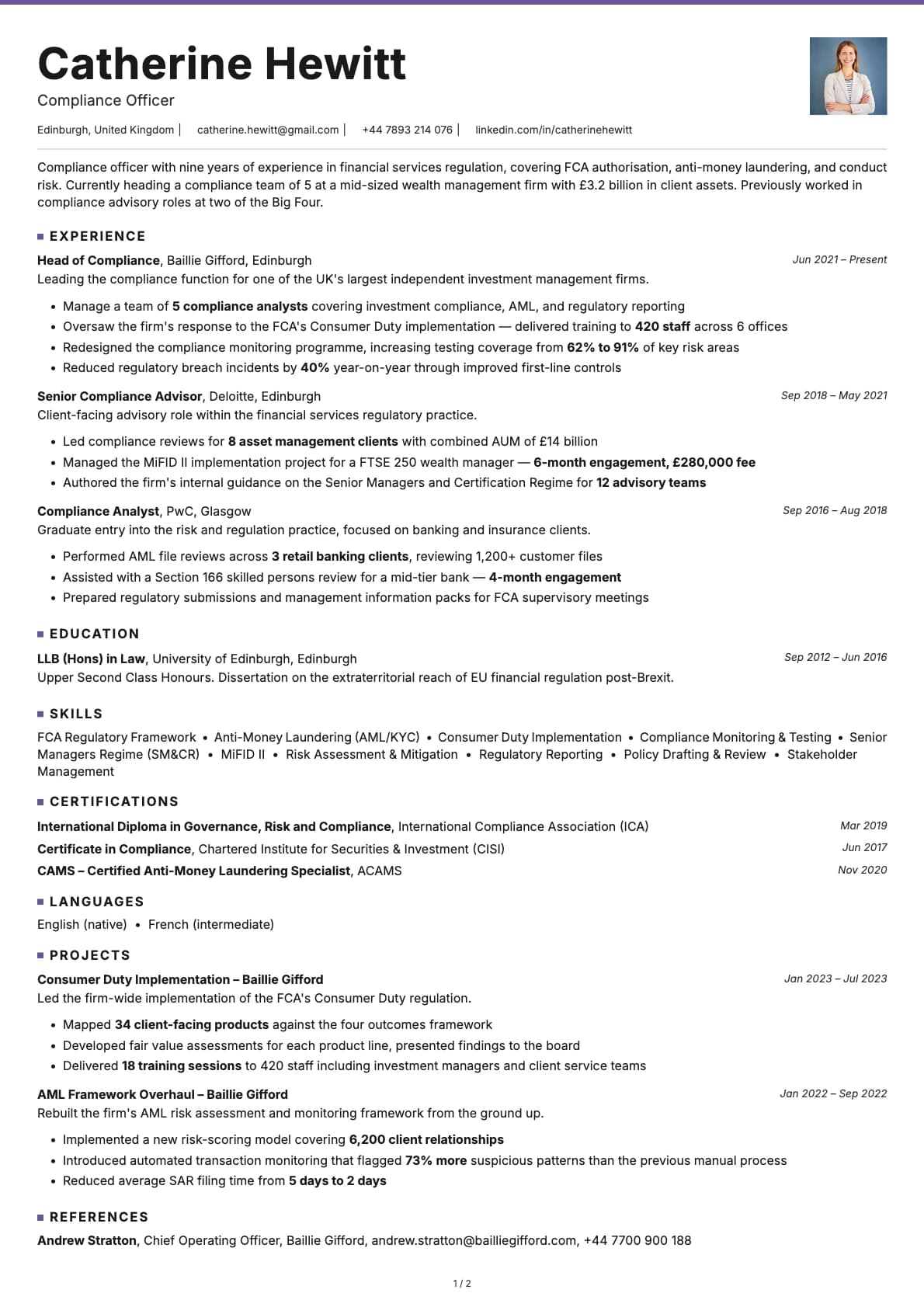
Compliance Officer
A compliance officer resume example with 9 years in financial services regulation at Baillie Gifford, Deloitte, and PwC.
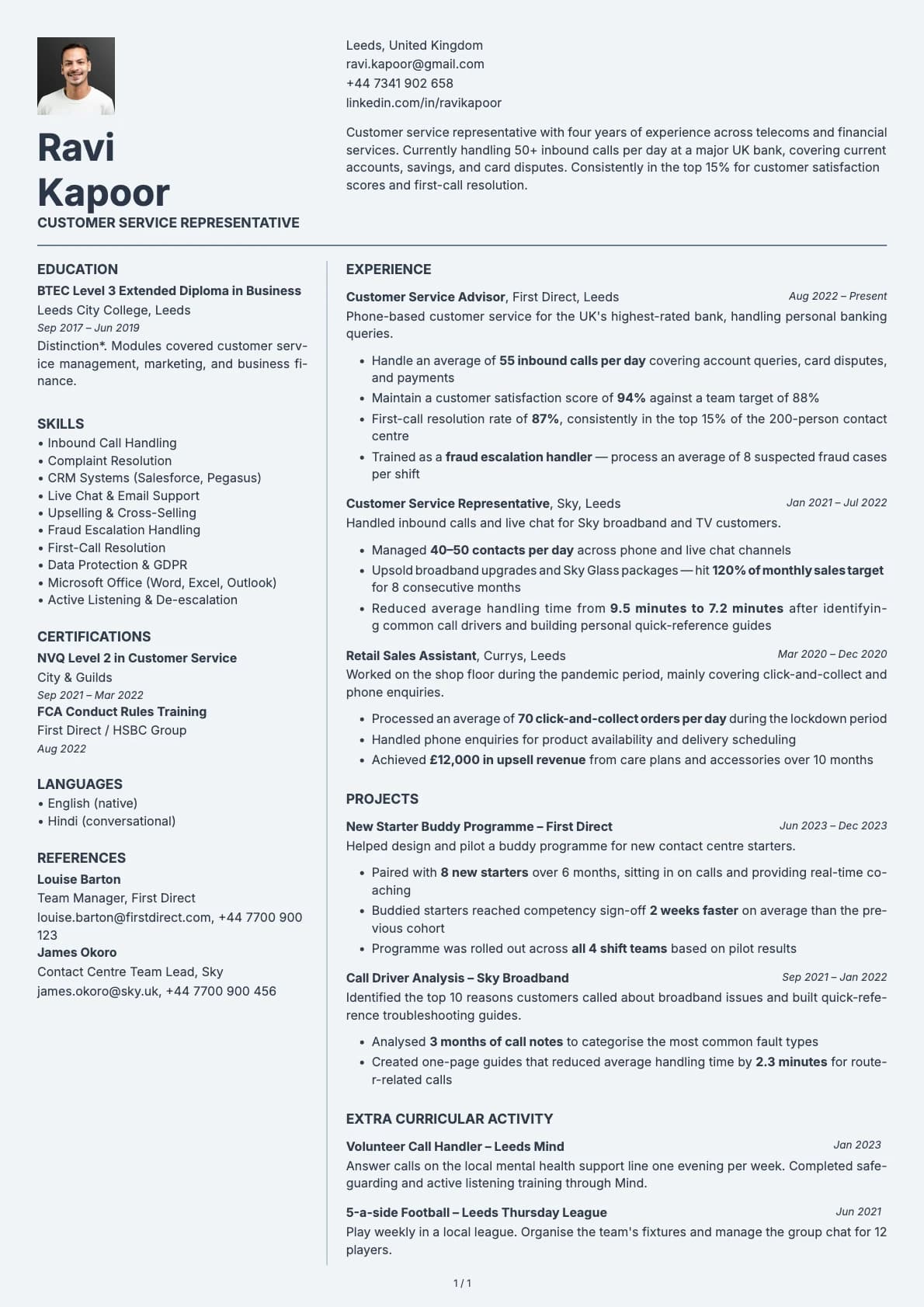
Customer Service Representative
A customer service representative resume example with experience at First Direct and Sky.
Related articles

AI Is Screening Your Resume Before Any Human Sees It
AI screens most resumes before a human ever reads them. 97.4% of Fortune 500 companies run an ATS. This is what that means for you and what you can do about it.

The Best Resume Builders in 2026, Compared Honestly
Resume.io, Zety, Enhancv, Kickresume, Teal, and Laddro compared honestly: real pricing, free tiers, mobile apps, and where each tool wins. All prices checked in September 2026.

Burnout Recovery: A Real Timeline, Not 'Take a Bubble Bath'
55% of the U.S. workforce is burned out. Recovery takes 3 to 12 months. Here's what that actually looks like, stage by stage.