Supply Chain Manager Cover Letter Example
A supply chain manager cover letter highlighting logistics optimization, vendor negotiations, and end-to-end fulfillment.
Free to use. No account needed to start.
Free to use. No account needed to start.
Overview
Supply chain manager cover letters need to demonstrate strategic thinking backed by operational results. Anyone can write "I have experience in end-to-end supply chain management." The letters that stand out are the ones where the candidate names the network they managed, the savings they delivered, and the improvements they drove with data.
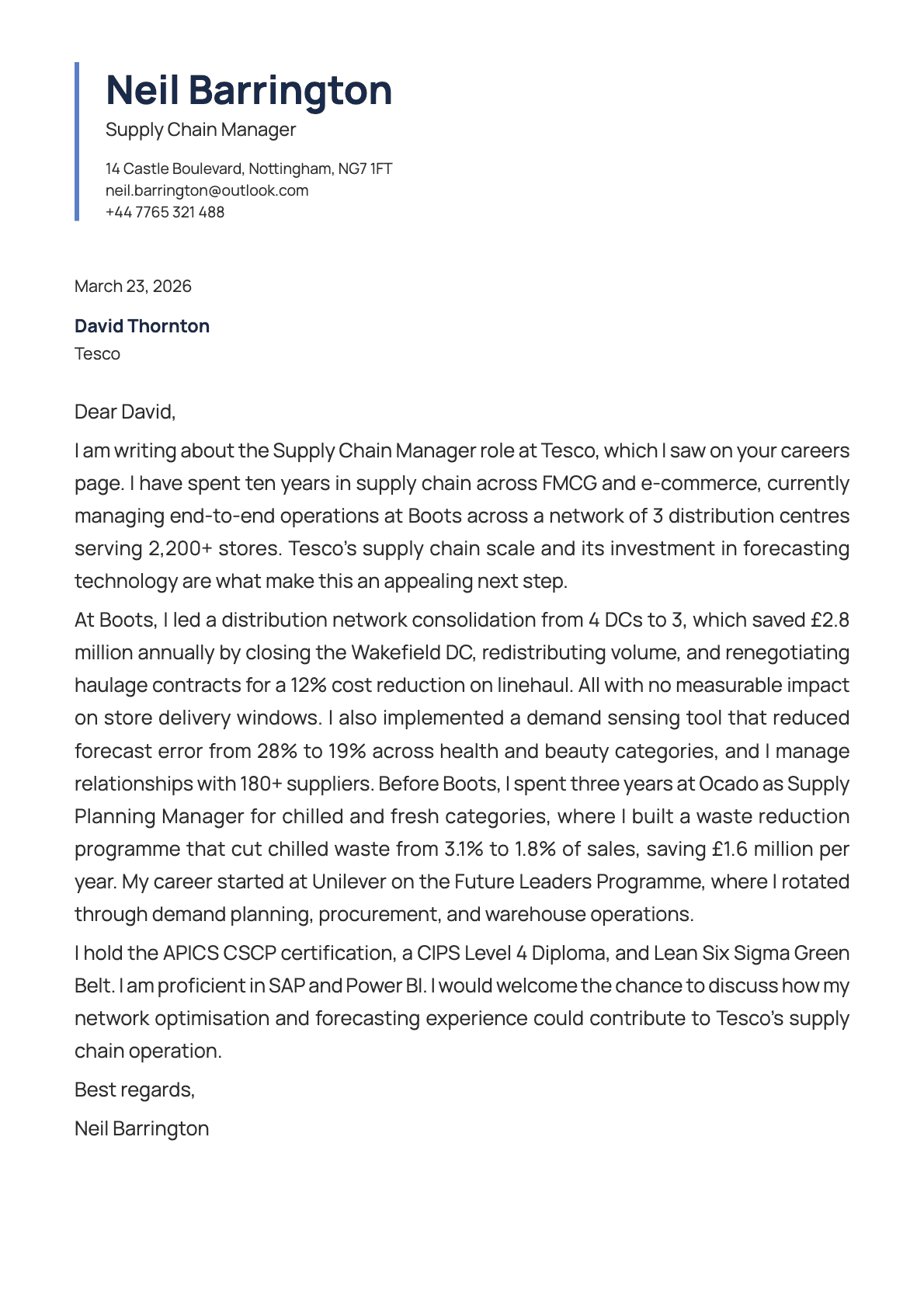
This cover letter is from Neil Barrington, applying for a Supply Chain Manager role at Tesco. He currently manages end-to-end operations at Boots across a network of 3 distribution centres serving 2,200+ stores. Let us look at what makes this letter work.
Opening with network scope
Neil starts by stating his experience (ten years in FMCG and e-commerce), his current employer (Boots), and the scale of his operation: 3 distribution centres serving 2,200+ stores. He then names what interests him about Tesco: the supply chain scale and investment in forecasting technology.
For supply chain roles, the scope of your current operation is the most important context to establish early. Number of DCs, number of stores or customers served, and the geographic reach of your network. These tell the hiring manager whether you are operating at the right level.
The DC consolidation project
The standout achievement in this letter is the distribution network consolidation from 4 DCs to 3. The results: £2.8 million saved annually by closing the Wakefield DC, redistributing volume, and renegotiating haulage contracts for a 12% cost reduction on linehaul. All with no measurable impact on store delivery windows.
That last sentence is critical. Any supply chain manager can cut costs by cutting service. Cutting costs while maintaining service levels is what good supply chain management looks like. This detail tells the reader that Neil makes decisions based on the full picture, not just the cost line.
For your own letter, if you have led a network optimization, DC closure, or distribution redesign, describe the savings and the service impact. Both numbers matter.
Demand sensing and forecast improvement
Implementing a demand sensing tool that reduced forecast error from 28% to 19% across health and beauty categories shows technical capability. Forecasting is one of the most impactful levers in supply chain management, and improving forecast accuracy by 9 percentage points translates directly to less waste, fewer stockouts, and better working capital.
If you have implemented or improved forecasting tools, planning systems, or demand management processes, quantify the accuracy improvement. A percentage point reduction in forecast error can be worth millions at scale.
Earlier career at Ocado and Unilever
The Ocado detail adds specificity: a chilled waste reduction programme that cut waste from 3.1% to 1.8% of sales, saving £1.6 million per year. Waste reduction in fresh and chilled supply chains is one of the hardest problems in the industry, and achieving a measurable improvement demonstrates real capability.
Starting at Unilever on the Future Leaders Programme and rotating through demand planning, procurement, and warehouse operations gives Neil's career story a strong foundation. Graduate programmes at major FMCG companies are well-respected in the supply chain world, and the rotation shows breadth of exposure.
Certifications
APICS CSCP, CIPS Level 4 Diploma, and Lean Six Sigma Green Belt. For supply chain management roles, these are strong credentials. The CSCP in particular is internationally recognized and shows depth of supply chain knowledge. Proficiency in SAP and Power BI rounds out the technical profile.
Template choice
This letter uses the Onyx template, which gives it a strong and professional appearance. For supply chain roles at major retailers, the presentation should feel polished and data-driven. Onyx delivers that without being overly corporate.
Was this cover letter example helpful?
Rate this example to help us create better content for you.
4.8 average from 89 ratingsBuild your own version
Open this layout in the builder and swap in your own details. It takes a few minutes.
Free to use. No account needed to start.
Related cover letter examples
Related articles

AI Is Screening Your Resume Before Any Human Sees It
AI screens most resumes before a human ever reads them. 97.4% of Fortune 500 companies run an ATS. This is what that means for you and what you can do about it.

The Best Resume Builders in 2026, Compared Honestly
Resume.io, Zety, Enhancv, Kickresume, Teal, and Laddro compared honestly: real pricing, free tiers, mobile apps, and where each tool wins. All prices checked in September 2026.

Burnout Recovery: A Real Timeline, Not 'Take a Bubble Bath'
55% of the U.S. workforce is burned out. Recovery takes 3 to 12 months. Here's what that actually looks like, stage by stage.