Supply Chain Manager Resume Example
A supply chain manager resume example with 10 years of FMCG experience at Boots, Ocado, and Unilever.

Laddro Team
Free to use. No account needed to start.
Free to use. No account needed to start.
Overview
Supply chain manager resumes live and die by numbers. Unlike some professions where impact is hard to measure, supply chain work has clear metrics: cost savings, service levels, forecast accuracy, waste reduction. If your resume does not include these, you are leaving your strongest selling points off the page.
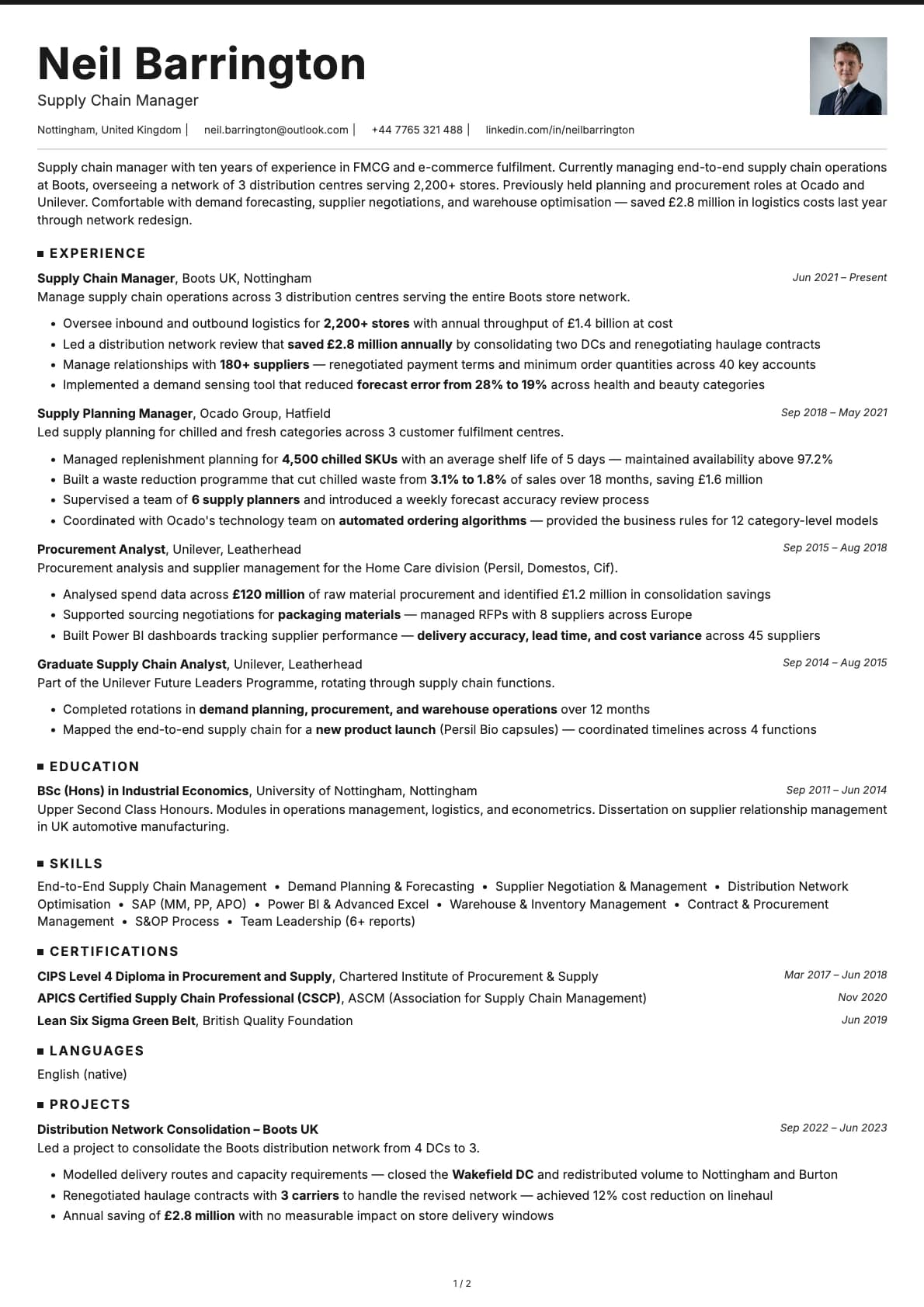
This resume belongs to Neil, a supply chain manager at Boots UK with ten years of experience across FMCG and e-commerce fulfilment. Before Boots, he held planning and procurement roles at Ocado and Unilever. His resume works because every bullet ties back to a number. A £2.8 million saving from network consolidation. Forecast error reduced from 28% to 19%. Chilled waste cut from 3.1% to 1.8%. These are the kinds of details that get you shortlisted.
Let us break down how he does it so you can apply the same approach.
Lead your summary with scope and savings
Here is Neil's summary:
Supply chain manager with ten years of experience in FMCG and e-commerce fulfilment. Currently managing end-to-end supply chain operations at Boots, overseeing a network of 3 distribution centres serving 2,200+ stores. Previously held planning and procurement roles at Ocado and Unilever. Saved £2.8 million in logistics costs last year through network redesign.
Four sentences. The recruiter immediately knows: years of experience, sector (FMCG and e-commerce), current scope (3 DCs, 2,200 stores), and biggest recent achievement (£2.8 million saved).
For yours: Start with years and sector. Then describe your current operational scope using numbers (DCs, stores, SKUs, team size, throughput). End with your most impressive recent number. That is all you need.
How to write experience bullets that land
Supply chain roles involve a lot of activity. Managing suppliers, running S&OP processes, optimising routes, building reports. The trap is writing bullets that describe activity instead of outcomes.
Bad version: "Managed relationships with suppliers across the network."
What Neil actually writes:
Manage relationships with 180+ suppliers. Renegotiated payment terms and minimum order quantities across 40 key accounts
The second version tells the recruiter the scale (180 suppliers) and that Neil actively renegotiates terms rather than just maintaining contacts. But it could be even better with a cost saving attached. If you renegotiated terms that saved money, say how much.
The strongest bullet on this resume:
Led a distribution network review that saved £2.8 million annually by consolidating two DCs and renegotiating haulage contracts
This follows a clear formula: Action + Scope + Outcome. What did you do? (Led a network review.) What was the scope? (Two DCs consolidated, haulage renegotiated.) What happened? (£2.8 million saved.)
Use this for every bullet. If you optimised inventory, state the stock reduction in days or pounds. If you improved availability, give the percentage. If you built a report, say who used it and what decisions it influenced.
Show career progression through increasing scope
Neil's resume shows a clear trajectory. Graduate analyst at Unilever, procurement analyst, supply planning manager at Ocado, then supply chain manager at Boots. Each role is bigger in scope.
At Unilever he was mapping supply chains for new product launches. At Ocado he managed 4,500 chilled SKUs and a team of 6 planners. At Boots he oversees £1.4 billion in throughput across 2,200 stores. The recruiter can see the growth without it being spelled out.
If your career path is not this linear, that is fine. Just make sure each role description shows what was bigger or different about it compared to the last.
Systems and certifications: speak the hiring manager's language
The skills section includes SAP (MM, PP, APO), Power BI, and Advanced Excel. For supply chain roles, naming the specific SAP modules you know is important. "SAP experience" is vague. "SAP MM and APO" tells the recruiter exactly which modules you can use.
Neil's certifications are also well chosen. CIPS Level 4, APICS CSCP, and Lean Six Sigma Green Belt. These are the three most recognised credentials in UK supply chain management. If you have any of them, list them. If you are studying for one, include it with an expected date.
The APICS CSCP is particularly valuable for supply chain manager roles because it covers end-to-end supply chain management. CIPS is stronger for procurement-focused roles. If you are choosing which one to pursue, pick the one that matches the type of role you want.
Projects that demonstrate strategic thinking
Neil includes two projects: the Boots DC consolidation and the Ocado chilled waste reduction programme. Both follow the same structure: problem, action, measurable result.
The Ocado project is particularly well written:
Analysed 18 months of waste data and identified dairy and prepared meals as the two worst categories. Adjusted safety stock levels and introduced dynamic ordering based on day-of-week demand patterns. Cut chilled waste from 3.1% to 1.8% of sales, saving £1.6 million per year.
This tells a story. He looked at data, found the root cause, built a solution, and measured the impact. That is what senior supply chain roles require. If you have led any cost reduction, waste reduction, or process improvement project, write it up this way.
Mistakes that cost supply chain managers interviews
No numbers. This is the biggest one. If your resume says "optimised warehouse operations" without a metric, it is just noise. How much did you save? By how much did you improve availability? What was the before and after?
Ignoring S&OP experience. Many senior supply chain roles require S&OP involvement. If you have participated in or led S&OP processes, include it. Mention the cadence (weekly, monthly) and who attended.
Listing tools without context. "SAP" on its own is not helpful. Specify the modules. Name the dashboards you built. Mention the reports you automated.
Generic team leadership claims. "Led a team" is not enough. How many direct reports? What did you develop them to do? Neil mentions supervising 6 supply planners and introducing a weekly forecast accuracy review. That is a specific leadership contribution.
One more thing
Supply chain resumes benefit from a clean, ATS-friendly layout. Graphite is a solid choice for this industry. No sidebars, no icons, just structured text that parses cleanly through automated screening.
And tailor your resume to each role. If the job says "demand planning," make sure your demand planning experience is near the top of each role description. If it says "procurement," lead with your supplier negotiation bullets. The order of your bullets within each job entry matters more than most people realise.
Build your own version
Open this layout in the builder and swap in your own details. It takes a few minutes.
Free to use. No account needed to start.
Was this resume example helpful?
Rate this example to help us create better content for you.
4.8 average from 143 ratingsRelated resume examples
Logistics Coordinator
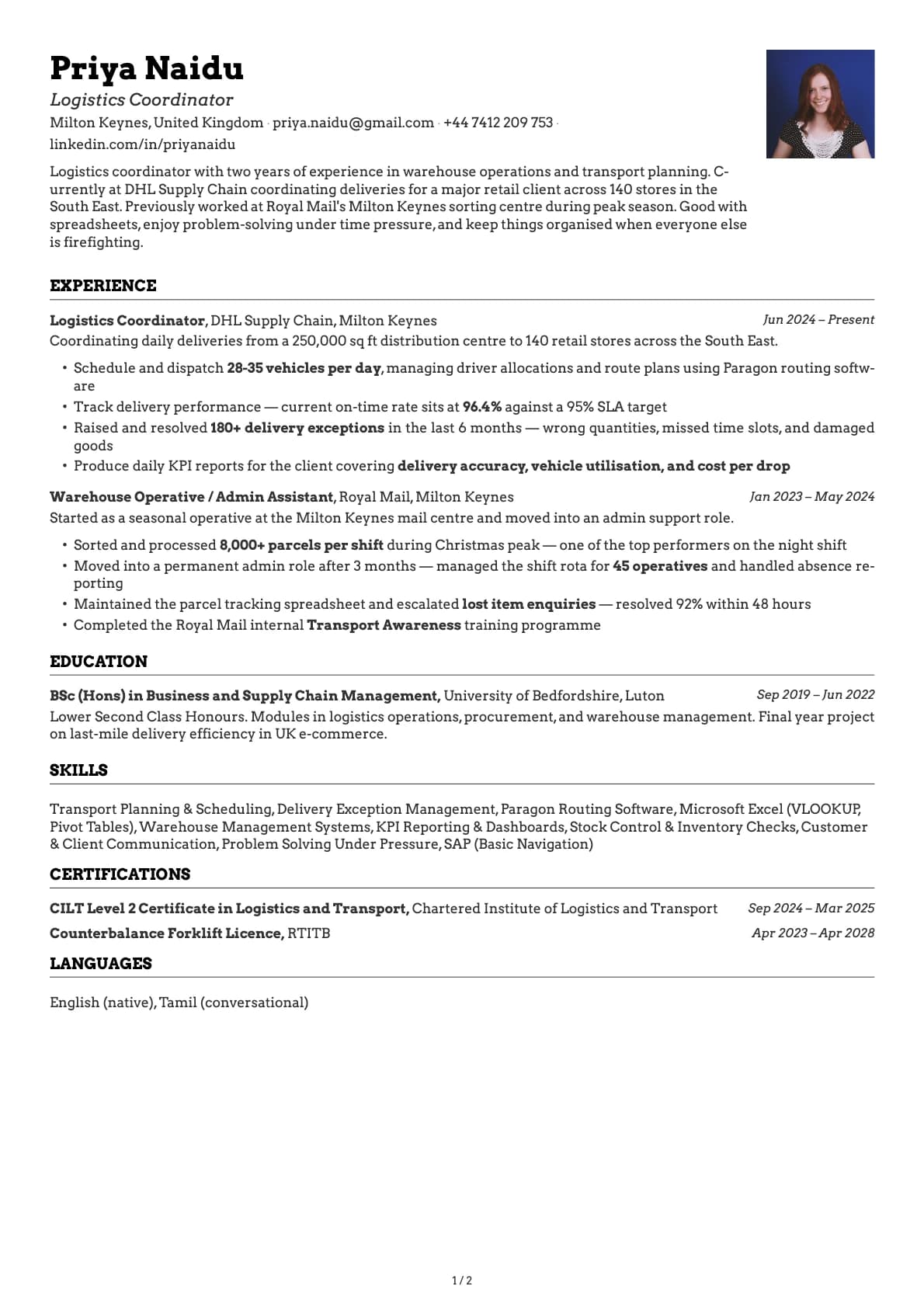
A logistics coordinator resume example with delivery KPIs, routing software experience, and exception management numbers.
Warehouse Manager
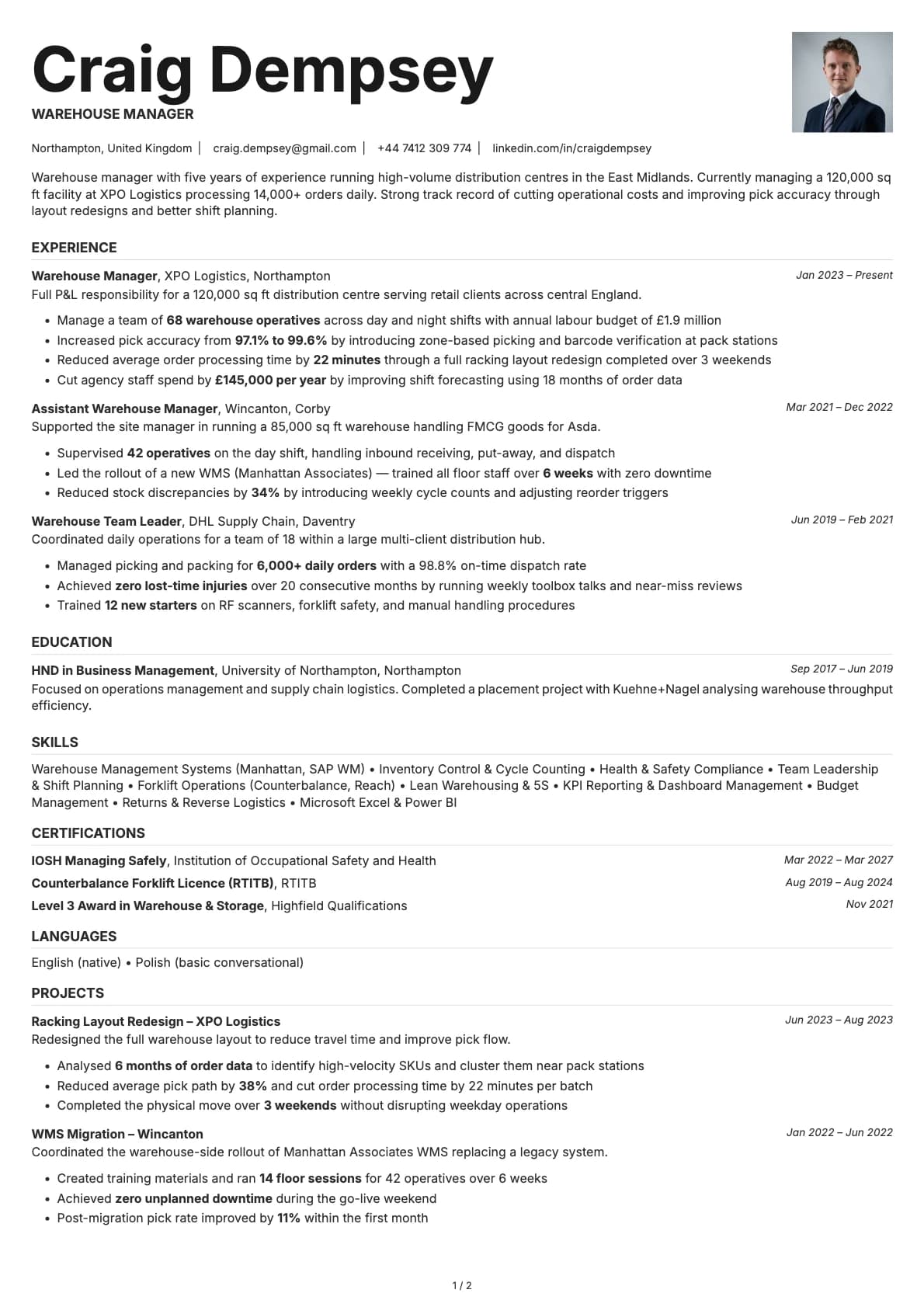
A warehouse manager resume example with P&L ownership, leadership of 68 operatives, and measurable gains in pick accuracy and cost reduction.
Truck Driver
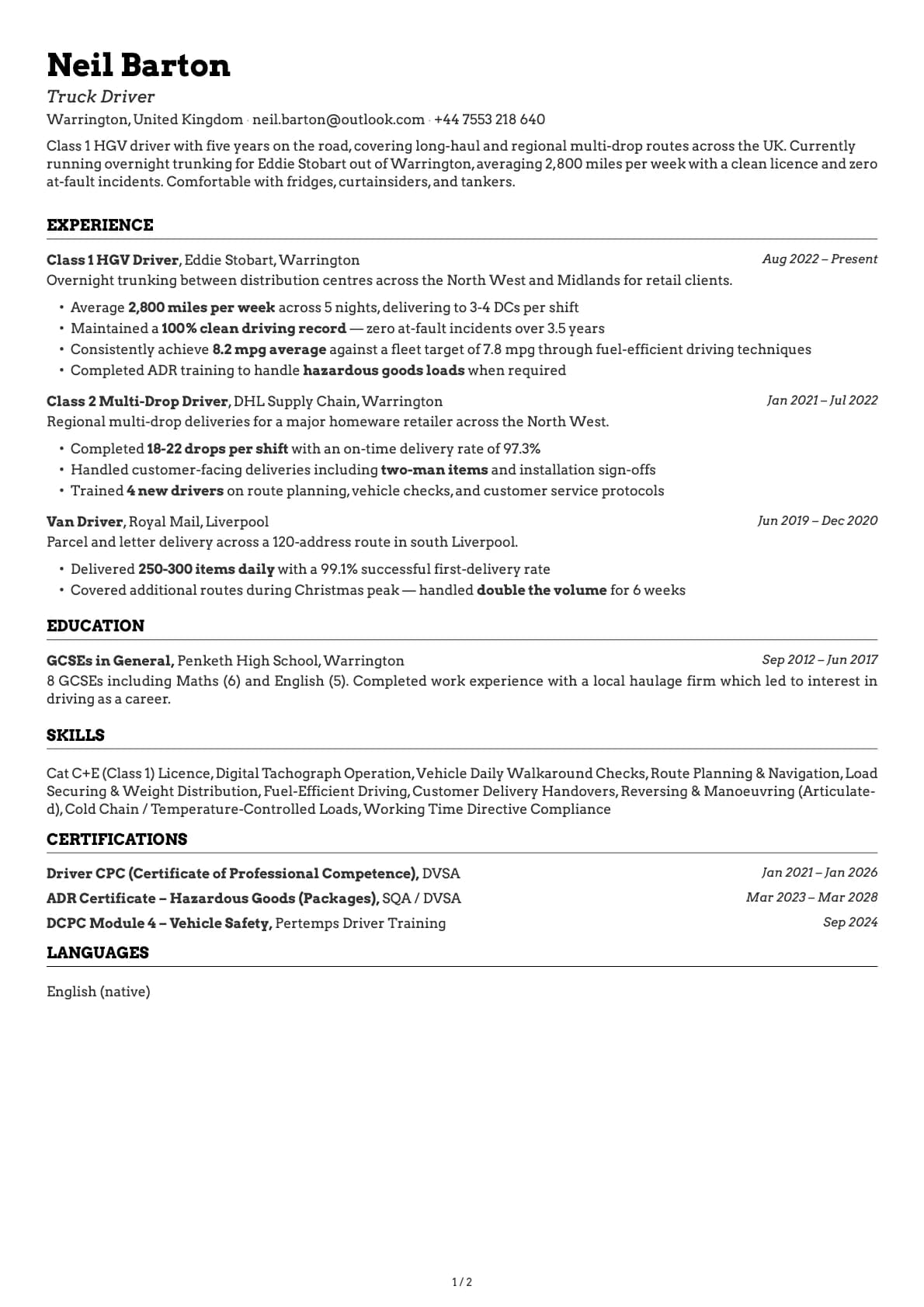
A truck driver resume example with 5 years of Class 1 HGV experience at Eddie Stobart and DHL.
Warehouse Worker
A warehouse worker resume example with 8 years across Amazon, DHL, and Ocado. See how to present pick rates, safety records, and forklift licences.
Related articles

AI Is Screening Your Resume Before Any Human Sees It
AI screens most resumes before a human ever reads them. 97.4% of Fortune 500 companies run an ATS. This is what that means for you and what you can do about it.

The Best Resume Builders in 2026, Compared Honestly
Resume.io, Zety, Enhancv, Kickresume, Teal, and Laddro compared honestly: real pricing, free tiers, mobile apps, and where each tool wins. All prices checked in September 2026.

Burnout Recovery: A Real Timeline, Not 'Take a Bubble Bath'
55% of the U.S. workforce is burned out. Recovery takes 3 to 12 months. Here's what that actually looks like, stage by stage.