Hair Stylist Resume Example
A hair stylist resume example with salon experience in colour, cutting, and textured hair.

Laddro Team
Free to use. No account needed to start.
Free to use. No account needed to start.
Overview
Most hair stylists do not have a resume. You get your next chair through your reputation, your client list, and maybe an Instagram page. But when you want to move to a bigger salon, apply for an artistic team, or go for a senior stylist position at a brand like Toni & Guy or Rush, you need something on paper that shows more than just "I can cut hair."
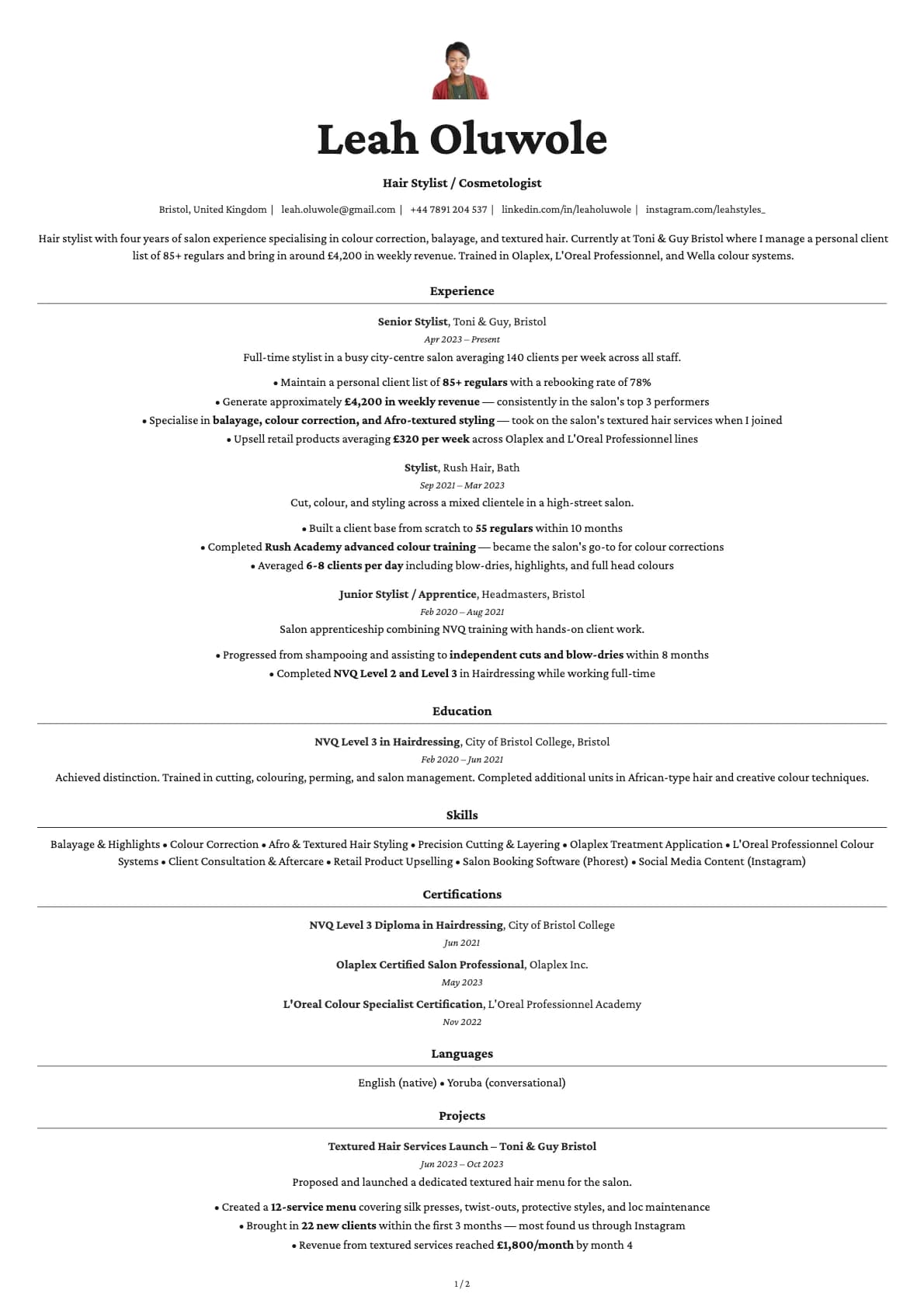
This resume belongs to Leah, a hair stylist with four years of salon experience based in Bristol. She currently works as a Senior Stylist at Toni & Guy, where she manages 85+ regular clients and generates around £4,200 in weekly revenue. Before that, she built her client base at Rush Hair in Bath and completed her apprenticeship at Headmasters. The resume works because it treats hairdressing like a business, with revenue numbers, client retention rates, and product sales.
Here is how to write a resume that shows a salon owner or manager exactly what you bring.
Lead with your revenue and your client list
When a salon manager hires a stylist, they are hiring revenue. The question in their head is: how much money will this person bring through the door?
From this resume's summary:
Currently at Toni & Guy Bristol where I manage a personal client list of 85+ regulars and bring in around £4,200 in weekly revenue.
Two numbers. Client list size and weekly takings. That tells the manager everything they need to know about whether this person will fill a chair.
For your summary: State your specialisms first (colour, cutting, textured hair, whatever you are known for). Then include your client list size and your weekly or monthly revenue if you know it. If you do not track exact revenue, estimate it based on your average service price and weekly bookings.
Experience bullets: show the business side
Hair styling resumes often read like a list of services: "cuts, colours, blow-dries, highlights." That describes every stylist on the floor. Your resume needs to show what makes you different.
Look at these bullets:
Maintain a personal client list of 85+ regulars with a rebooking rate of 78%
Generate approximately £4,200 in weekly revenue. Consistently in the salon's top 3 performers.
Rebooking rate is a number salon managers track closely. A 78% rebooking rate means clients come back. That is the clearest sign of a stylist who does good work and builds relationships.
Another strong bullet:
Upsell retail products averaging £320 per week across Olaplex and L'Oreal Professionnel lines
Product sales are a significant revenue stream for salons. If you sell retail, include the weekly average. It shows you are not just a great stylist. You understand the business model.
The formula: Your client base size + Revenue numbers + Rebooking rate + Retail sales. Use whatever numbers you have.
Specialisms: be specific about what you are known for
Specialise in balayage, colour correction, and Afro-textured styling. Took on the salon's textured hair services when I joined.
This tells the recruiter two things. First, Leah has specific technical specialisms. Second, the salon trusted her to build out an entire service category. That is a level of responsibility beyond just taking bookings.
If you have a specialism, name it explicitly. Colour correction is a very different skill from a standard full-head colour. Afro-textured hair requires specific training and technique. Bridal hair, extensions, chemical straightening. Whatever you do best, make it the centerpiece of your resume.
Training and certifications: the brands matter
In hairdressing, brand certifications carry weight. This resume lists:
- NVQ Level 3 Diploma in Hairdressing
- Olaplex Certified Salon Professional
- L'Oreal Colour Specialist Certification
NVQ Level 3 is your baseline qualification. But the Olaplex and L'Oreal certifications show investment in specific product systems. If you have trained with a recognised colour house (Wella, Goldwell, Schwarzkopf, L'Oreal), include the certification. Salon owners want to know you can work with the product lines they stock.
If you have done any advanced training (through Rush Academy, Sassoon Academy, Toni & Guy Academy, or similar), list it even if it was internal. It shows progression beyond your initial qualification.
Building a client base from scratch
If you are earlier in your career, the Rush Hair entry shows how to present growth:
Built a client base from scratch to 55 regulars within 10 months
Starting from zero and building to 55 regulars in under a year is a strong indicator. It shows someone who can build relationships, get rebookings, and fill a column without relying on the salon's walk-in traffic.
Even the apprenticeship role has useful detail:
Progressed from shampooing and assisting to independent cuts and blow-dries within 8 months
That timeline shows fast progression. If you moved through your apprenticeship quickly, say how quickly.
Social media: your other portfolio
This resume includes an Instagram link (instagram.com/leahstyles_) and mentions social media in the projects section:
Grew from 200 to 3,400 followers over 18 months posting before/after transformations. Approximately 30% of new client enquiries now come through my Instagram page.
For a hair stylist, Instagram is not a hobby. It is a client acquisition channel. If you generate client enquiries through social media, that is a business metric. Include the follower count, the growth, and the percentage of new clients that come from it.
If you do not have a strong social presence, do not list it. But if you do, treat it as a professional asset on your resume.
Mistakes that hold stylists back
Only listing services. "Cuts, colours, highlights, blow-dries" describes every stylist. Talk about your clients, your numbers, and your specialisms instead.
Not mentioning revenue. Salon managers think in weekly takings. If you do not include any revenue figures, they have to guess. Even an approximate number is better than nothing.
Skipping retail performance. Product sales are part of the job. If you are good at it, show the numbers. If you are not, at least mention the brands you are trained in.
Forgetting to show progression. The jump from junior stylist to stylist to senior stylist matters. Make sure each role shows a clear step up in client numbers, revenue, or responsibility.
Using a template that is too formal. This is one field where a slightly more visual template works. This resume uses Topaz, which has a bit of personality while still being clean and readable. A corporate-looking resume feels wrong for a creative trade.
One last thing
If you have done any community or volunteer styling work, include it. This resume mentions volunteering at a women's refuge providing free haircuts. It shows character, and it is the kind of detail a salon owner notices. It tells them this person cares about the work, not just the paycheque.
Build your own version
Open this layout in the builder and swap in your own details. It takes a few minutes.
Free to use. No account needed to start.
Was this resume example helpful?
Rate this example to help us create better content for you.
4.6 average from 203 ratings
Related articles

AI Is Screening Your Resume Before Any Human Sees It
AI screens most resumes before a human ever reads them. 97.4% of Fortune 500 companies run an ATS. This is what that means for you and what you can do about it.

The Best Resume Builders in 2026, Compared Honestly
Resume.io, Zety, Enhancv, Kickresume, Teal, and Laddro compared honestly: real pricing, free tiers, mobile apps, and where each tool wins. All prices checked in September 2026.

Burnout Recovery: A Real Timeline, Not 'Take a Bubble Bath'
55% of the U.S. workforce is burned out. Recovery takes 3 to 12 months. Here's what that actually looks like, stage by stage.