Security Guard Resume Example
A security guard resume example with incident handling stats, CCTV monitoring experience, and SIA licensing.

Laddro Team
Free to use. No account needed to start.
Free to use. No account needed to start.
Overview
Security guard resumes get a bad reputation for being thin. A lot of them are just a list of sites you have worked at and the words "SIA licensed" somewhere near the top. That might get you a callback from an agency for a basic static role. But if you want the better contracts (shopping centres, corporate offices, event work), your resume needs to show what you actually do on shift.
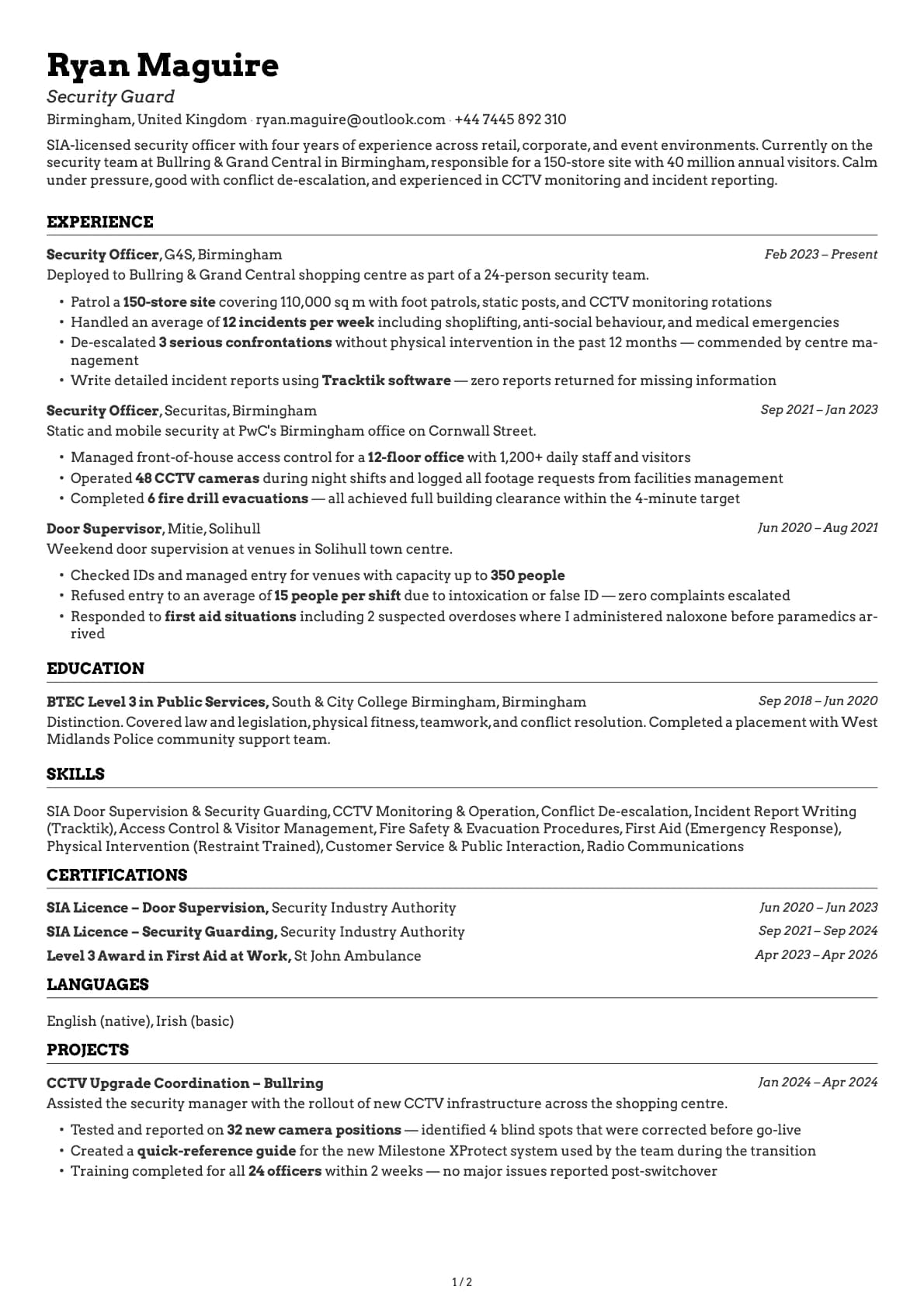
This resume belongs to Ryan Maguire, a security officer in Birmingham with four years of experience. He currently works for G4S at the Bullring & Grand Central shopping centre, covering a 150-store site with 40 million annual visitors. Before that, he was on static and mobile security at PwC's Birmingham office through Securitas, and he started as a door supervisor at venues in Solihull.
What makes this resume work is the detail. Not just "patrolled the site" but how big the site is, how many incidents he handles per week, and how he handles them.
SIA licence details come first
In security, your SIA licence is your right to work. If the hiring manager or agency cannot find it on your resume immediately, they may not read further. This resume lists both the Door Supervision and Security Guarding licences in the certifications section.
Put your licence type, the issuing body (Security Industry Authority), and the validity dates. If your licence is about to expire, renew it before you start applying. An expired or expiring SIA licence is an instant rejection for most companies.
If you hold additional licences (CCTV, Close Protection), list them all.
Describe the site, not just the job title
The biggest mistake on security resumes is being vague about where you work. "Security officer at a shopping centre" could mean a small retail park with 10 shops or the Bullring with 150 stores. Context matters.
"Patrol a 150-store site covering 110,000 sq m with foot patrols, static posts, and CCTV monitoring rotations"
That tells the reader three things: the scale of the site, the size of the area, and the variety of duties. Now look at the PwC role:
"Managed front-of-house access control for a 12-floor office with 1,200+ daily staff and visitors"
Same idea. Different environment. The reader can picture both roles instantly.
For your resume: Always include the type of site (retail, corporate, residential, event), the size (square metres, number of floors, capacity), and the number of people who pass through it.
Incident handling is your core skill
Security work is about dealing with incidents. Your resume needs to show you can handle them. Not just that they happened, but how you responded:
"Handled an average of 12 incidents per week including shoplifting, anti-social behaviour, and medical emergencies"
That gives volume and variety. And then:
"De-escalated 3 serious confrontations without physical intervention in the past 12 months, commended by centre management"
This is a strong line. It shows restraint, professionalism, and the fact that management noticed. De-escalation is a skill employers value highly because physical intervention creates liability. If you are good at talking people down, say so and give an example.
From the door supervisor role:
"Responded to first aid situations including 2 suspected overdoses where I administered naloxone before paramedics arrived"
First aid capability is a differentiator. If you have a Level 3 First Aid at Work certificate (like this resume shows), and you have used those skills on the job, include it.
Report writing and technology
A lot of security managers will tell you that good report writing separates the average officer from a good one. This resume mentions it:
"Write detailed incident reports using Tracktik software, zero reports returned for missing information"
Zero returns means the reports are thorough and accurate. That matters because incident reports often end up with police, insurers, or legal teams. If you use Tracktik, PKMS, Guarding Expert, or any specific incident management software, name it.
For CCTV:
"Operated 48 CCTV cameras during night shifts and logged all footage requests from facilities management"
Again, numbers and context. Not "monitored CCTV" but 48 cameras, night shifts, and footage management.
Certifications and training
Beyond your SIA licence, additional certifications set you apart. This resume includes Level 3 First Aid at Work from St John Ambulance. Other certifications worth listing: fire marshal training, conflict management courses, CCTV operator licences, and any restraint or physical intervention training.
If you have been through specific company training programmes (G4S Academy, Securitas Training Centre), mention them. They show structured professional development in a field where many people learn entirely on the job.
Mistakes security guards make on resumes
Just listing sites. "Worked at Tesco, worked at NEC, worked at a building site." That tells the reader nothing about what you did. Give each role proper bullets with context and detail.
Forgetting soft skills. Security is a people job. You interact with the public, with staff, with emergency services. "Customer Service & Public Interaction" is on this resume's skills list because it matters. If you have worked front-of-house at a corporate reception or managed crowds at events, those are people skills worth highlighting.
Not mentioning fire drills. "Completed 6 fire drill evacuations, all achieved full building clearance within the 4-minute target." If you have been involved in emergency procedures, evacuations, or lockdowns, include them.
Skipping the projects. This resume includes a CCTV upgrade coordination project and an anti-shoplifting initiative. If you have been involved in any operational improvement beyond your daily duties, write it up. It shows initiative.
Final thought
Security is a growing industry and the better contracts go to officers who can demonstrate professionalism on paper. Your resume is often the first thing an operations manager sees. Keep it clean, keep it specific, and put your SIA licence where they cannot miss it.
Build your own version
Open this layout in the builder and swap in your own details. It takes a few minutes.
Free to use. No account needed to start.
Was this resume example helpful?
Rate this example to help us create better content for you.
4.6 average from 89 ratings
Related articles

AI Is Screening Your Resume Before Any Human Sees It
AI screens most resumes before a human ever reads them. 97.4% of Fortune 500 companies run an ATS. This is what that means for you and what you can do about it.

The Best Resume Builders in 2026, Compared Honestly
Resume.io, Zety, Enhancv, Kickresume, Teal, and Laddro compared honestly: real pricing, free tiers, mobile apps, and where each tool wins. All prices checked in September 2026.

Burnout Recovery: A Real Timeline, Not 'Take a Bubble Bath'
55% of the U.S. workforce is burned out. Recovery takes 3 to 12 months. Here's what that actually looks like, stage by stage.