Recruiter Cover Letter Example
A recruiter cover letter example that demonstrates talent sourcing, candidate screening, and hiring pipeline management.
Free to use. No account needed to start.
Free to use. No account needed to start.
Overview
Recruiter cover letters should demonstrate the same skills you use in the job itself: clear communication, an understanding of what the reader wants, and evidence that you can deliver. If you spend your days convincing candidates to take roles and hiring managers to make offers, your cover letter should show that ability in action.
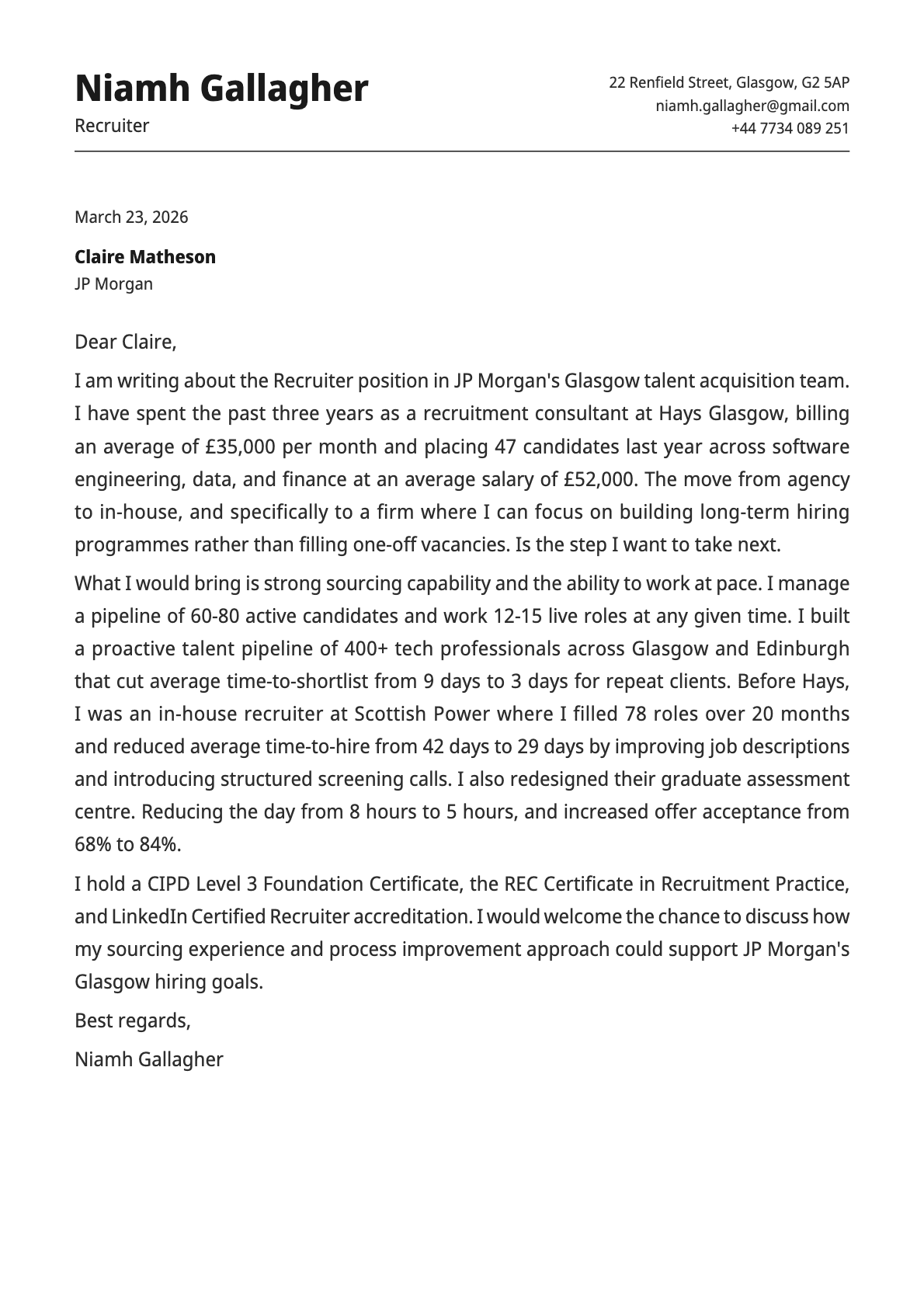
This cover letter is from Niamh Gallagher, a recruitment consultant at Hays Glasgow, applying for a Recruiter position in JP Morgan's talent acquisition team. She is making the move from agency to in-house. Let us look at how she frames that transition.
Opening with billing and placement data
Niamh leads with her numbers: £35,000 per month in billing and 47 placements last year at an average salary of £52,000. For a recruiter, these are the metrics that matter. They tell the reader she generates revenue, fills roles consistently, and works at a professional salary level.
She then explains her motivation for the move: "building long-term hiring programmes rather than filling one-off vacancies." This is exactly the right framing for an agency-to-in-house transition. It does not criticize agency work. It simply explains what the next step looks like.
For your own recruiter cover letter, lead with your numbers. Placements per year, billing per month, fill rate, time-to-hire, or whatever metrics best represent your performance. Recruitment is a numbers game, and your cover letter should reflect that.
Pipeline and sourcing capability
The detail about managing a pipeline of 60-80 active candidates while working 12-15 live roles at once shows capacity. The proactive talent pipeline of 400+ tech professionals across Glasgow and Edinburgh that cut average time-to-shortlist from 9 days to 3 days shows strategic sourcing.
This is the difference between a recruiter who posts jobs and waits, and one who builds systems that deliver candidates faster. If you have built a sourcing pipeline, talent community, or candidate database that improved your speed or quality metrics, describe it.
The in-house experience adds depth
Before Hays, Niamh worked as an in-house recruiter at Scottish Power, where she filled 78 roles over 20 months and reduced average time-to-hire from 42 days to 29 days. She also redesigned their graduate assessment centre, reducing the day from 8 hours to 5 hours and increasing offer acceptance from 68% to 84%.
Having both agency and in-house experience is a real advantage when applying for corporate TA roles. It shows she understands both sides of the relationship and can adapt her approach to fit an in-house model.
The assessment centre redesign is a particularly strong detail. It shows process thinking and a willingness to question how things are done. The outcome (higher offer acceptance in less time) proves the redesign worked.
Process improvement as a theme
Throughout the letter, there is a consistent theme: Niamh finds ways to make things faster and better. Shorter time-to-shortlist. Shorter time-to-hire. Shorter assessment days with better results. This pattern tells the reader she is not just a recruiter who fills seats. She is someone who improves the hiring function.
For your cover letter, look for the thread that connects your achievements. If there is a pattern (speed, quality, candidate experience, diversity), name it. A consistent theme is more memorable than a list of unrelated accomplishments.
Qualifications
CIPD Level 3 Foundation Certificate, REC Certificate in Recruitment Practice, and LinkedIn Certified Recruiter accreditation. These are solid credentials for a recruiter, and they show investment in the profession beyond just billing numbers.
Template choice
This letter uses the Cobalt template, which is clean and professional. For corporate recruitment roles at firms like JP Morgan, the presentation needs to match the brand. Cobalt provides an authoritative look without being over the top.
Was this cover letter example helpful?
Rate this example to help us create better content for you.
4.7 average from 136 ratingsBuild your own version
Open this layout in the builder and swap in your own details. It takes a few minutes.
Free to use. No account needed to start.
Related articles

AI Is Screening Your Resume Before Any Human Sees It
AI screens most resumes before a human ever reads them. 97.4% of Fortune 500 companies run an ATS. This is what that means for you and what you can do about it.

The Best Resume Builders in 2026, Compared Honestly
Resume.io, Zety, Enhancv, Kickresume, Teal, and Laddro compared honestly: real pricing, free tiers, mobile apps, and where each tool wins. All prices checked in September 2026.

Burnout Recovery: A Real Timeline, Not 'Take a Bubble Bath'
55% of the U.S. workforce is burned out. Recovery takes 3 to 12 months. Here's what that actually looks like, stage by stage.