Sales Manager Cover Letter Example
A sales manager cover letter example showcasing consistent quota achievement, team leadership, and revenue growth strategies.
Free to use. No account needed to start.
Free to use. No account needed to start.
Overview
Sales manager cover letters should do one thing above all else: prove you can sell. Not in a cheesy way. In a "here are the numbers, here is the team I built, here is what happened" way. The hiring manager reading your letter manages a number too, and they want to know if your track record is real.
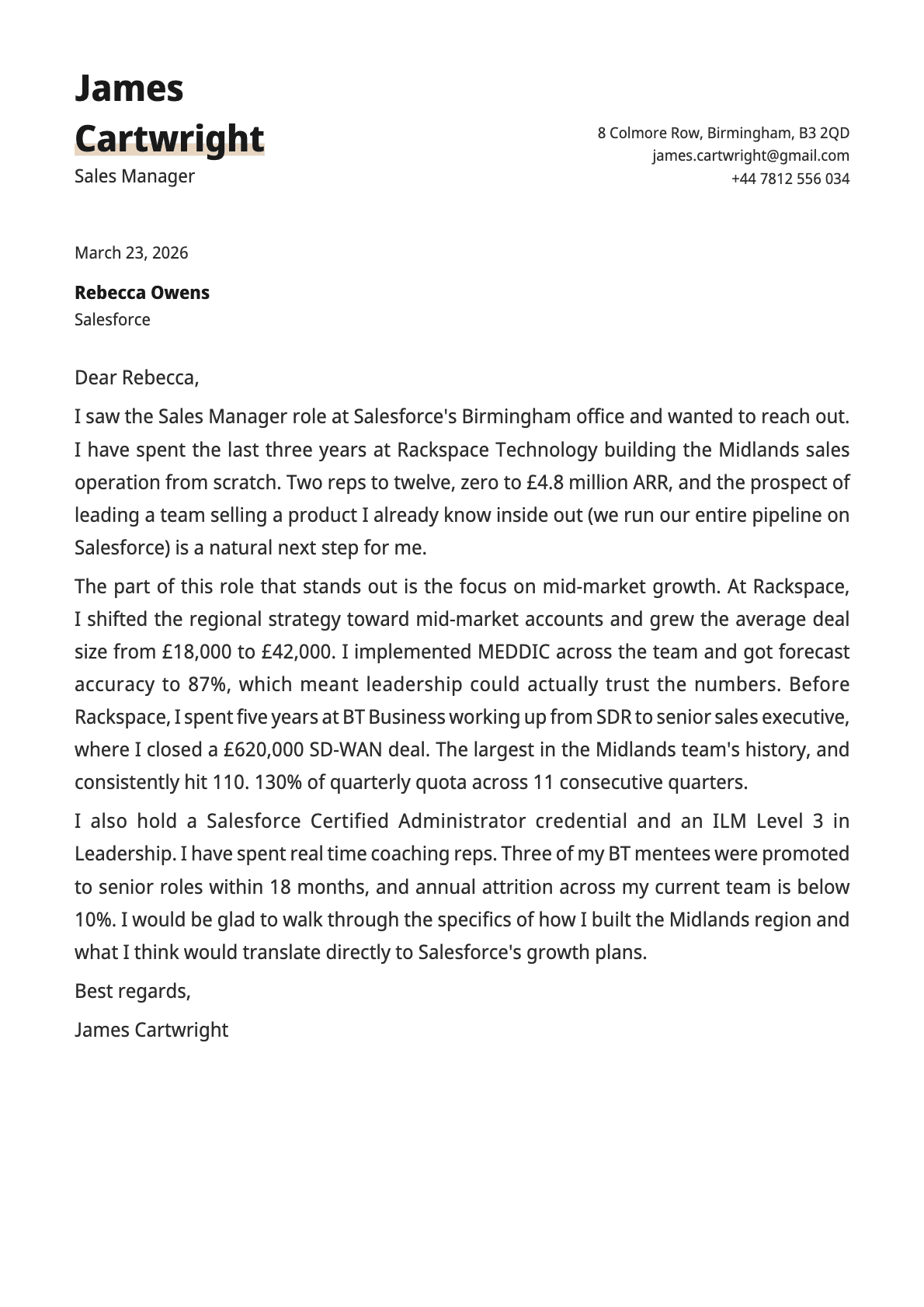
This cover letter is from James Cartwright, applying for a Sales Manager role at Salesforce's Birmingham office. He is coming from Rackspace Technology, where he built a regional sales operation from the ground up. Let us look at what makes this letter effective and how you can apply the same thinking to your own.
The opening is confident without being arrogant
James does not waste time with pleasantries. He names the role, then immediately drops the headline: he built the Midlands sales operation from scratch. Two reps to twelve. Zero to £4.8 million ARR. In two sentences, the reader knows his scale and trajectory.
The clever part is the bridge: "the prospect of leading a team selling a product I already know inside out (we run our entire pipeline on Salesforce) is a natural next step." This is not generic flattery. He is telling the hiring manager that he is already a power user of their product. That connection between his current tools and the company he is applying to is something a lot of candidates miss.
If you are writing a sales manager cover letter, your opening should answer one question: what is your number? Revenue, team size, growth rate. Pick the most impressive metric and lead with it.
The middle paragraph is a masterclass in specifics
This is where most sales cover letters fall apart. People write things like "I have a proven track record in B2B sales" and think that is enough. James takes a completely different approach.
He names the strategy shift: moving toward mid-market accounts. He quantifies the result: average deal size grew from £18,000 to £42,000. He names the methodology: MEDDIC. He quantifies the outcome: 87% forecast accuracy. Then he goes further back in his career and mentions a £620,000 SD-WAN deal at BT and 11 consecutive quarters hitting 110-130% of quota.
Every sentence has a number or a named framework. There is nothing vague here. If a hiring manager wanted to verify any of these claims, they could. That level of transparency builds trust instantly.
For your own letter, think about three categories of proof: revenue numbers, team performance metrics, and deal-level highlights. Try to include at least one from each category.
The coaching angle is the differentiator
The third paragraph shifts from selling to leading. James mentions his Salesforce Certified Administrator credential and ILM Level 3 in Leadership, but the real weight comes from the coaching specifics. Three mentees promoted to senior roles within 18 months. Annual attrition below 10%.
Sales managers get hired for two reasons: they can hit their own number, and they can build a team that hits the team number. Most cover letters focus entirely on the first point. By showing that people he coached got promoted and that his team does not leave, James addresses both concerns.
If you have coached, mentored, or developed junior sales reps, put the outcomes in your cover letter. Promotions, ramp time improvements, retention rates. These are the metrics that separate a good individual contributor from a real manager.
What makes this letter work for Salesforce specifically
James does something subtle throughout this letter. He is not just writing a generic sales manager cover letter. He is writing one that fits Salesforce's culture and priorities.
He mentions mid-market growth, which is a known Salesforce focus area. He mentions MEDDIC, a methodology Salesforce teams commonly use. He holds a Salesforce certification. He already uses the product. Every detail tells the reader: "I already live in your world."
When you write your cover letter, research the company's sales methodology, their target market segment, and their recent strategic priorities. Then weave those into your narrative. You do not need to name-drop everything, but showing genuine understanding of how the company sells is more persuasive than any amount of enthusiasm.
Formatting and template choice
This letter uses the Copper template, which gives it a professional but warm feel. For a sales role, you want your letter to look polished without being stiff. The Copper template strikes that balance well.
Notice the length. James covers a lot of ground, but the letter stays on one page. He does not repeat himself, and every sentence carries new information. That is the goal: density without clutter.
Was this cover letter example helpful?
Rate this example to help us create better content for you.
4.8 average from 167 ratingsBuild your own version
Open this layout in the builder and swap in your own details. It takes a few minutes.
Free to use. No account needed to start.
Related cover letter examples
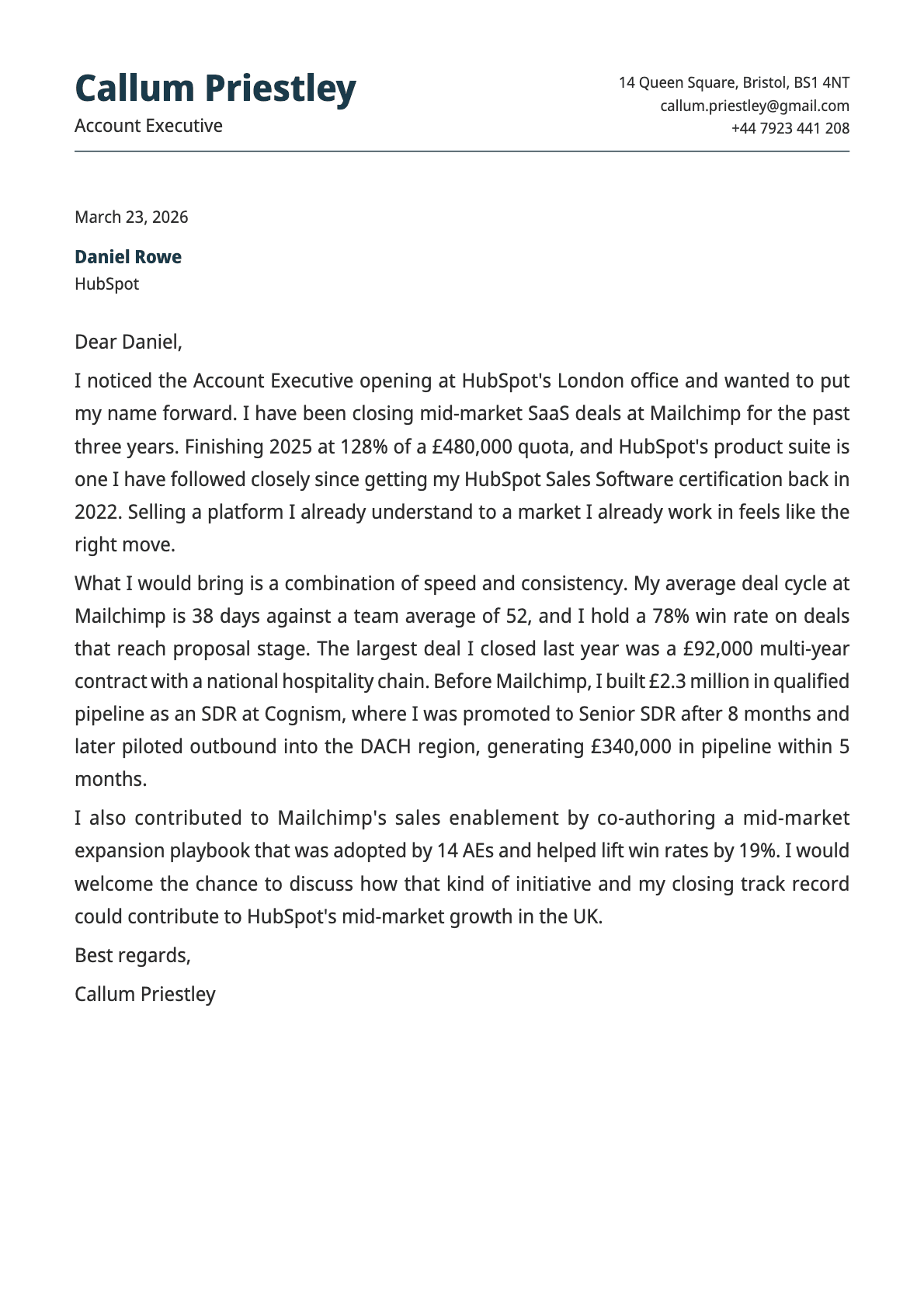
Account Executive
See how this account executive cover letter highlights client growth, revenue targets, and relationship-building skills.
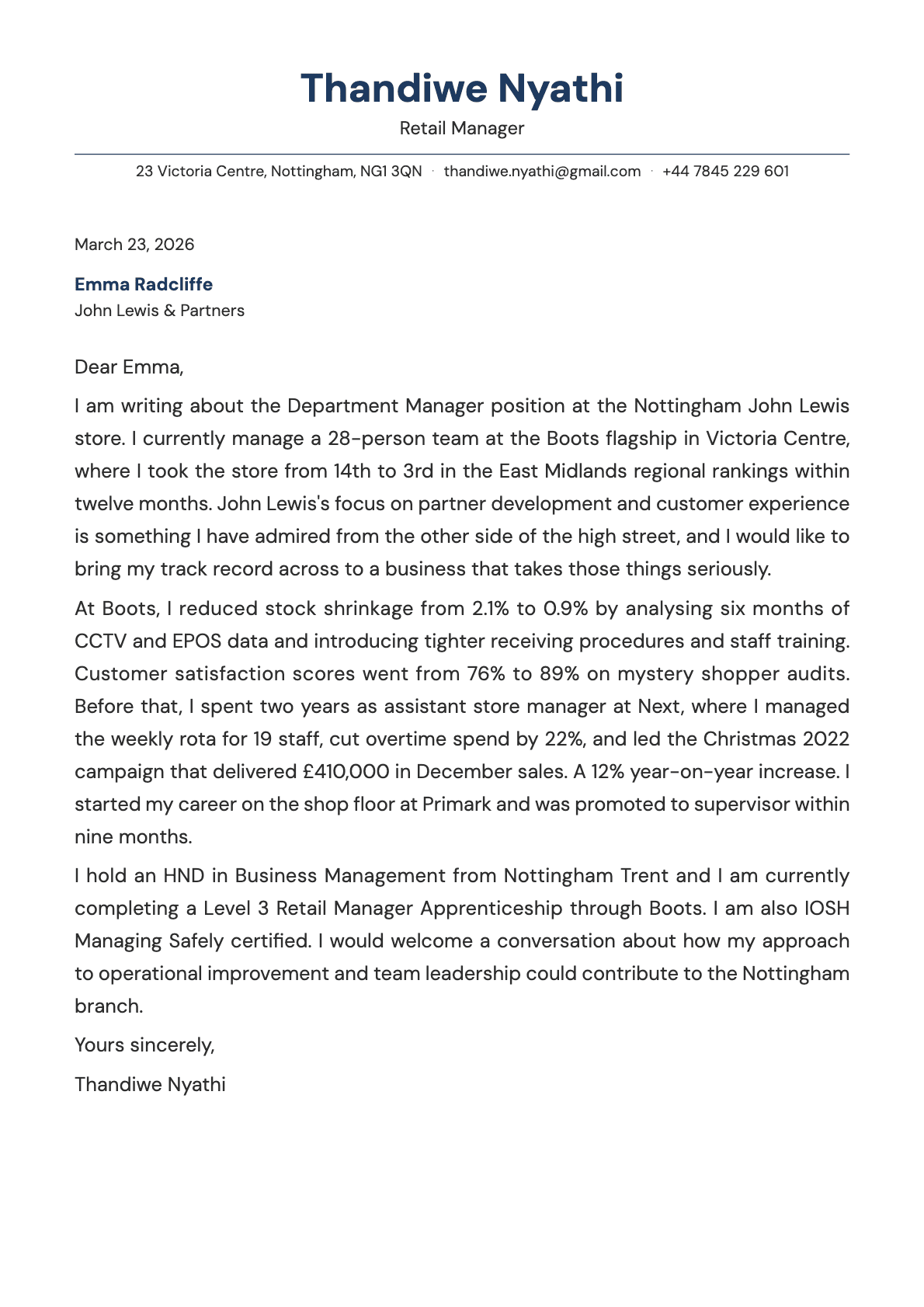
Retail Manager
This retail manager cover letter example highlights store performance, team development, and inventory management expertise.
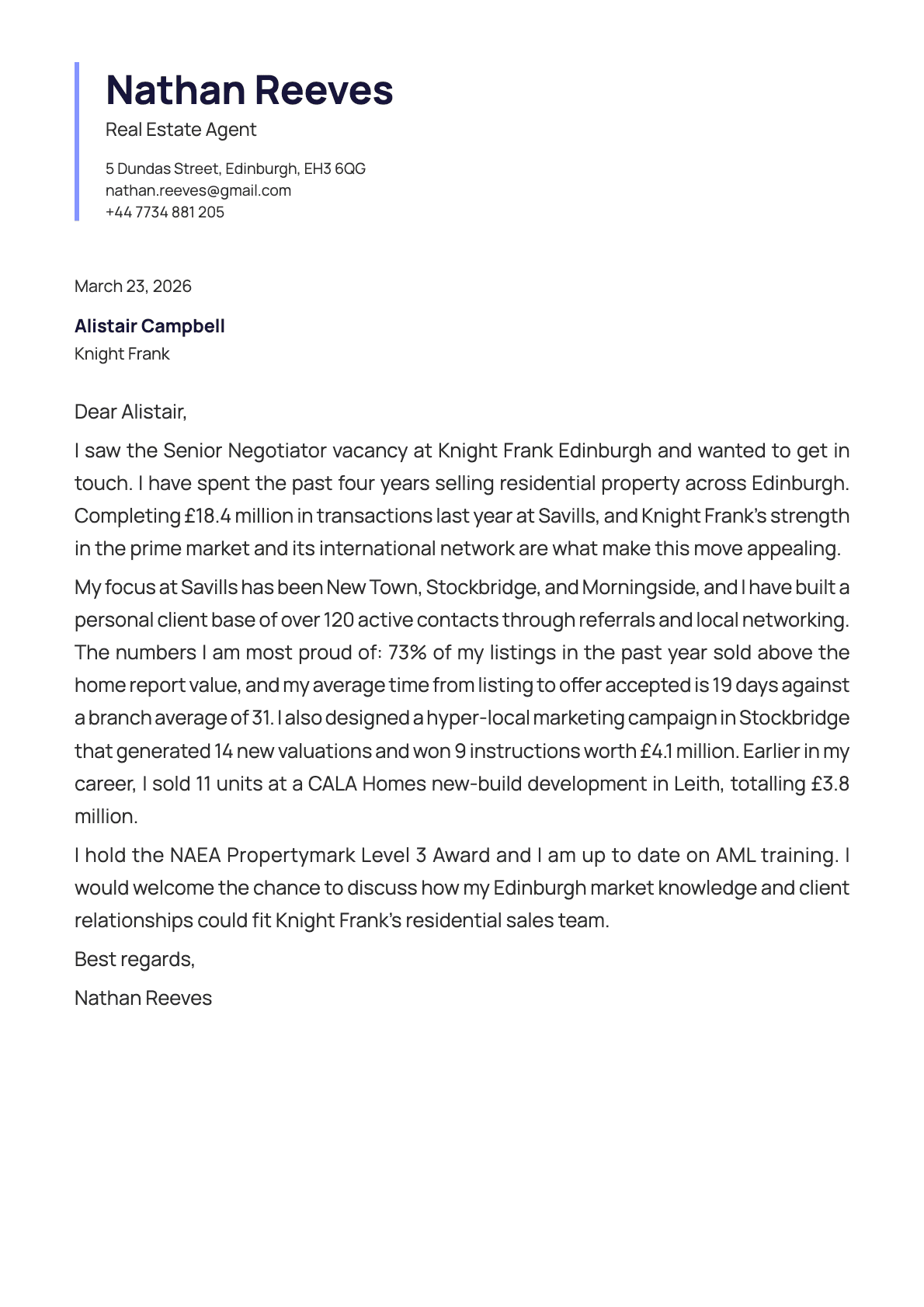
Real Estate Agent
See how this real estate agent cover letter presents market knowledge, client relationships, and property sales results.
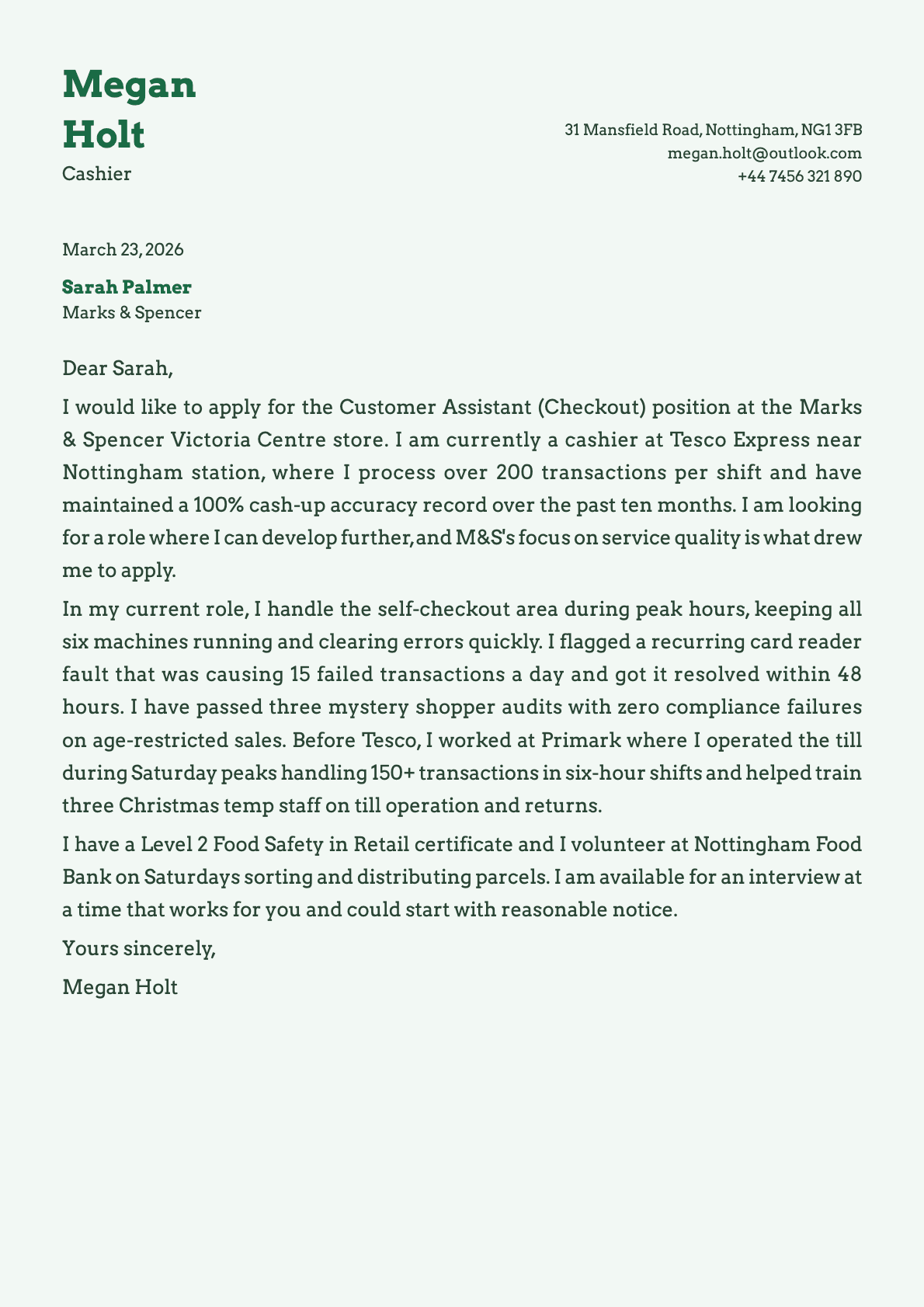
Cashier
This cashier cover letter example demonstrates how to present transaction accuracy, customer interaction, and retail readiness.
Related articles

AI Is Screening Your Resume Before Any Human Sees It
AI screens most resumes before a human ever reads them. 97.4% of Fortune 500 companies run an ATS. This is what that means for you and what you can do about it.
The Best Resume Builders in 2026, Compared Honestly
Resume.io, Zety, Enhancv, Kickresume, Teal, and Laddro compared honestly: real pricing, free tiers, mobile apps, and where each tool wins. All prices checked in September 2026.

Burnout Recovery: A Real Timeline, Not 'Take a Bubble Bath'
55% of the U.S. workforce is burned out. Recovery takes 3 to 12 months. Here's what that actually looks like, stage by stage.