Architect Resume Example
An ARB-registered architect resume example with RIBA Stage 4 project experience, BIM coordination.

Laddro Team
Free to use. No account needed to start.
Free to use. No account needed to start.
Overview
Architecture resumes sit in an awkward spot between creative portfolio and professional CV. Most practices want to see your portfolio first, but the resume still matters. It is what HR screens before your drawings ever reach a project director. And if it is vague about your registration status, your RIBA stage experience, or the scale of projects you have worked on, you will not make it past that screen.
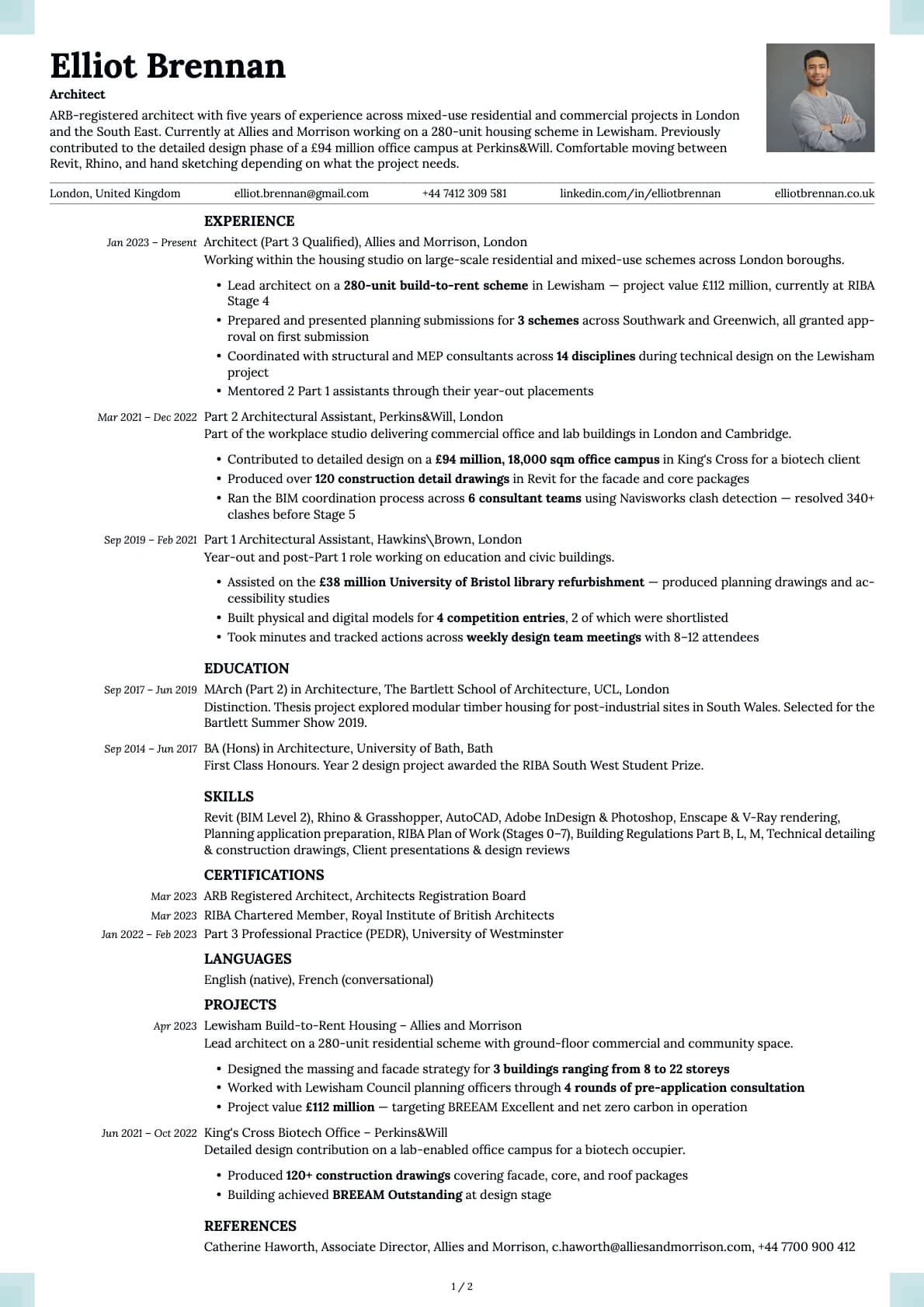
This resume belongs to Elliot Brennan, an ARB-registered, Part 3 qualified architect with five years of post-education experience. He currently works at Allies and Morrison in London on a 280-unit housing scheme in Lewisham valued at £112 million. Before that, he produced detailed construction drawings at Perkins&Will and built competition models at Hawkins\Brown.
What works here is that the resume speaks the language of practice, not academia. RIBA stages, project values, unit counts, planning outcomes. Let us go through it.
Your summary: registration, sector, and scale
Architecture hiring works on a hierarchy. First question: are you ARB registered? Second: what sector do you work in? Third: what is the biggest project you have touched?
Elliot's summary covers all three:
ARB-registered architect with five years of experience across mixed-use residential and commercial projects in London and the South East. Currently at Allies and Morrison working on a 280-unit housing scheme in Lewisham. Previously contributed to the detailed design phase of a £94 million office campus at Perkins&Will.
No mention of "creative vision" or "design philosophy." Just facts. The hiring manager knows immediately: registered, residential and commercial, working at a known practice on a big scheme.
For yours: Start with your registration status (ARB, Part 2, Part 1). Name your sector. Then give the project value or unit count of your biggest current or recent project.
Experience: RIBA stages are your framework
In architecture, your experience section should be organised around RIBA stages. This is how practices think about workload allocation. They need someone who can handle Stage 3 design development, or someone with Stage 4-5 technical design experience. If your resume does not make clear which stages you have worked through, you are making the hiring manager guess.
Look at Elliot's current role:
Lead architect on a 280-unit build-to-rent scheme in Lewisham, project value £112 million, currently at RIBA Stage 4
Prepared and presented planning submissions for 3 schemes across Southwark and Greenwich, all granted approval on first submission
Coordinated with structural and MEP consultants across 14 disciplines during technical design
The first bullet names the project, the scale, the value, and the RIBA stage. The second shows planning experience with a success rate. The third demonstrates coordination across a large consultant team. All of this is specific to architecture practice. None of it is generic.
The formula: Project type + Scale (units, sqm, or value) + RIBA stage + Your specific role.
"Worked on a housing project" becomes "Lead architect on a 280-unit build-to-rent scheme at RIBA Stage 4." Much more useful.
Part 1 and Part 2 roles: they still count
If you are a Part 2 assistant or recently Part 3 qualified, your earlier roles need the same level of detail. Look at Elliot's Part 2 role at Perkins&Will:
Contributed to detailed design on a £94 million, 18,000 sqm office campus in King's Cross for a biotech client
Produced over 120 construction detail drawings in Revit for the facade and core packages
Ran the BIM coordination process across 6 consultant teams using Navisworks clash detection, resolved 340+ clashes before Stage 5
The drawing count (120+) and the clash resolution number (340+) are the kind of details that show you actually did the work. Anyone can say "contributed to a large project." The person who produced 120 detail drawings and resolved 340 clashes clearly sat at a desk and delivered.
For Part 1 roles, focus on what you produced and what you learned. Elliot's Hawkins\Brown entry mentions building models for competition entries and producing planning drawings. Simple, but it shows he was trusted with real deliverables early on.
Skills: software fluency is non-negotiable
Every architecture practice runs on specific software. Revit for BIM. Rhino and Grasshopper for computational design. AutoCAD for legacy drawings. Adobe InDesign and Photoshop for presentations. If you do not list these by name, the recruiter cannot match you.
Elliot's skills section also includes "RIBA Plan of Work (Stages 0-7)" and "Building Regulations Part B, L, M." These are not software skills. They are knowledge areas that tell the practice you understand the regulatory framework, not just the design tools.
One thing specific to architecture: rendering software. If you use Enscape, V-Ray, Lumion, or Twinmotion, list it. Practices increasingly want architects who can produce their own visualisations without outsourcing to a separate viz team.
Certifications: ARB and RIBA are the headline acts
For architects, ARB registration is the legal requirement to call yourself an architect in the UK. RIBA membership is the professional body. Both should be listed prominently.
Elliot also lists his Part 3 PEDR (Professional Experience and Development Record) from the University of Westminster. If you completed Part 3, include where you did it. If you are currently working through your PEDR, list it as in progress.
For Part 1 and Part 2 candidates, your degree is your main credential. Make sure you list your Part 1 or Part 2 institution, your grade, and any awards or exhibitions.
Mistakes architects make on their resume
Not stating your registration status clearly. If you are ARB registered, say "ARB Registered Architect" in the first line. If you are Part 2, say "Part 2 Architectural Assistant." Practices need to know this immediately because it affects what work they can legally assign you.
Being vague about project scale. "Worked on a residential scheme" is useless. "Lead architect on a 280-unit build-to-rent at RIBA Stage 4, project value £112 million" is immediately useful.
Listing software without proficiency levels. If your Revit skills are at BIM Level 2 and you are just learning Grasshopper, say so. Practices would rather know your honest level than discover mid-project that you cannot model what they need.
Sending the resume without a portfolio link. Elliot includes a personal website (elliotbrennan.co.uk). Your portfolio is where the design work lives, but the resume is what gets you to the interview. Make sure you connect the two. A website URL or a portfolio PDF link is essential.
One more thing
Architecture is a small industry. Practices talk. The names on your resume (Allies and Morrison, Perkins&Will, Hawkins\Brown) carry weight because hiring directors know those offices and the standard of work they produce. If you have worked at a recognised practice, make sure the name is visible and spelled correctly. It is one of the fastest ways to establish credibility before a single drawing is reviewed.
Build your own version
Open this layout in the builder and swap in your own details. It takes a few minutes.
Free to use. No account needed to start.
Was this resume example helpful?
Rate this example to help us create better content for you.
4.8 average from 103 ratingsRelated resume examples
Graphic Designer
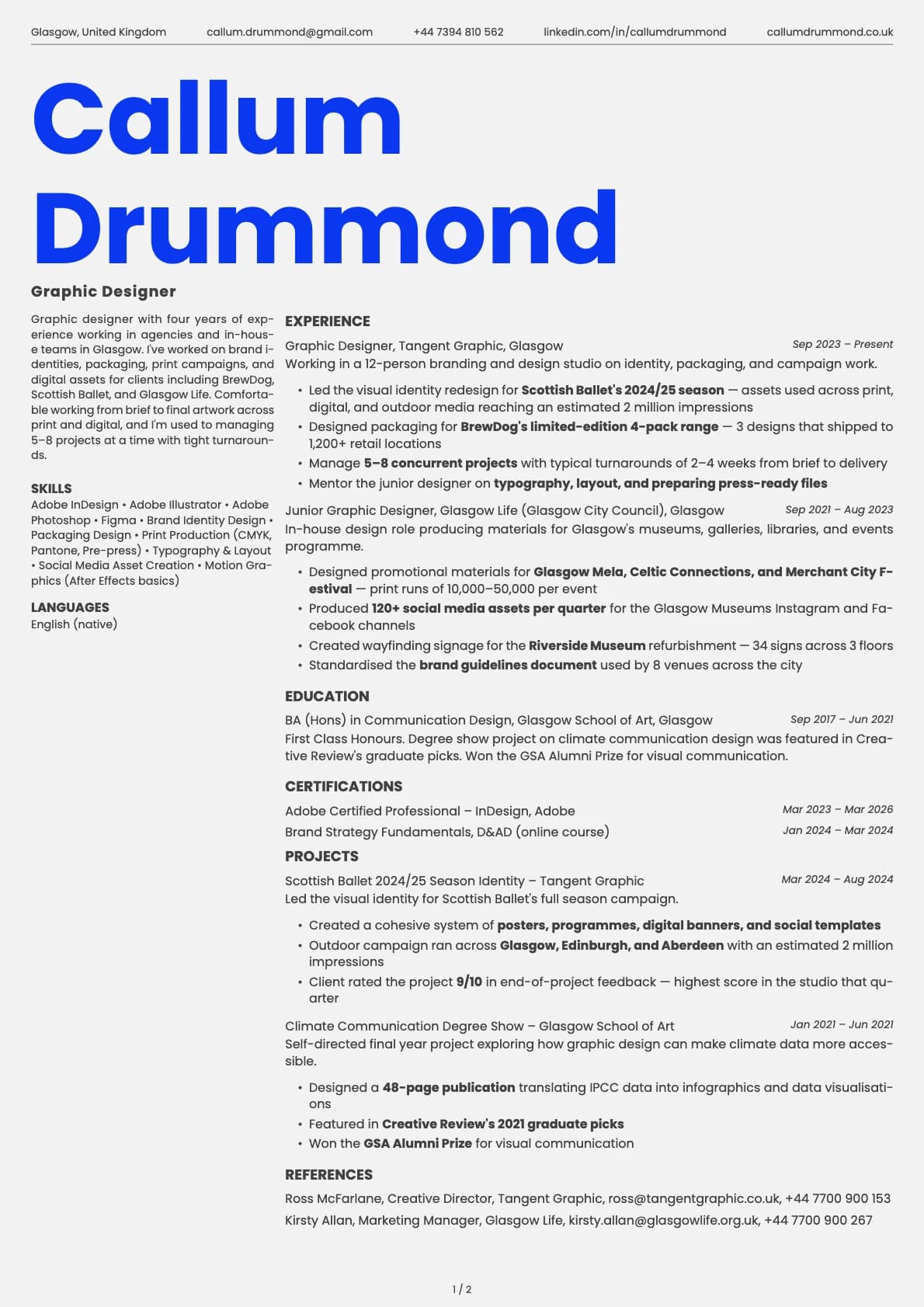
A graphic designer resume example with agency and in-house experience in branding, packaging, and print.
Interior Designer
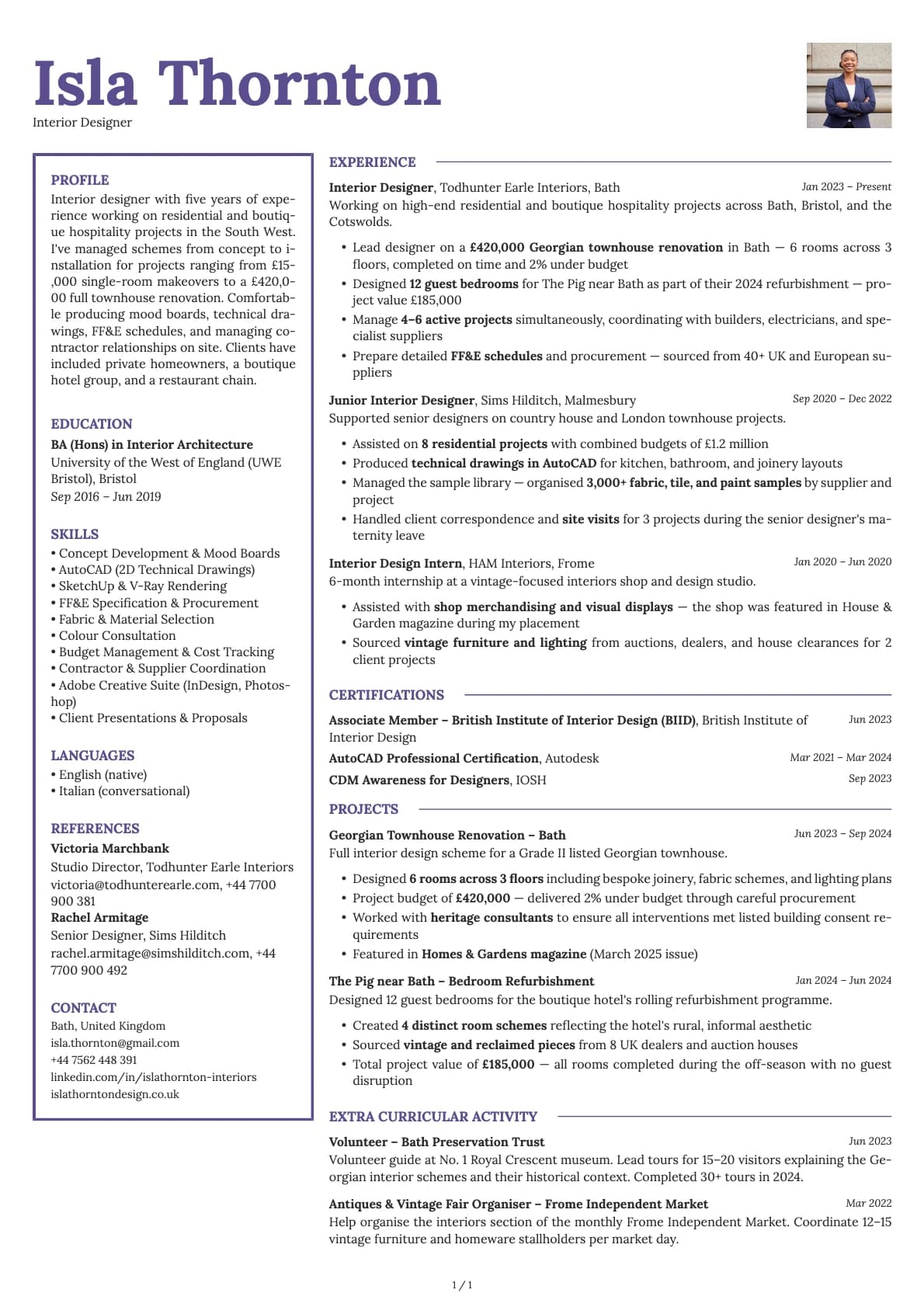
An interior designer resume example with project budgets, client types, and FF&E details. See how to present residential and hospitality design experience.
Photographer
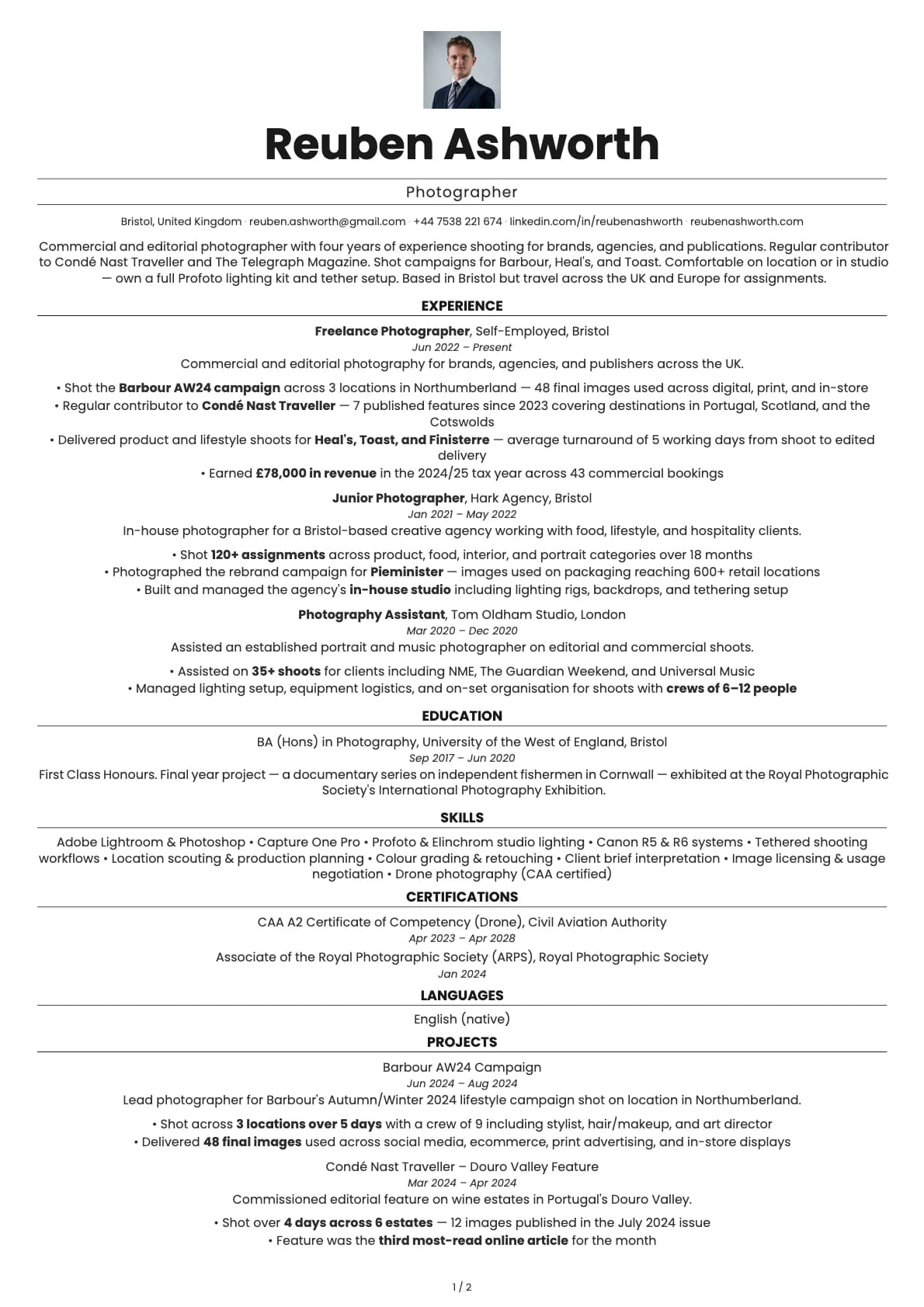
A photographer resume example with commercial campaign work, editorial credits, and revenue figures from a freelance career.
Content Writer
A content writer resume example with in-house and agency experience writing for FreeAgent, Xero, and Starling Bank.
Copywriter
A copywriter resume example with McCann and Saatchi & Saatchi experience. See how to showcase your portfolio, campaign results, and tone of voice.
Video Editor
A video editor resume example with 4 years of experience cutting branded content and social video at Channel 4.
Creative Director
A creative director resume example with 14 years in advertising, Cannes Lions wins.
Related articles

AI Is Screening Your Resume Before Any Human Sees It
AI screens most resumes before a human ever reads them. 97.4% of Fortune 500 companies run an ATS. This is what that means for you and what you can do about it.

The Best Resume Builders in 2026, Compared Honestly
Resume.io, Zety, Enhancv, Kickresume, Teal, and Laddro compared honestly: real pricing, free tiers, mobile apps, and where each tool wins. All prices checked in September 2026.

Burnout Recovery: A Real Timeline, Not 'Take a Bubble Bath'
55% of the U.S. workforce is burned out. Recovery takes 3 to 12 months. Here's what that actually looks like, stage by stage.