Brand Manager Resume Example
A brand manager resume example from FMCG with campaign budgets, NPD launches, and Nielsen/Kantar data experience across PZ Cussons and Premier Foods.

Laddro Team
Free to use. No account needed to start.
Free to use. No account needed to start.
Overview
Brand management resumes in FMCG tend to split into two types. There are the ones that read like a marketing textbook ("developed brand strategies to enhance consumer engagement") and the ones that read like a P&L ("launched 3 SKUs into Boots, £2.4 million first-year retail sales"). Hiring managers at FMCG companies want the second type.
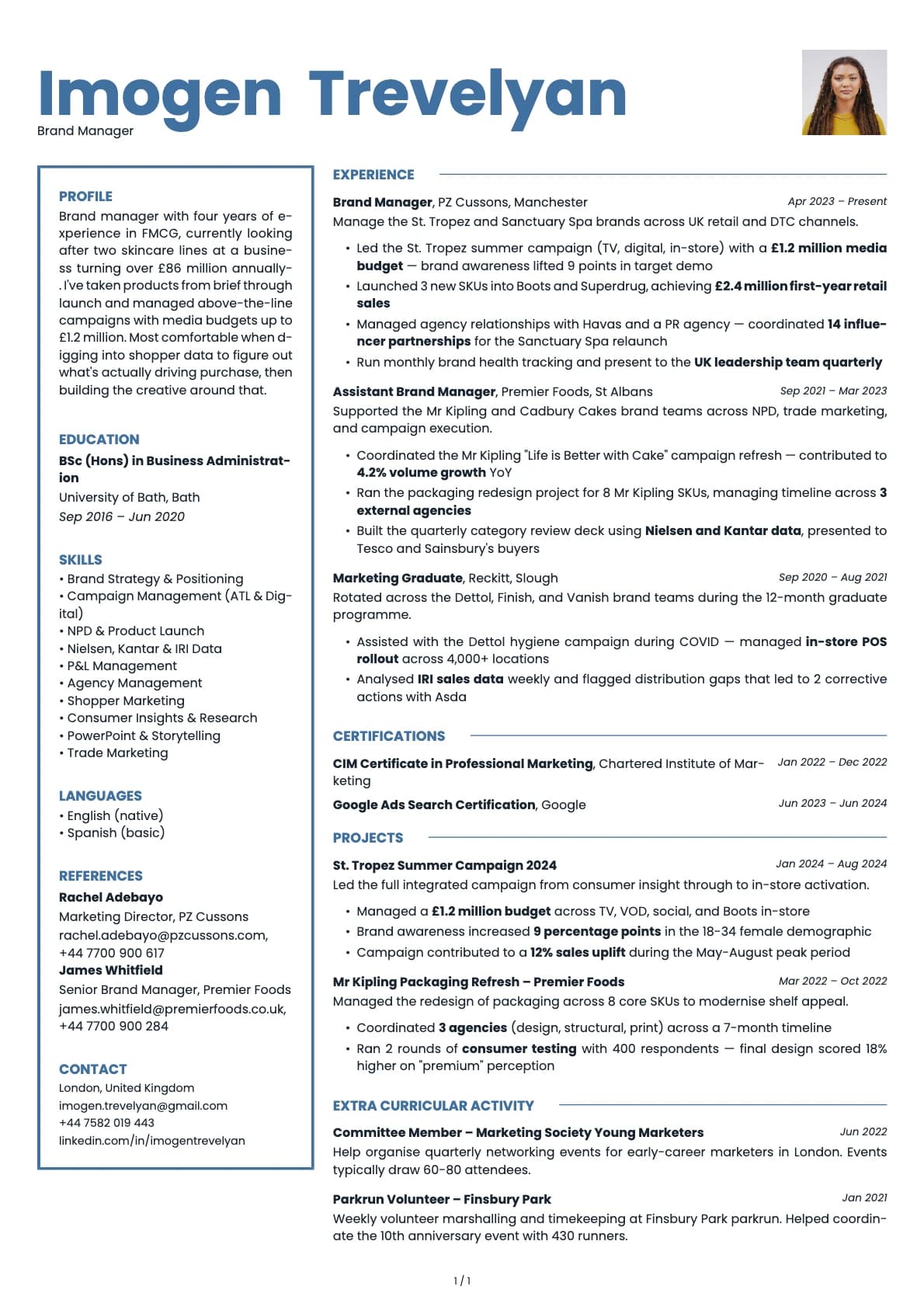
This resume belongs to Imogen Trevelyan, a brand manager with four years in FMCG. She currently manages the St. Tropez and Sanctuary Spa brands at PZ Cussons, handling campaigns with media budgets up to £1.2 million. Before that, she worked on Mr Kipling and Cadbury Cakes at Premier Foods, and started on the Reckitt graduate programme rotating across Dettol, Finish, and Vanish.
What makes this resume strong is the commercial language. Media budgets, sales uplift percentages, SKU launches, retailer names, and data sources (Nielsen, Kantar, IRI). Let us break it down.
Summary: brands, budgets, and what you are best at
In FMCG brand management, your summary should name the brands you manage, the budget size, and your commercial strength. Hiring managers are scanning for these three things before they read another word.
Imogen's summary:
Brand manager with four years of experience in FMCG, currently looking after two skincare lines at a business turning over £86 million annually. I've taken products from brief through launch and managed above-the-line campaigns with media budgets up to £1.2 million.
She names the business turnover. She mentions ATL campaigns. She gives the budget size. And the last line about "digging into shopper data to figure out what's actually driving purchase" tells the reader she is analytics-led, not just creative.
For yours: Name your category (skincare, bakery, beverages). Name your biggest budget. Then add one sentence about what you do best, whether that is NPD, campaign execution, or trade marketing.
Experience: campaigns need numbers, not adjectives
Brand manager bullets should read like mini case studies. What was the campaign? What was the budget? What happened?
Imogen's PZ Cussons role:
Led the St. Tropez summer campaign (TV, digital, in-store) with a £1.2 million media budget, brand awareness lifted 9 points in target demo
Launched 3 new SKUs into Boots and Superdrug, achieving £2.4 million first-year retail sales
Managed agency relationships with Havas and a PR agency, coordinated 14 influencer partnerships for the Sanctuary Spa relaunch
Every bullet has a number. The brand awareness lift (9 points) shows she knows how to measure campaign effectiveness, not just execute it. The retail sales figure (£2.4 million) shows NPD that actually sold. The influencer count (14 partnerships) shows she can manage scale.
The formula: What you did + The budget or scale + The measurable result.
"Managed a brand campaign" becomes "Led the St. Tropez summer campaign with a £1.2 million media budget, lifting brand awareness by 9 points in the 18-34 female demographic." Same work, completely different resume bullet.
The Assistant Brand Manager years
Most brand managers start as ABMs or marketing graduates. These roles involve a lot of execution and coordination, not always strategic decision-making. But you can still make them count.
Imogen's Premier Foods role:
Coordinated the Mr Kipling "Life is Better with Cake" campaign refresh, contributed to 4.2% volume growth YoY
Ran the packaging redesign project for 8 Mr Kipling SKUs, managing timeline across 3 external agencies
Built the quarterly category review deck using Nielsen and Kantar data, presented to Tesco and Sainsbury's buyers
The last bullet is important. Presenting to Tesco and Sainsbury's buyers is a big deal in FMCG. It shows she was trusted to be in the room with major retail partners, even at ABM level. If you have presented to retail buyers, category managers, or senior stakeholders, always include it.
Her graduate role at Reckitt is shorter. Two bullets. One about the Dettol campaign during COVID (in-store POS across 4,000+ locations) and one about using IRI data. Brief, relevant, done.
Skills: data tools and commercial skills
In FMCG, the data sources you know matter as much as the creative skills. Imogen lists "Nielsen, Kantar & IRI Data" as a single skill. This tells a hiring manager she can pull and analyse the three main data platforms used in UK grocery and pharmacy retail.
She also lists "P&L Management," which is critical at brand manager level and above. If you own a brand P&L, say so. It signals you think about profitability, not just brand awareness.
Other smart inclusions: "Shopper Marketing," "NPD & Product Launch," and "Agency Management." These are the core tasks of a brand manager, but stated in specific enough terms to match job descriptions.
One thing to note about certifications: Imogen has a CIM Certificate in Professional Marketing. The Chartered Institute of Marketing (CIM) is the recognised professional body for marketing in the UK. If you have CIM qualifications, list them. If you are working towards them, include it as in progress. Many larger FMCG companies view CIM as a sign of professional commitment.
The graduate programme: name the brands
If you went through an FMCG graduate programme (Reckitt, Unilever, P&G, Mars, PepsiCo), the brands you rotated across are your selling point. Imogen names Dettol, Finish, and Vanish. Even though she was a junior, those brand names signal the quality and scale of the programme.
If you rotated across brands, name them all. If you only worked on one, name it and describe your contribution in detail.
Mistakes brand managers make on their resume
Using marketing buzzwords instead of numbers. "Enhanced brand visibility" means nothing without a metric. "Lifted brand awareness by 9 points in target demo" means everything. Every brand manager has access to tracking data. Use it.
Not naming retailers. In FMCG, the retailers you have worked with matter. If you have presented to Tesco, Sainsbury's, Boots, or Superdrug buyers, name them. If your product is listed in those stores, say which ones.
Forgetting the data source. If you built a deck using Nielsen data, say "Nielsen." If your shopper insights come from Kantar, say "Kantar." These are the tools FMCG companies use daily, and naming them is an instant keyword match.
Overdesigning the resume. Brand managers might be tempted to use a highly visual template to show creative flair. But your resume goes through ATS first. Imogen uses Opal, which has a clean layout with some visual personality but does not sacrifice readability. That is the right balance.
One last thought
In FMCG, your career path is well defined: graduate, ABM, brand manager, senior brand manager, marketing director. Your resume should make the progression obvious. Imogen goes Reckitt graduate to Premier Foods ABM to PZ Cussons brand manager. Each step up is visible. If your career path is not as linear, use your summary to explain the thread that connects your roles. Maybe it is a category focus (always in personal care) or a skill focus (always in NPD). Find the narrative and make it clear.
Build your own version
Open this layout in the builder and swap in your own details. It takes a few minutes.
Free to use. No account needed to start.
Was this resume example helpful?
Rate this example to help us create better content for you.
4.8 average from 127 ratingsRelated resume examples
Marketing Manager
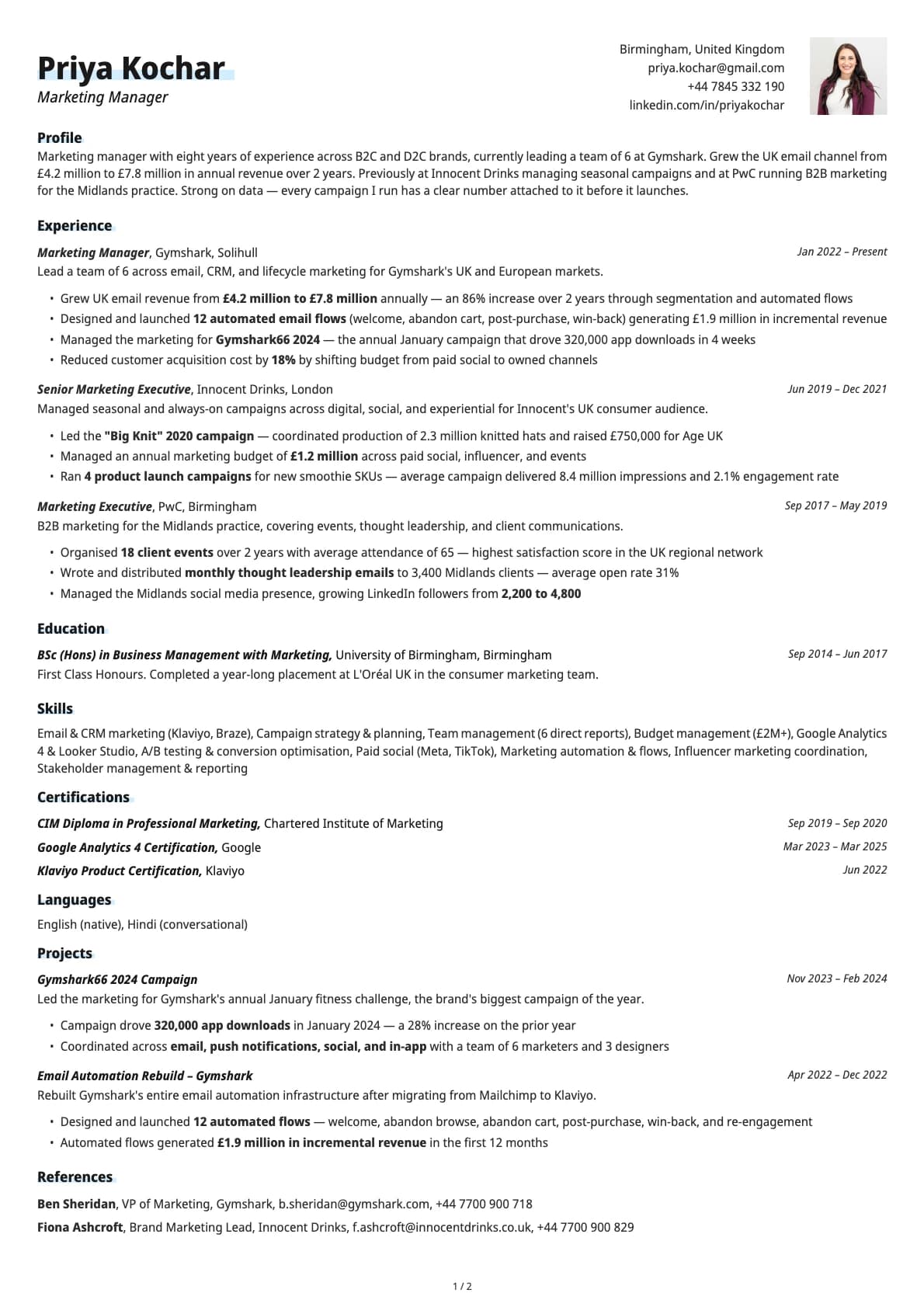
A marketing manager resume example with channel revenue growth, campaign results, and team management details.
Social Media Manager
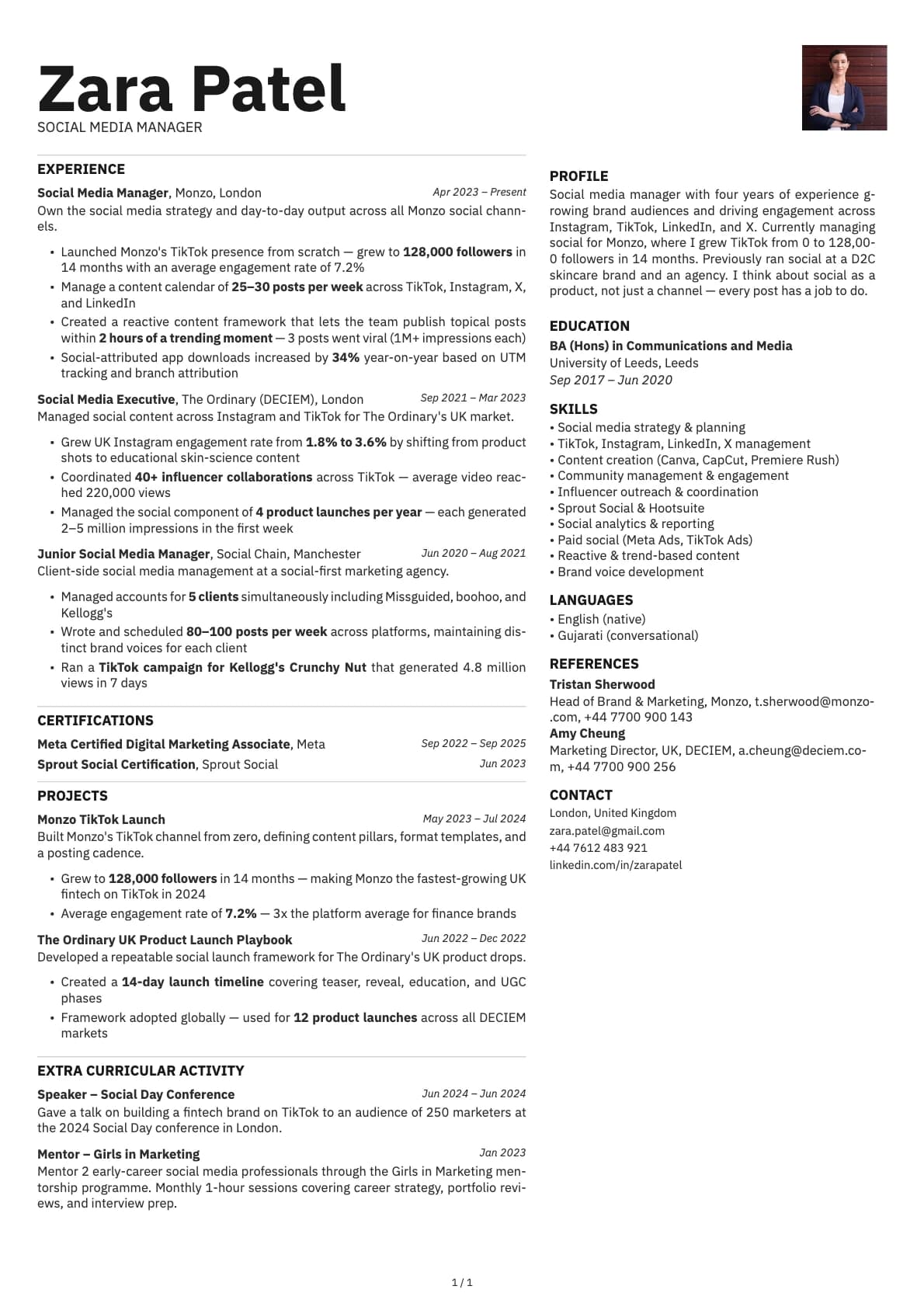
A social media manager resume example with follower growth, engagement rates, and campaign results.
Public Relations Manager
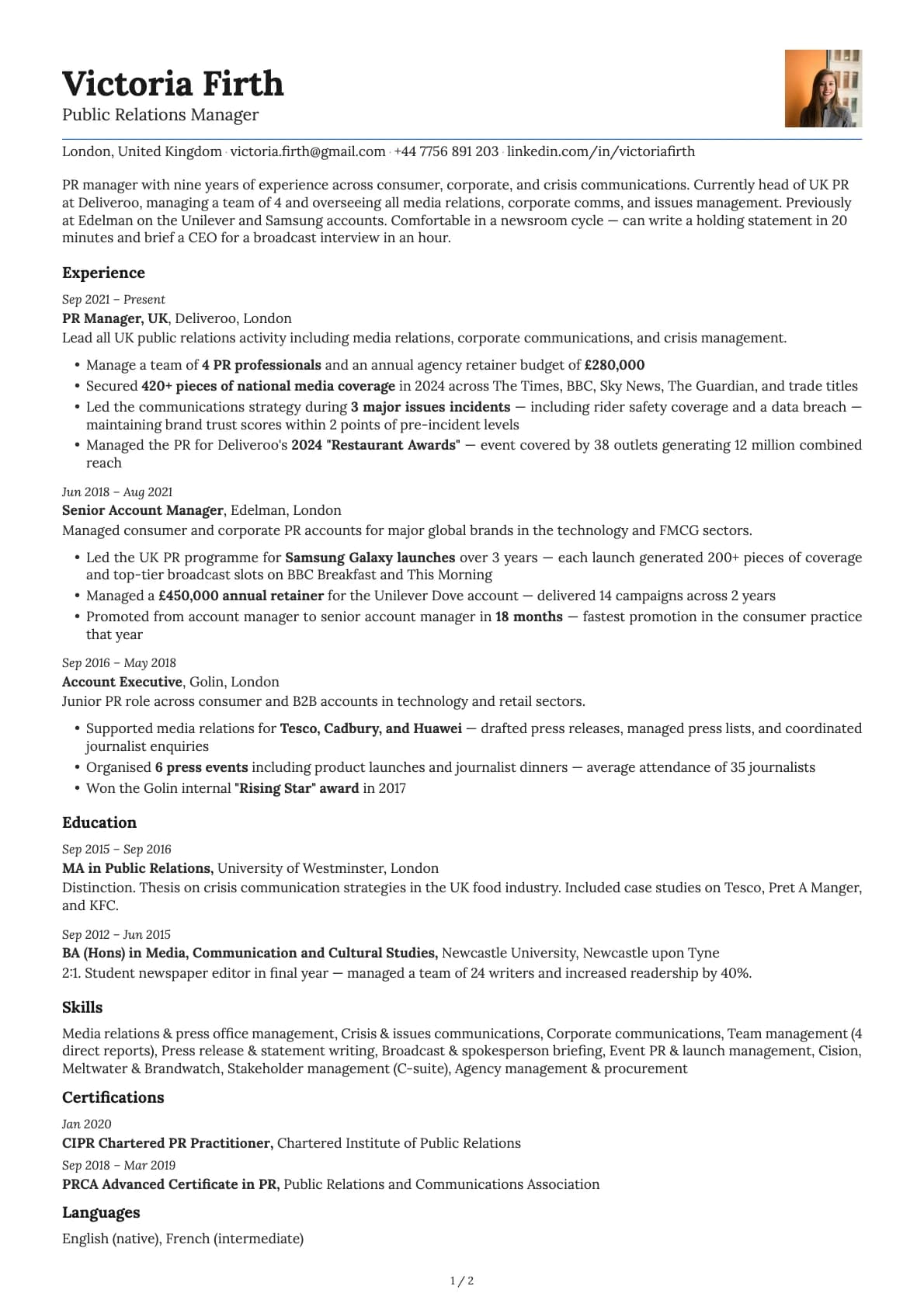
A public relations manager resume example with media coverage numbers, crisis communications experience, and campaign reach from agency and in-house roles.
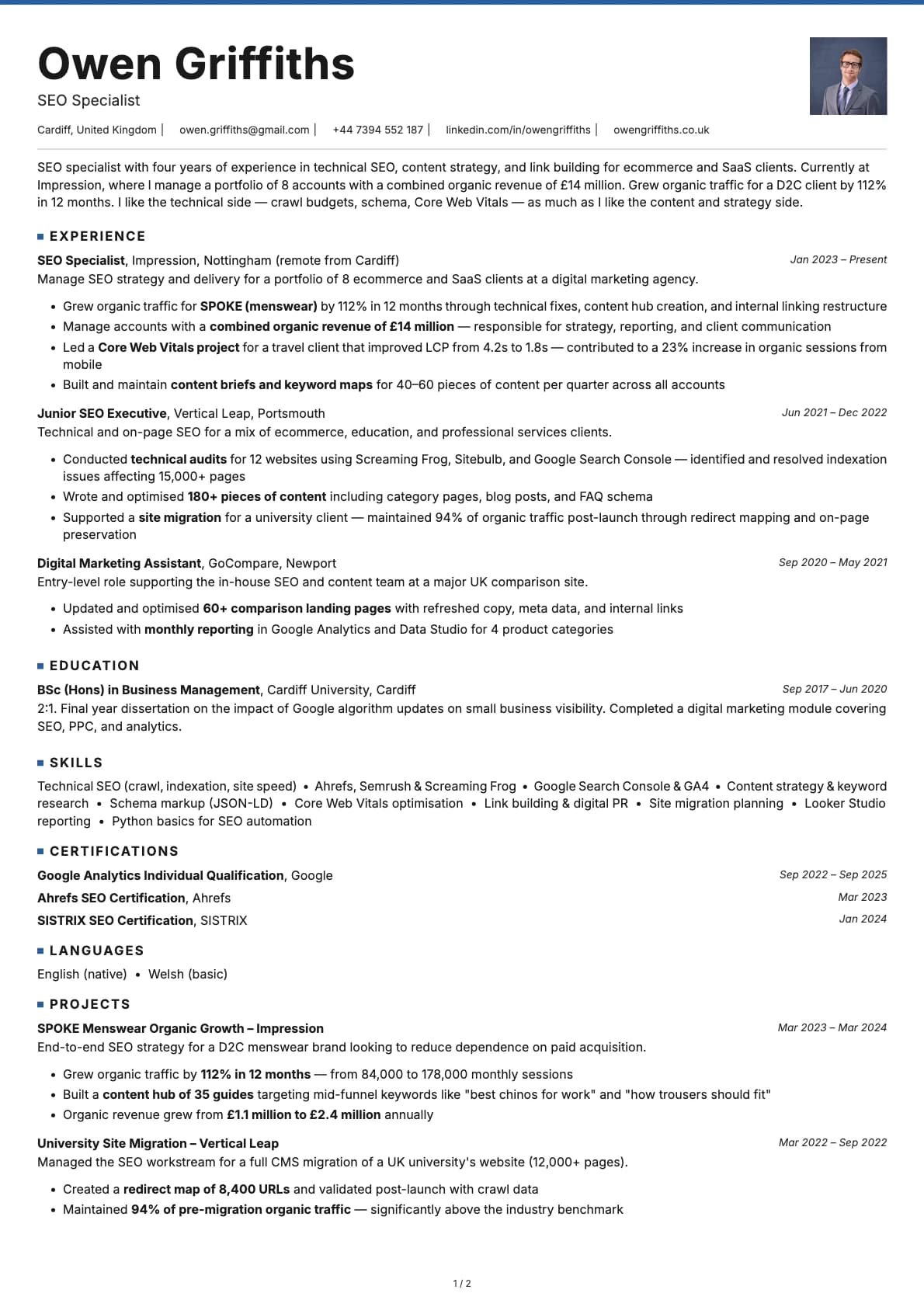
SEO Specialist
An SEO specialist resume example with traffic growth numbers, technical audit results, and content strategy outcomes.
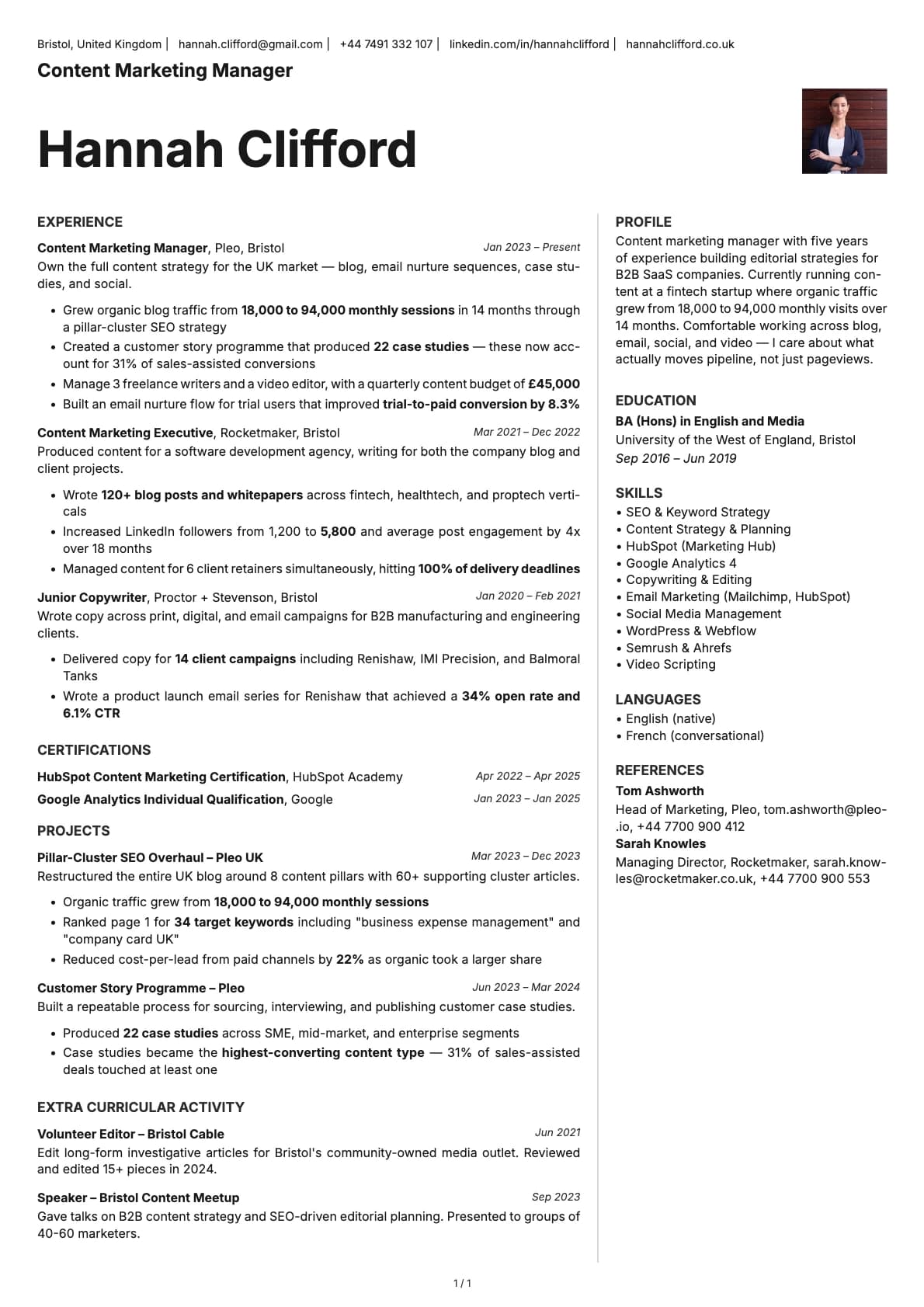
Content Marketing Manager
A content marketing manager resume example with B2B SaaS experience at Pleo.
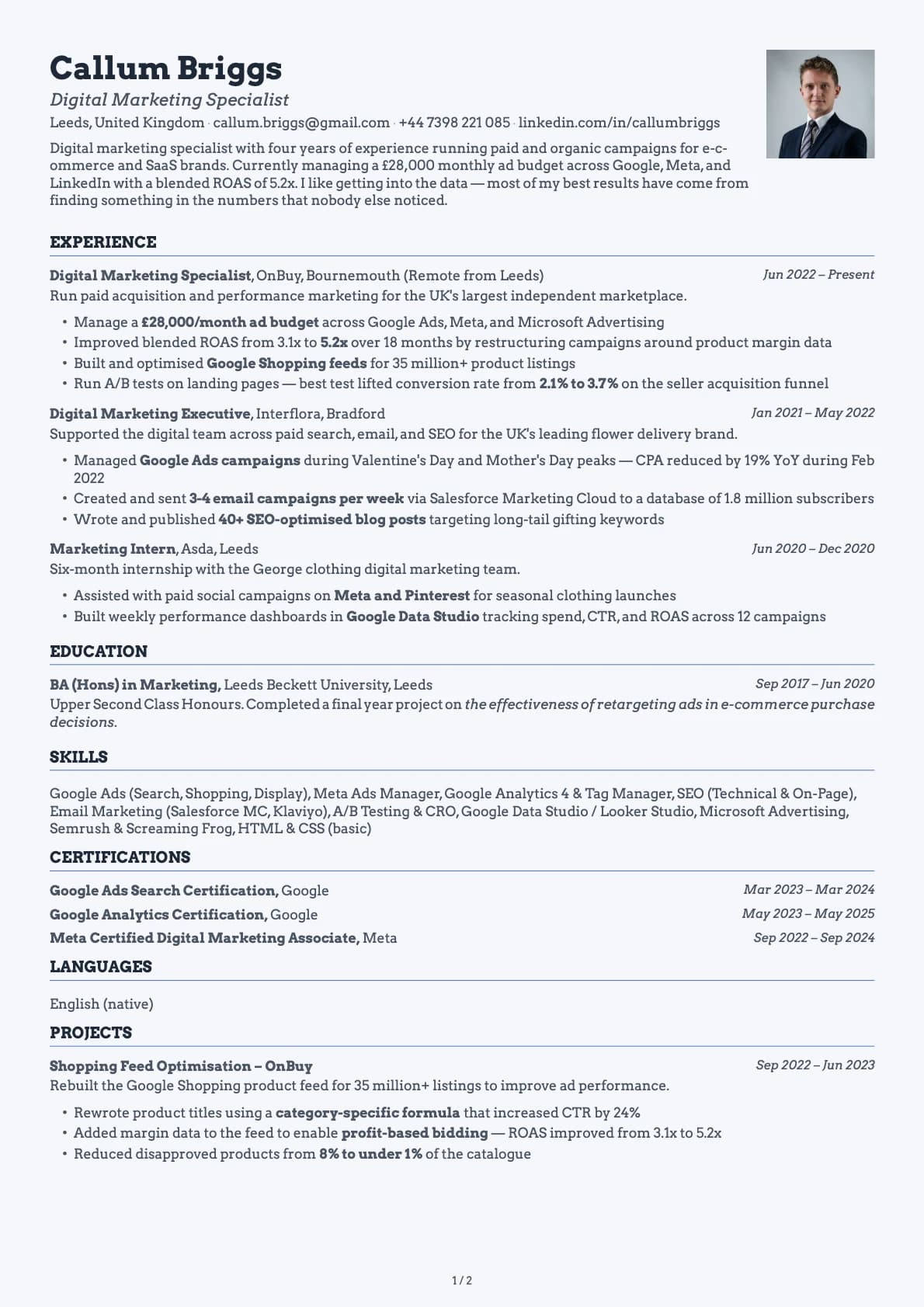
Digital Marketing Specialist
A digital marketing specialist resume example showing how to present campaign performance, ad spend management, and ROI numbers that recruiters actually.
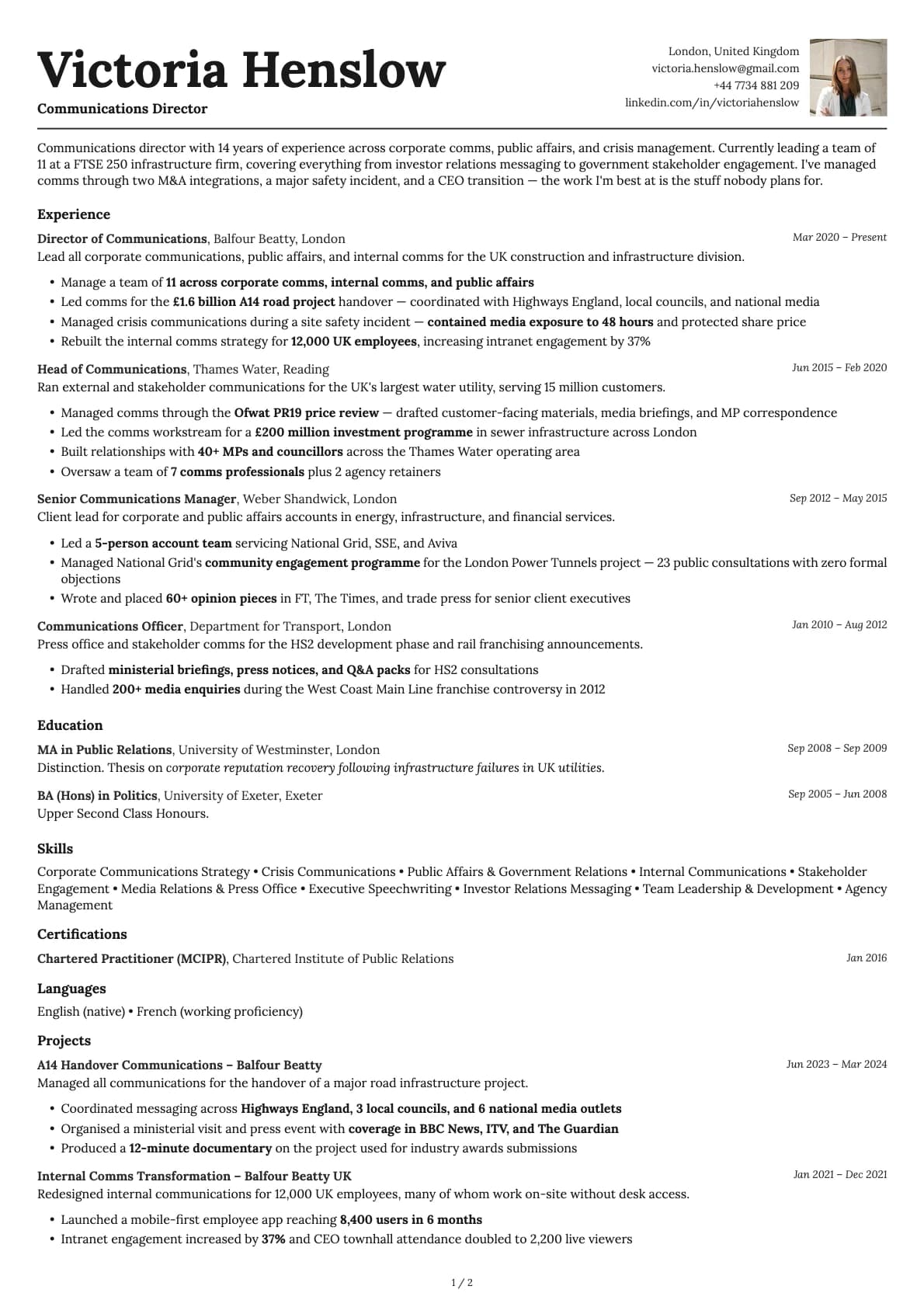
Communications Director
A communications director resume example with 14 years of experience across corporate comms, public affairs.
Related articles

AI Is Screening Your Resume Before Any Human Sees It
AI screens most resumes before a human ever reads them. 97.4% of Fortune 500 companies run an ATS. This is what that means for you and what you can do about it.

The Best Resume Builders in 2026, Compared Honestly
Resume.io, Zety, Enhancv, Kickresume, Teal, and Laddro compared honestly: real pricing, free tiers, mobile apps, and where each tool wins. All prices checked in September 2026.

Burnout Recovery: A Real Timeline, Not 'Take a Bubble Bath'
55% of the U.S. workforce is burned out. Recovery takes 3 to 12 months. Here's what that actually looks like, stage by stage.