Bartender Resume Example
A bartender resume example from a top Glasgow cocktail bar, covering drink volumes, GP targets, menu development, and how to present hospitality.

Laddro Team
Free to use. No account needed to start.
Free to use. No account needed to start.
Overview
Bartender resumes are often the weakest in hospitality. Not because bartenders lack skills, but because they write their resume like a job listing: "made cocktails, served customers, cleaned bar." Every bartender does those things. That is the job description, not a resume.
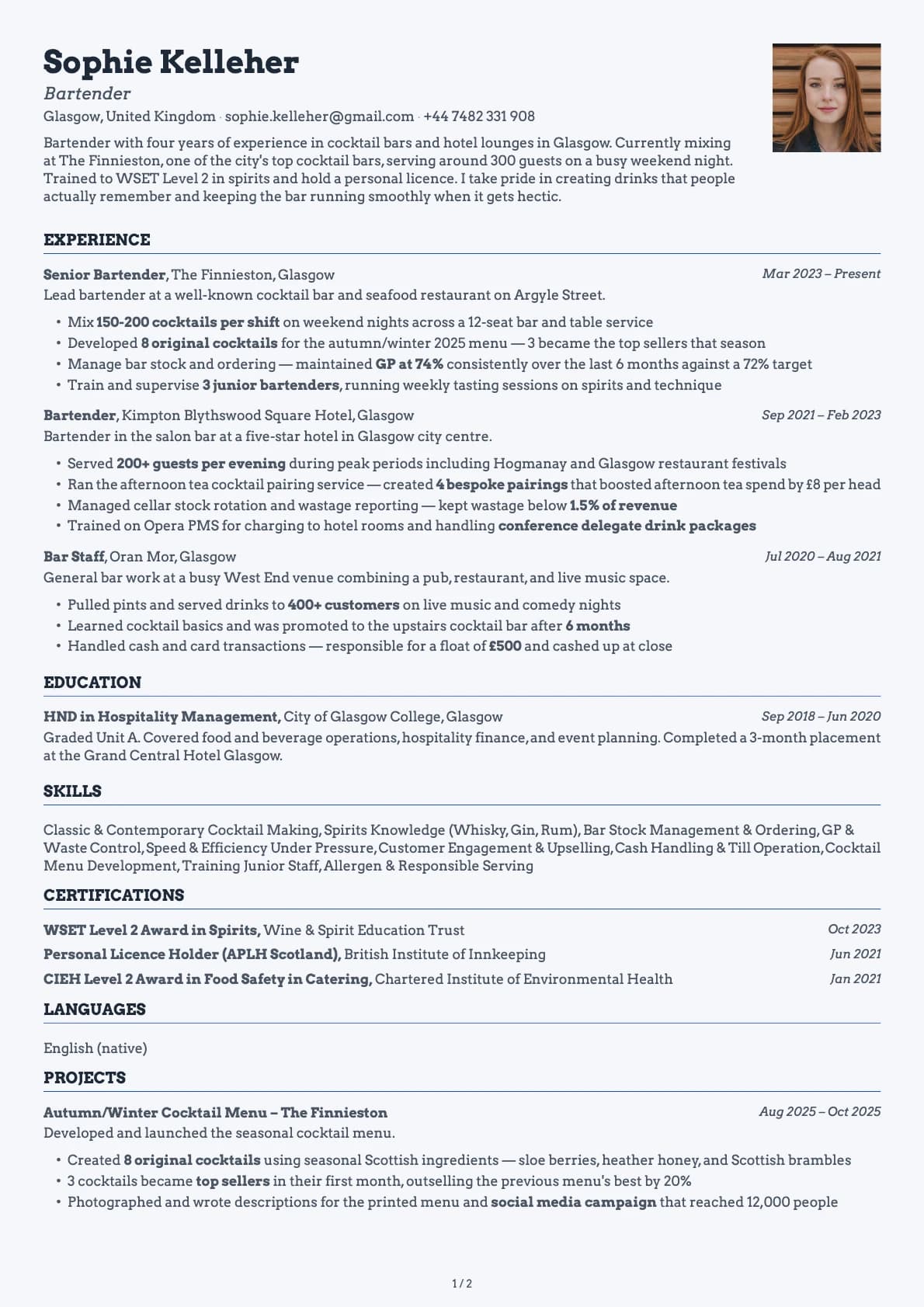
This resume belongs to Sophie Kelleher, a bartender with four years of experience in cocktail bars and hotel lounges in Glasgow. She currently works at The Finnieston, one of Glasgow's best-known cocktail bars, mixing 150-200 cocktails per shift on busy weekends. She has a WSET Level 2 in spirits, holds a personal licence, and has developed cocktails that became top sellers.
What makes this resume work is that Sophie treats bartending as a serious profession with measurable output. Drink counts, gross profit margins, revenue impact, and staff training. Let us go through how you can do the same.
Your summary: the venue, the volume, and your edge
Bar managers hiring for a good cocktail bar are not just looking for someone who can pour drinks. They want to know where you work now, how busy that venue is, and what sets you apart from the next applicant.
Sophie's summary:
Bartender with four years of experience in cocktail bars and hotel lounges in Glasgow. Currently mixing at The Finnieston, one of the city's top cocktail bars, serving around 300 guests on a busy weekend night. Trained to WSET Level 2 in spirits and hold a personal licence.
The venue name carries weight. If you work at a place with a reputation, name it. The guest count (300 on a weekend night) tells the hiring manager this person can handle volume. And the WSET and personal licence show professional development beyond just showing up for shifts.
For yours: Name your current venue. Give a volume number (guests per night, cocktails per shift). Then mention your most relevant qualification or specialism.
Experience: cocktails per shift, not "made drinks"
The number one rule for bartender resumes: quantify everything. How many drinks do you make per shift? What is your GP? How many staff do you train? If you do not know these numbers, start tracking them now.
Sophie's current role at The Finnieston:
Mix 150-200 cocktails per shift on weekend nights across a 12-seat bar and table service
Developed 8 original cocktails for the autumn/winter 2025 menu, 3 became the top sellers that season
Manage bar stock and ordering, maintained GP at 74% consistently over the last 6 months against a 72% target
Train and supervise 3 junior bartenders, running weekly tasting sessions on spirits and technique
That GP bullet is gold. In hospitality, gross profit is the number that matters most to the business. Showing you know yours and that it exceeds target tells a bar manager you understand the commercial side, not just the creative side. If you do not know your bar's GP, ask your manager. It is usually displayed somewhere in the weekly reports.
The formula: What you do + How much + The business impact.
"Served drinks to customers" becomes "Mix 150-200 cocktails per shift on weekend nights." "Helped with stock" becomes "Manage bar stock and ordering, maintaining GP at 74% against a 72% target."
Hotel bars vs. cocktail bars vs. pubs: it all counts
Sophie has worked at a cocktail bar, a five-star hotel, and a busy West End pub. Each type of venue teaches different skills, and she makes that clear in her descriptions.
The hotel role at Kimpton Blythswood Square:
Ran the afternoon tea cocktail pairing service, created 4 bespoke pairings that boosted afternoon tea spend by £8 per head
Managed cellar stock rotation and wastage reporting, kept wastage below 1.5% of revenue
Hotel bars are a different world from busy pubs. The service style is slower, the drinks are often more complex, and there is more emphasis on upselling and guest experience. Sophie highlights the revenue impact of her cocktail pairings (£8 per head increase) which shows commercial awareness.
Her pub role at Oran Mor is simpler, but still includes useful detail:
Learned cocktail basics and was promoted to the upstairs cocktail bar after 6 months
That promotion shows progression. If you started pulling pints and moved into cocktails, that is worth mentioning.
Skills: be specific to bartending
Bartender skills sections should not include "teamwork" or "communication." Every job requires those. Instead, list skills that are specific to your trade.
Sophie includes "Classic & Contemporary Cocktail Making," "Spirits Knowledge (Whisky, Gin, Rum)," "Bar Stock Management & Ordering," and "GP & Waste Control." These are industry skills that a bar manager can evaluate.
One important one that people forget: "Allergen & Responsible Serving." Allergen awareness is a legal requirement in hospitality. If you have training in this, list it. Same with responsible serving and challenge 25 compliance.
Certifications: WSET, personal licence, and food safety
Sophie lists three certifications: WSET Level 2 in Spirits, a Personal Licence (APLH Scotland), and a CIEH Level 2 in Food Safety. In bartending, these are not just nice-to-haves.
A personal licence is required if you want to be a designated premises supervisor or if the venue needs licence holders on shift. If you have one, it makes you more valuable to the business. WSET qualifications (especially Level 2 and above) show you have formal spirits knowledge beyond just knowing recipes. And food safety is expected in any venue that serves food alongside drinks.
Notice what is NOT on this resume: a LinkedIn profile. Sophie left it blank. For bartending, this is completely fine. Most bar managers are not checking LinkedIn. They are looking at your venues, your experience, and whether you have the right certifications. Do not add a LinkedIn just because you think you should.
Mistakes bartenders make on their resume
Not including venue names. Where you worked matters in hospitality. A hiring manager at a cocktail bar wants to see other cocktail bars on your resume, not just "bar staff at various locations." Name every venue.
Ignoring the commercial side. GP margins, wastage percentages, upselling results, and revenue impact are what separate a good bartender from someone who just makes drinks. If you can show you understand the business, you will be first in line for senior roles.
Writing the same bullets for every job. "Served drinks and maintained cleanliness" repeated three times is a waste of space. Each venue taught you something different. Show that.
Overdesigning the resume. Some bartenders go for flashy creative templates thinking it matches the industry. But if you are applying to a large hotel group or a hospitality company, your resume goes through an ATS first. Sophie uses Emerald, a clean single-column layout. It works everywhere.
One last tip
If you have competed in any bartending competition, even if you did not win, include it. Sophie finished 3rd out of 24 at Glasgow Cocktail Week's speed challenge. That tells a hiring manager she can perform under pressure and cares enough about the craft to put herself out there. Competitions, guest shifts at other bars, and charity bartending events all show initiative that a standard bar resume does not.
Build your own version
Open this layout in the builder and swap in your own details. It takes a few minutes.
Free to use. No account needed to start.
Was this resume example helpful?
Rate this example to help us create better content for you.
4.7 average from 96 ratingsRelated resume examples
Hotel Manager
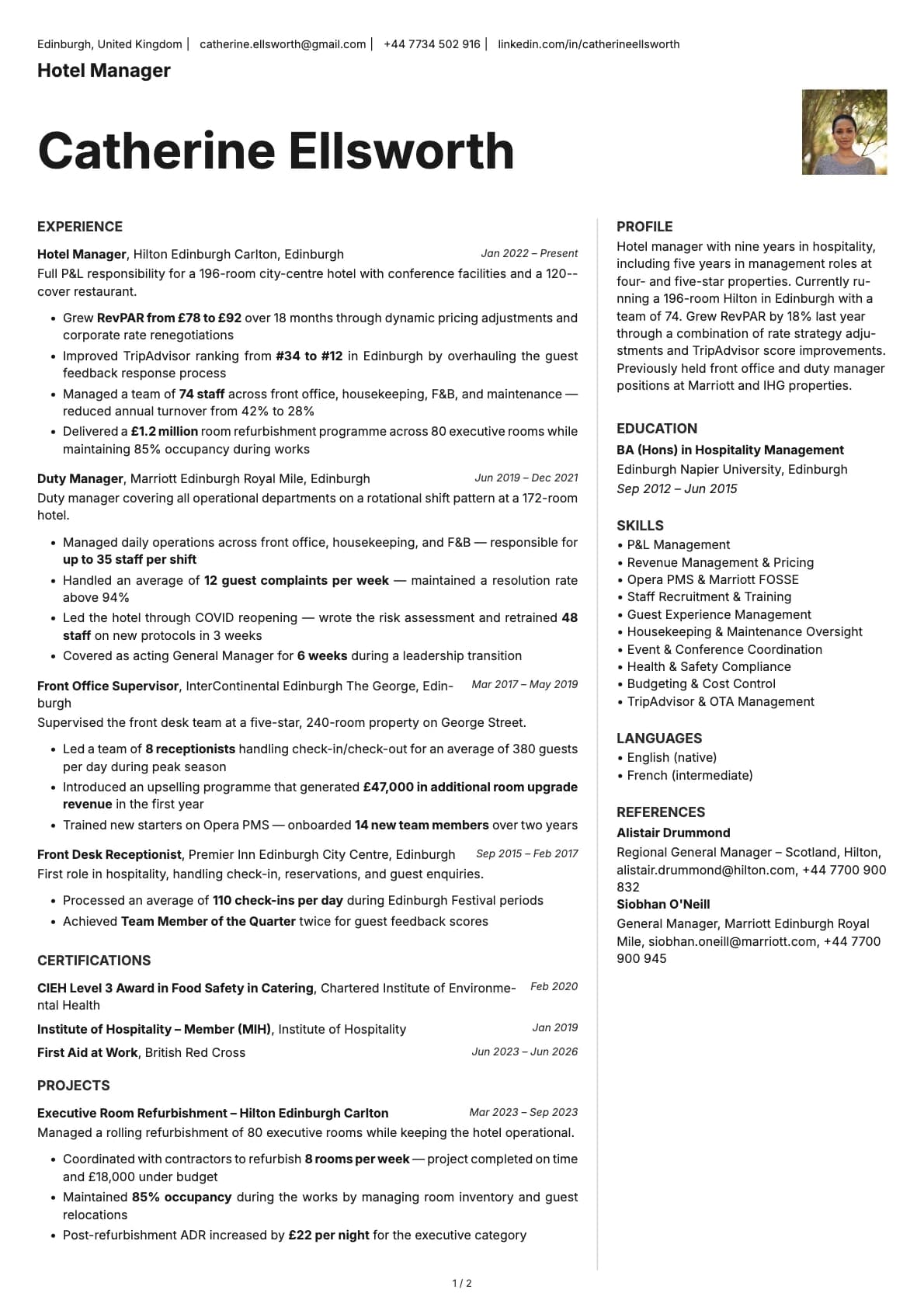
A hotel manager resume example with P&L ownership at a 196-room Hilton. See how to present RevPAR growth, team management, and guest satisfaction.
Chef
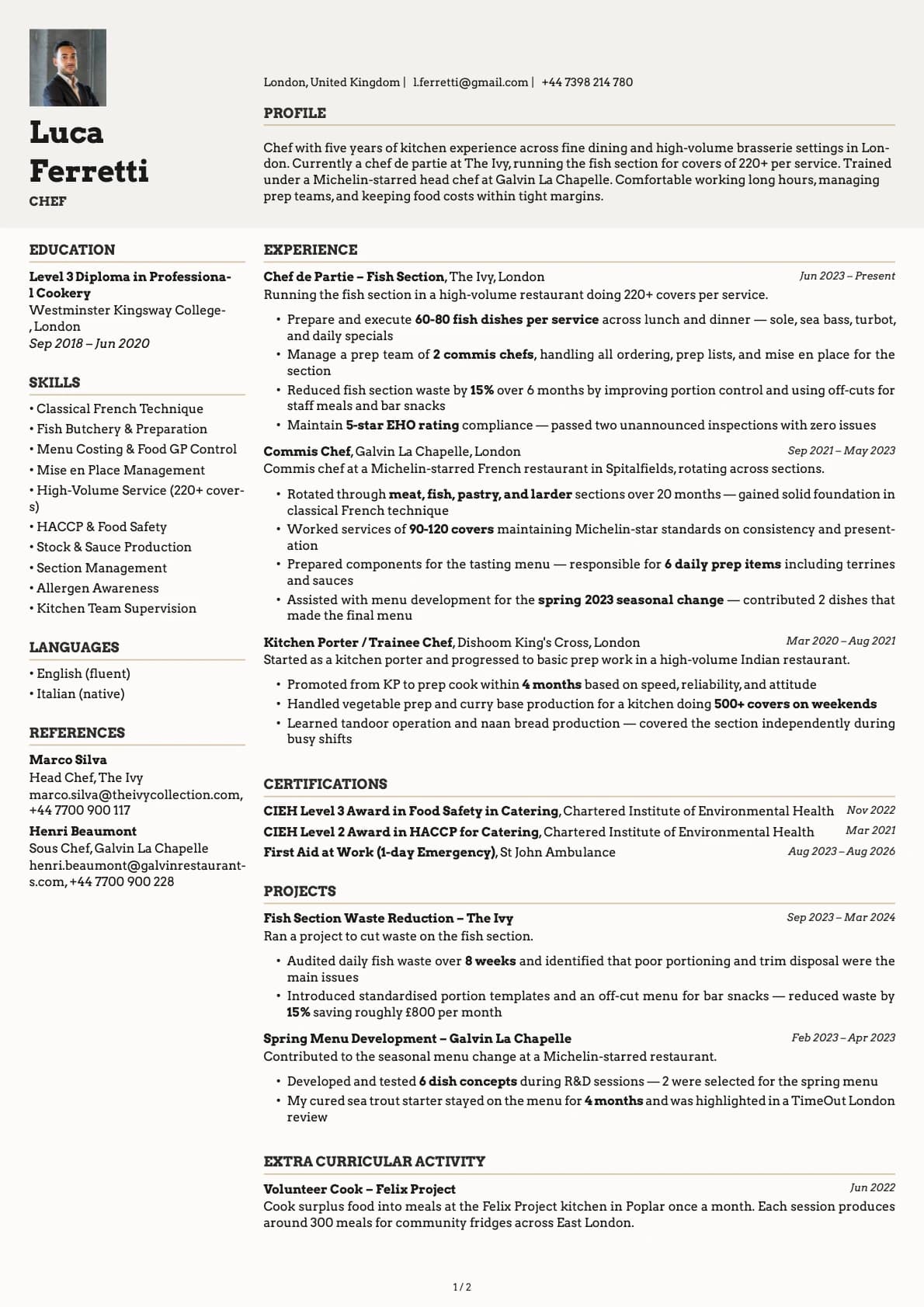
A chef resume example with fine dining and high-volume experience at The Ivy and Galvin La Chapelle.
Event Manager
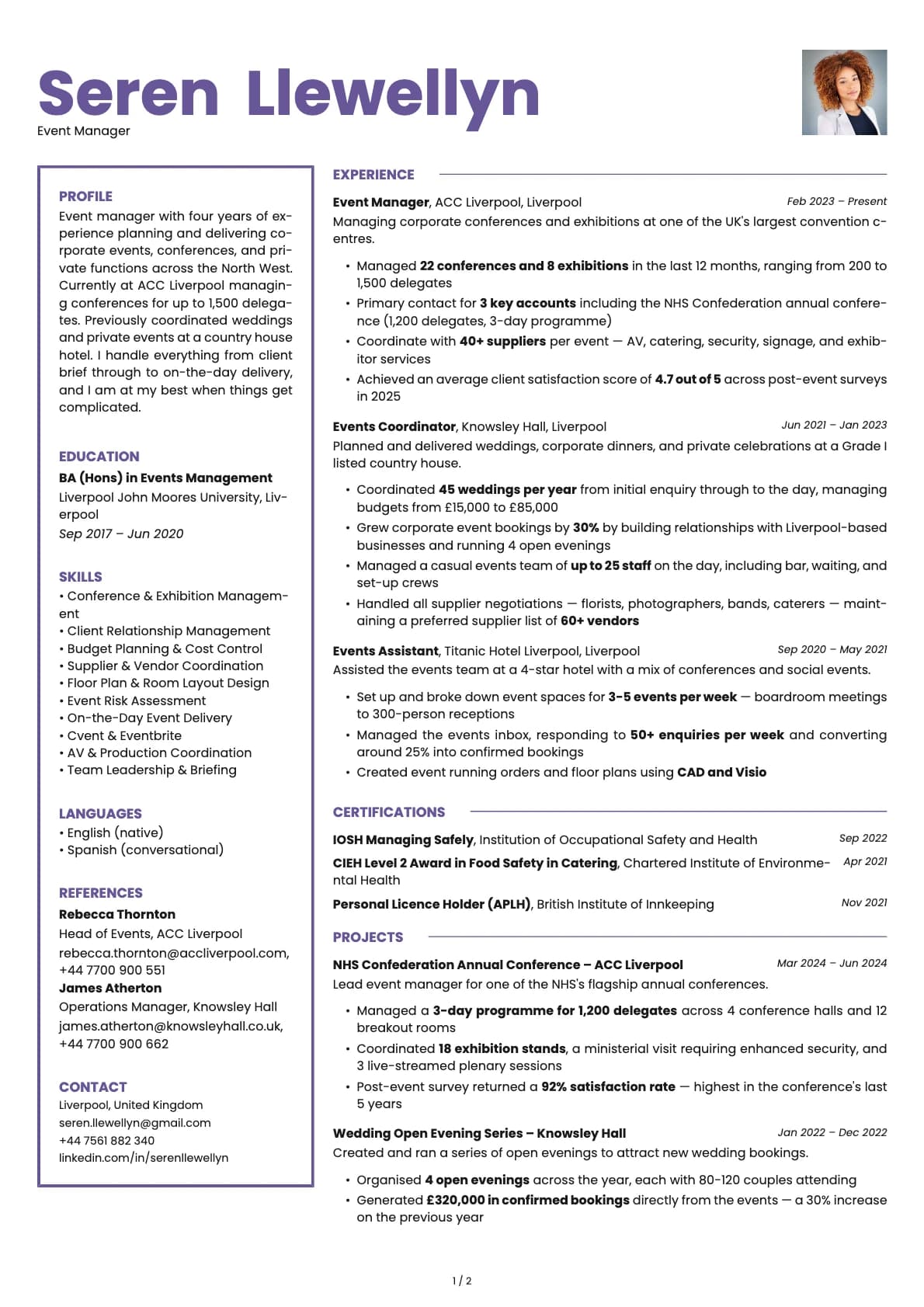
An event manager resume example with conference and wedding planning experience.
Server / Waiter
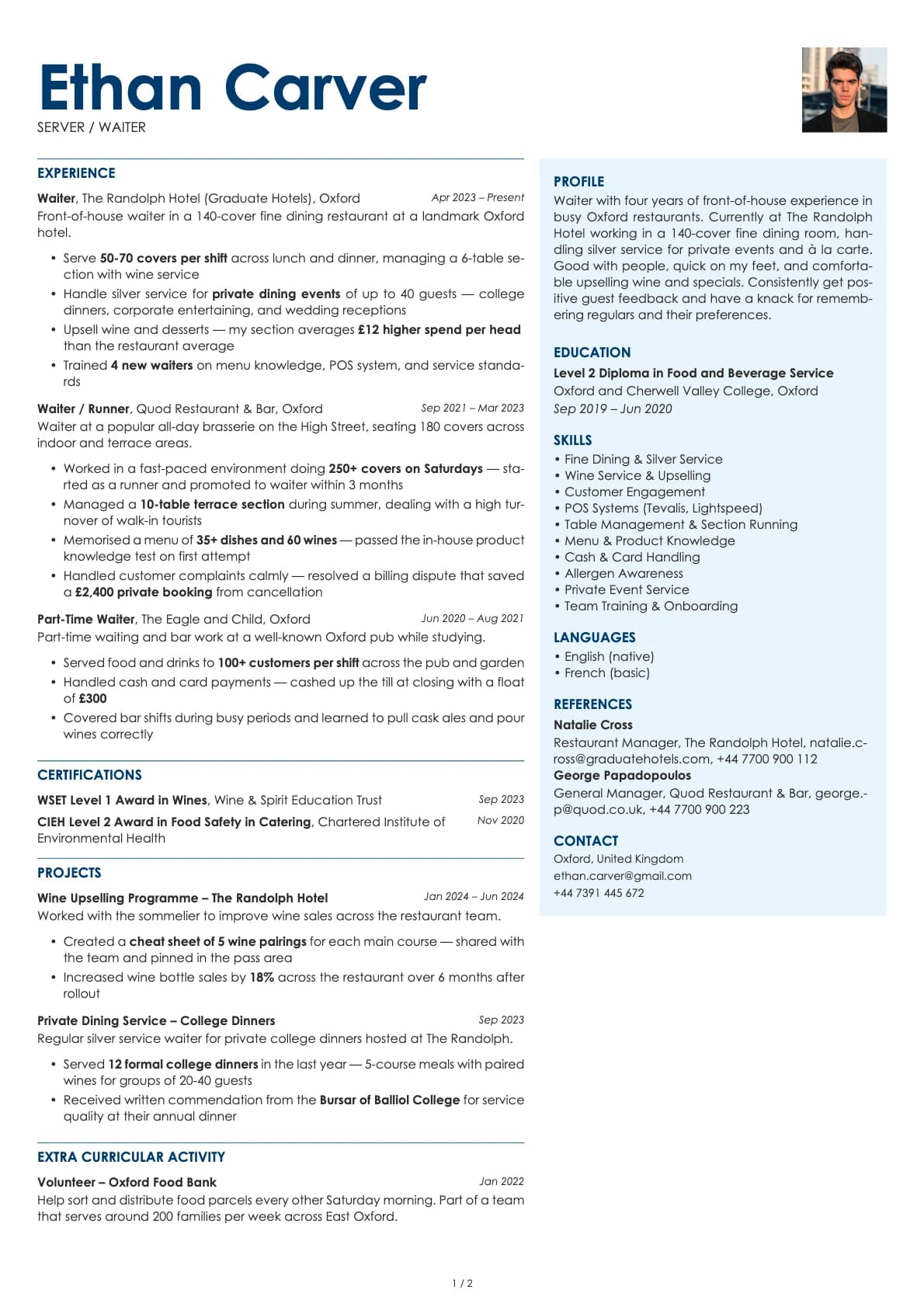
A server and waiter resume example with cover counts, upselling results, and private event experience.
Related articles

AI Is Screening Your Resume Before Any Human Sees It
AI screens most resumes before a human ever reads them. 97.4% of Fortune 500 companies run an ATS. This is what that means for you and what you can do about it.

The Best Resume Builders in 2026, Compared Honestly
Resume.io, Zety, Enhancv, Kickresume, Teal, and Laddro compared honestly: real pricing, free tiers, mobile apps, and where each tool wins. All prices checked in September 2026.

Burnout Recovery: A Real Timeline, Not 'Take a Bubble Bath'
55% of the U.S. workforce is burned out. Recovery takes 3 to 12 months. Here's what that actually looks like, stage by stage.