Chef Resume Example
A chef resume example with fine dining and high-volume experience at The Ivy and Galvin La Chapelle.

Laddro Team
Free to use. No account needed to start.
Free to use. No account needed to start.
Overview
Most chef resumes read like a job description. "Prepared food to a high standard." "Worked in a busy kitchen." "Maintained hygiene standards." Every chef in the country could write those exact words. They give the head chef hiring you absolutely no reason to call you in for a trial shift.
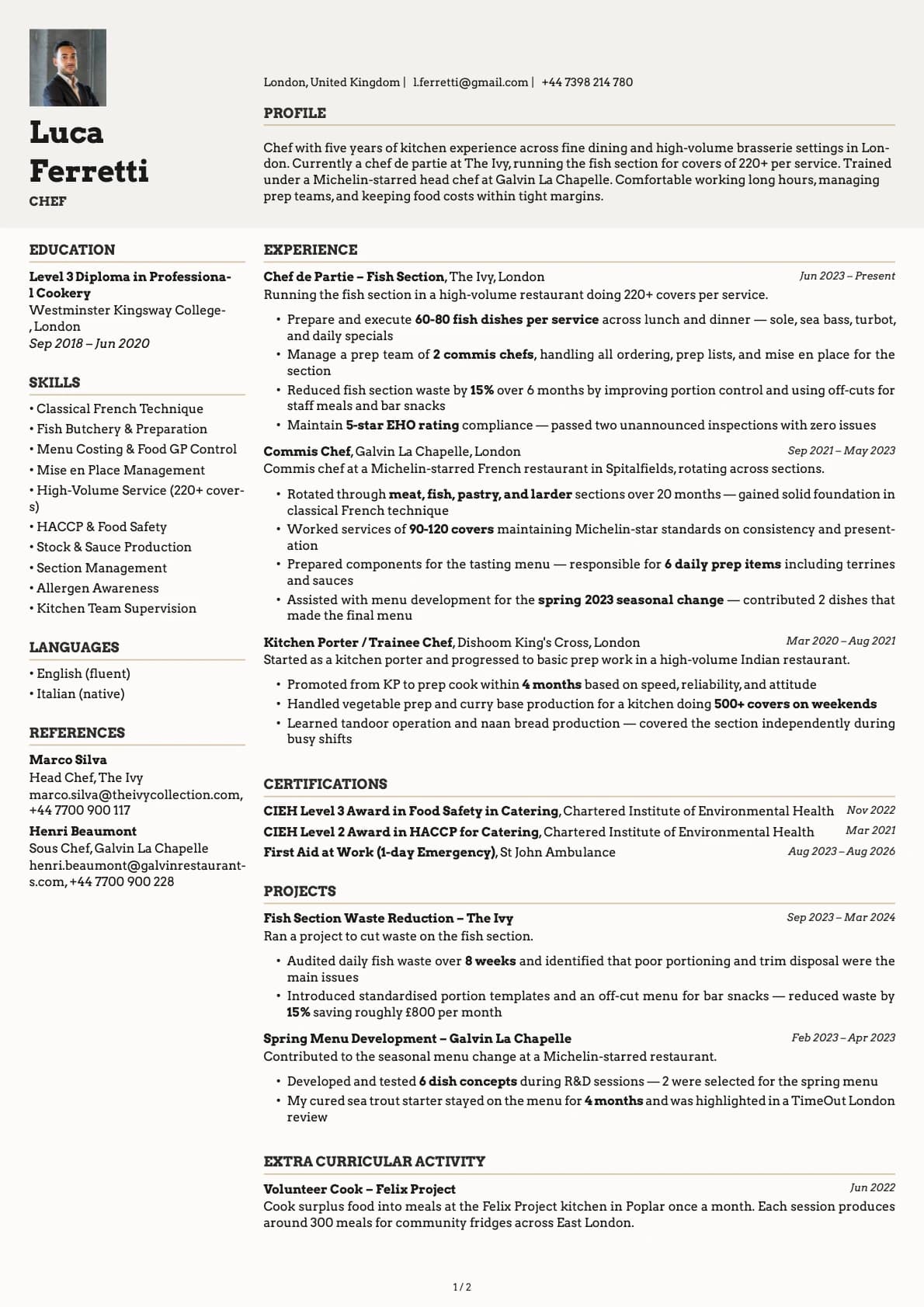
This resume belongs to Luca Ferretti, a chef de partie at The Ivy in London. Five years of experience. Started as a kitchen porter at Dishoom, trained at a Michelin-starred restaurant, and now runs the fish section doing 220+ covers per service. No LinkedIn. No personal website. Just a clean resume that tells you exactly what he can do, how fast he can do it, and what kitchens he has survived.
That last part matters. In hospitality, where you have worked says almost as much as what you did there. Let us break this down.
Your summary should read like a kitchen CV, not a cover letter
Head chefs do not want to read about your "love for creating culinary experiences." They want to know three things: What level are you? What kind of kitchen have you worked in? And how many covers can you handle?
Here is the summary from this resume:
Chef with five years of kitchen experience across fine dining and high-volume brasserie settings in London. Currently a chef de partie at The Ivy, running the fish section for covers of 220+ per service. Trained under a Michelin-starred head chef at Galvin La Chapelle.
That is it. No adjectives. No filler. The head chef reading this immediately knows the experience level, the section, the cover count, and the pedigree. Galvin La Chapelle is a known name. The Ivy is a known name. Mentioning them upfront does the selling for you.
For yours: State your current position and section. Name the restaurant. Give the cover count. If you trained somewhere notable, mention it. Delete everything else from your summary.
How to write your experience (covers, not cliches)
The experience section is where most chef resumes fall apart. They describe the job instead of showing the workload. Here is how this resume handles it:
"Prepare and execute 60-80 fish dishes per service across lunch and dinner, sole, sea bass, turbot, and daily specials"
That tells you the volume per service, the protein types, and that this is across two sittings. Compare that with "prepared fish dishes for the restaurant." Same job. Completely different impression.
Here is another good one:
"Reduced fish section waste by 15% over 6 months by improving portion control and using off-cuts for staff meals and bar snacks"
Now the head chef knows this person thinks about food costs. A 15% waste reduction on the fish section is real money. The resume even explains how it was done. Portion control and off-cut utilisation. Those are practical skills that translate to any kitchen.
The formula: What you cooked + how many covers + what happened because of your work. If you reduced waste, improved a process, or contributed to a menu, say so with numbers.
Show your kitchen progression
One thing this resume does well is showing a clear career path. Kitchen porter at Dishoom. Commis chef at Galvin La Chapelle. Chef de partie at The Ivy. Each step up is visible and logical.
The Dishoom entry is especially good:
"Promoted from KP to prep cook within 4 months based on speed, reliability, and attitude"
If you started as a KP, do not hide it. Being promoted from porter to prep is a story of progression. It shows you earned your place in the kitchen. And the Galvin entry shows training in a Michelin-starred environment:
"Rotated through meat, fish, pastry, and larder sections over 20 months, gained solid foundation in classical French technique"
Rotation across sections shows versatility. Twenty months at a starred restaurant shows you can handle the pressure and the standards. Head chefs reading this know exactly what Galvin La Chapelle demands.
Why chefs do not need LinkedIn
Notice that this resume has no LinkedIn profile and no personal website. That is normal for chefs. Nobody in a kitchen is checking your LinkedIn. Your references, your restaurant names, and your trial shift will tell them everything they need to know.
What does matter: your email address and phone number need to be correct and checked regularly. Kitchens hire fast. If they call you for a trial and you do not pick up, they are calling the next person.
Certifications and food safety
This resume lists three certifications. CIEH Level 3 Food Safety, CIEH Level 2 HACCP, and a First Aid at Work certificate. The Level 3 Food Safety is important because it is a legal requirement for anyone managing a section or supervising other chefs. Many CDP roles will not consider you without it.
If you only have a Level 2, that is fine for commis and demi chef roles. But if you want to move up, get the Level 3 done. It takes a couple of days and it removes a barrier on every application.
The HACCP certificate shows you understand hazard analysis and critical control points. If your current kitchen runs HACCP documentation and you have been involved in it, list that on your resume. EHO inspectors care about it, and so do head chefs who have been through a bad inspection.
One more detail. This resume mentions maintaining a "5-star EHO rating" and passing two unannounced inspections with zero issues. If your kitchen has a strong hygiene rating, reference it. It is a team achievement, but showing you were part of maintaining it matters.
The skills section: keep it kitchen-specific
The skills list on this resume is focused: Classical French Technique, Fish Butchery, Menu Costing & Food GP Control, HACCP & Food Safety, Section Management. These are all things a head chef can verify during a trial shift.
Do not list "teamwork" or "communication" on a chef resume. Every kitchen requires teamwork. It is not a skill to advertise. Instead, list the specific things you can do: butchery, pastry, larder, sauce production, menu development, allergen management. If you can run a section independently, say which one.
Mistakes that cost kitchen interviews
Not naming your restaurants. "Worked at a fine dining restaurant in London" is suspicious. If you worked somewhere good, name it. If you did not, still name it. The head chef wants to know where you have been.
Skipping cover counts. Every kitchen operates at a certain volume. 60 covers is different from 220 covers. Put the number on your resume.
Ignoring food cost experience. If you have ever been involved in ordering, waste tracking, or GP control, mention it. Kitchens run on margins. Showing you understand costs makes you more valuable than someone who only knows how to cook.
Using a complicated template. Chefs print resumes or email them as PDFs. Fancy layouts break when printed on a kitchen office printer. This resume uses Limestone, a simple layout with a photo. Clean and easy to scan.
One last thing
Chef recruitment works differently from most industries. A good resume gets you the trial shift. The trial shift gets you the job. Your resume needs to show you can handle the pace, you understand food safety, and you have worked in kitchens that the head chef respects. Keep it tight, name your restaurants, and always include the covers.
Build your own version
Open this layout in the builder and swap in your own details. It takes a few minutes.
Free to use. No account needed to start.
Was this resume example helpful?
Rate this example to help us create better content for you.
4.8 average from 147 ratingsRelated resume examples
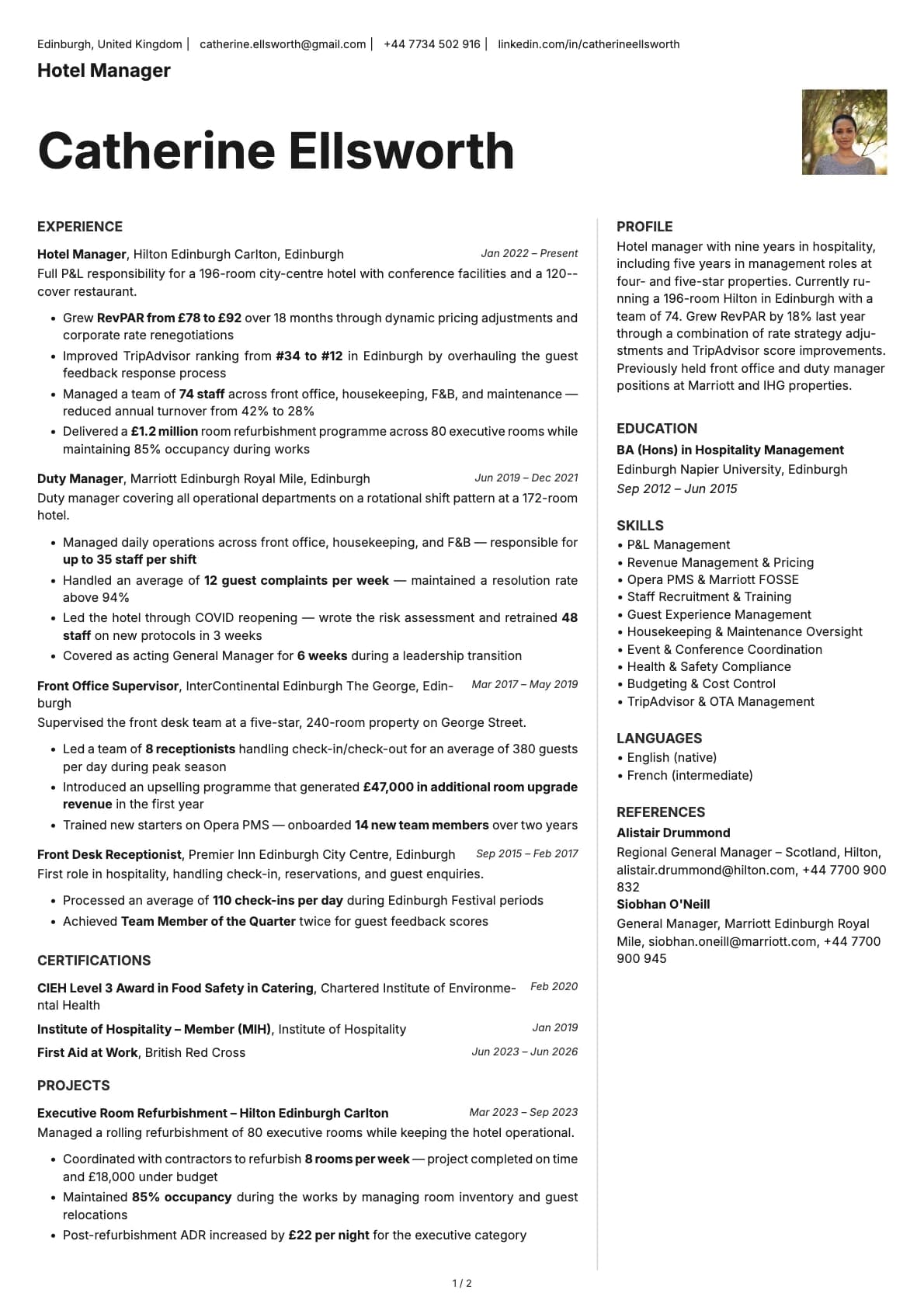
Hotel Manager
A hotel manager resume example with P&L ownership at a 196-room Hilton. See how to present RevPAR growth, team management, and guest satisfaction.
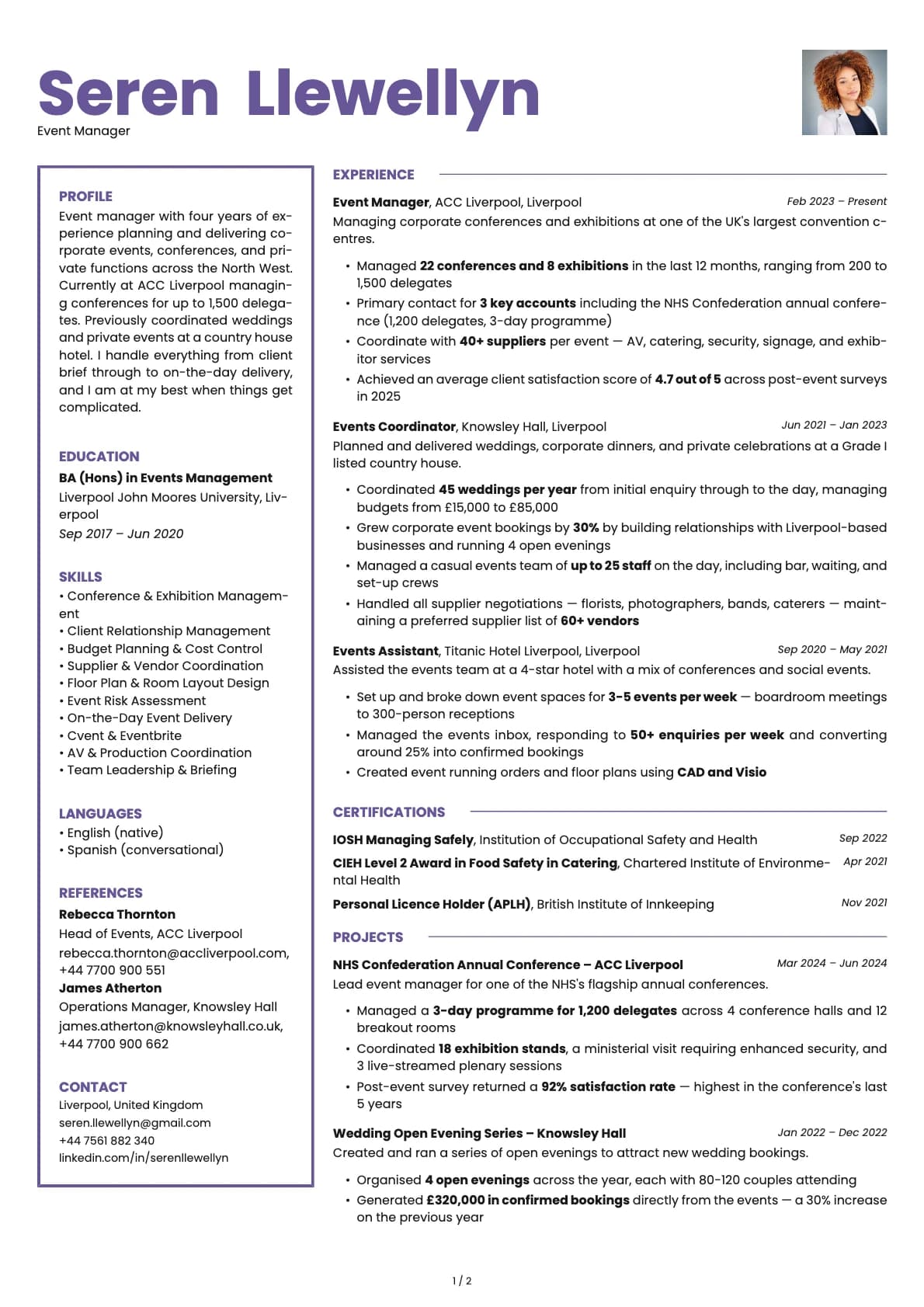
Event Manager
An event manager resume example with conference and wedding planning experience.
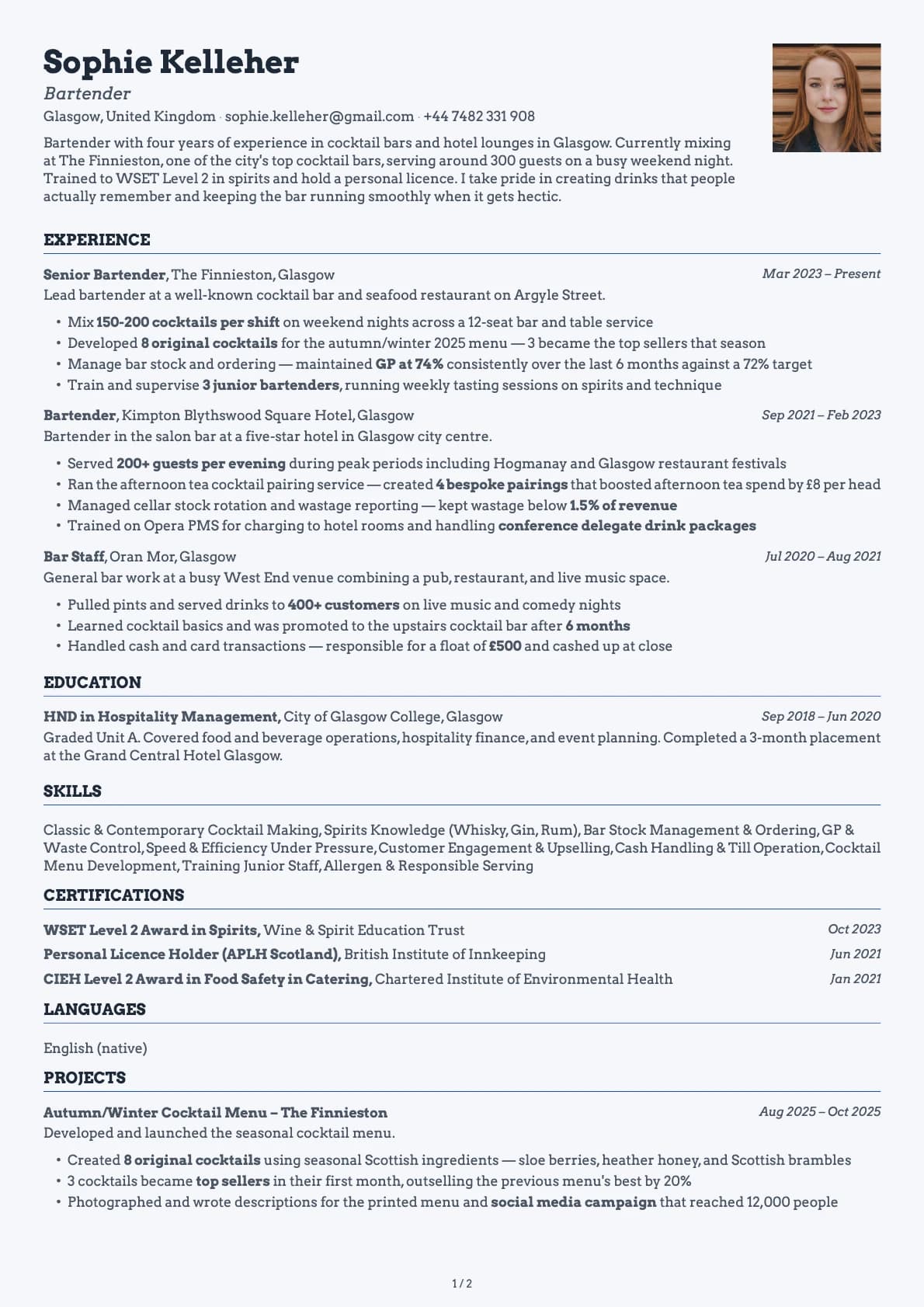
Bartender
A bartender resume example from a top Glasgow cocktail bar, covering drink volumes, GP targets, menu development, and how to present hospitality.
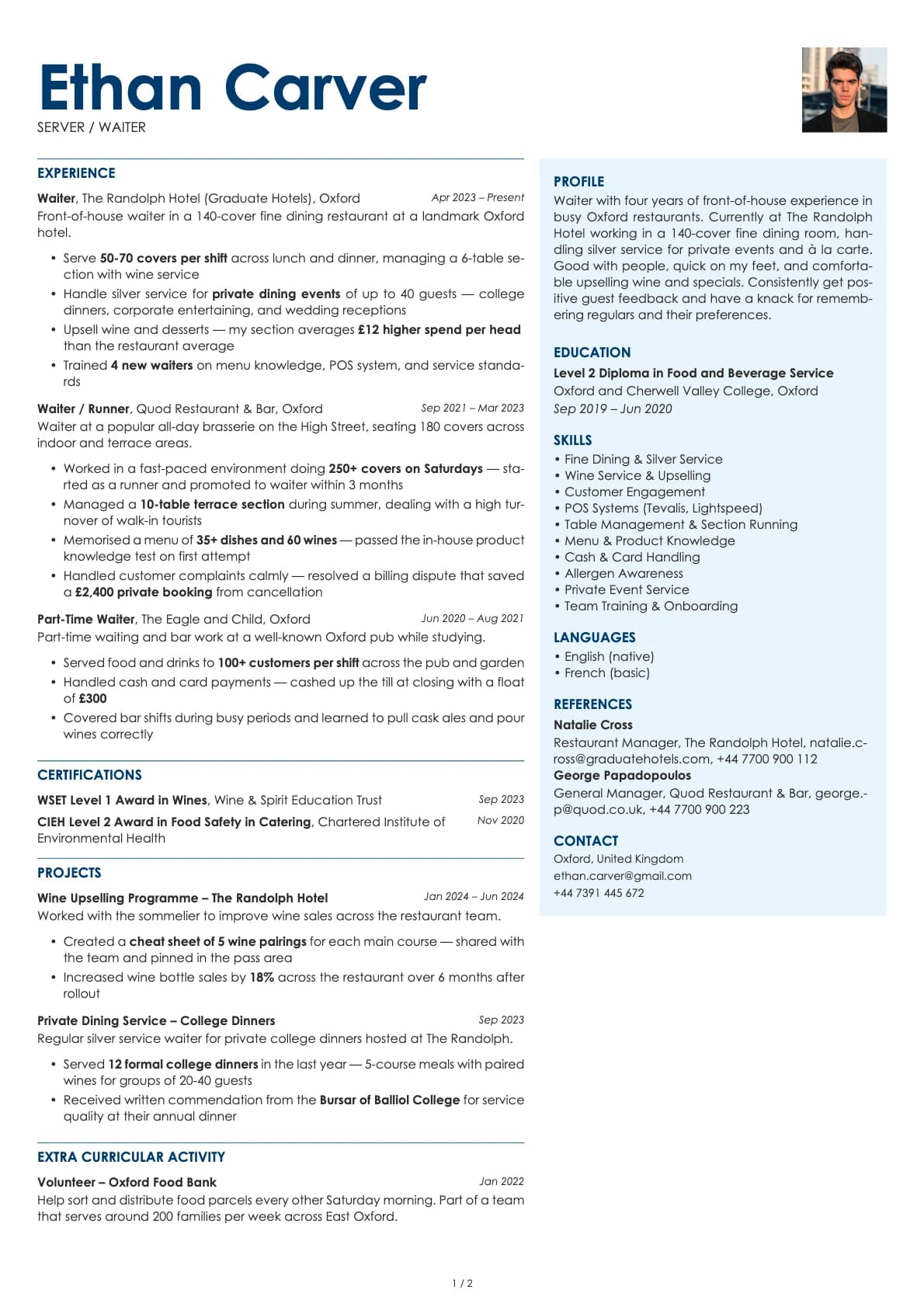
Server / Waiter
A server and waiter resume example with cover counts, upselling results, and private event experience.
Related articles

AI Is Screening Your Resume Before Any Human Sees It
AI screens most resumes before a human ever reads them. 97.4% of Fortune 500 companies run an ATS. This is what that means for you and what you can do about it.

The Best Resume Builders in 2026, Compared Honestly
Resume.io, Zety, Enhancv, Kickresume, Teal, and Laddro compared honestly: real pricing, free tiers, mobile apps, and where each tool wins. All prices checked in September 2026.

Burnout Recovery: A Real Timeline, Not 'Take a Bubble Bath'
55% of the U.S. workforce is burned out. Recovery takes 3 to 12 months. Here's what that actually looks like, stage by stage.