Lawyer Resume Example
A lawyer resume example for a commercial property solicitor with Magic Circle training and £28 million deal experience.

Laddro Team
Free to use. No account needed to start.
Free to use. No account needed to start.
Overview
Lawyer resumes in England and Wales follow their own conventions. The training contract still matters years after qualification. Your practice area needs to be obvious within three seconds. And deal values or caseload numbers are what separate a strong CV from a forgettable one.
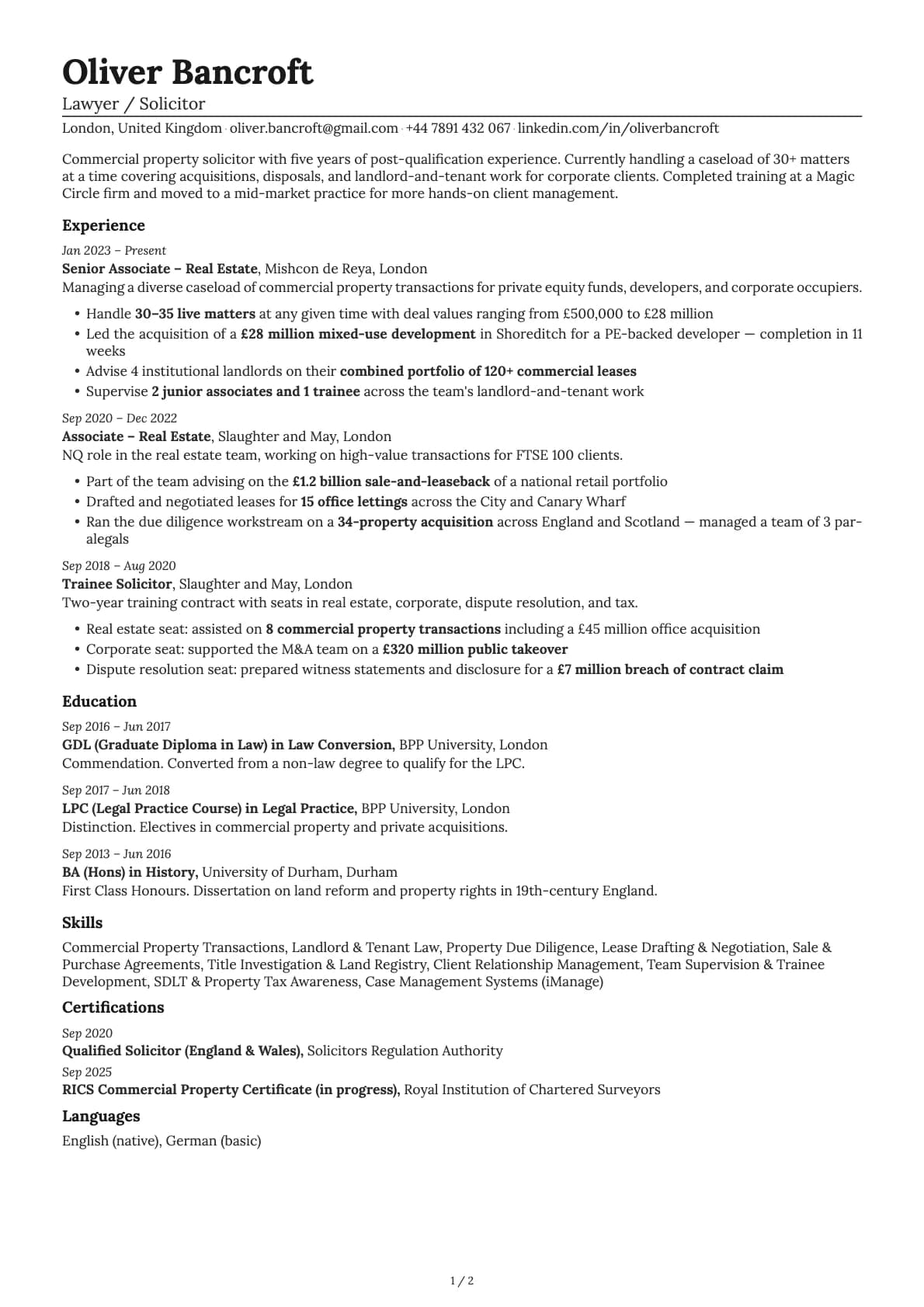
This resume belongs to Oliver, a Senior Associate in the Real Estate team at Mishcon de Reya. He has five years of post-qualification experience. He trained at Slaughter and May, qualified into their real estate team, and then moved to Mishcon for more hands-on client management. His caseload includes deals from 500,000 to 28 million, and he manages 30-35 live matters at any given time.
The resume works because it reads like a deal list with context. Every role has specific transactions, values, and outcomes.
Your summary: PQE, practice area, and current caseload
Legal recruiters scan the summary for three things: how many years PQE, what practice area, and what kind of work you do now. Give them all three immediately.
Oliver's:
Commercial property solicitor with five years of post-qualification experience. Currently handling a caseload of 30+ matters at a time covering acquisitions, disposals, and landlord-and-tenant work for corporate clients. Completed training at a Magic Circle firm and moved to a mid-market practice for more hands-on client management.
Three sentences. PQE, current caseload and work types, and the training background. He also explains the move from Slaughter and May to Mishcon, which is smart because lateral moves in law always prompt the question "why did they leave?" Saying he wanted more client management is a clear, positive answer.
Your formula: Practice area + PQE. Current caseload type and volume. Training contract firm and a one-sentence explanation of your career path.
Experience: deal values and caseload numbers
Legal hiring partners want to see what kind of matters you have handled and how much responsibility you had. Generic descriptions like "advised clients on commercial property matters" tell them nothing.
From Oliver's current role:
"Handle 30-35 live matters at any given time with deal values ranging from £500,000 to £28 million"
"Led the acquisition of a £28 million mixed-use development in Shoreditch for a PE-backed developer, completion in 11 weeks"
"Advise 4 institutional landlords on their combined portfolio of 120+ commercial leases"
"Supervise 2 junior associates and 1 trainee across the team's landlord-and-tenant work"
The first bullet gives caseload size and value range. The second names a specific deal. The third shows ongoing advisory relationships. The fourth shows team leadership.
From his time at Slaughter and May:
"Part of the team advising on the £1.2 billion sale-and-leaseback of a national retail portfolio"
"Ran the due diligence workstream on a 34-property acquisition across England and Scotland, managed a team of 3 paralegals"
Even though he was more junior here, the deal values are significant (1.2 billion), and he names his specific contribution (ran due diligence, managed paralegals). This is how to write about work at a large firm without overstating your role.
The training contract: what to include
Oliver's training contract gets its own entry with bullets from each seat:
"Real estate seat: assisted on 8 commercial property transactions including a £45 million office acquisition"
"Corporate seat: supported the M&A team on a £320 million public takeover"
"Dispute resolution seat: prepared witness statements and disclosure for a £7 million breach of contract claim"
This is the right approach. Name the seat, name the biggest deal you worked on, and describe your contribution in one line. Training contract entries should be concise. 2-4 years after qualification, the training contract still adds credibility (especially from a Magic Circle or top-tier firm), but it should not dominate the resume.
Education: GDL, LPC, and your degree
Oliver's education section lists his GDL (Commendation), LPC (Distinction), and BA from Durham (First Class). For solicitors in England and Wales, listing all three is standard if you did the GDL conversion route. If you did the SQE instead, list that.
The grades matter. A Distinction on the LPC or a First from a good university is worth noting. If your grades are solid, include them. If they are average, just list the qualification without the grade and let your experience do the talking.
One detail: Oliver's BA is in History, not Law. That is perfectly normal for a GDL convert and does not need explaining. But his dissertation topic ("land reform and property rights in 19th-century England") neatly connects to his current practice area. If your degree dissertation had any legal angle, mention it.
Skills: practice-specific and system-aware
Oliver's skills list includes "Commercial Property Transactions," "Lease Drafting & Negotiation," "Title Investigation & Land Registry," and "SDLT & Property Tax Awareness." These are practice-specific technical skills, not generic soft skills.
He also includes "Case Management Systems (iManage)." This is a small detail but a useful one. Law firms care about whether you know their systems. If you use iManage, NetDocuments, Aderant, or any other legal technology, include it.
Certifications and professional qualification
Oliver lists his SRA qualification first ("Qualified Solicitor, England & Wales"), which is correct. That goes at the top. He also lists an RICS Commercial Property Certificate as "in progress," which shows he is adding cross-disciplinary knowledge.
Your SRA or BSB qualification should always be the first certification listed. After that, include any specialist qualifications or courses that are relevant to your practice area.
Mistakes lawyers make on their resumes
Not naming deal values. "Advised on commercial property transactions" is meaningless without a value. Was it a 50,000 lease extension or a 28 million development acquisition? The difference matters. If confidentiality is a concern, describe the deal type and approximate value without naming the client.
Hiding the training firm. If you trained at a well-known firm, make it visible. The training contract still carries weight in legal recruitment, especially for lateral hires with under 10 years PQE. Put the firm name in your experience section and mention it in your summary.
Too much detail on early seats. Your training contract should have 1 bullet per seat, maybe 2. By the time you have 5+ years PQE, the training seats should not take up more than 3-4 lines total.
No supervision evidence. From about 3 years PQE, firms expect you to supervise trainees or junior associates. If you do, say how many people you supervise and what kind of work they do under your guidance.
Generic skills. "Excellent communication" and "attention to detail" belong nowhere on a legal CV. Replace them with practice-specific technical skills. Every solicitor needs attention to detail. It is not a differentiator.
One last tip
If you are making a lateral move (like Oliver's move from Slaughter and May to Mishcon), address the reason in your summary or cover letter. Legal recruiters always wonder why someone left a Magic Circle firm. Having a clear narrative ("wanted more client contact and hands-on deal leadership") makes the move look intentional, not like a step down.
Build your own version
Open this layout in the builder and swap in your own details. It takes a few minutes.
Free to use. No account needed to start.
Was this resume example helpful?
Rate this example to help us create better content for you.
4.8 average from 129 ratingsRelated resume examples
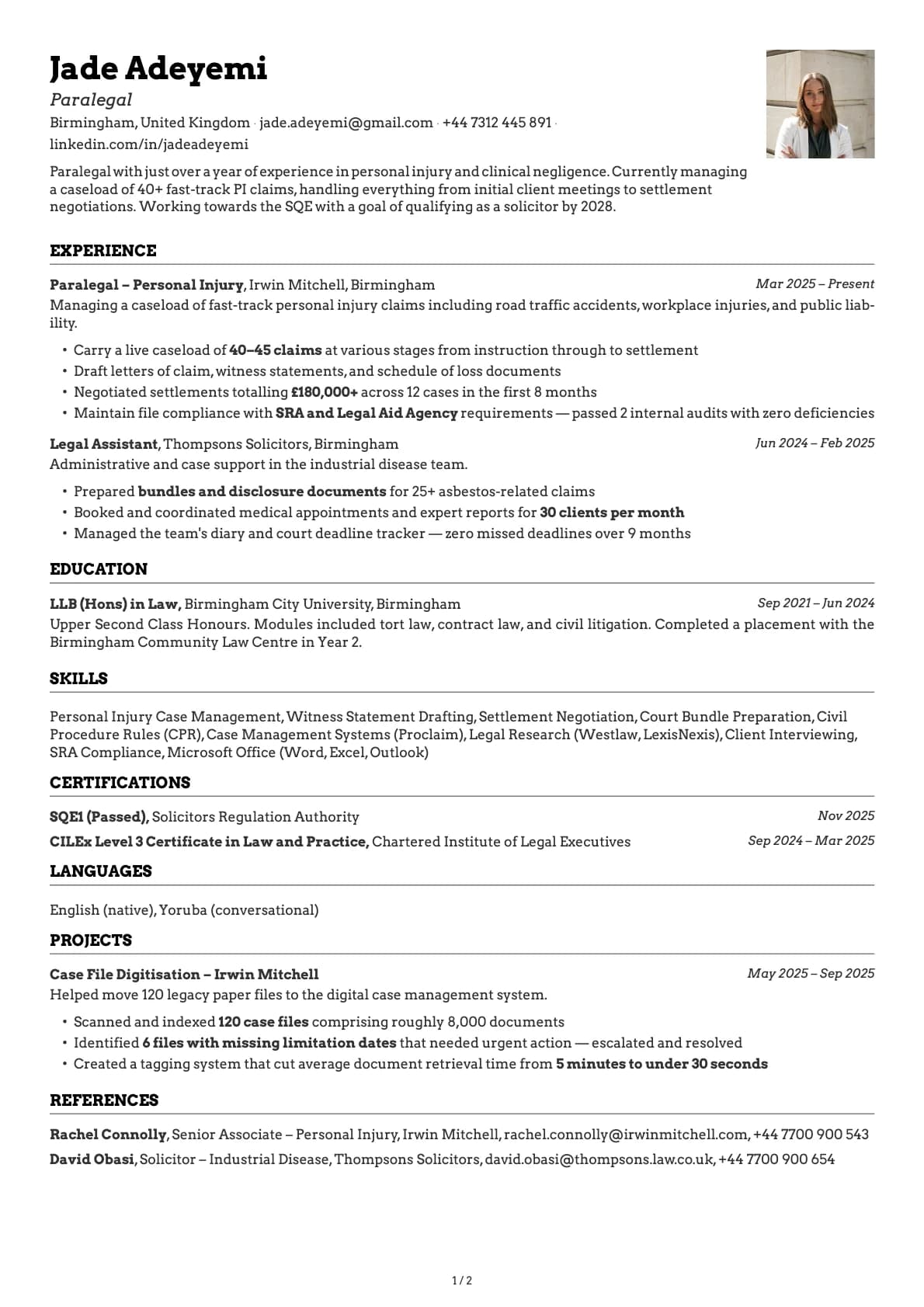
Paralegal
A paralegal resume example with caseload numbers, settlement figures, and SRA compliance details.
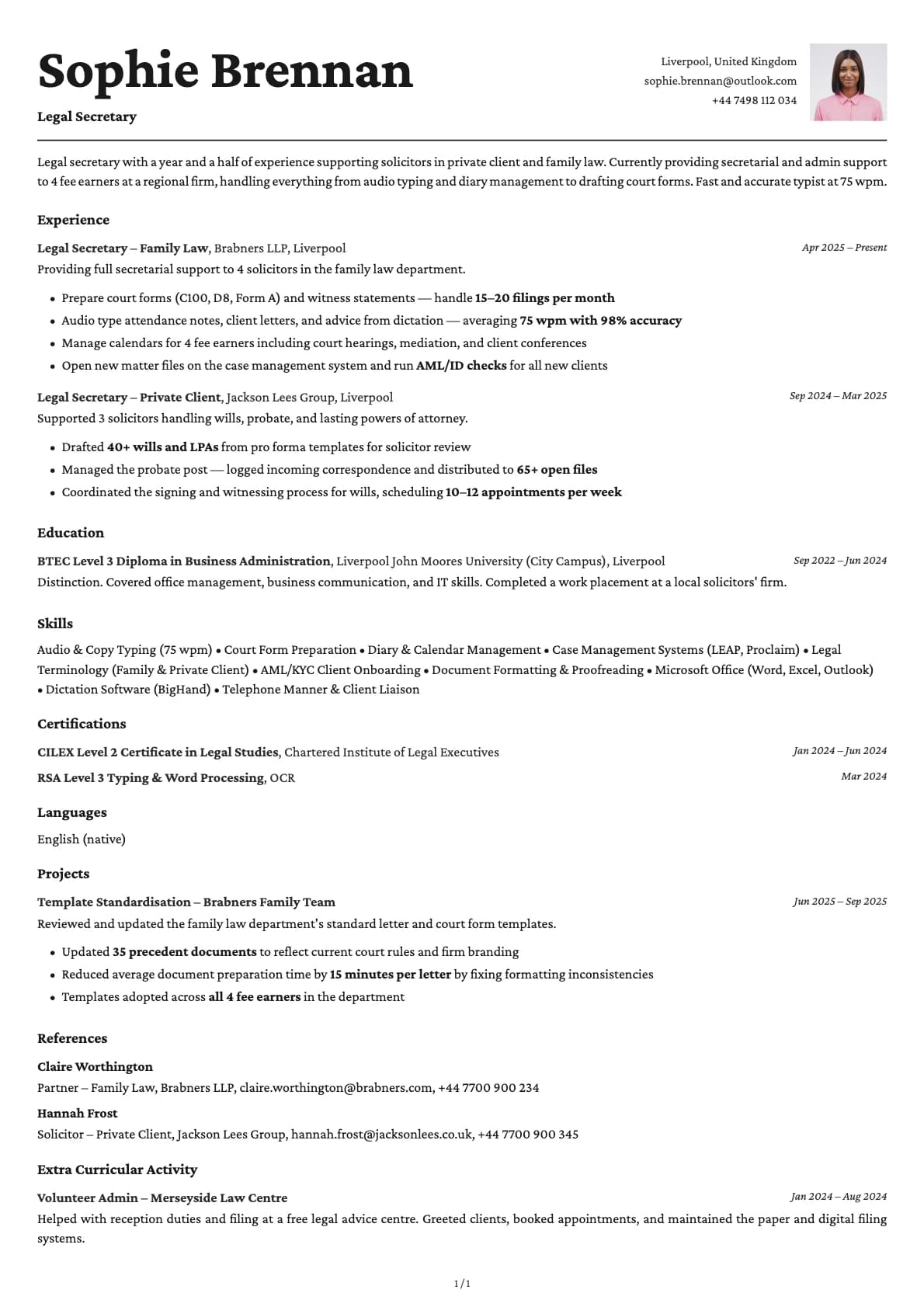
Legal Secretary
A legal secretary resume example with family law experience, court form preparation, and 75 wpm typing speed.
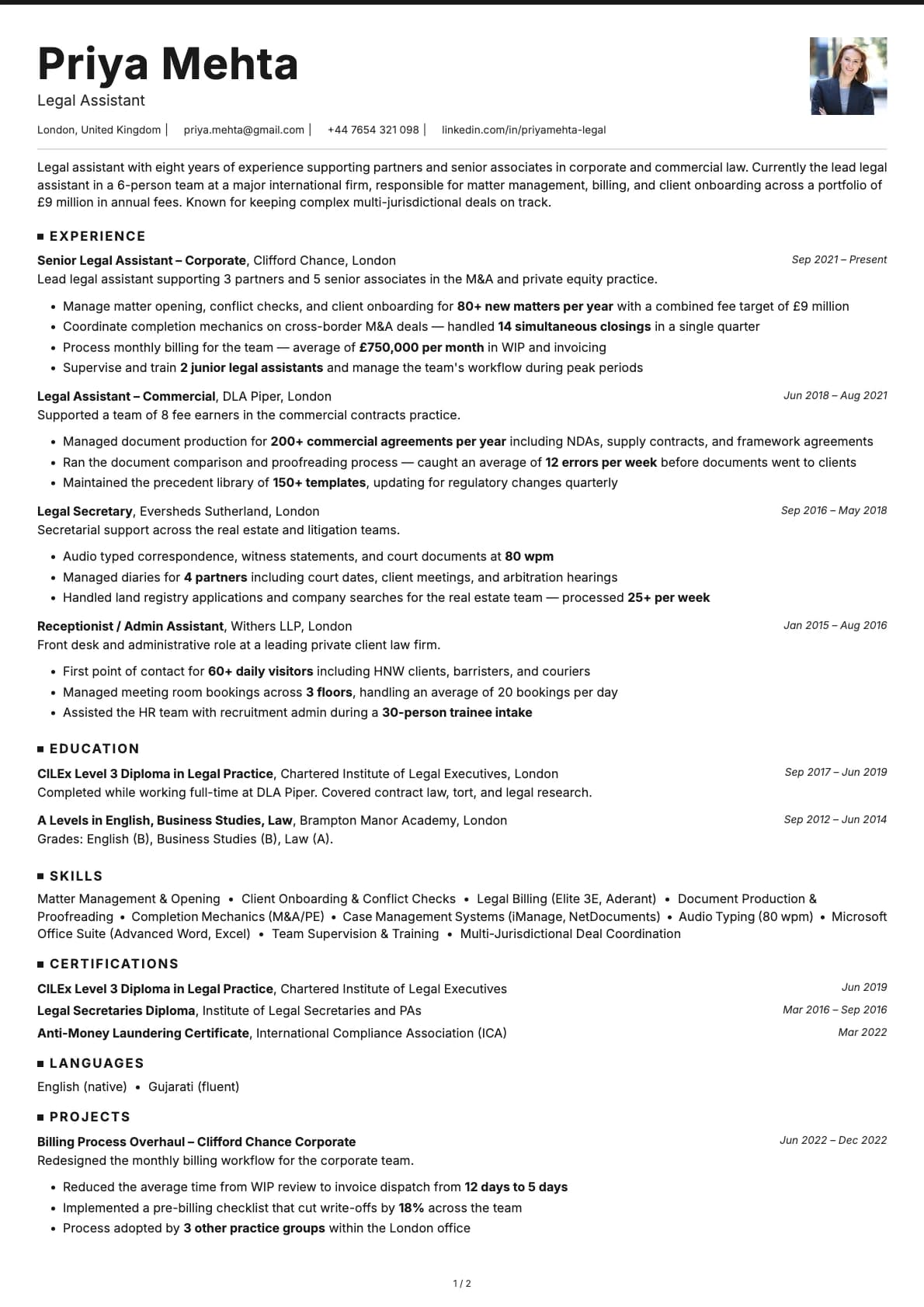
Legal Assistant
A legal assistant resume example with eight years at City law firms, billing metrics, and deal coordination experience.
Related articles

AI Is Screening Your Resume Before Any Human Sees It
AI screens most resumes before a human ever reads them. 97.4% of Fortune 500 companies run an ATS. This is what that means for you and what you can do about it.

The Best Resume Builders in 2026, Compared Honestly
Resume.io, Zety, Enhancv, Kickresume, Teal, and Laddro compared honestly: real pricing, free tiers, mobile apps, and where each tool wins. All prices checked in September 2026.

Burnout Recovery: A Real Timeline, Not 'Take a Bubble Bath'
55% of the U.S. workforce is burned out. Recovery takes 3 to 12 months. Here's what that actually looks like, stage by stage.