Paralegal Resume Example
A paralegal resume example with caseload numbers, settlement figures, and SRA compliance details.

Laddro Team
Free to use. No account needed to start.
Free to use. No account needed to start.
Overview
Paralegal resumes are tricky because the role sits between admin support and qualified legal work. Write too little detail and you sound like a legal secretary. Write too much and it looks like you are overclaiming. The key is showing the actual legal work you do, with caseload numbers and outcomes, while being honest about your level.
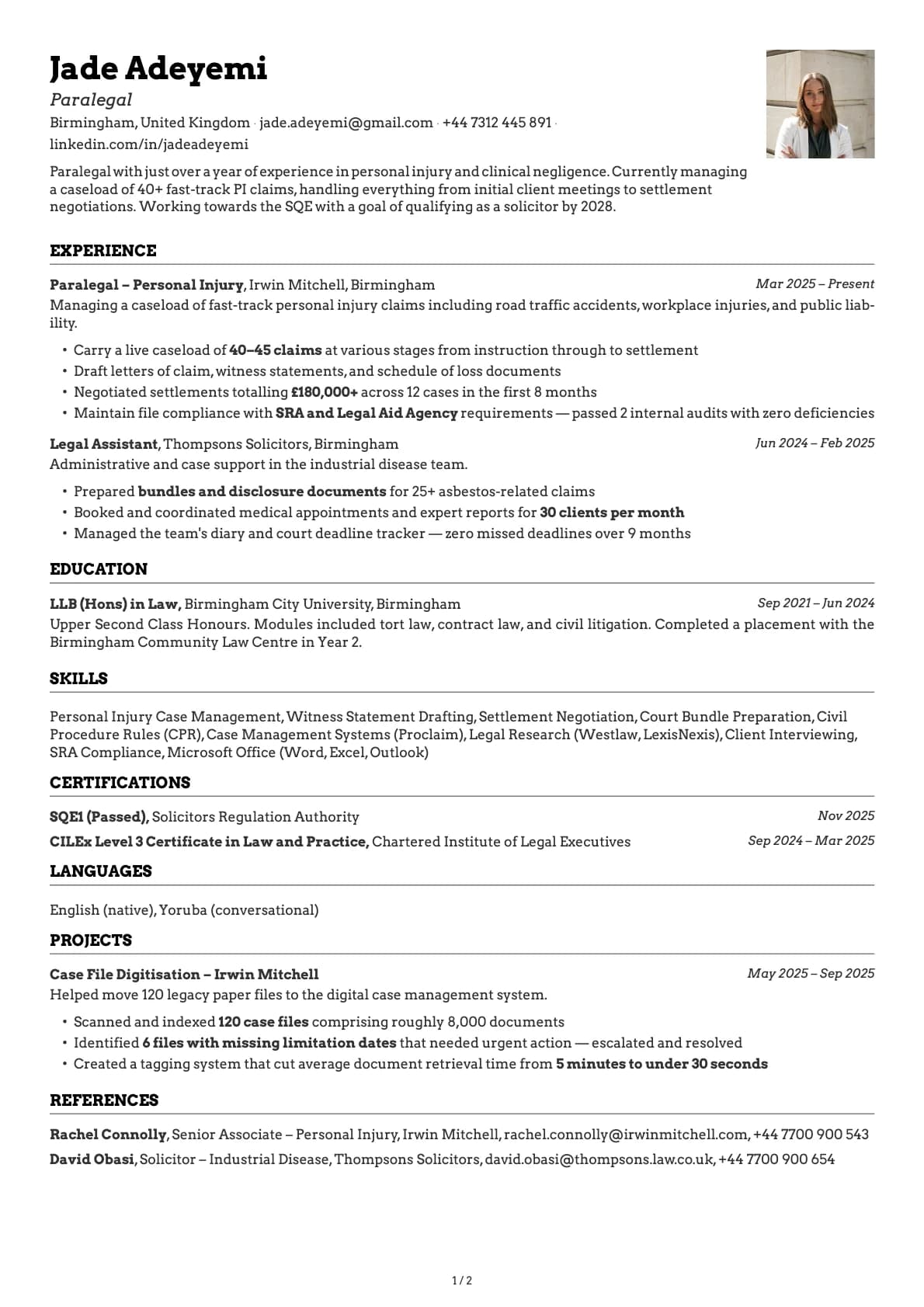
This resume belongs to Jade Adeyemi, a paralegal with just over a year of experience in personal injury and clinical negligence. She currently manages a caseload of 40+ fast-track PI claims at Irwin Mitchell, handling everything from initial client meetings to settlement negotiations. She previously worked as a legal assistant at Thompsons Solicitors. She is working towards the SQE with a goal of qualifying by 2028.
Let us look at what makes this resume effective for someone early in their legal career.
Your summary should name your practice area, your caseload, and your direction
Law firms hire paralegals for specific teams. A PI paralegal and a commercial property paralegal are completely different roles. Your summary needs to make your practice area and caseload size obvious immediately.
Here is Jade's:
Paralegal with just over a year of experience in personal injury and clinical negligence. Currently managing a caseload of 40+ fast-track PI claims, handling everything from initial client meetings to settlement negotiations. Working towards the SQE with a goal of qualifying as a solicitor by 2028.
Three sentences. Practice area (PI and clin neg), caseload (40+ claims), scope of work (client meetings through to settlement), and career direction (SQE, qualifying by 2028). A recruiting partner can read this and immediately know whether Jade fits the vacancy.
Your formula: Practice area + caseload size + the range of tasks you handle + your qualification pathway (if applicable).
How to write experience bullets for legal work
Legal work is procedural, which makes it easy to quantify if you think about volume, deadlines, and outcomes.
Look at these bullets from the Irwin Mitchell role:
"Carry a live caseload of 40-45 claims at various stages from instruction through to settlement"
"Negotiated settlements totalling £180,000+ across 12 cases in the first 8 months"
"Maintain file compliance with SRA and Legal Aid Agency requirements. Passed 2 internal audits with zero deficiencies"
The first bullet shows volume and scope (instruction through settlement). The second shows she handles real money and can negotiate. The third shows compliance awareness. Zero audit deficiencies is the kind of detail that makes a supervising solicitor feel confident about hiring you.
The formula: Legal task + the volume or value + the compliance or outcome standard.
Even if you do not negotiate settlements yourself, you can quantify your work. "Prepared bundles and disclosure documents for 25+ asbestos-related claims" shows volume. "Managed the team's diary and court deadline tracker. Zero missed deadlines over 9 months" shows reliability.
Your legal assistant or admin role still matters
Jade's previous role at Thompsons was administrative. But she frames it to show legal work:
"Prepared bundles and disclosure documents for 25+ asbestos-related claims"
"Booked and coordinated medical appointments and expert reports for 30 clients per month"
"Managed the team's diary and court deadline tracker. Zero missed deadlines over 9 months"
None of these are paralegal-level tasks. But they show someone who is organised, handles legal documents, and understands the importance of deadlines in litigation. If your previous role was administrative, pull out the legal elements and describe them with specifics.
Skills: name your case management system and your research tools
This resume lists Proclaim (case management), Westlaw, and LexisNexis. All three are directly relevant to daily paralegal work.
Law firms care about which case management system you know. Proclaim, iManage, Clio, LEAP. If you use one, name it. It saves the firm training time and it is a keyword match for ATS screening.
Legal research tools matter too. Westlaw and LexisNexis are the two main ones. If you use either (or both), include them. And list the Civil Procedure Rules (CPR) as a skill if you work in litigation. It signals that you understand the procedural framework, not just the substantive law.
SQE and qualification pathway
Jade lists her SQE1 pass and her CILEx Level 3 certificate. If you are on a qualification pathway, showing it on your resume tells the employer two things: you are serious about a legal career, and you are developing your skills independently.
If you have passed SQE1 or SQE2, list it. If you are studying for it, list it with an expected date. If you are pursuing the CILEx route, include your current level. Firms that hire paralegals often want people who will eventually qualify. Showing your pathway works in your favour.
Mistakes that hurt paralegal applications
Not stating your caseload. "Managed personal injury cases" could mean 5 cases or 50. The number matters. If you carry 40 cases, say so. It shows capacity.
Ignoring compliance. SRA compliance and audit results are not glamorous, but they matter enormously to law firms. If you have passed an audit or maintained zero deficiencies on your files, include it.
Being vague about your legal tasks. "Assisted solicitors with casework" is too vague. Name the specific documents you draft (witness statements, letters of claim, schedules of loss), the systems you use, and the types of cases you work on.
Overdesigning your resume. Law firms are conservative. A single-column, clean layout is expected. This resume uses Emerald, which is professional without being flashy. No icons, no colour blocks, no sidebars.
One more thing
If you are applying to firms that handle Legal Aid work, check whether the job posting mentions Legal Aid Agency requirements. If it does, make sure your resume shows you understand LAA compliance. "Maintain file compliance with SRA and Legal Aid Agency requirements" is a single line that can make the difference between a shortlist and a rejection.
Build your own version
Open this layout in the builder and swap in your own details. It takes a few minutes.
Free to use. No account needed to start.
Was this resume example helpful?
Rate this example to help us create better content for you.
4.7 average from 131 ratingsRelated resume examples
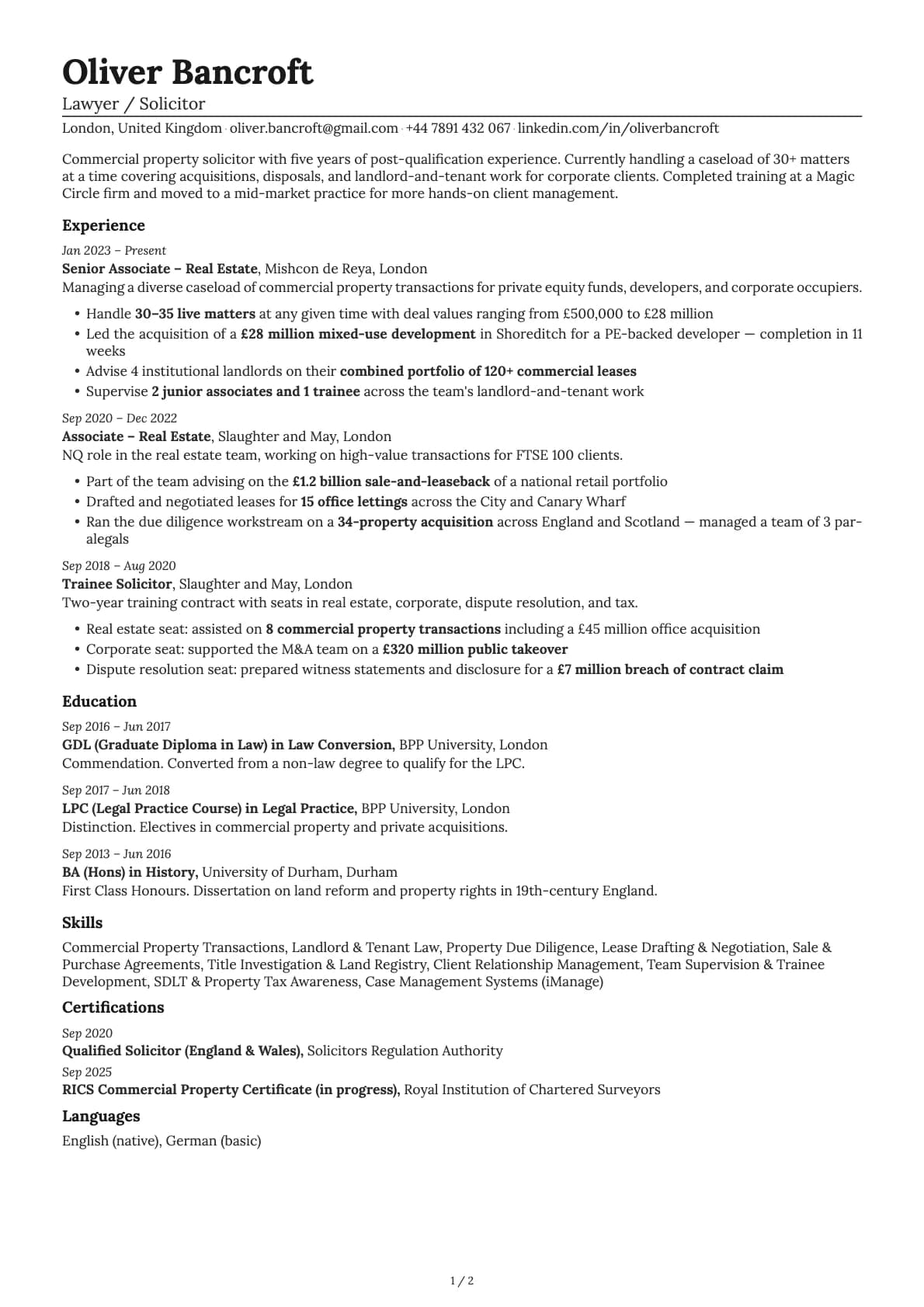
Lawyer / Solicitor
A lawyer resume example for a commercial property solicitor with Magic Circle training and £28 million deal experience.
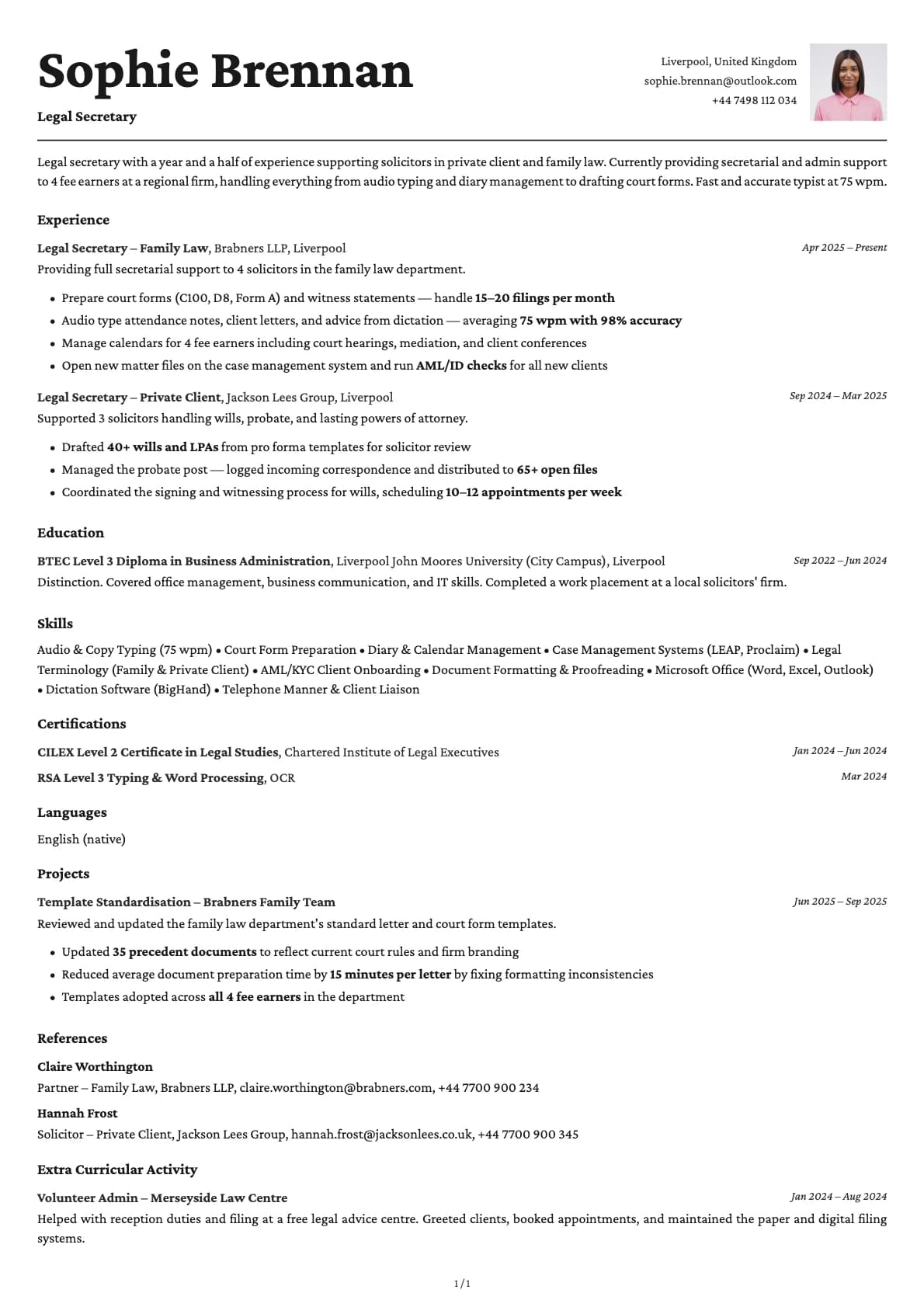
Legal Secretary
A legal secretary resume example with family law experience, court form preparation, and 75 wpm typing speed.
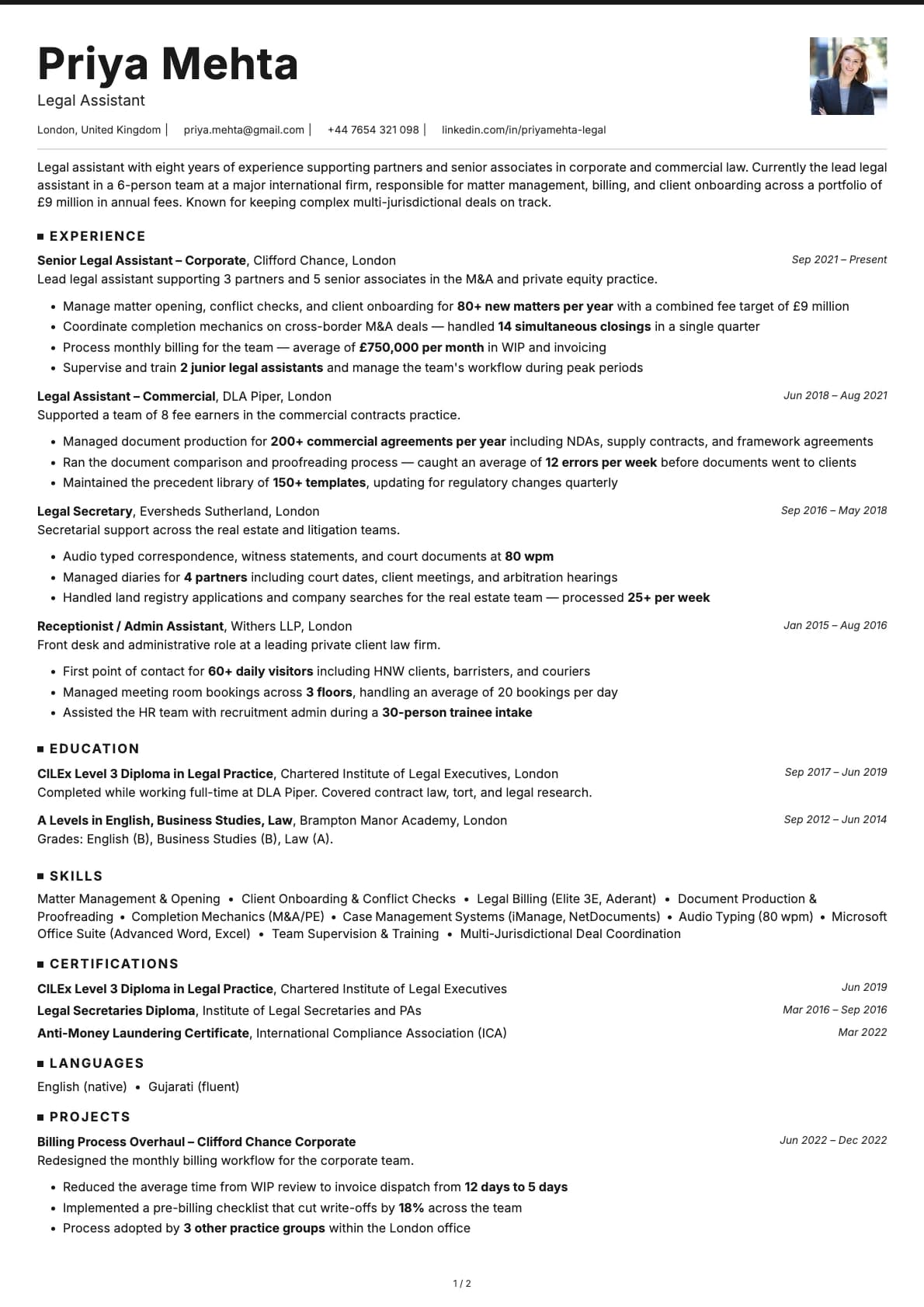
Legal Assistant
A legal assistant resume example with eight years at City law firms, billing metrics, and deal coordination experience.
Related articles

AI Is Screening Your Resume Before Any Human Sees It
AI screens most resumes before a human ever reads them. 97.4% of Fortune 500 companies run an ATS. This is what that means for you and what you can do about it.

The Best Resume Builders in 2026, Compared Honestly
Resume.io, Zety, Enhancv, Kickresume, Teal, and Laddro compared honestly: real pricing, free tiers, mobile apps, and where each tool wins. All prices checked in September 2026.

Burnout Recovery: A Real Timeline, Not 'Take a Bubble Bath'
55% of the U.S. workforce is burned out. Recovery takes 3 to 12 months. Here's what that actually looks like, stage by stage.