Legal Secretary Resume Example
A legal secretary resume example with family law experience, court form preparation, and 75 wpm typing speed.

Laddro Team
Free to use. No account needed to start.
Free to use. No account needed to start.
Overview
Legal secretary resumes are hard to write when you are early in your career. The roles themselves are intense. You are typing letters from dictation, preparing court forms, managing four diaries at once, and opening new files. But when you sit down to write about it, it can feel like all you did was type.
The trick is showing what you type, how fast, how accurately, and what systems you use to keep everything organised.
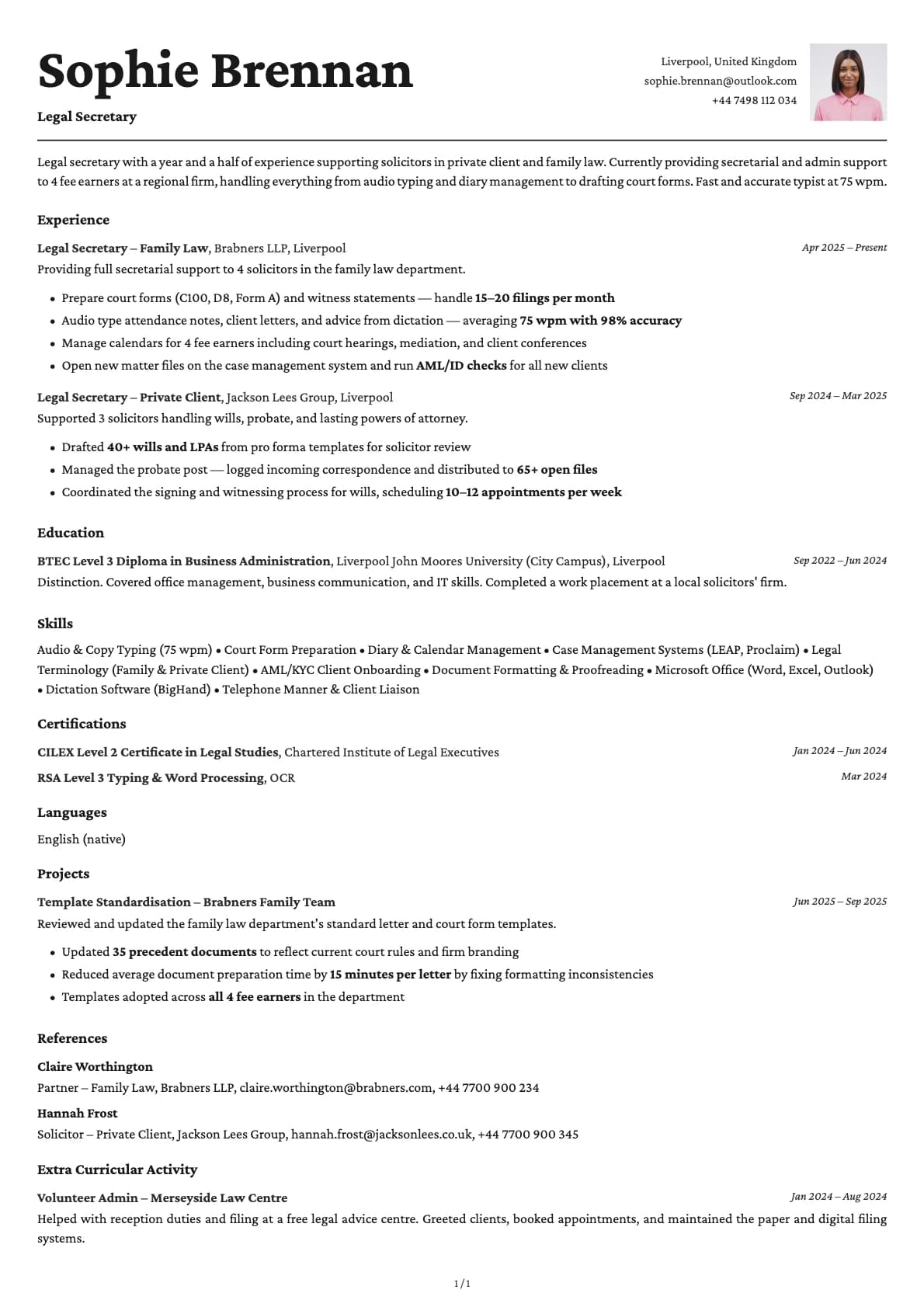
This resume belongs to Sophie, a legal secretary at Brabners in Liverpool. She has about a year and a half of experience across two firms, working in family law and private client. Before that, she completed a BTEC in Business Administration. It is a short career history. But the resume makes every line count by being specific about the work.
Your summary: practice area, team size, and typing speed
Legal secretary hiring managers want to know three things immediately. What area of law? How many fee earners do you support? And can you type fast enough to keep up?
Sophie's:
Legal secretary with a year and a half of experience supporting solicitors in private client and family law. Currently providing secretarial and admin support to 4 fee earners at a regional firm, handling everything from audio typing and diary management to drafting court forms. Fast and accurate typist at 75 wpm.
Short and direct. She names two practice areas, the number of fee earners she supports, the types of work she does, and her typing speed. That is everything a hiring manager needs to decide whether to keep reading.
Your formula: Experience length + practice area(s). Number of fee earners you support. Main tasks. Typing speed.
Experience: name the documents and the volume
The most common mistake on legal secretary resumes is being too vague about what you actually produce. "Provided secretarial support" tells the reader nothing. Name the specific documents and forms you prepare.
From Sophie's current role at Brabners:
"Prepare court forms (C100, D8, Form A) and witness statements, handle 15-20 filings per month"
"Audio type attendance notes, client letters, and advice from dictation, averaging 75 wpm with 98% accuracy"
"Open new matter files on the case management system and run AML/ID checks for all new clients"
The first bullet names specific court forms. Any family law hiring manager reading this immediately knows Sophie can prepare the right documents. The form numbers (C100, D8, Form A) are keywords that prove familiarity with the work.
The second bullet gives speed and accuracy. 75 wpm with 98% accuracy is a strong metric for a junior legal secretary. It shows she can handle the volume without making mistakes that cost fee earners time.
The third bullet shows she handles matter opening and compliance checks, which are essential skills that go beyond pure typing.
Earlier roles still count, even with limited experience
Sophie's previous role at Jackson Lees covered private client work: wills, probate, and lasting powers of attorney. Even though it was only six months, she gets three strong bullets from it:
"Drafted 40+ wills and LPAs from pro forma templates for solicitor review"
"Managed the probate post, logged incoming correspondence and distributed to 65+ open files"
"Coordinated the signing and witnessing process for wills, scheduling 10-12 appointments per week"
40 wills and LPAs. 65 open files. 10-12 appointments per week. These numbers show someone who handled a real workload, not just shadowed a solicitor for six months.
If your experience is limited, focus on what you actually produced. How many letters? How many files? How many appointments did you schedule? Even small numbers are better than no numbers.
Skills: be specific about legal systems and software
Legal secretaries need to show they can use the firm's systems from day one. Sophie lists LEAP, Proclaim, BigHand, and Microsoft Office. She also includes practice-specific skills like "Court Form Preparation" and "Legal Terminology (Family & Private Client)."
If you use BigHand, SpeechExec, or any other dictation software, name it. If you work with LEAP, Proclaim, Clio, or any case management system, name it. Law firms use specific software and knowing their system (or a similar one) can be the difference between getting an interview and being filtered out.
Also include your typing speed as a specific skill, not just in your summary. "Audio & Copy Typing (75 wpm)" is a keyword that ATS systems will pick up.
Certifications and qualifications
Sophie has a CILEX Level 2 Certificate in Legal Studies and an RSA Level 3 Typing & Word Processing qualification. These are entry-level credentials, but they matter for legal secretary roles. The CILEX certificate shows some formal legal knowledge. The RSA typing qualification is a recognised standard.
If you do not have a law degree or a CILEx qualification, consider starting one. Even the Level 2 certificate shows hiring managers that you are serious about the profession and not just using the role as a temporary job.
Projects: even small improvements count
Sophie lists one project: standardising the family law department's letter and court form templates. She updated 35 precedent documents, reduced average preparation time by 15 minutes per letter, and the templates were adopted by all 4 fee earners.
This is not a dramatic achievement. But it shows initiative. She saw that the templates were inconsistent, fixed them, and the whole department benefited. For someone with less than two years of experience, that kind of practical improvement is exactly what hiring managers want to see.
If you have ever tidied up a filing system, fixed a template, or improved a process, write it up. It does not need to be a formal project. It just needs to show you made something better.
Common mistakes on legal secretary resumes
No typing speed. This is the most basic metric for a legal secretary role and many applicants leave it off. If you can type at 60+ wpm, include it. If you can type faster, definitely include it. Some firms will not interview candidates without a stated typing speed.
Vague document descriptions. "Typed legal documents" could mean anything. "Prepared C100 and D8 court forms, witness statements, and Form A financial statements" tells the hiring manager exactly what you can do. Be specific about the documents you prepare.
Not mentioning the practice area. Legal secretaries specialise. Family law, commercial property, litigation, private client. Each requires different knowledge. If you have experience in a specific area, make it the focus of your resume.
Ignoring AML and compliance. Most legal secretary roles now involve some compliance work: AML checks, ID verification, file opening procedures. If you do this, include it. It shows you understand the regulatory side of running a legal practice.
Using a flashy template. Law firms are conservative. A legal secretary resume should be clean, well-formatted, and easy to read. Sophie's resume uses Cobalt, which has a professional look without unnecessary design elements. Stick with something similar.
One more thing
If you are new to legal secretarial work, your transferable skills from other admin or customer service roles are relevant. But translate them into legal language. "Handled 60 calls per day" becomes useful context for diary management and client liaison. "Maintained records for 200 accounts" connects to file management. Show the hiring manager that you already have the core skills, even if you have not used them in a law firm before.
Build your own version
Open this layout in the builder and swap in your own details. It takes a few minutes.
Free to use. No account needed to start.
Was this resume example helpful?
Rate this example to help us create better content for you.
4.6 average from 149 ratingsRelated resume examples
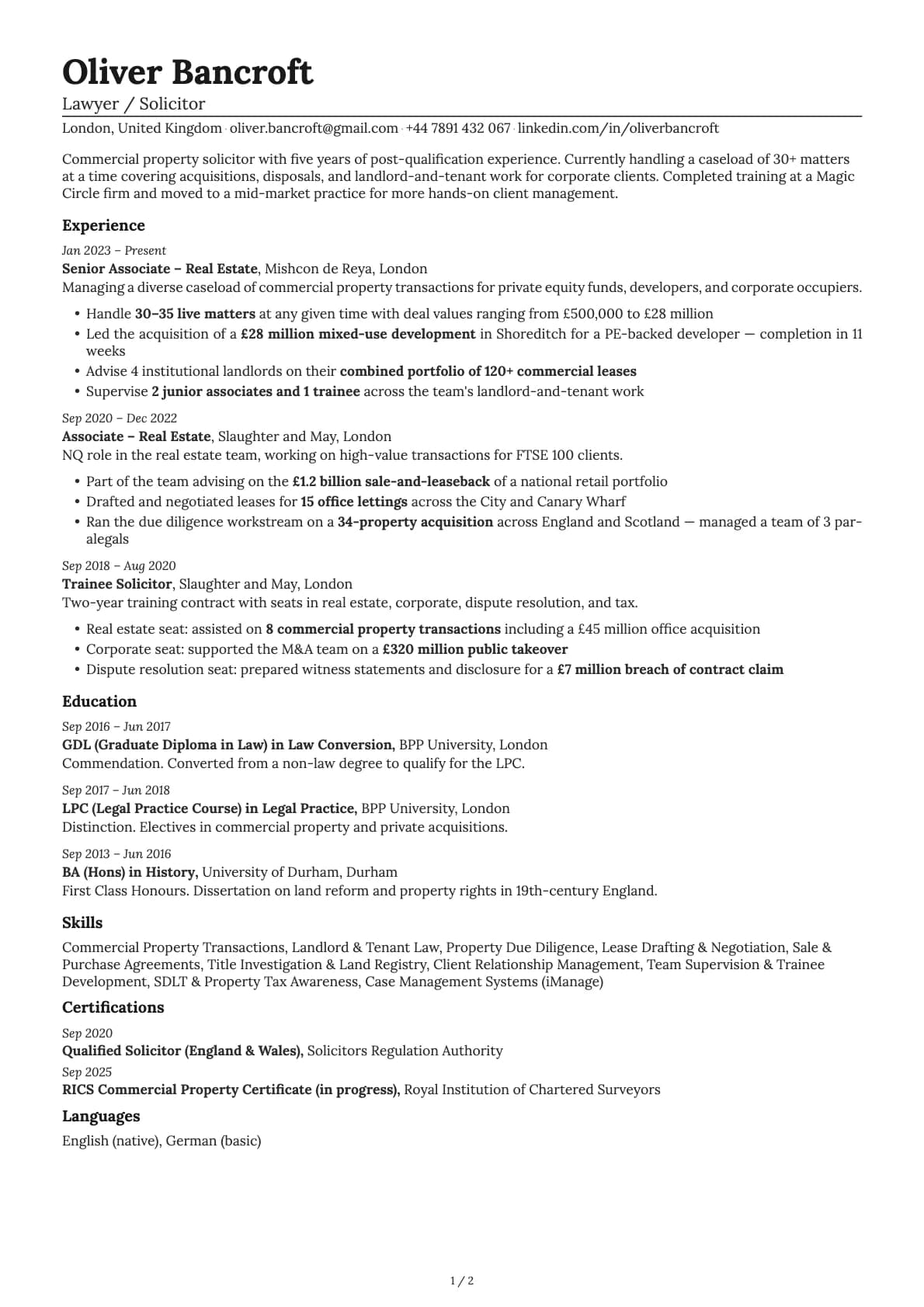
Lawyer / Solicitor
A lawyer resume example for a commercial property solicitor with Magic Circle training and £28 million deal experience.
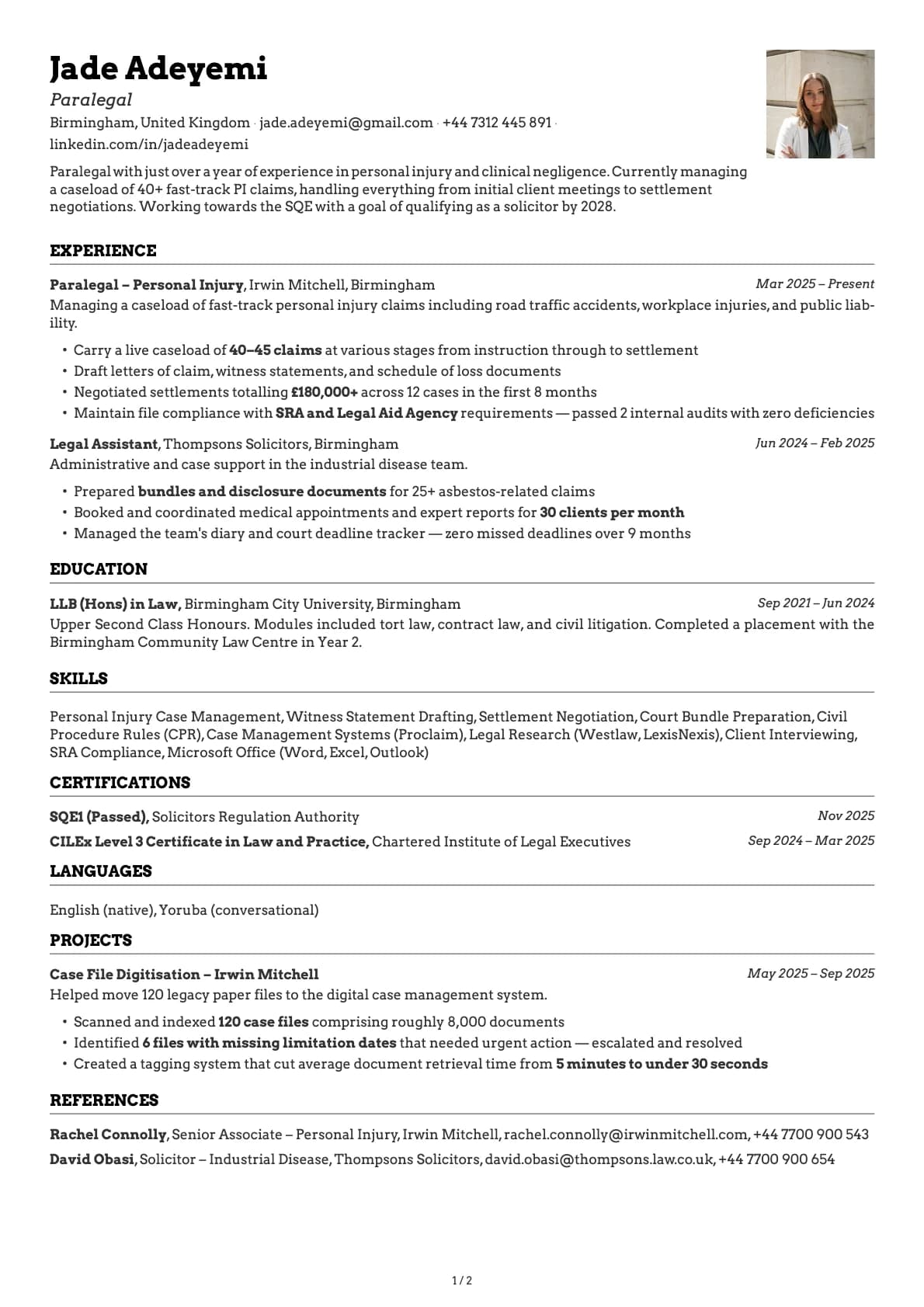
Paralegal
A paralegal resume example with caseload numbers, settlement figures, and SRA compliance details.
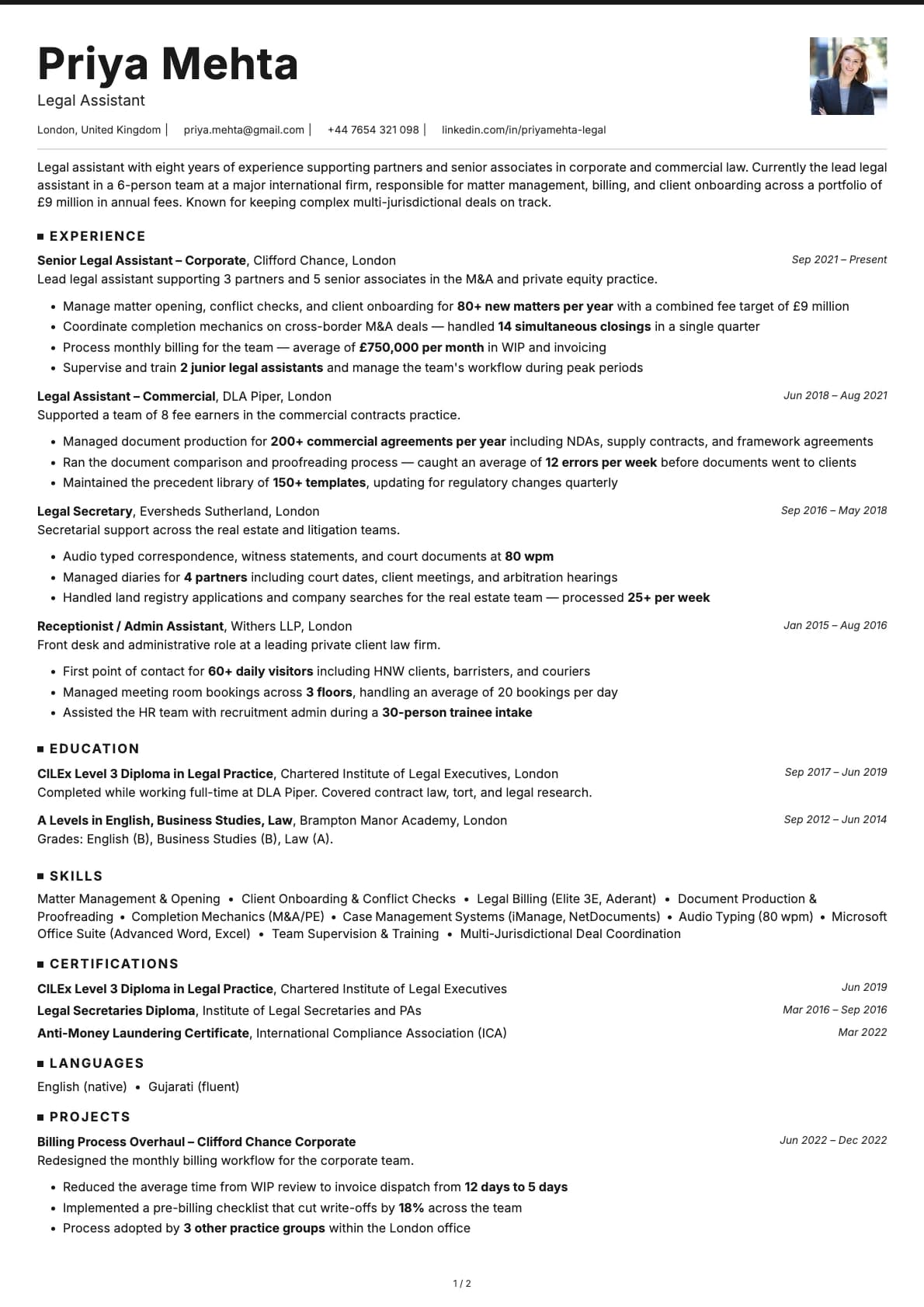
Legal Assistant
A legal assistant resume example with eight years at City law firms, billing metrics, and deal coordination experience.
Related articles

AI Is Screening Your Resume Before Any Human Sees It
AI screens most resumes before a human ever reads them. 97.4% of Fortune 500 companies run an ATS. This is what that means for you and what you can do about it.

The Best Resume Builders in 2026, Compared Honestly
Resume.io, Zety, Enhancv, Kickresume, Teal, and Laddro compared honestly: real pricing, free tiers, mobile apps, and where each tool wins. All prices checked in September 2026.

Burnout Recovery: A Real Timeline, Not 'Take a Bubble Bath'
55% of the U.S. workforce is burned out. Recovery takes 3 to 12 months. Here's what that actually looks like, stage by stage.