Operations Manager Cover Letter Example
An operations manager cover letter example targeting Walkers (PepsiCo).

Laddro Team
Free to use. No account needed to start.
Free to use. No account needed to start.
Overview
Operations manager cover letters need to prove one thing above all: that you can make things run better. Not in theory, but with measurable evidence. Reduced costs, improved delivery times, lower turnover, higher throughput. Operations is a discipline where the results are either quantifiable or they do not count. A letter full of claims about being a "focused leader" without any actual results will not survive the first read.
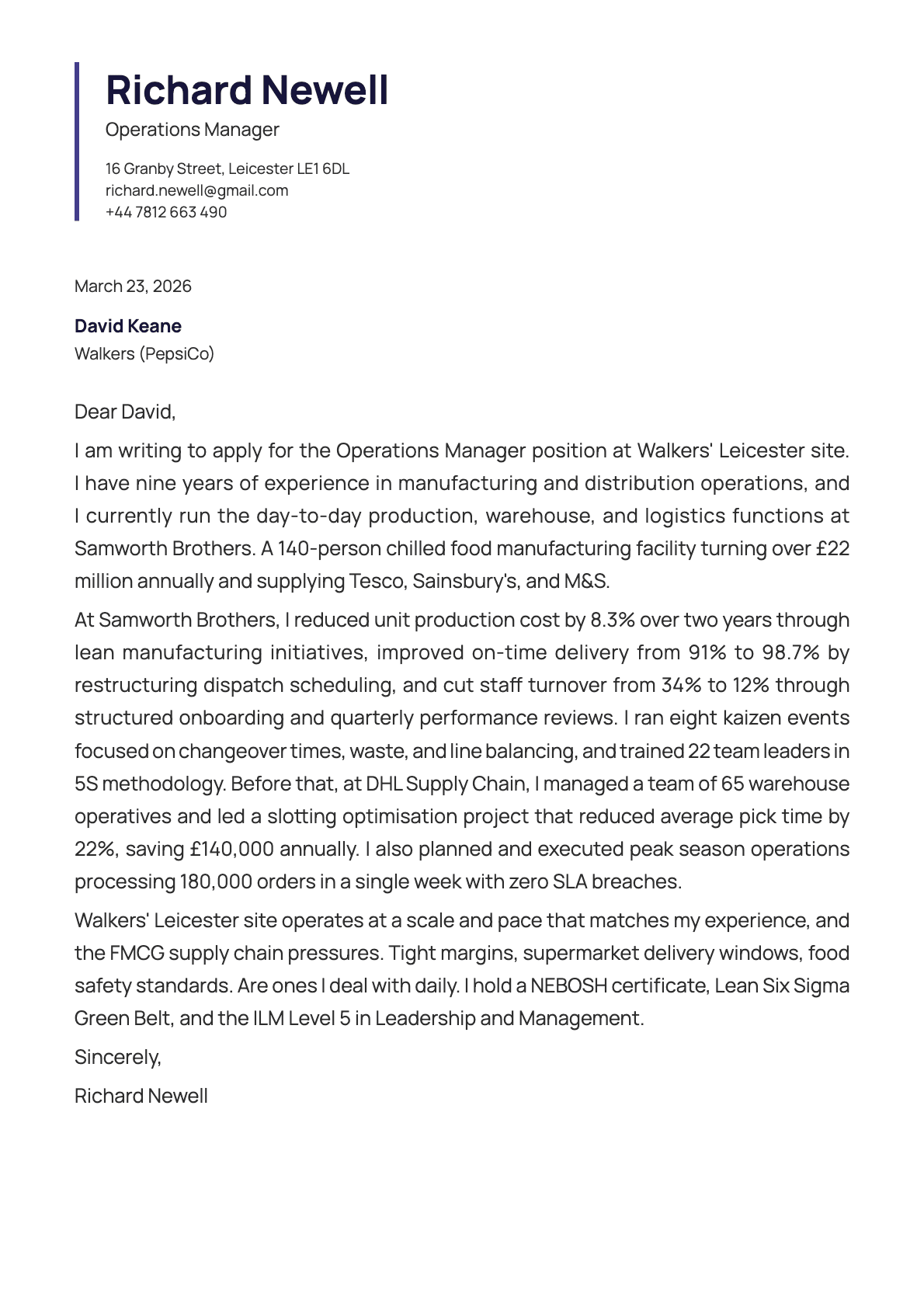
This cover letter belongs to Richard Newell, an operations manager with nine years of experience in manufacturing and distribution, currently running production, warehouse, and logistics at Samworth Brothers. He is applying for the Operations Manager role at Walkers' Leicester site. His letter works because every sentence contains a measurable improvement.
The opening: scope and scale
Richard opens with a clear picture of his current operation. He runs a 140-person chilled food manufacturing facility with £22 million annual turnover, supplying Tesco, Sainsbury's, and M&S. Naming the retailers is a smart move. It tells the reader he works within the demanding quality and delivery standards that major supermarkets require.
For your letter: describe your current operation in terms of headcount, revenue, and key customers or partners. These three details give the reader an immediate understanding of the scale and complexity of your work.
The body: a portfolio of improvements
The middle paragraph reads like a continuous improvement case study. Unit production cost reduced by 8.3%. On-time delivery improved from 91% to 98.7%. Staff turnover cut from 34% to 12%. Each of these would be a strong result on its own. Together, they show a manager who improves every dimension of an operation.
Richard then adds the methodology: eight kaizen events, 5S training for 22 team leaders. This matters because it shows his improvements are systematic, not lucky. He does not just fix problems. He builds capability in his team so they can identify and fix problems themselves.
The DHL experience adds a different operational context: warehouse management, a 65-person team, a slotting optimisation project saving £140,000 annually, and peak season execution (180,000 orders in one week, zero SLA breaches). This demonstrates he can operate across both manufacturing and distribution environments.
The lesson for operations managers: structure your body paragraph around three to four key metrics that show before-and-after improvements. Cost, quality, delivery, and people are the four pillars of operations. Show improvement in at least two of them.
The closing: sector fit and qualifications
Richard's closing connects Walkers' operational environment to his own experience. The reference to "tight margins, supermarket delivery windows, food safety standards" shows he understands FMCG supply chain pressures because he deals with them daily. This is not generic company research. It is a statement of direct relevance.
The certifications (NEBOSH, Lean Six Sigma Green Belt, ILM Level 5) add formal credibility. In operations, these qualifications signal that you have structured training in safety, continuous improvement, and leadership. All three matter for a site-level management role.
What makes this letter effective
Richard lets the numbers carry the argument. He does not claim to be an effective operations manager. He proves it with six distinct metrics across two companies. The letter is also well paced. It moves from current scope to specific results to company fit without any wasted space.
The variety of improvements (cost, delivery, turnover, peak execution) shows a manager who thinks about the whole operation, not just one dimension. That breadth is what separates an operations manager from a production supervisor or a logistics coordinator.
Mistakes operations managers make in cover letters
Using improvement language without numbers. "Improved operational efficiency" is meaningless without a percentage or a cost figure. Operations is a numbers discipline. Every claim needs a metric.
Focusing only on cost reduction. Cost matters, but so do delivery performance, quality, safety, and employee engagement. A letter that only talks about cutting costs can sound like someone who achieves savings at the expense of everything else. Show balanced improvement.
Not mentioning methodology. If you use lean manufacturing, Six Sigma, 5S, TPM, or kaizen, name the methodology and describe how you applied it. Hiring managers want to see structured approaches, not just good outcomes.
Leaving out people management. Operations roles involve managing large teams, often including shift workers, temporary staff, and team leaders. State the size of your team and include at least one example of how you developed or improved your workforce (training programmes, reduced turnover, promotion of team leaders).
Ignoring safety. In manufacturing and logistics, safety is non-negotiable. If you hold NEBOSH, IOSH, or equivalent certifications, mention them. If you have improved safety metrics (reduced incidents, improved audit scores), include those too.
Was this cover letter example helpful?
Rate this example to help us create better content for you.
4.8 average from 112 ratingsBuild your own version
Open this layout in the builder and swap in your own details. It takes a few minutes.
Free to use. No account needed to start.
Related cover letter examples
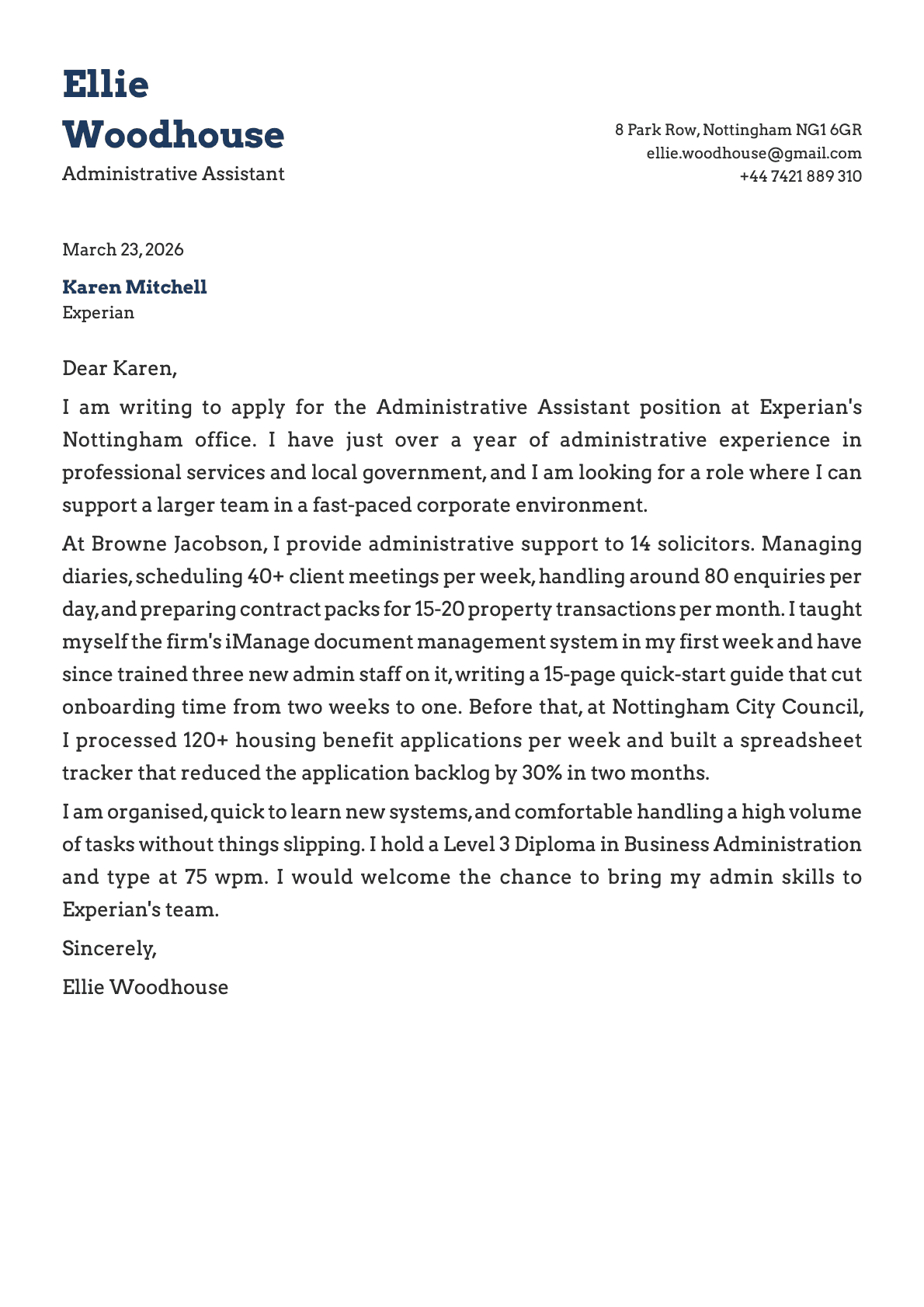
Administrative Assistant
An administrative assistant cover letter example for a corporate role at Experian.
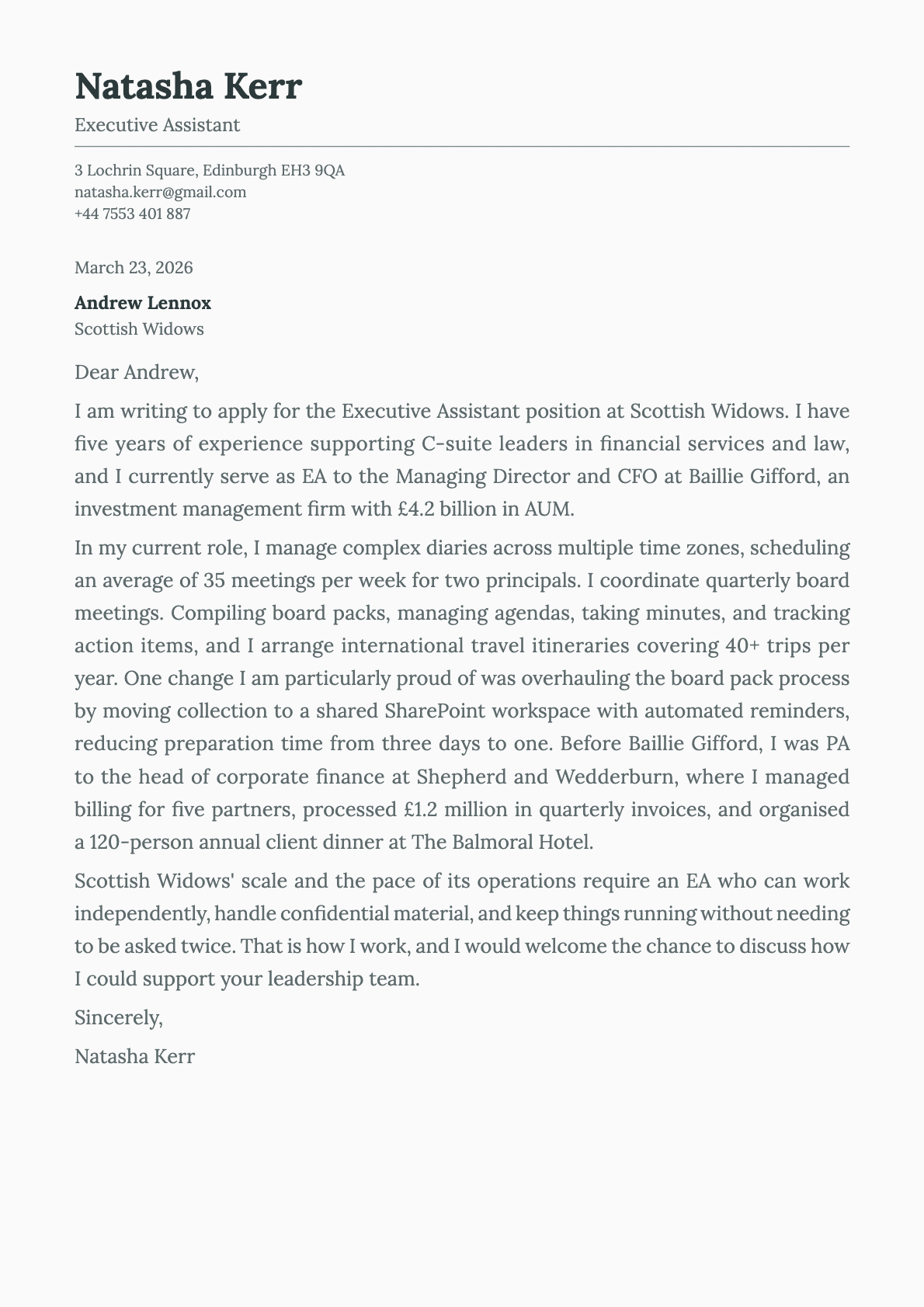
Executive Assistant
An executive assistant cover letter example targeting Scottish Widows.
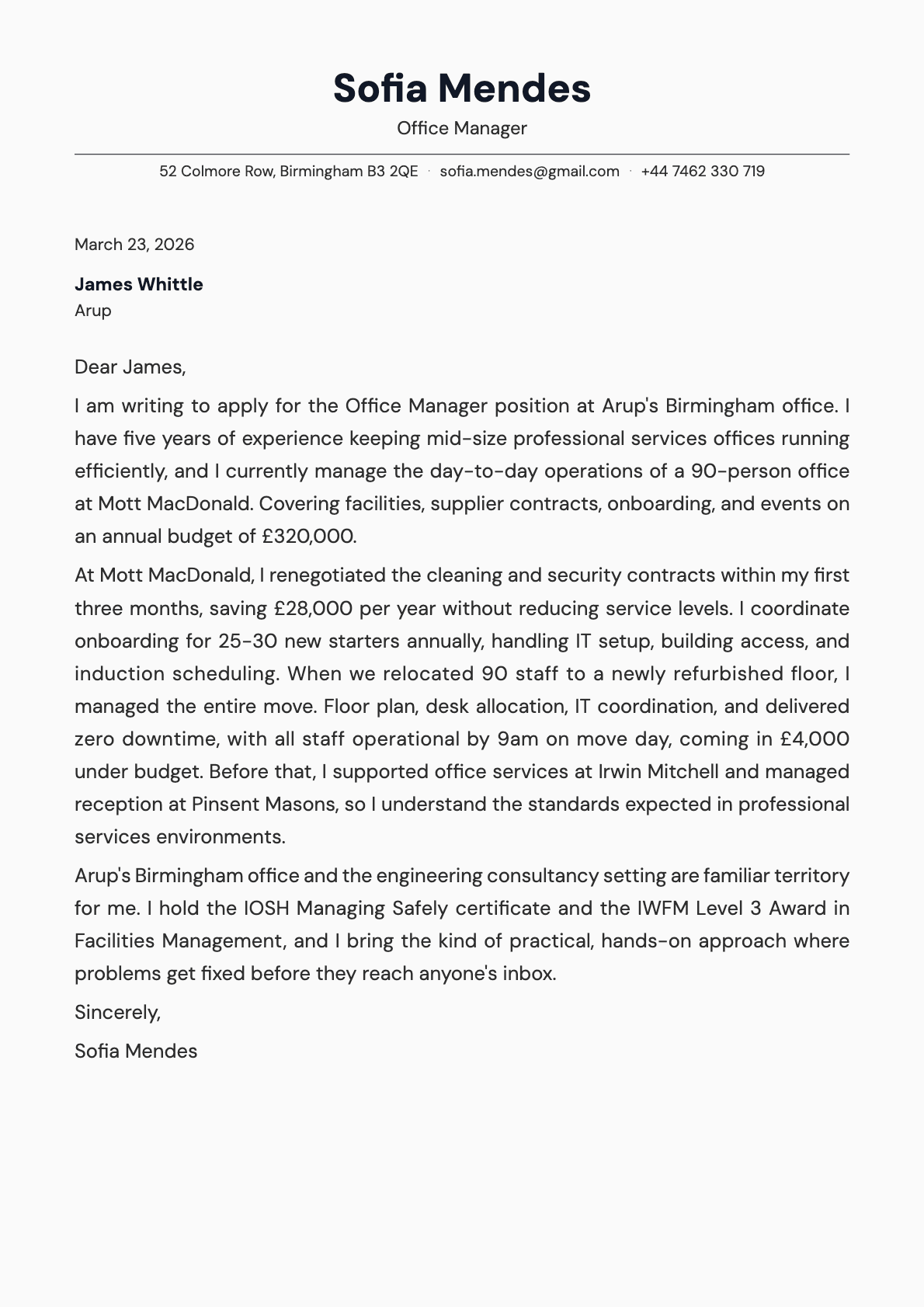
Office Manager
An office manager cover letter example targeting Arup.
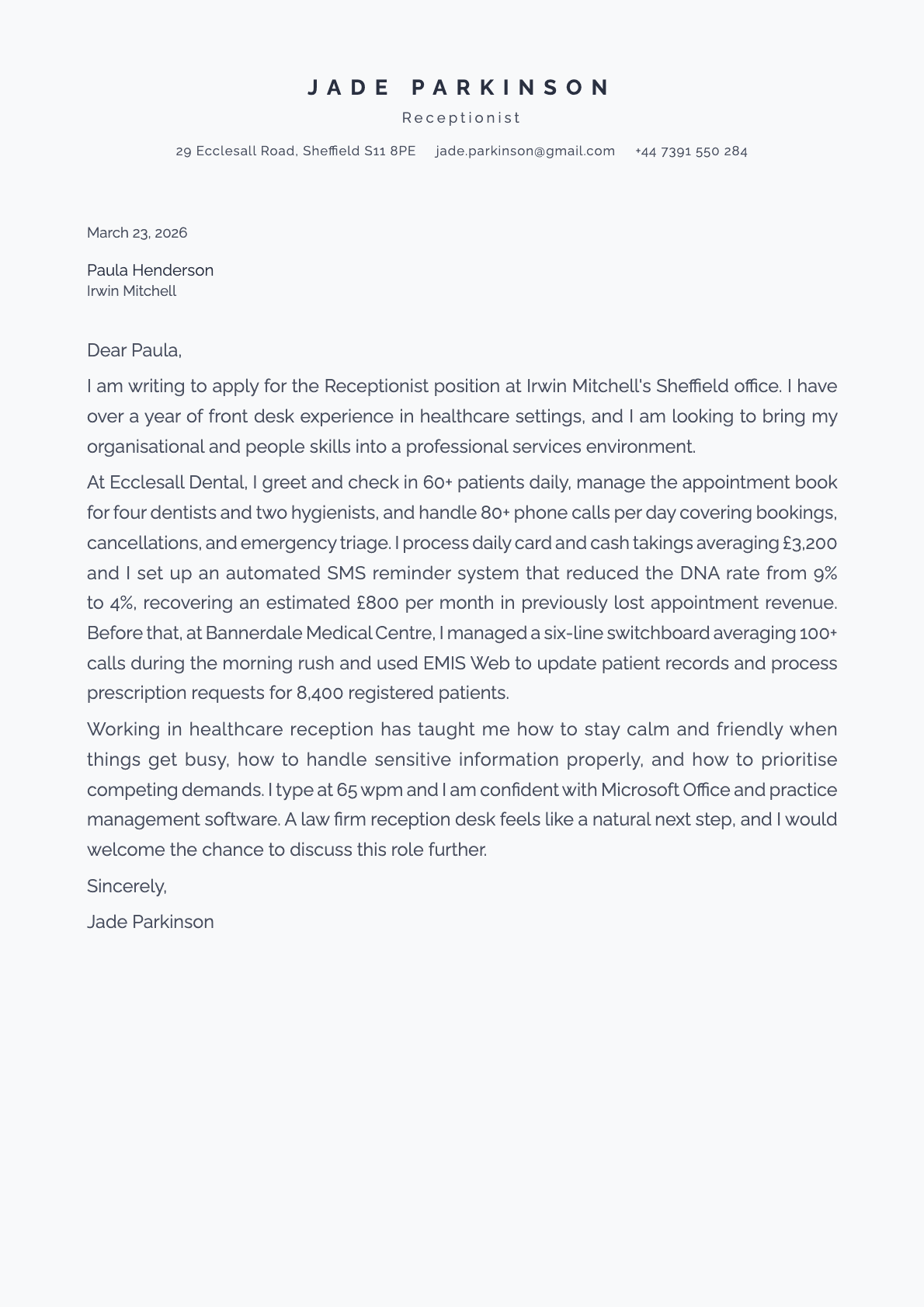
Receptionist
A receptionist cover letter example targeting a law firm role at Irwin Mitchell.
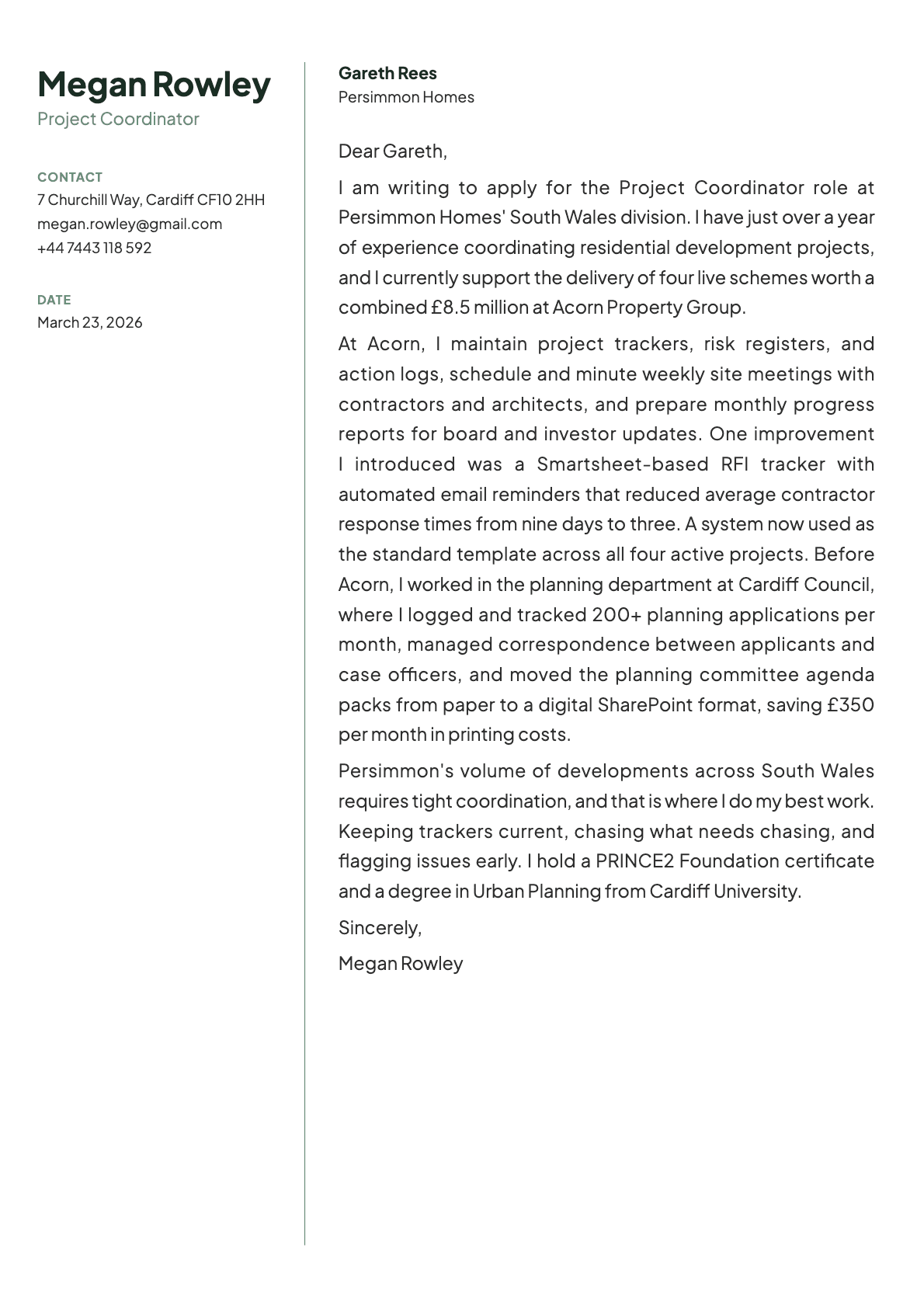
Project Coordinator
A project coordinator cover letter example targeting Persimmon Homes.
Related articles

AI Is Screening Your Resume Before Any Human Sees It
AI screens most resumes before a human ever reads them. 97.4% of Fortune 500 companies run an ATS. This is what that means for you and what you can do about it.

The Best Resume Builders in 2026, Compared Honestly
Resume.io, Zety, Enhancv, Kickresume, Teal, and Laddro compared honestly: real pricing, free tiers, mobile apps, and where each tool wins. All prices checked in September 2026.

Burnout Recovery: A Real Timeline, Not 'Take a Bubble Bath'
55% of the U.S. workforce is burned out. Recovery takes 3 to 12 months. Here's what that actually looks like, stage by stage.