Executive Assistant Cover Letter Example
An executive assistant cover letter example targeting Scottish Widows.

Laddro Team
Free to use. No account needed to start.
Free to use. No account needed to start.
Overview
Executive assistant cover letters need to communicate something that most admin cover letters do not: trust. EAs work with confidential information, manage complex logistics across time zones, and often serve as the gatekeeper between a senior leader and the rest of the organisation. The cover letter needs to convey not just competence but the kind of quiet reliability that C-suite leaders depend on.
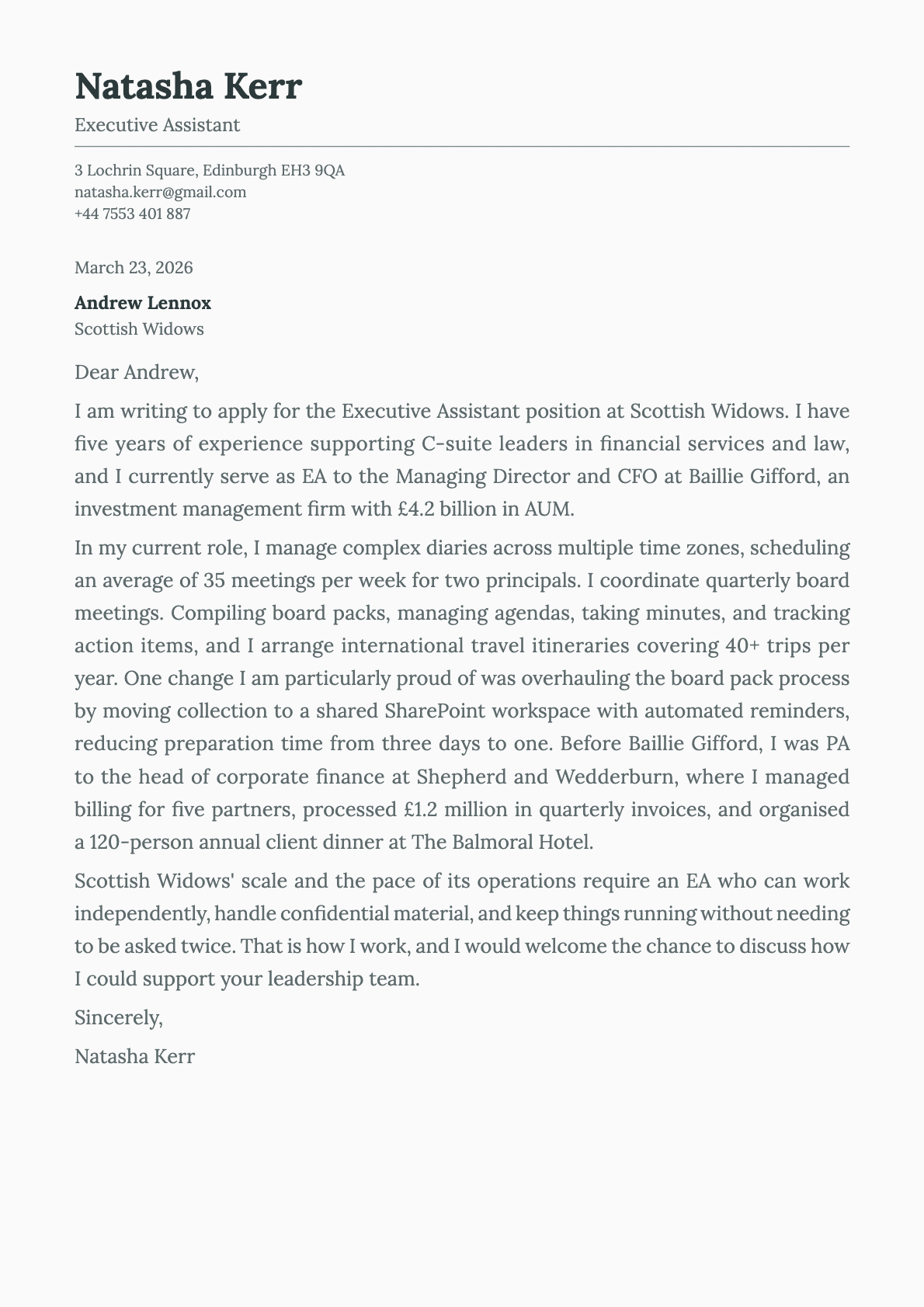
This letter belongs to Natasha Kerr, an executive assistant with five years of experience supporting C-suite leaders at Baillie Gifford and Shepherd and Wedderburn. She is applying for an EA role at Scottish Widows. Her letter works because it shows the complexity and scale of her support work, then highlights a specific process improvement that demonstrates strategic thinking.
The opening: who you support and at what level
Natasha opens with her experience level and immediately names the principals she supports: the Managing Director and CFO at Baillie Gifford, a firm with £4.2 billion in AUM. This is critical for EA roles because the seniority of the person you support defines the seniority of your role.
I have five years of experience supporting C-suite leaders in financial services and law, and I currently serve as EA to the Managing Director and CFO at Baillie Gifford, an investment management firm with £4.2 billion in AUM.
For your letter: always name the level of the executives you support (CEO, CFO, MD, Partner) and the type of organisation. Supporting a Managing Director at a £4.2 billion investment firm signals a very different level of responsibility than supporting a department head at a small company.
The body: complexity, volume, and improvement
The middle paragraph covers three dimensions of Natasha's work. First, the daily complexity: managing diaries across multiple time zones with 35 meetings per week for two principals. Second, the formal coordination: quarterly board meetings including pack compilation, agenda management, minutes, and action tracking. Third, the volume: 40+ international travel itineraries per year.
The board pack process improvement is the standout detail. Moving from a three-day manual process to a one-day automated SharePoint workflow is a concrete, measurable improvement. It shows Natasha does not just execute tasks. She looks for ways to make things work better.
The Shepherd and Wedderburn experience adds a different dimension: billing management (£1.2 million quarterly), partner support, and event coordination for 120 people. This shows she can handle financial administration and logistics alongside diary management.
The lesson for EAs: your cover letter should show that you manage complexity, not just volume. Multiple principals, cross-timezone scheduling, board governance, and travel logistics are all forms of complexity. Describe them with specific numbers.
The closing: understanding what the role requires
Natasha's closing describes the qualities Scottish Widows needs in an EA: independence, confidentiality, and the ability to anticipate needs without being prompted. Then she states, simply, "That is how I work."
This is confident without being arrogant. It matches the tone that EA cover letters should aim for. Calm, capable, and self-assured. The best EAs do not need to be loud about their skills. They demonstrate them through how they write and present themselves.
What makes this letter effective
The letter reads like it was written by someone who understands the EA role at a deep level. It is not a list of tasks. It is a portrait of someone who manages a complex support function with skill and professionalism. The board pack improvement and the event coordination detail show someone who takes ownership beyond the basic job description.
The financial services context is also consistently maintained. Both roles are in finance (investment management and law), which makes the application to Scottish Widows a natural fit.
Mistakes executive assistants make in cover letters
Describing the role as secretarial. Modern EA roles involve project coordination, stakeholder management, financial administration, and sometimes team leadership. If your letter reads like a secretary's job description, you are underselling yourself.
Not mentioning confidentiality. EAs handle sensitive information daily. Stating that you are experienced with confidential material is not optional. It is expected.
Leaving out board or governance work. If you coordinate board meetings, compile board packs, or take minutes at governance meetings, include it. This is senior-level administrative work and it distinguishes you from general administrative assistants.
Being vague about travel coordination. "Arranged travel" could mean booking a train ticket. "Coordinated 40+ international travel itineraries per year across four time zones" tells a completely different story. Include the volume, the complexity, and the geography.
Not showing process improvement. Any EA can follow existing processes. Showing that you have improved a process (even a small one) signals that you think strategically about your work. The board pack example in this letter is a perfect model.
Was this cover letter example helpful?
Rate this example to help us create better content for you.
4.8 average from 148 ratingsBuild your own version
Open this layout in the builder and swap in your own details. It takes a few minutes.
Free to use. No account needed to start.
Related cover letter examples
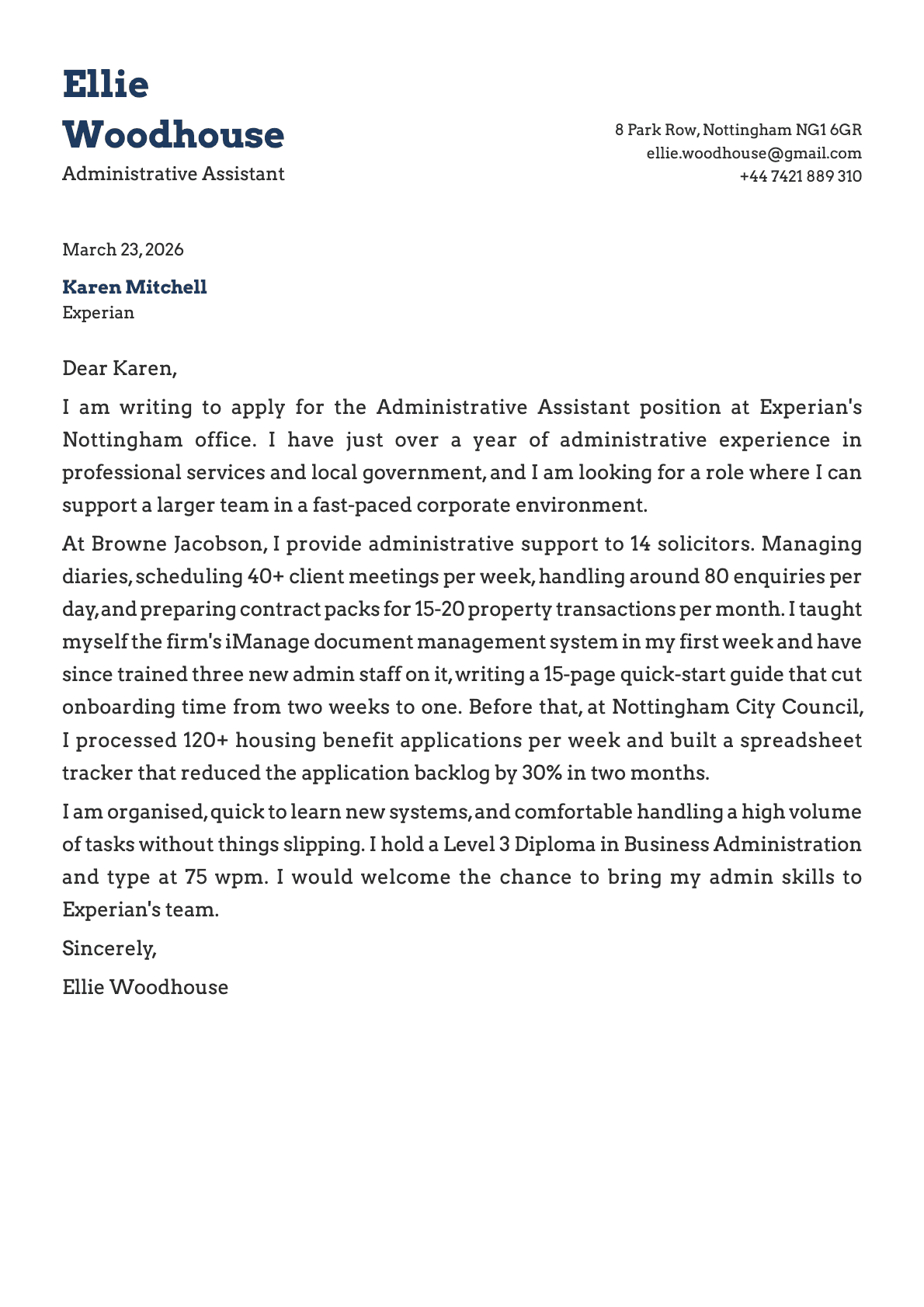
Administrative Assistant
An administrative assistant cover letter example for a corporate role at Experian.
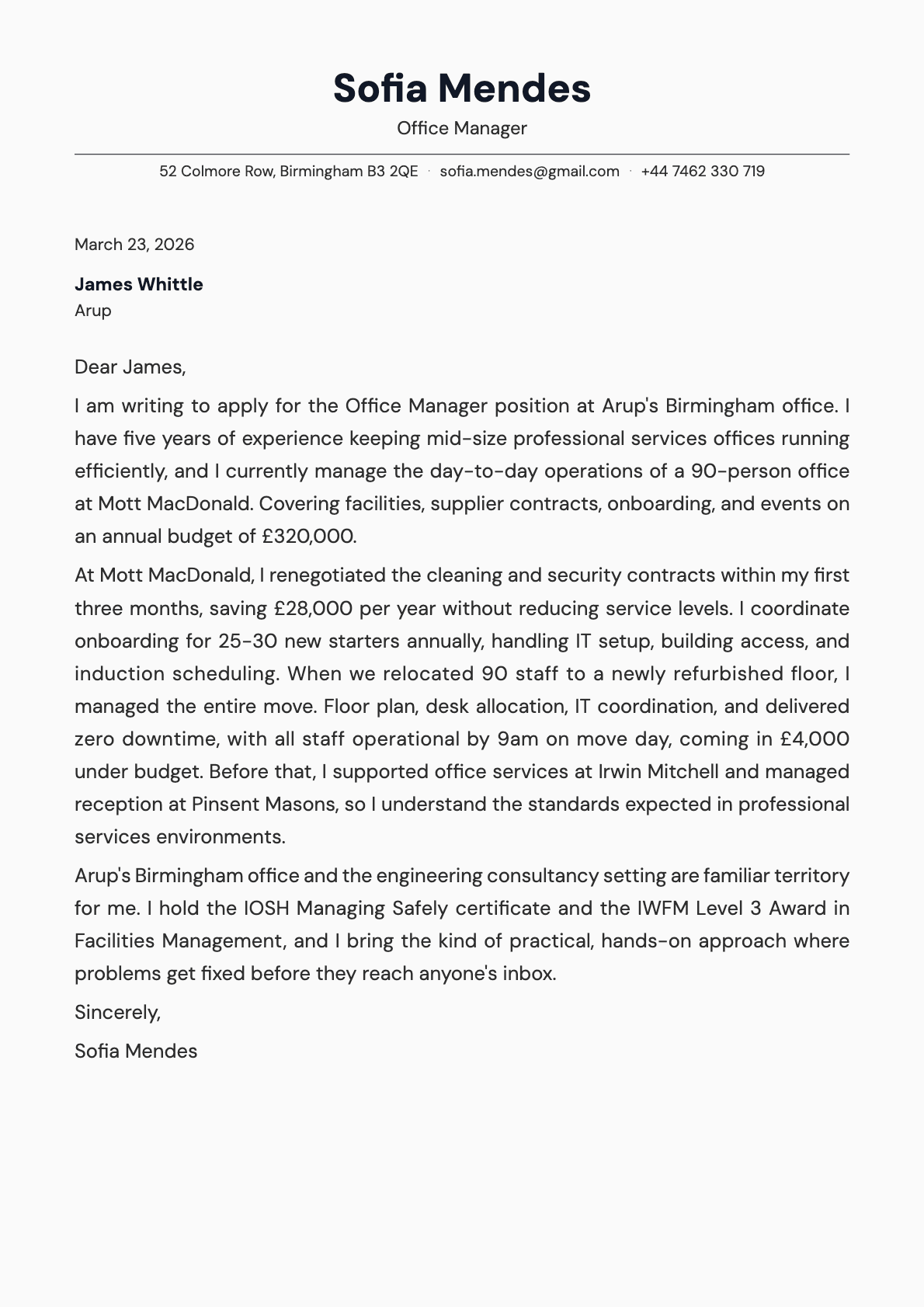
Office Manager
An office manager cover letter example targeting Arup.
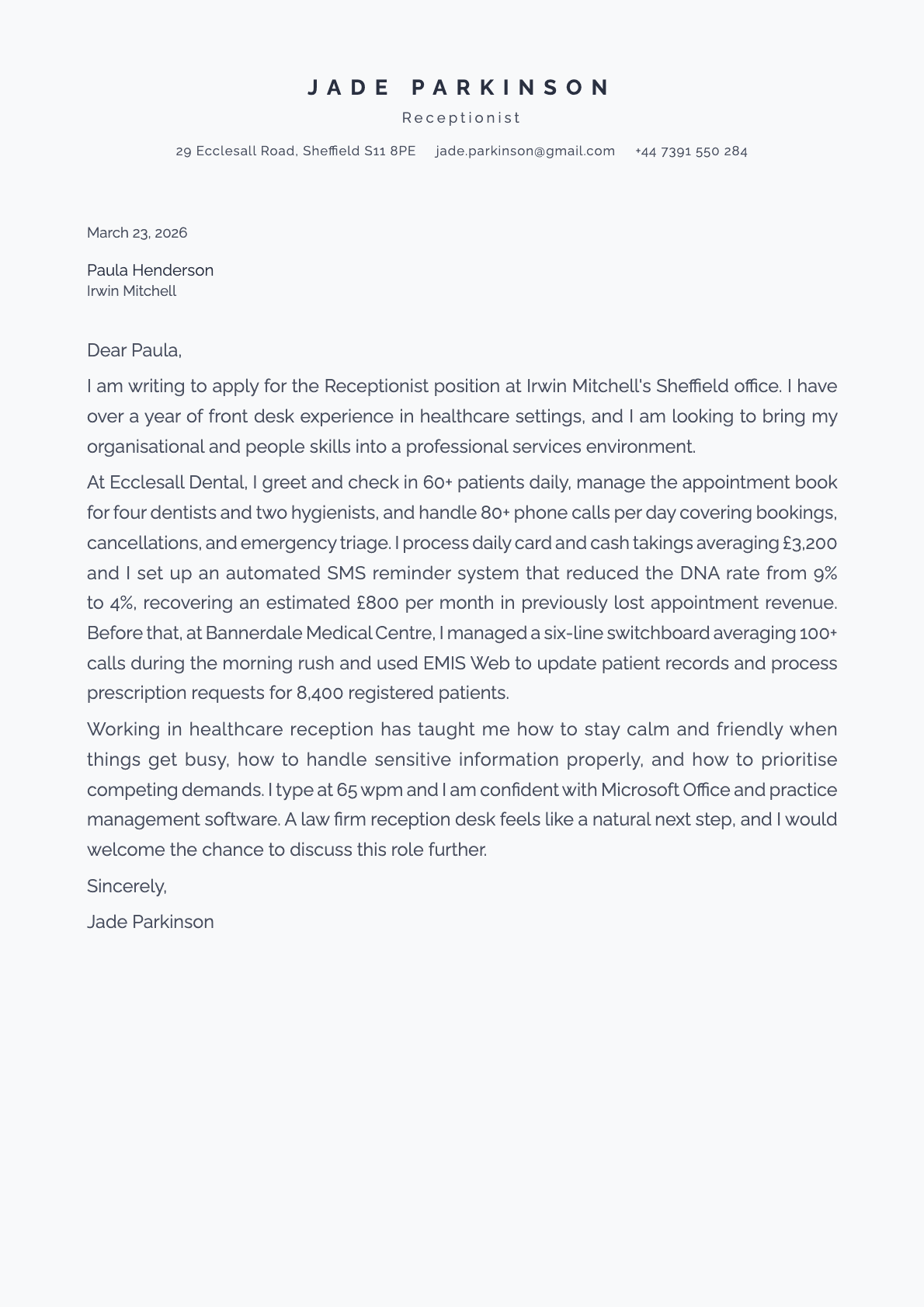
Receptionist
A receptionist cover letter example targeting a law firm role at Irwin Mitchell.
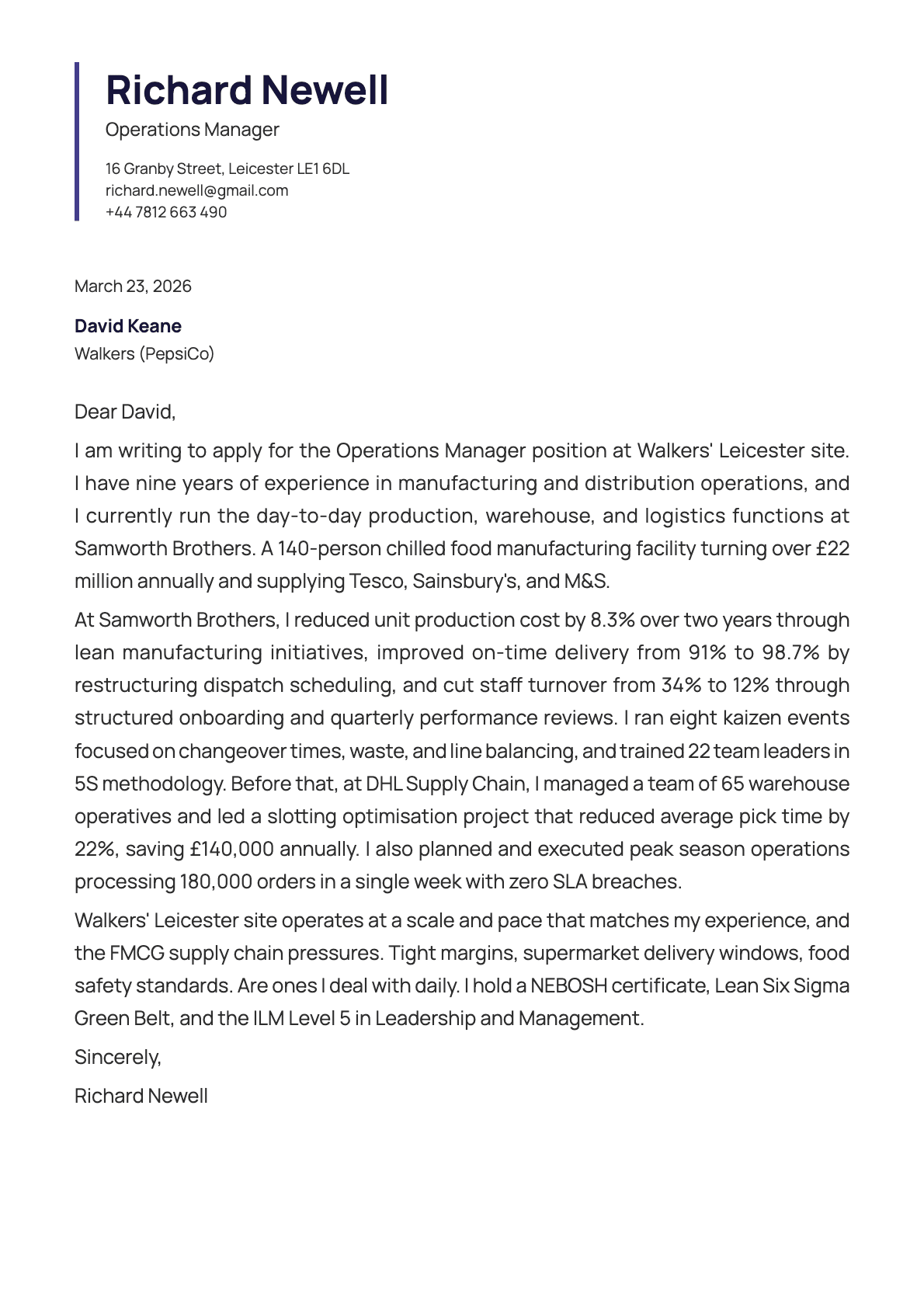
Operations Manager
An operations manager cover letter example targeting Walkers (PepsiCo).
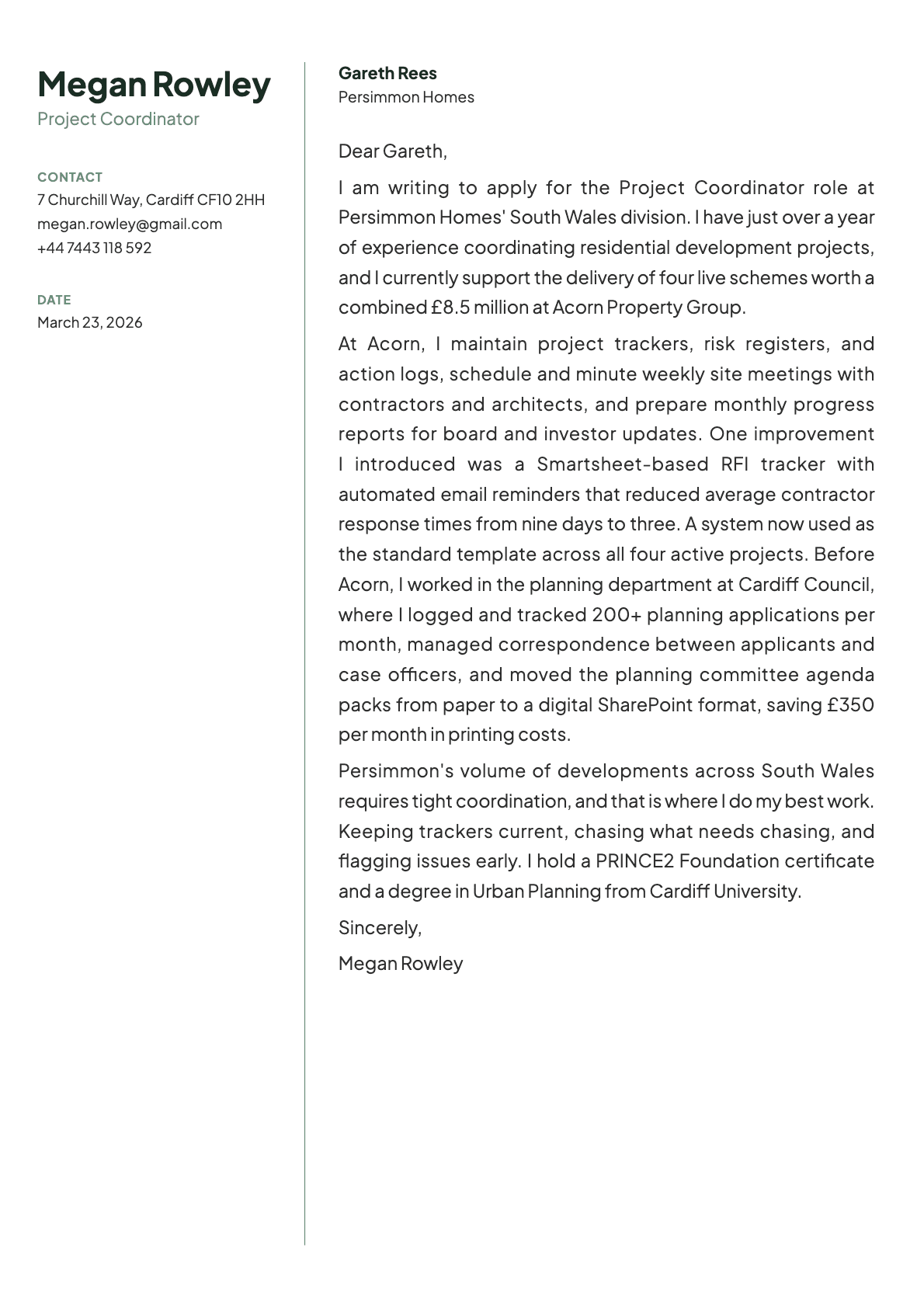
Project Coordinator
A project coordinator cover letter example targeting Persimmon Homes.
Related articles

AI Is Screening Your Resume Before Any Human Sees It
AI screens most resumes before a human ever reads them. 97.4% of Fortune 500 companies run an ATS. This is what that means for you and what you can do about it.
The Best Resume Builders in 2026, Compared Honestly
Resume.io, Zety, Enhancv, Kickresume, Teal, and Laddro compared honestly: real pricing, free tiers, mobile apps, and where each tool wins. All prices checked in September 2026.

Burnout Recovery: A Real Timeline, Not 'Take a Bubble Bath'
55% of the U.S. workforce is burned out. Recovery takes 3 to 12 months. Here's what that actually looks like, stage by stage.