Civil Engineer Cover Letter Example
A civil engineer cover letter example showing how to present project design, site analysis, and infrastructure expertise.
Free to use. No account needed to start.
Free to use. No account needed to start.
Overview
Civil engineer cover letters work best when they are technical enough to prove competence but readable enough that a non-engineer hiring manager can follow along. The challenge is finding that balance. Too technical and it reads like a specification document. Too vague and it sounds like every other application.
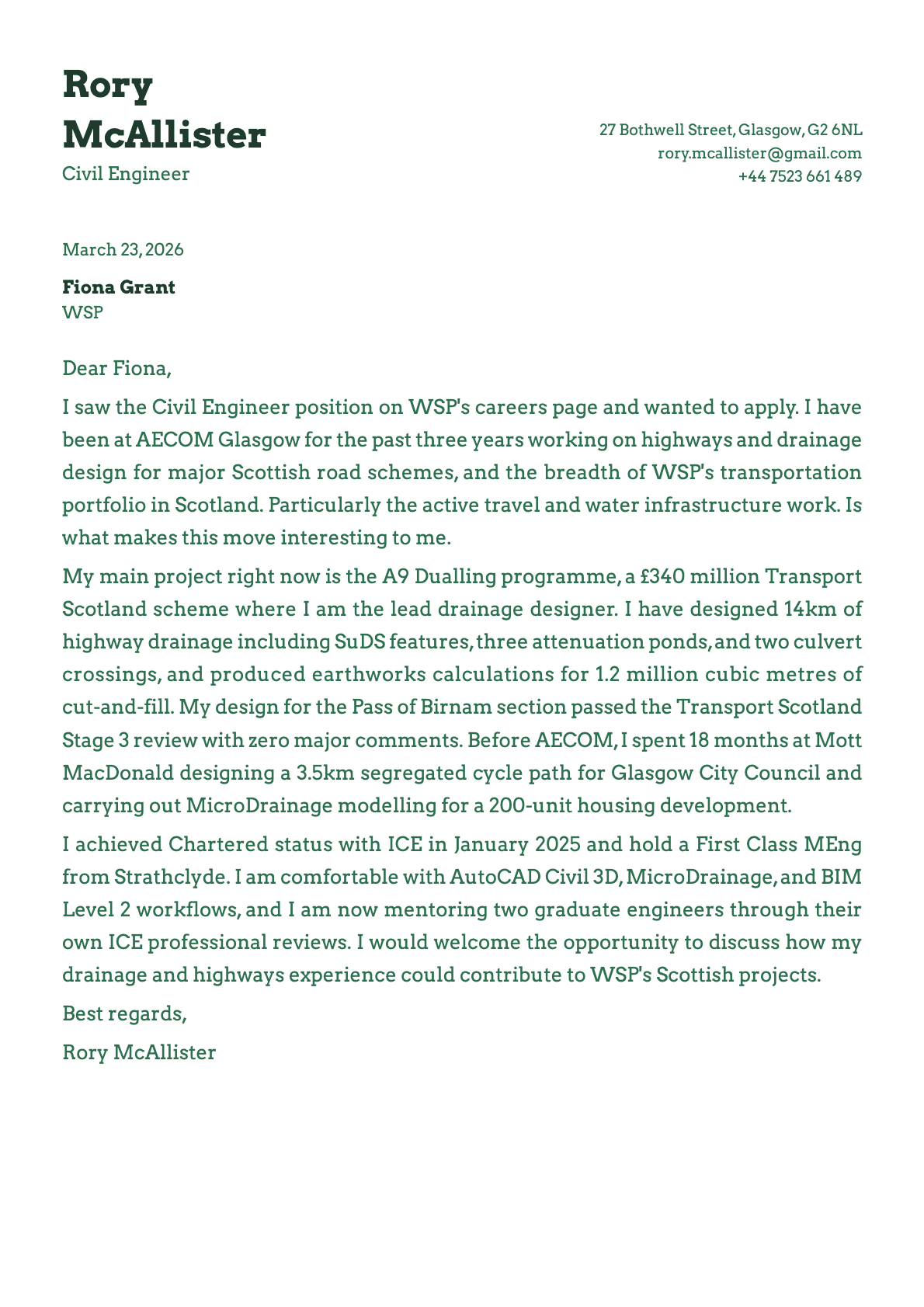
This cover letter is from Rory McAllister, a civil engineer at AECOM Glasgow applying for a position at WSP. He works on major Scottish road schemes and specializes in highways and drainage design. Let us examine what makes this letter effective.
Opening with the current project
Rory does not waste time with pleasantries. He names the role, states his current employer and focus area, and then explains what interests him about WSP: the breadth of the transportation portfolio in Scotland, particularly the active travel and water infrastructure work.
That last detail matters. He is not saying "WSP is a great company" or "I admire WSP's global reach." He is naming specific practice areas he wants to work in. That tells the reader he has researched the firm and has a genuine reason for applying.
For your own civil engineering cover letter, name the specific projects or sectors at the target company that interest you. It shows intentionality and helps the reader see where you would fit.
The A9 Dualling programme as a centerpiece
The middle paragraph is where this letter really lands. Rory is the lead drainage designer on the A9 Dualling programme, a £340 million Transport Scotland scheme. He has designed 14km of highway drainage including SuDS features, three attenuation ponds, and two culvert crossings. He produced earthworks calculations for 1.2 million cubic metres of cut-and-fill. His design for the Pass of Birnam section passed the Stage 3 review with zero major comments.
Every detail here is specific and verifiable. The project value, the lengths, the volumes, the review outcome. A civil engineering hiring manager can read this paragraph and know exactly what level Rory operates at.
When writing about your projects, include the project name and value, your specific design responsibilities, the technical scope (lengths, areas, volumes), and the outcome. If your design passed a stage review, obtained planning consent, or received client approval, say so.
Earlier career experience adds breadth
The mention of a 3.5km segregated cycle path for Glasgow City Council and MicroDrainage modelling for a 200-unit housing development at Mott MacDonald shows that Rory has experience beyond major road schemes. This breadth is valuable because it tells WSP he can contribute across different project types.
If you have worked across different sectors or project types, mention them briefly. Civil engineering firms value engineers who can move between highways, drainage, site development, and infrastructure work.
Chartered status and mentoring
Rory achieved Chartered status with ICE in January 2025, holds a First Class MEng from Strathclyde, and is mentoring two graduate engineers through their own ICE professional reviews. The chartership is the big credential in civil engineering, and having it removes any question about his professional standing.
The mentoring detail is a nice touch. It signals maturity and a willingness to invest in the team, which matters more as you move into intermediate and senior engineer roles.
Software and BIM capability
Mentioning AutoCAD Civil 3D, MicroDrainage, and BIM Level 2 workflows is essential for civil engineering roles. These are the standard tools, and listing them confirms that Rory can work within the digital environment the firm uses. If your target firm uses specific software or follows particular BIM standards, naming them shows you are ready to integrate.
Template choice
This letter uses the Emerald template, which is clean and professional. For engineering roles, the template should not be flashy. It should be well-organized and easy to scan, much like a well-structured technical report. Emerald achieves that.
Was this cover letter example helpful?
Rate this example to help us create better content for you.
4.8 average from 109 ratingsBuild your own version
Open this layout in the builder and swap in your own details. It takes a few minutes.
Free to use. No account needed to start.
Related cover letter examples
Electrician
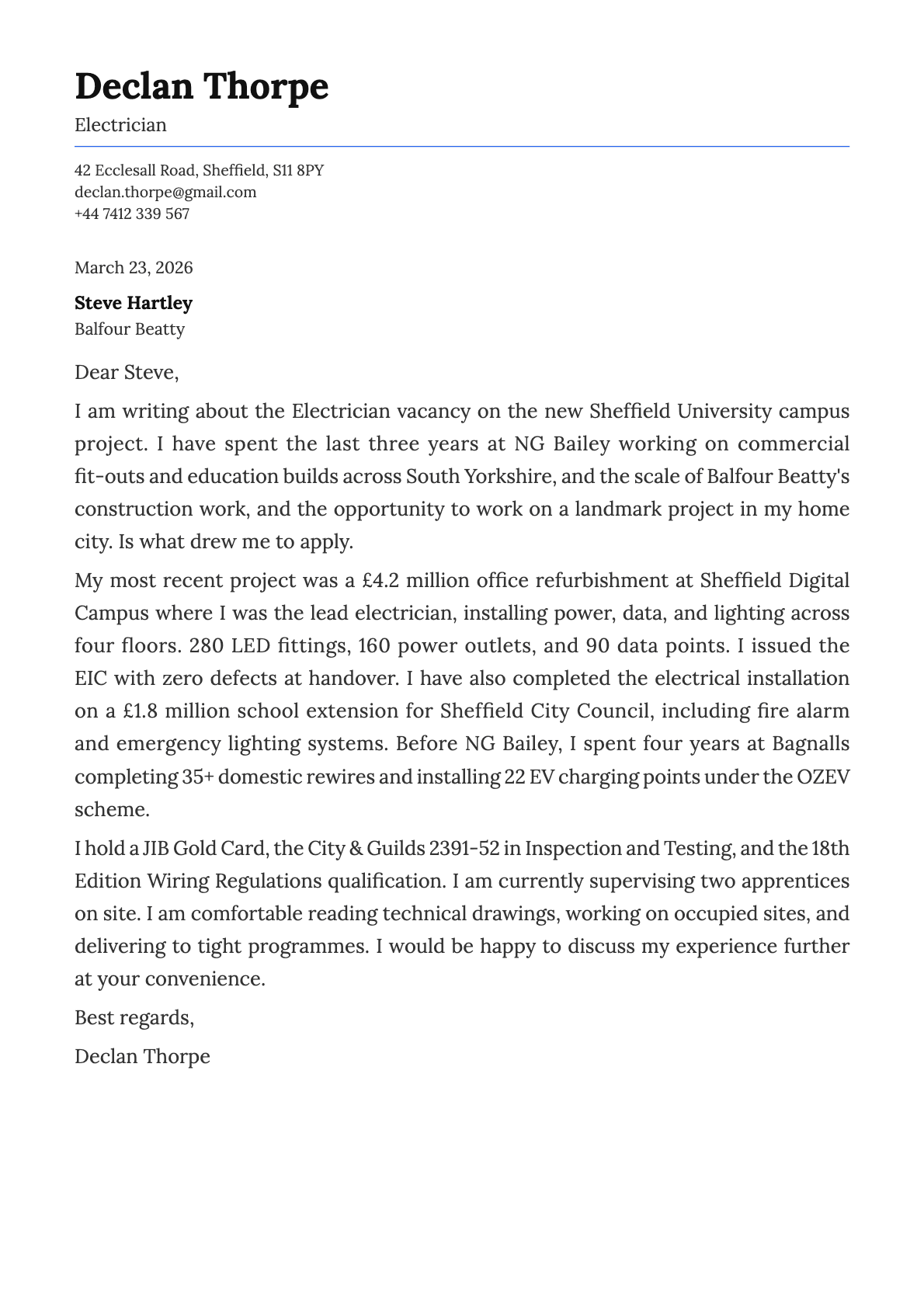
An electrician cover letter example that presents wiring expertise, safety code compliance, and hands-on technical skills.
Construction Manager
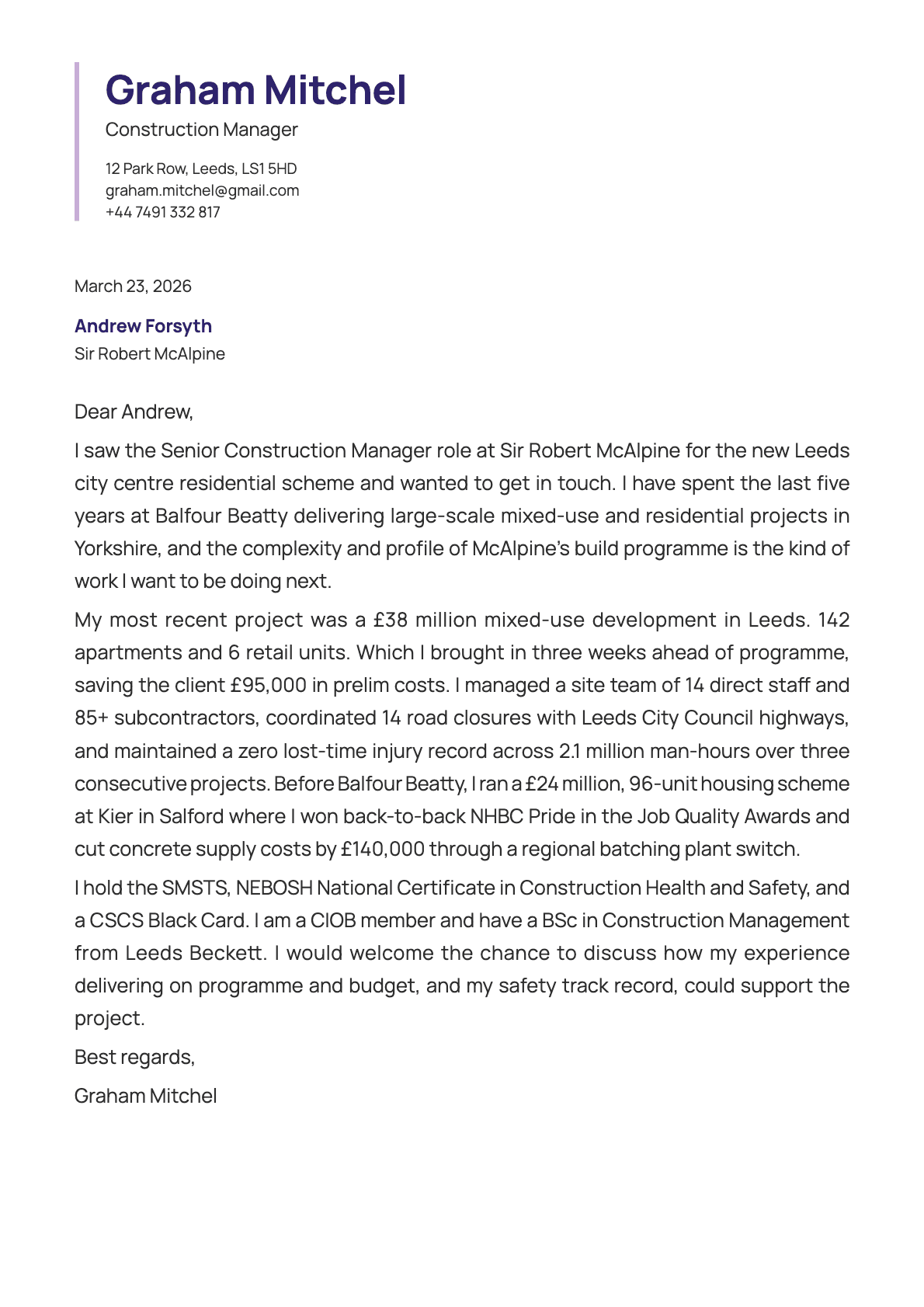
See how this construction manager cover letter highlights project oversight, budget control, and on-site team coordination.
Structural Engineer
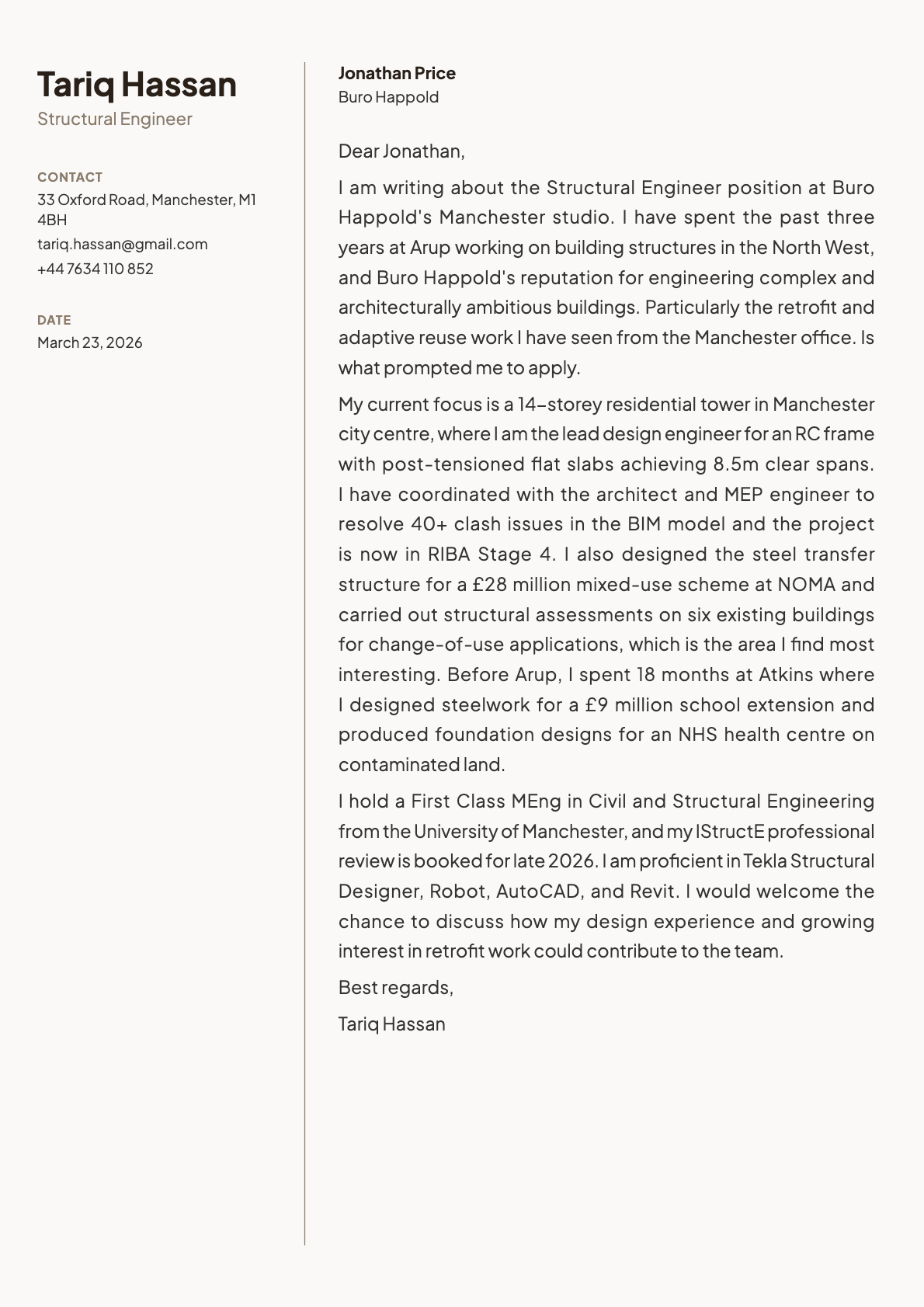
See how this structural engineer cover letter presents load analysis, building design, and structural code compliance expertise.
Related articles

AI Is Screening Your Resume Before Any Human Sees It
AI screens most resumes before a human ever reads them. 97.4% of Fortune 500 companies run an ATS. This is what that means for you and what you can do about it.

The Best Resume Builders in 2026, Compared Honestly
Resume.io, Zety, Enhancv, Kickresume, Teal, and Laddro compared honestly: real pricing, free tiers, mobile apps, and where each tool wins. All prices checked in September 2026.

Burnout Recovery: A Real Timeline, Not 'Take a Bubble Bath'
55% of the U.S. workforce is burned out. Recovery takes 3 to 12 months. Here's what that actually looks like, stage by stage.