Construction Manager Cover Letter Example
See how this construction manager cover letter highlights project oversight, budget control, and on-site team coordination.
Free to use. No account needed to start.
Free to use. No account needed to start.
Overview
Construction manager cover letters need to do three things: prove you can deliver projects on time and on budget, demonstrate that you can run a large site safely, and show that you are ready for the scale of work the new employer offers. Generic statements about "strong leadership skills" will not cut it. The hiring manager wants project values, team sizes, and safety records.
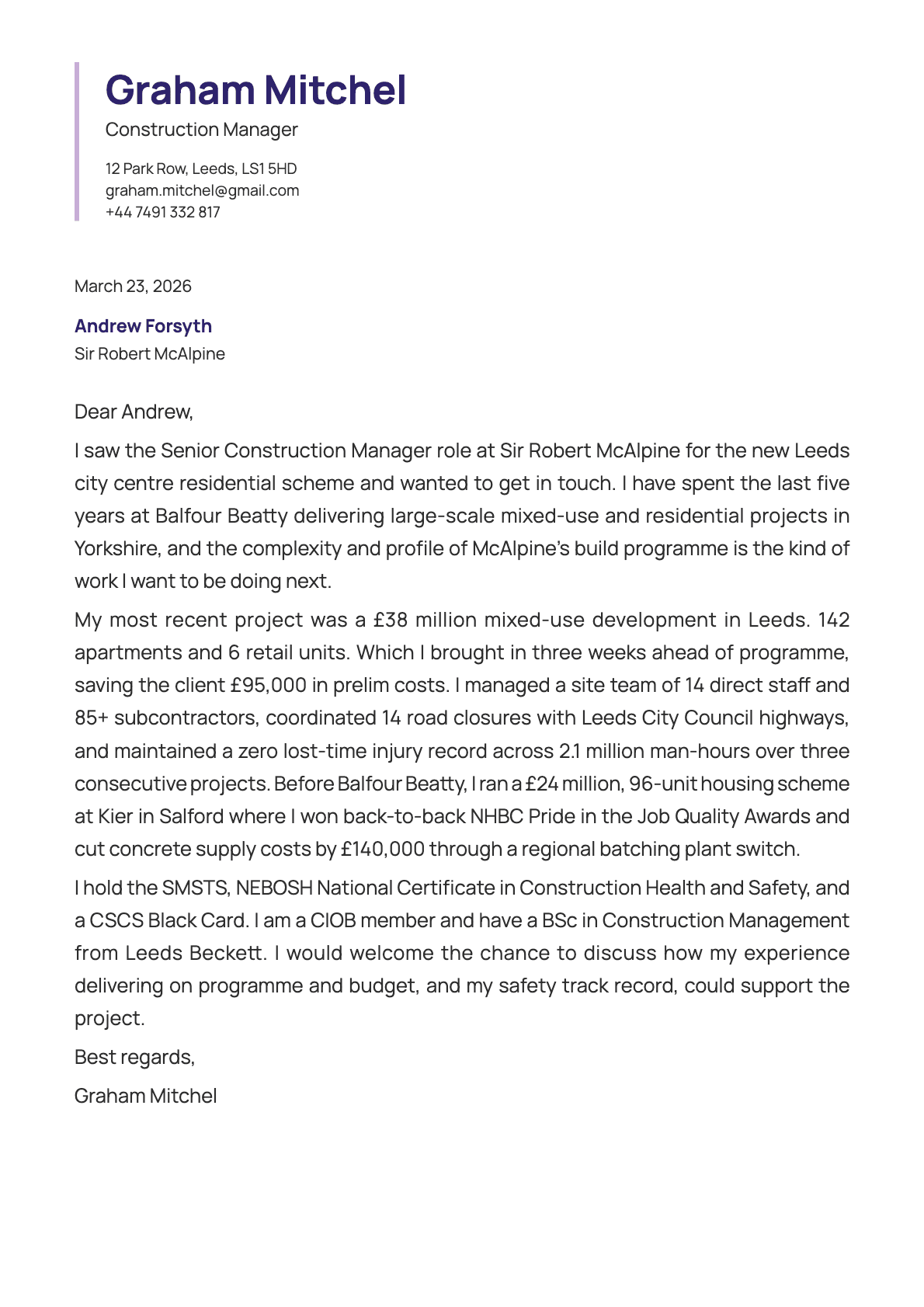
This cover letter is from Graham Mitchel, applying for a Senior Construction Manager role at Sir Robert McAlpine for a Leeds city centre residential scheme. He is currently at Balfour Beatty. Let us look at what works.
Opening with ambition and context
Graham names the specific project at McAlpine and connects it to his current work. He has spent five years delivering large-scale mixed-use and residential projects in Yorkshire, and the complexity and profile of McAlpine's programme is what draws him. This framing is important because it tells the reader this is not a random application. It is a considered move to a higher-profile project.
For construction manager cover letters, naming the project you are applying for and explaining why it appeals to you is a strong opening. It shows awareness of the work and genuine interest in the challenge.
The numbers that matter in construction
The middle paragraph is loaded with the metrics construction hiring managers care about. A £38 million mixed-use development. 142 apartments and 6 retail units. Delivered three weeks ahead of programme, saving the client £95,000 in prelim costs. A site team of 14 direct staff and 85+ subcontractors. 14 road closures coordinated with the local council. And the headline safety number: zero lost-time injuries across 2.1 million man-hours over three consecutive projects.
That safety record is arguably the most important number in the letter. Construction is a high-risk industry, and a zero LTI record across that volume of man-hours signals that Graham takes safety seriously at every level. No hiring manager will overlook that.
He also mentions a previous role at Kier: a £24 million, 96-unit housing scheme where he won back-to-back NHBC Pride in the Job Quality Awards and cut concrete supply costs by £140,000 through a procurement change.
For your own letter, include project values, unit counts, team sizes, programme performance (ahead, on time, or recovered), and safety statistics. These are the benchmarks your application will be judged against.
Quality awards add credibility
The NHBC Pride in the Job awards are widely recognized in the UK housebuilding sector. Winning them signals quality workmanship and site management, and winning them consecutively is even more impressive. If you have won any industry awards or recognition, include them. They provide third-party validation that your work meets a high standard.
Qualifications for construction management
Graham holds the SMSTS, NEBOSH National Certificate in Construction Health and Safety, a CSCS Black Card, CIOB membership, and a BSc in Construction Management. For senior construction roles, the SMSTS and CSCS Black Card are baseline requirements. The NEBOSH certificate and CIOB membership show deeper investment in safety and professional development.
List your qualifications, but keep them concise. In construction, the cards you hold determine whether you can step on site. They are non-negotiable and should be included in every application.
What could be stronger
The letter could benefit from a mention of specific software or systems used for programme management. Asta Powerproject, Procore, or BIM coordination tools would add another layer of detail and show digital competence, which is increasingly important in construction management.
Template choice
This letter uses the Onyx template, which gives it a strong, professional appearance. For senior construction roles, you want a template that looks authoritative without being corporate. Onyx hits that mark well.
Was this cover letter example helpful?
Rate this example to help us create better content for you.
4.8 average from 102 ratingsBuild your own version
Open this layout in the builder and swap in your own details. It takes a few minutes.
Free to use. No account needed to start.
Related cover letter examples
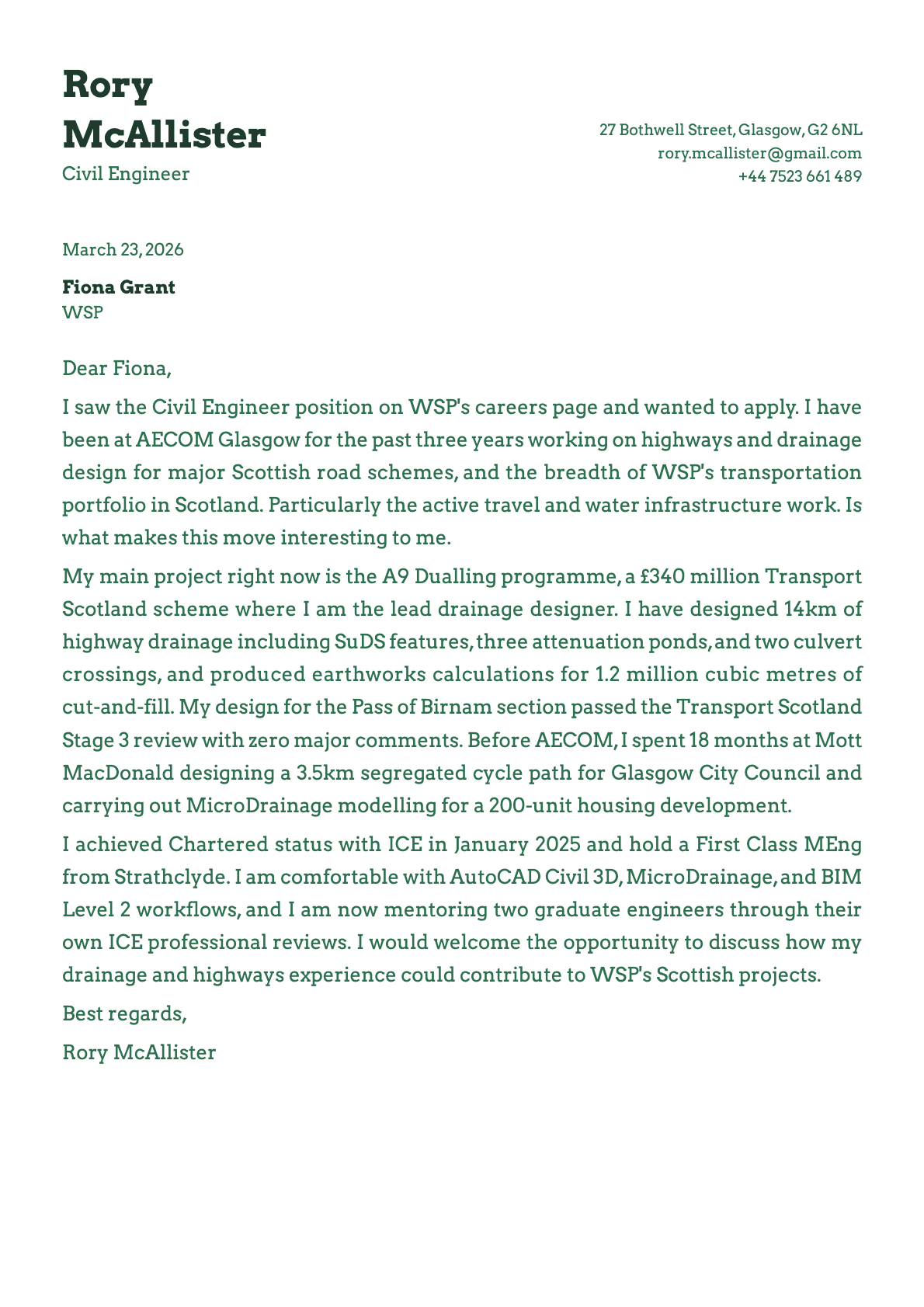
Civil Engineer
A civil engineer cover letter example showing how to present project design, site analysis, and infrastructure expertise.
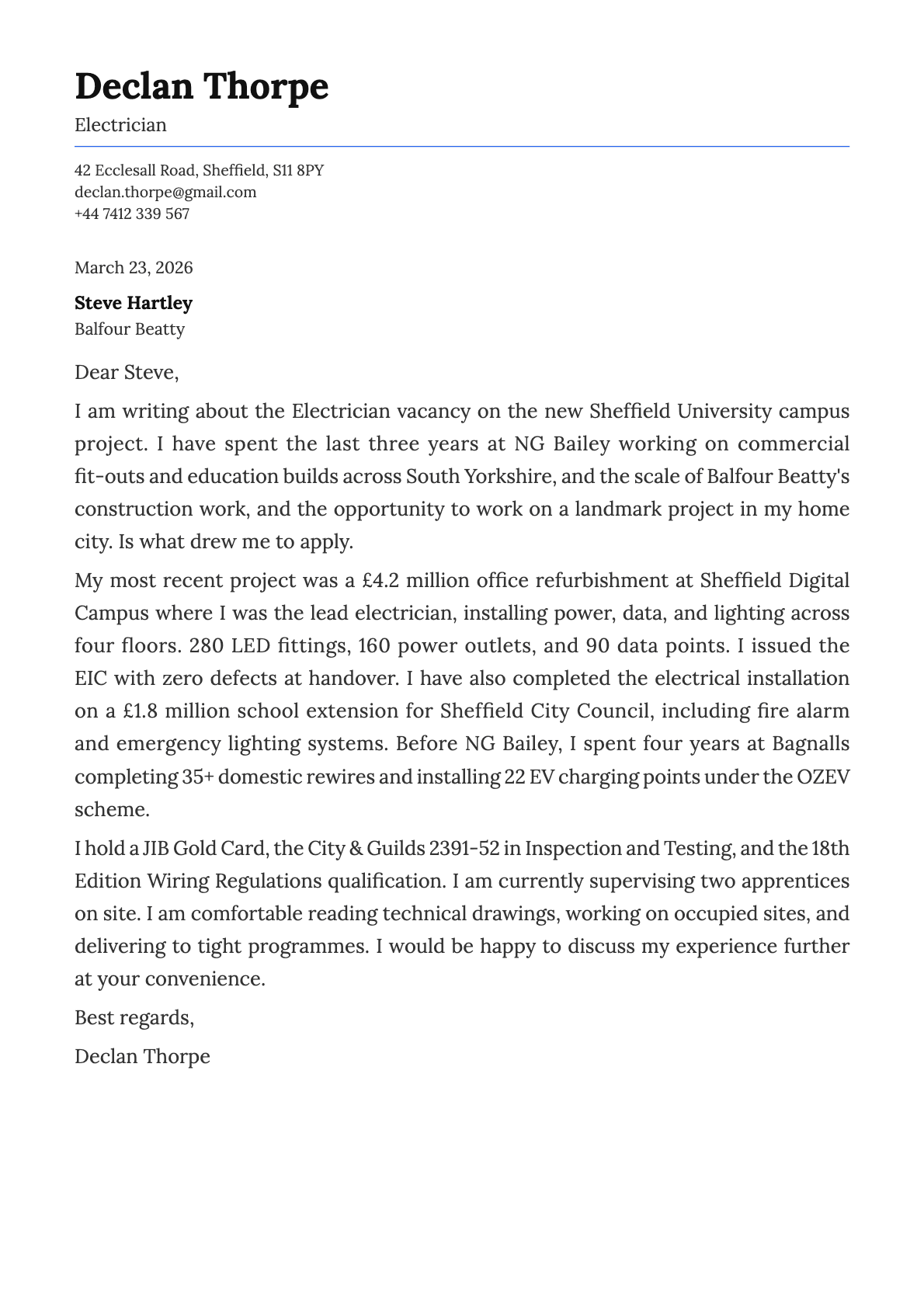
Electrician
An electrician cover letter example that presents wiring expertise, safety code compliance, and hands-on technical skills.
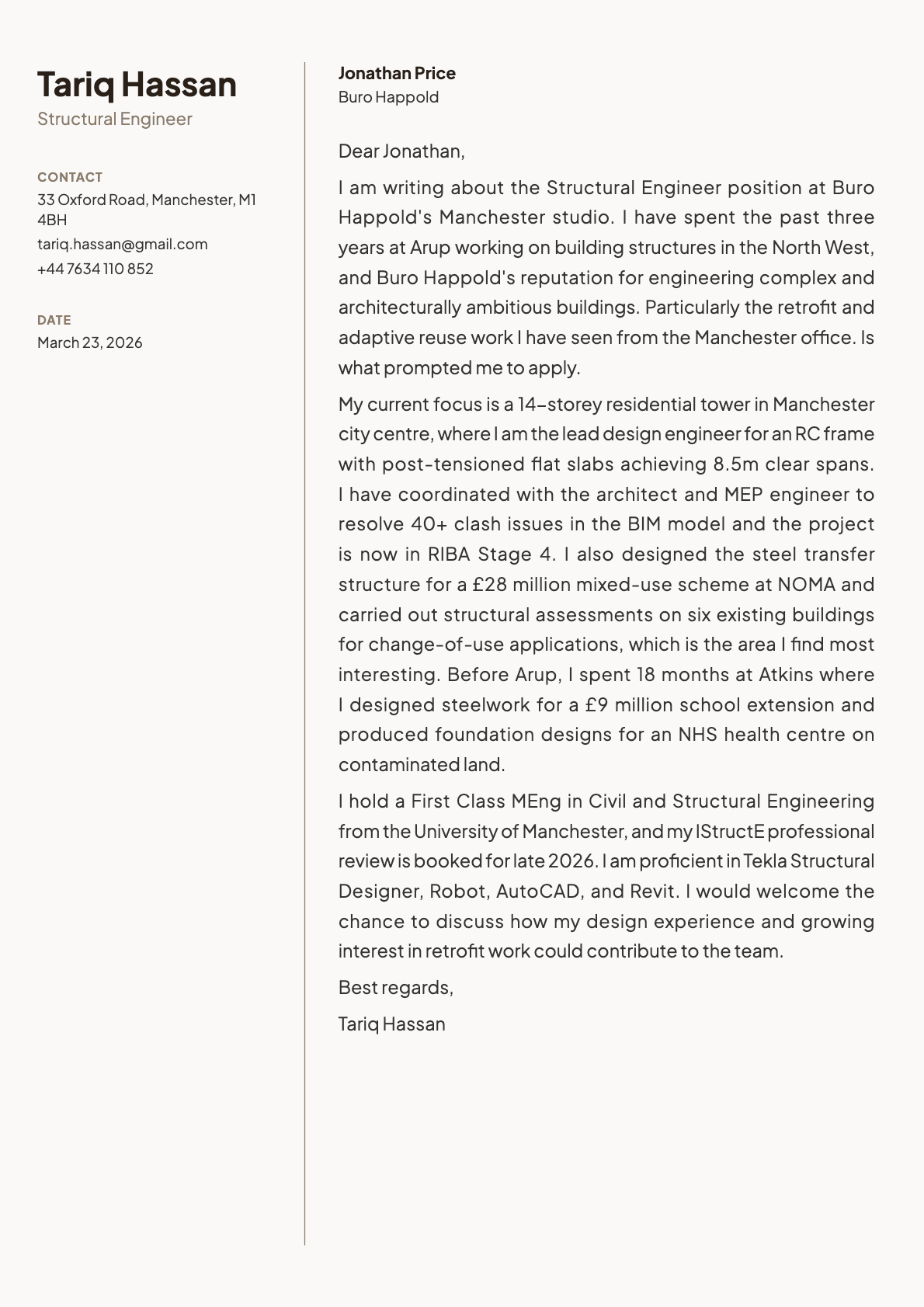
Structural Engineer
See how this structural engineer cover letter presents load analysis, building design, and structural code compliance expertise.
Related articles

AI Is Screening Your Resume Before Any Human Sees It
AI screens most resumes before a human ever reads them. 97.4% of Fortune 500 companies run an ATS. This is what that means for you and what you can do about it.

The Best Resume Builders in 2026, Compared Honestly
Resume.io, Zety, Enhancv, Kickresume, Teal, and Laddro compared honestly: real pricing, free tiers, mobile apps, and where each tool wins. All prices checked in September 2026.

Burnout Recovery: A Real Timeline, Not 'Take a Bubble Bath'
55% of the U.S. workforce is burned out. Recovery takes 3 to 12 months. Here's what that actually looks like, stage by stage.