Structural Engineer Cover Letter Example
See how this structural engineer cover letter presents load analysis, building design, and structural code compliance expertise.
Free to use. No account needed to start.
Free to use. No account needed to start.
Overview
Structural engineer cover letters sit in an unusual space. They need to be technical enough to impress the engineering director reviewing them, but clear enough that an HR professional can understand the general scope and impact of your work. The best structural engineering cover letters describe specific projects, name the structural systems you designed, and show progression toward chartership.
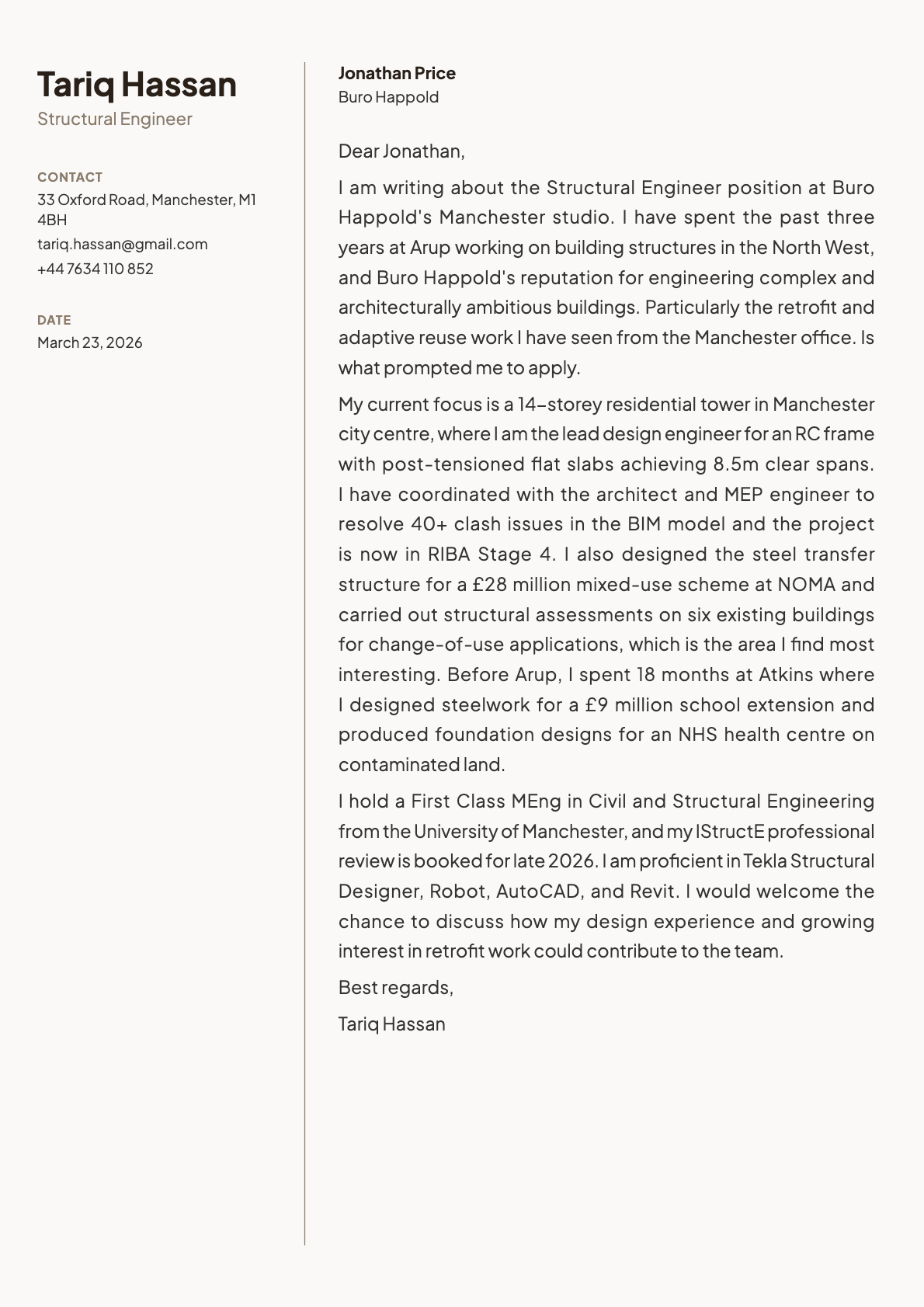
This cover letter is from Tariq Hassan, a structural engineer at Arup's Manchester office, applying for a position at Buro Happold. Let us look at what he does well.
An opening that names the interest area
Tariq starts by naming the role and studio, then explains what attracted him: Buro Happold's reputation for complex and architecturally ambitious buildings, particularly the retrofit and adaptive reuse work coming out of the Manchester office.
This is more specific than most engineering cover letters manage. By naming retrofit and adaptive reuse, Tariq tells the reader he has a direction he wants to go in and that he has been paying attention to what the firm does. That kind of targeted interest stands out compared to letters that simply say "I would like to join a leading structural engineering consultancy."
The 14-storey tower as a centerpiece
The main project description is detailed and technical in the right ways. A 14-storey residential tower with an RC frame using post-tensioned flat slabs achieving 8.5m clear spans. He coordinated with the architect and MEP engineer to resolve 40+ clash issues in the BIM model, and the project is in RIBA Stage 4.
For structural engineers reading this, those details carry real weight. Post-tensioned flat slabs at 8.5m spans are a specific and non-trivial design challenge. The BIM coordination work shows he does not just design in isolation. He works within the digital model and resolves real coordination issues.
When writing your own structural engineering cover letter, describe your primary project in technical terms. Name the structural system (steel frame, RC, timber, hybrid), the key design parameters (spans, loads, heights), and the current project stage. If you have resolved coordination issues or achieved design milestones, include those too.
Breadth across project types
Beyond the residential tower, Tariq mentions a £28 million mixed-use scheme at NOMA (steel transfer structure), six existing building assessments for change of use, and a school extension and NHS health centre at Atkins. This range shows he is not a one-project engineer. He can work across residential, commercial, education, and healthcare sectors.
The mention of change-of-use assessments is particularly smart because he identified that as his area of interest in the opening. By circling back to it in the body of the letter, he reinforces his narrative. He is not just interested in retrofit work. He already has experience doing it.
Working toward chartership
Tariq holds a First Class MEng and has his IStructE professional review booked for late 2026. For a mid-level structural engineering role, the IStructE chartership is the key credential. Showing that it is booked and imminent tells the hiring firm that he is on track and committed.
If you are working toward chartership with IStructE or ICE, mention where you are in the process. If you have a review date, include it. Firms invest in engineers they believe will achieve chartered status, and showing progress reduces the perceived risk of hiring you.
Software proficiency
Listing Tekla Structural Designer, Robot, AutoCAD, and Revit covers the main tools a UK structural engineering practice expects. If the firm uses specific software, matching your list to their tools shows you can integrate quickly.
Template choice
This letter uses the Birch template, which is clean and well-structured. For engineering consultancy applications, your letter should reflect the clarity and precision of your design work. Birch delivers a professional look that lets the technical content take center stage.
Was this cover letter example helpful?
Rate this example to help us create better content for you.
4.7 average from 93 ratingsBuild your own version
Open this layout in the builder and swap in your own details. It takes a few minutes.
Free to use. No account needed to start.
Related cover letter examples
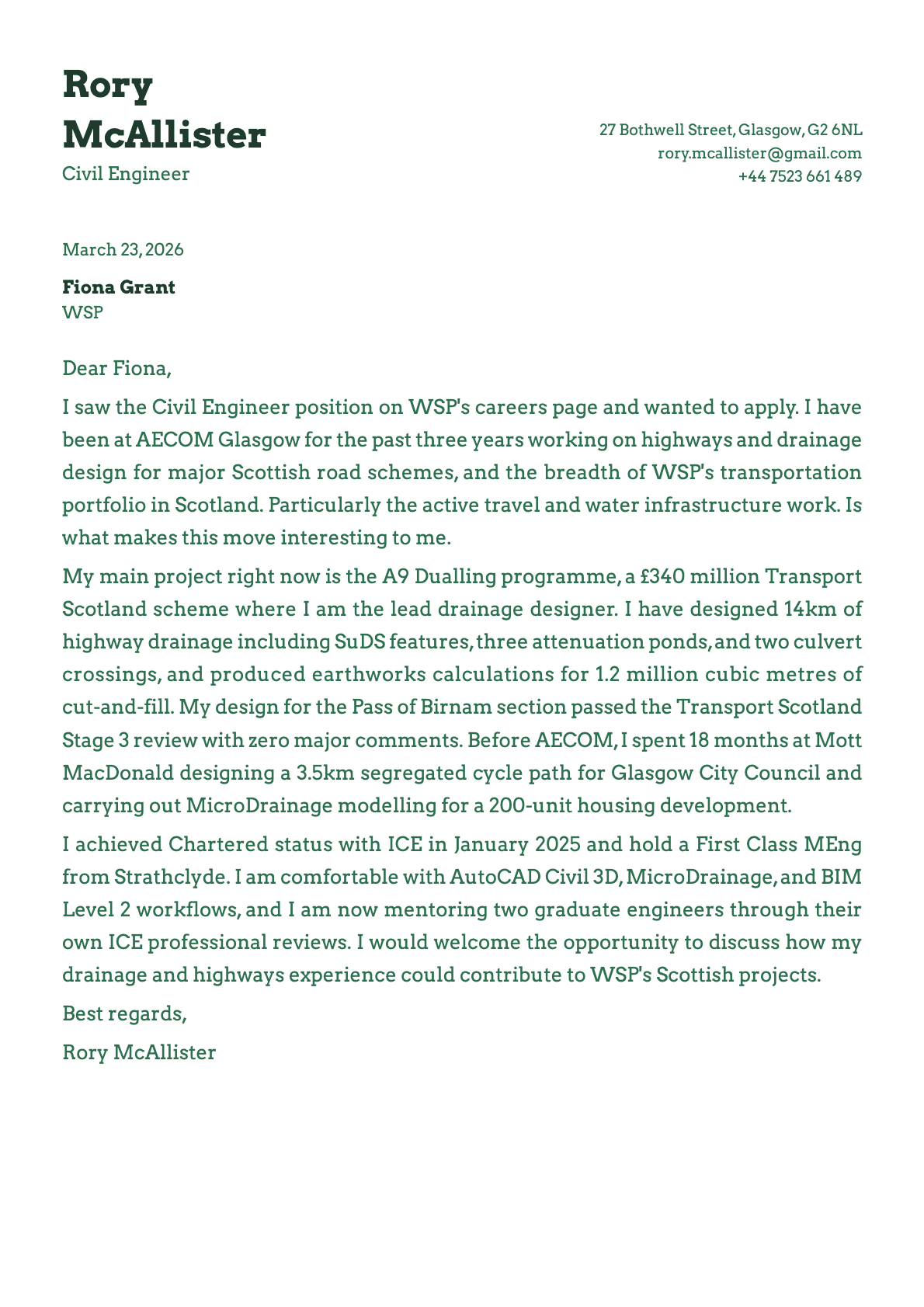
Civil Engineer
A civil engineer cover letter example showing how to present project design, site analysis, and infrastructure expertise.
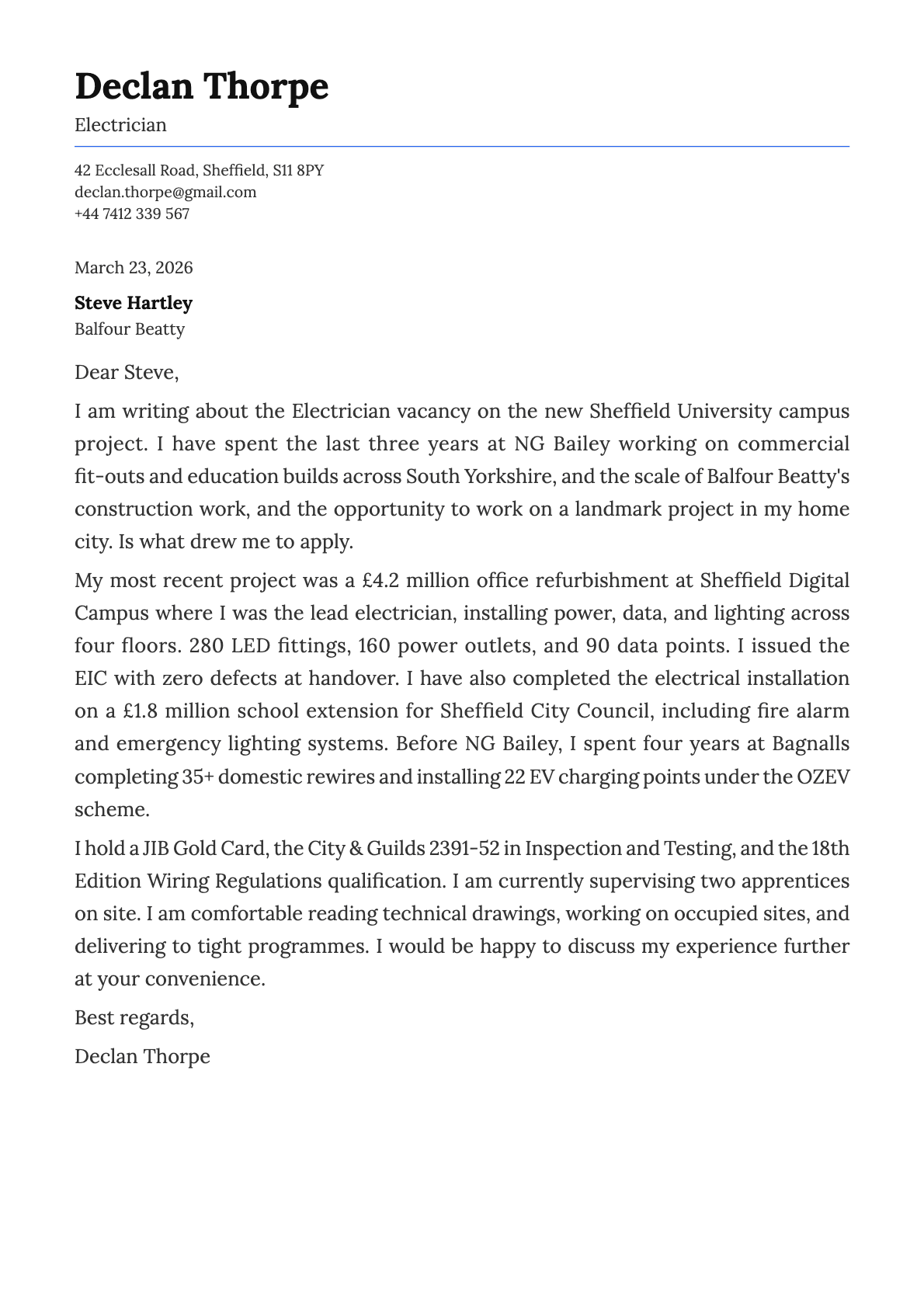
Electrician
An electrician cover letter example that presents wiring expertise, safety code compliance, and hands-on technical skills.
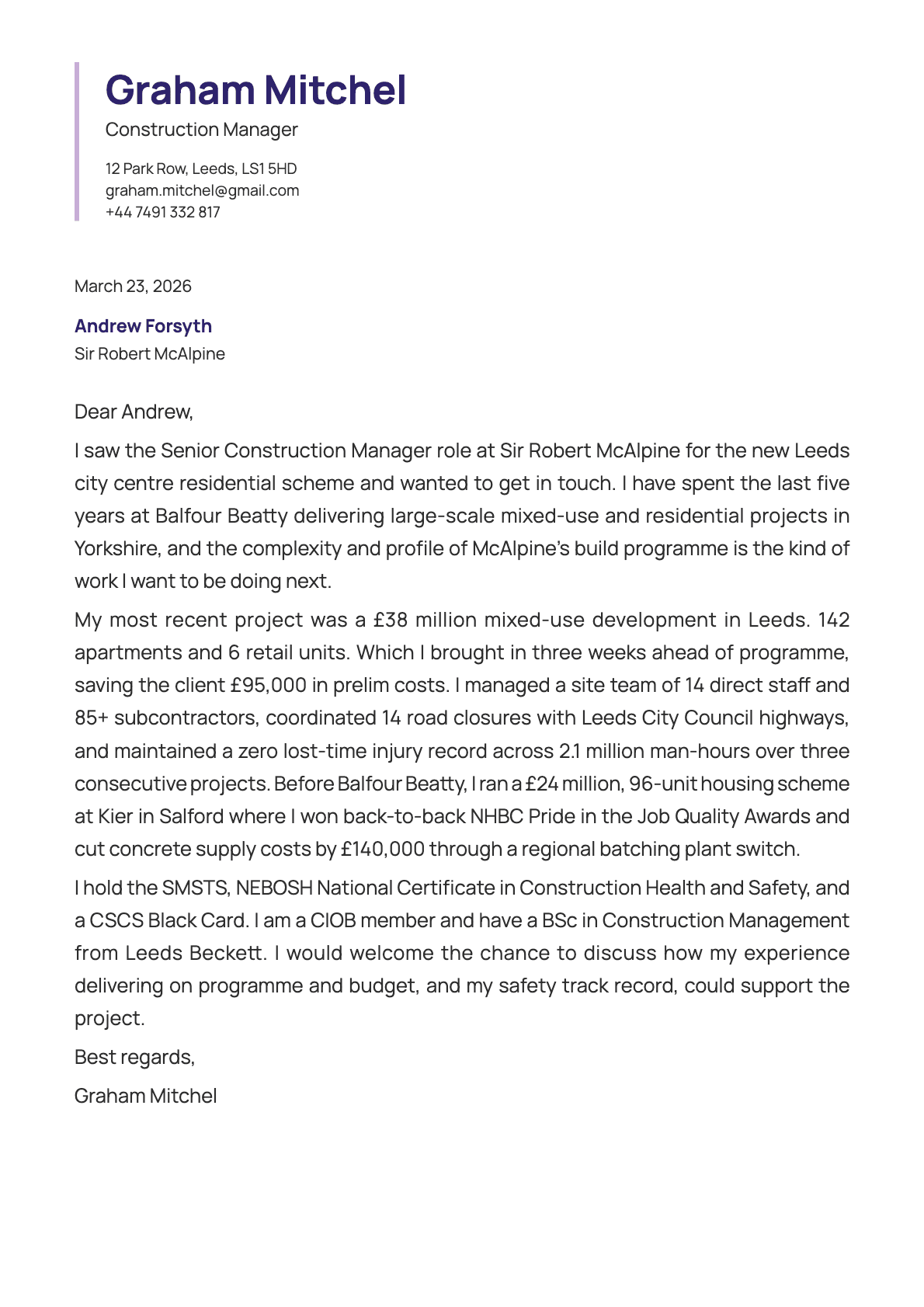
Construction Manager
See how this construction manager cover letter highlights project oversight, budget control, and on-site team coordination.
Related articles

AI Is Screening Your Resume Before Any Human Sees It
AI screens most resumes before a human ever reads them. 97.4% of Fortune 500 companies run an ATS. This is what that means for you and what you can do about it.

The Best Resume Builders in 2026, Compared Honestly
Resume.io, Zety, Enhancv, Kickresume, Teal, and Laddro compared honestly: real pricing, free tiers, mobile apps, and where each tool wins. All prices checked in September 2026.

Burnout Recovery: A Real Timeline, Not 'Take a Bubble Bath'
55% of the U.S. workforce is burned out. Recovery takes 3 to 12 months. Here's what that actually looks like, stage by stage.