Civil Engineer Resume Example
A civil engineer resume example with highways and drainage design experience at AECOM and Mott MacDonald.

Laddro Team
Free to use. No account needed to start.
Free to use. No account needed to start.
Overview
Civil engineering resumes often suffer from being too general. "Involved in the design of infrastructure projects." That could mean anything from drawing a kerb detail to leading a billion-pound highways scheme. The hiring manager at a consultancy like AECOM or Mott MacDonald wants to know exactly what you designed, what software you used, and what scale you operated at. If your resume does not answer those questions in the first ten seconds, it goes in the pile.
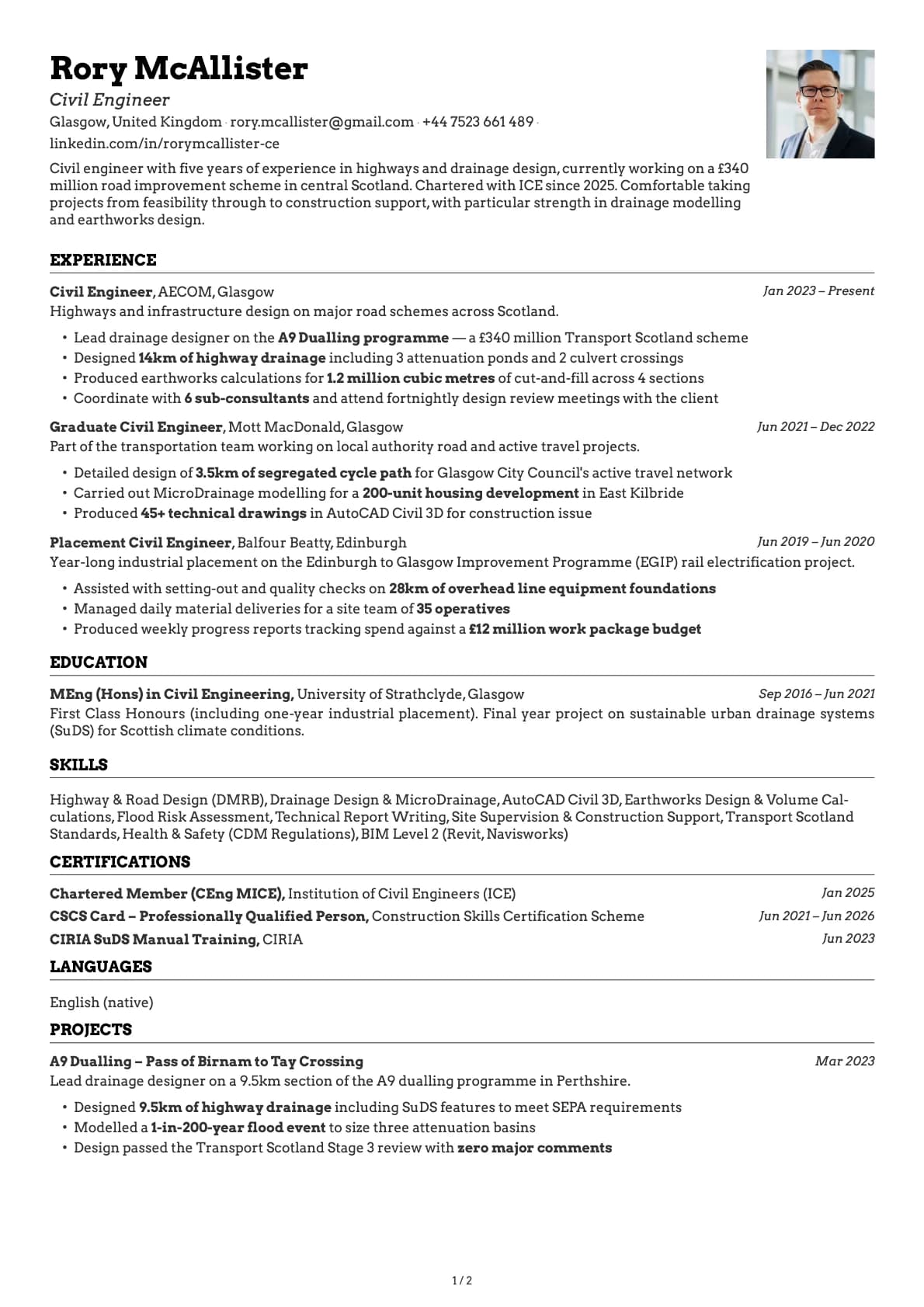
This resume belongs to Rory McAllister, a chartered civil engineer with five years of experience in highways and drainage design. He works at AECOM on the A9 Dualling programme in Scotland, a Transport Scotland scheme worth around 340 million pounds. Before that, he was at Mott MacDonald doing active travel and housing infrastructure. And before that, a placement year at Balfour Beatty on a rail electrification project.
Three roles, three different types of civil engineering work, but the resume ties them together with a clear technical thread. Let us look at what makes it work.
Your summary needs chartership and project scale
For civil engineers, the first thing a hiring manager checks is whether you are chartered, working towards chartership, or neither. This resume opens with it clearly:
Civil engineer with five years of experience in highways and drainage design, currently working on a £340 million road improvement scheme in central Scotland. Chartered with ICE since 2025.
Two sentences. Years of experience, specialism, project value, and chartership status. That is all you need. If you are still working towards CEng, say "currently preparing ICE professional review" or "aiming for CEng MICE review in 2026." Do not leave it out. Every engineering recruiter is looking for it.
For yours: State your specialism (highways, structures, drainage, geotechnical). Name your current project and its value. State your chartership status. Stop there.
How to write design experience that stands out
The experience section needs to show technical depth. Not "worked on a road project" but exactly what you designed, what standards you followed, and what quantities were involved.
Look at these bullets from the AECOM role:
"Lead drainage designer on the A9 Dualling programme, a £340 million Transport Scotland scheme"
"Designed 14km of highway drainage including 3 attenuation ponds and 2 culvert crossings"
"Produced earthworks calculations for 1.2 million cubic metres of cut-and-fill across 4 sections"
Each bullet gives the hiring manager something concrete. 14km of drainage. Three attenuation ponds. 1.2 million cubic metres of earthworks. These are not vague claims. They are measurable pieces of design work that another engineer can evaluate.
The formula: What you designed + what standard or client requirement you met + the scale or quantity. Every bullet should answer "how much?" or "how many?"
Software and standards matter
Civil engineering is a technical profession. Recruiters and hiring managers scan for specific software names and design standards. This resume lists AutoCAD Civil 3D, MicroDrainage, BIM Level 2 (Revit, Navisworks), and DMRB (Design Manual for Roads and Bridges).
The Mott MacDonald entry reinforces this:
"Carried out MicroDrainage modelling for a 200-unit housing development in East Kilbride"
"Produced 45+ technical drawings in AutoCAD Civil 3D for construction issue"
If you use specific software daily, name it in your experience bullets and your skills section. Not just "proficient in CAD" but "AutoCAD Civil 3D" or "12d Model" or "OpenRoads Designer." The same goes for design standards. If you design to DMRB, CIRIA SuDS Manual, or Sewers for Scotland, say so. These are keywords that both ATS systems and human reviewers look for.
The value of a placement year
This resume includes a placement year at Balfour Beatty on the Edinburgh to Glasgow Improvement Programme. Some people skip placement years or bury them at the bottom. That is a mistake, especially when the placement was on a significant project.
"Assisted with setting-out and quality checks on 28km of overhead line equipment foundations"
"Produced weekly progress reports tracking spend against a £12 million work package budget"
The placement shows site experience, which is valuable for any civil engineer who primarily works in design. It demonstrates that Rory has actually been on a construction site, understood how budgets are tracked, and worked alongside a contractor. When a consultancy is looking for someone who can do both design and construction support, that placement year becomes a selling point.
Certifications: CSCS and chartership
Three certifications on this resume, each serving a different purpose.
CEng MICE. This is the big one. Chartered membership of the Institution of Civil Engineers tells employers you have met the professional standard. If you have it, list it first. If you are working towards it, include it with your target date.
CSCS Card (Professionally Qualified Person). You cannot get onto a UK construction site without a valid CSCS card. For engineers who do site visits, construction support, or supervision, this is essential. List the card colour and type, because different roles require different levels.
CIRIA SuDS Manual Training. This is a specialist certification relevant to drainage engineers. It shows that Rory has formal training in sustainable drainage design beyond just using the software. If you have completed any CPD courses specific to your discipline, include them.
Projects section: go deeper on your best work
The projects section gives more detail on the A9 Dualling work and the Cathkin Braes active travel route. This is useful because the experience bullets are necessarily brief. The project entries allow more room to explain the complexity.
"Modelled a 1-in-200-year flood event to size three attenuation basins"
"Design passed the Transport Scotland Stage 3 review with zero major comments"
That second line is the kind of detail that engineers notice. Passing a Stage 3 review with zero major comments means the design was right. It is a quality indicator that does not need explanation within the industry.
If you have worked on a notable project, use the projects section to expand on it. What was the design challenge? What was the review or approval outcome? Did your design pass without major changes?
Mistakes civil engineers make on resumes
Not stating your chartership status. CEng MICE, IEng MICE, or working towards it. If you leave this off, the recruiter has to ask, and they might not bother.
Vague project descriptions. "Worked on a major highways project" is useless. Name the project, name the client, give the value, and describe your specific design contribution.
Missing CSCS card details. If the role involves any site work, the CSCS card is a gatekeeper. List it with the card type and expiry date.
Listing software without context. "Proficient in AutoCAD" does not tell the hiring manager what you have designed with it. "Produced 45+ technical drawings in AutoCAD Civil 3D for construction issue" does. Put the software in your experience bullets, not just the skills list.
One more thing
Civil engineering recruitment at consultancies often works through internal referrals and LinkedIn approaches. But every applicant still needs a resume that passes the initial screen. Make sure yours states your chartership, names your projects, gives quantities, and lists the exact software and standards you work with. An engineer reading your resume should be able to picture exactly what you do every day. If they cannot, it is not specific enough.
Build your own version
Open this layout in the builder and swap in your own details. It takes a few minutes.
Free to use. No account needed to start.
Was this resume example helpful?
Rate this example to help us create better content for you.
4.8 average from 162 ratingsRelated resume examples
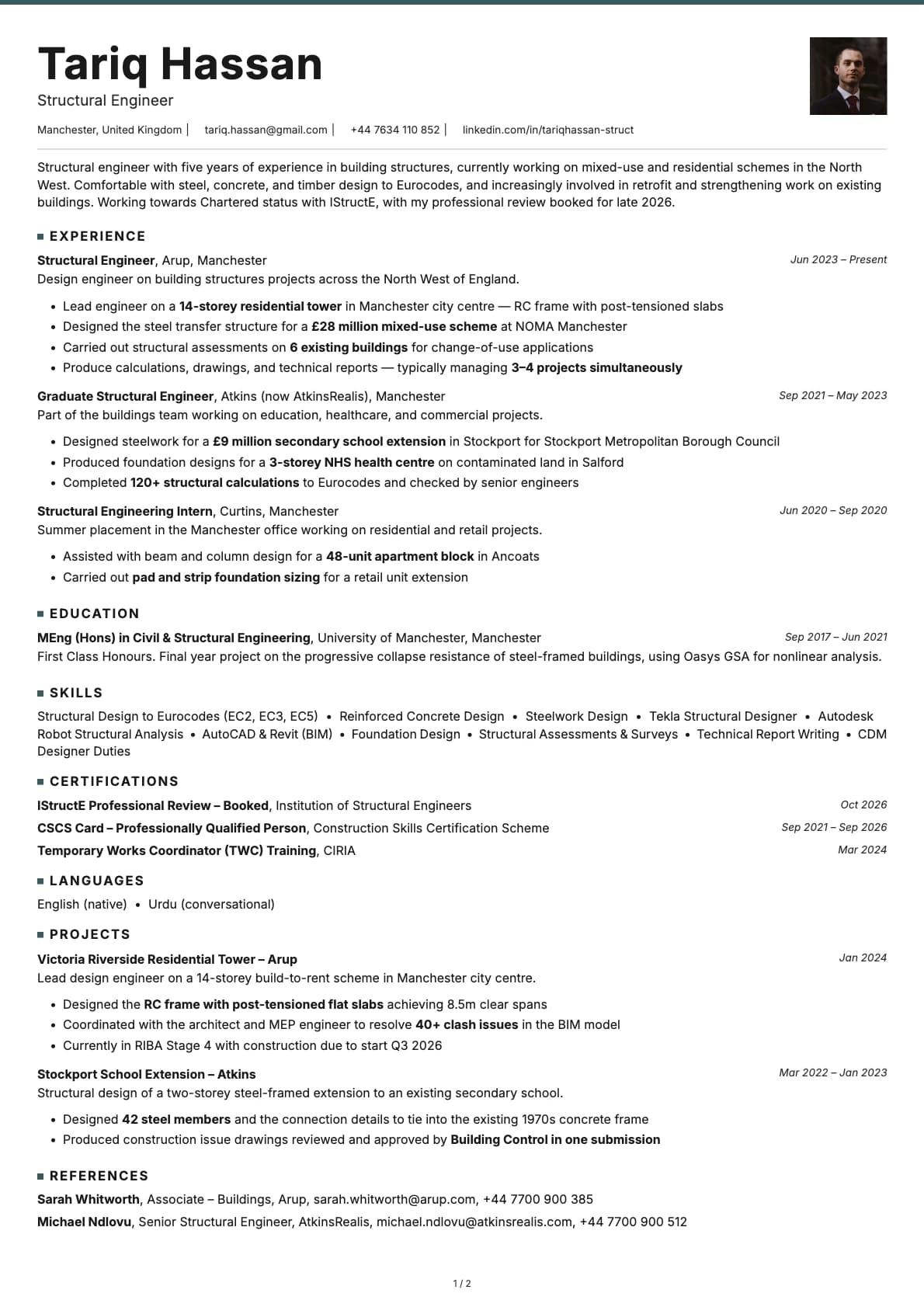
Structural Engineer
A structural engineer resume example with 5 years of experience at Arup and Atkins.
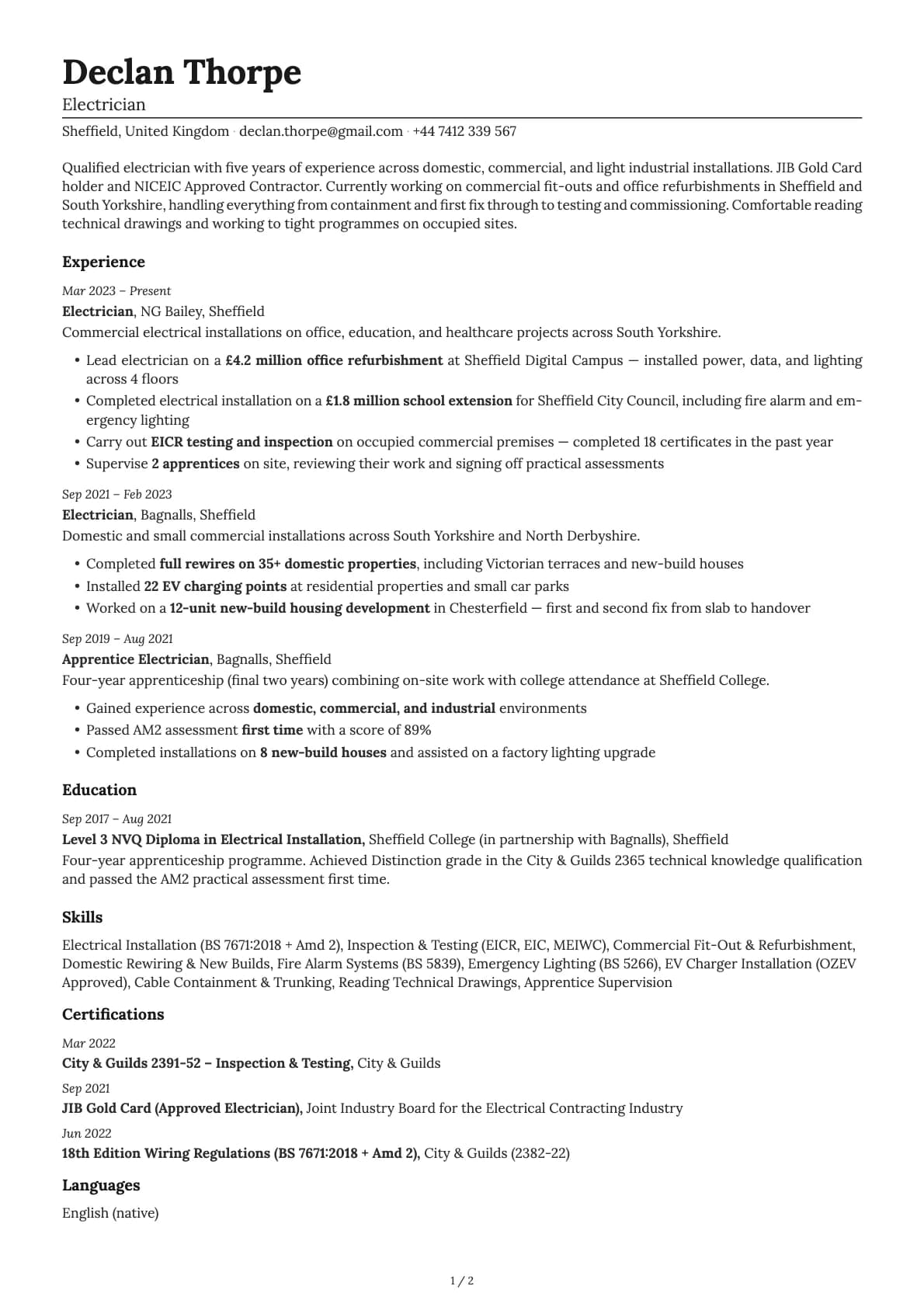
Electrician
An electrician resume example with commercial and domestic installation experience.
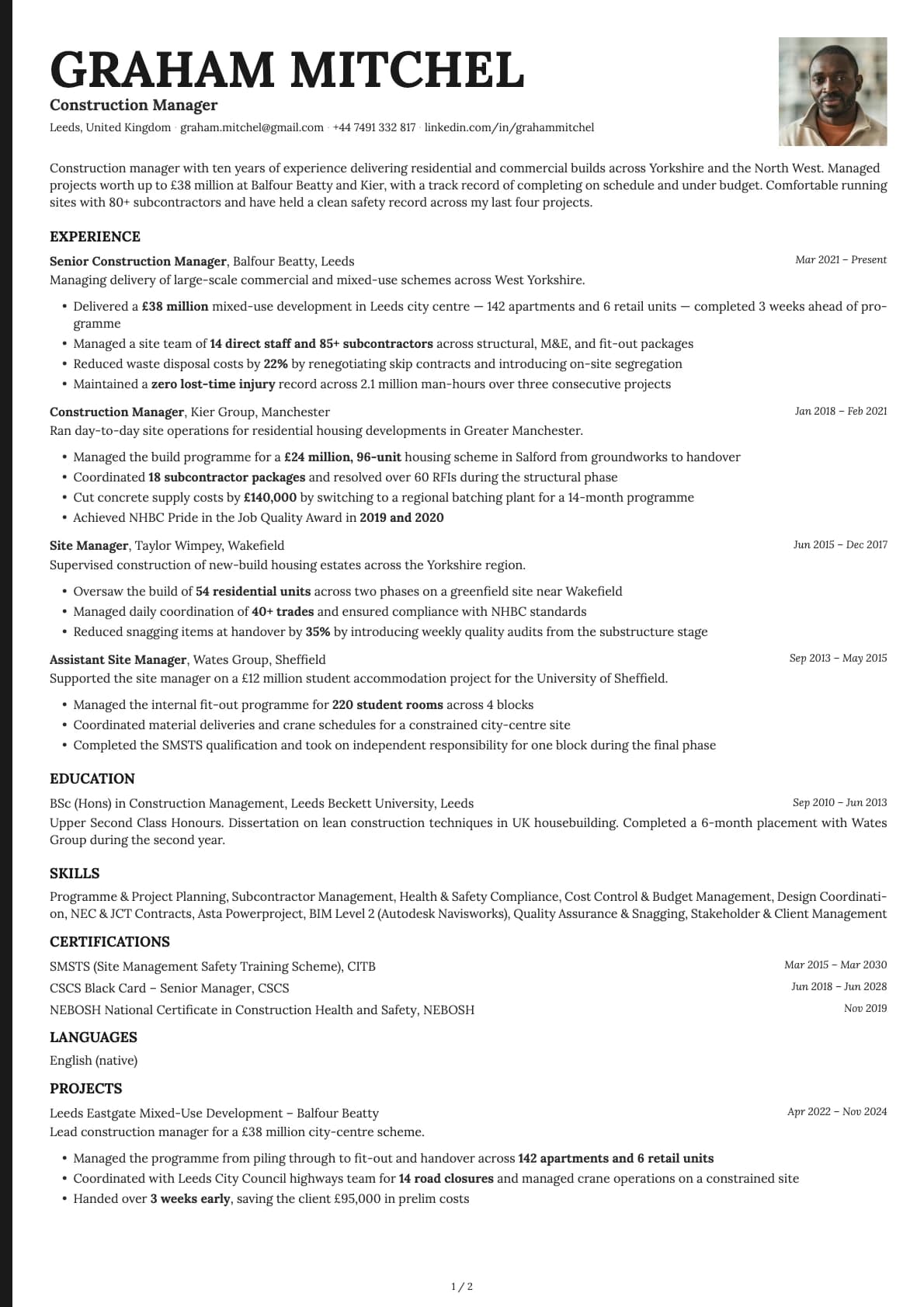
Construction Manager
A construction manager resume example with 10 years of experience delivering projects up to £38 million at Balfour Beatty and Kier.
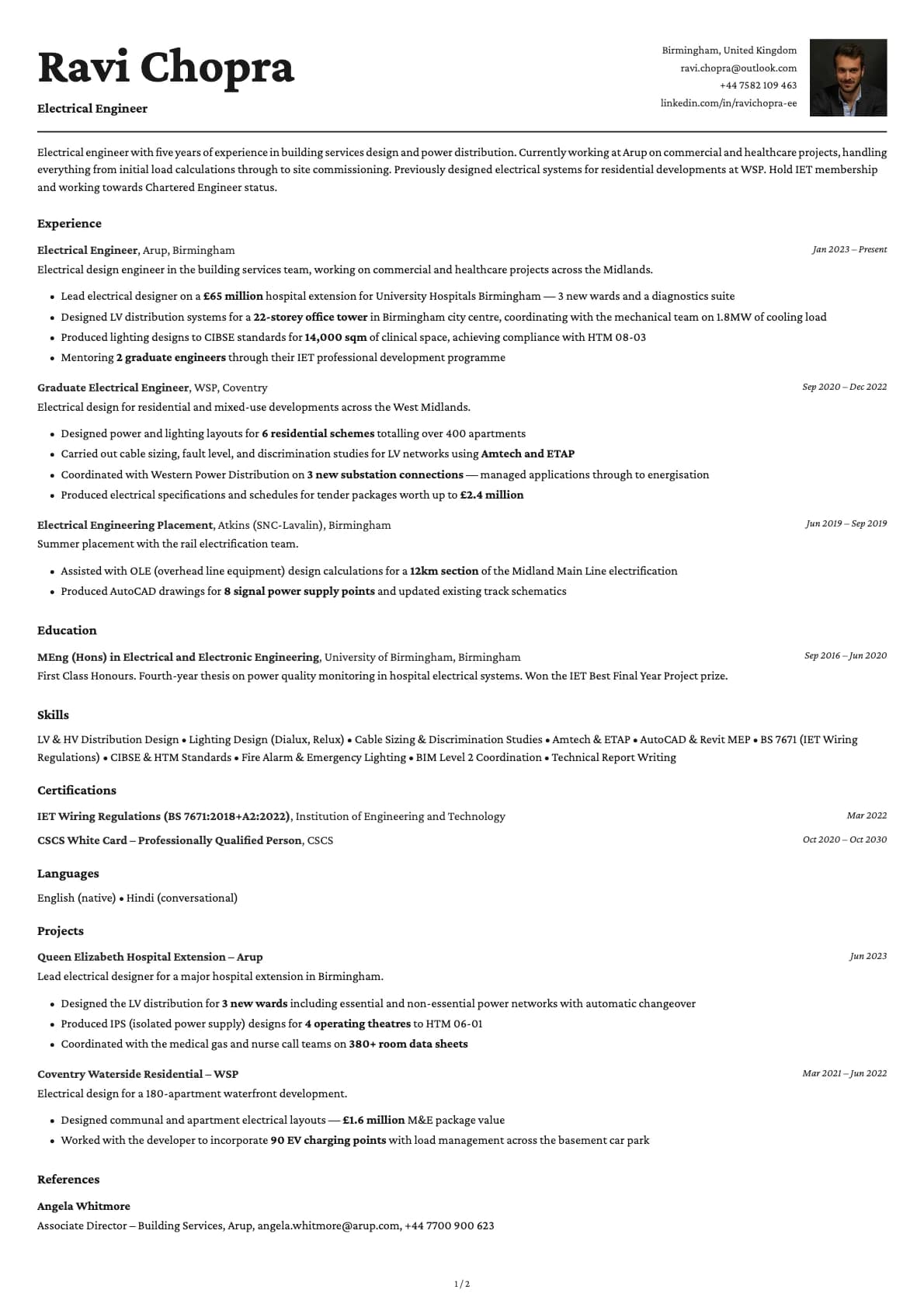
Electrical Engineer
An electrical engineer resume example with building services design experience at Arup and WSP.
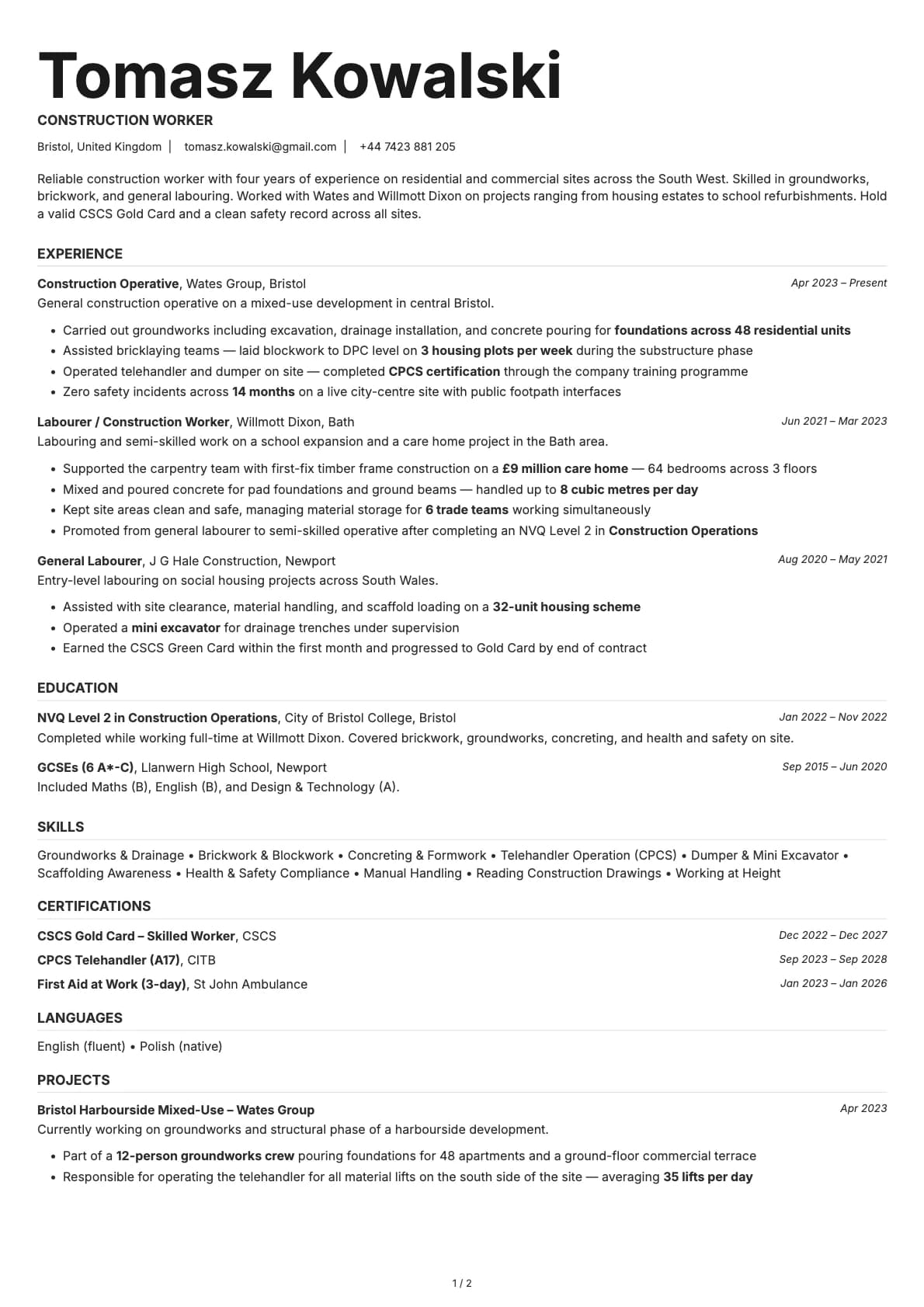
Construction Worker
A construction worker resume example with 4 years of site experience at Wates and Willmott Dixon.
Related articles

AI Is Screening Your Resume Before Any Human Sees It
AI screens most resumes before a human ever reads them. 97.4% of Fortune 500 companies run an ATS. This is what that means for you and what you can do about it.

The Best Resume Builders in 2026, Compared Honestly
Resume.io, Zety, Enhancv, Kickresume, Teal, and Laddro compared honestly: real pricing, free tiers, mobile apps, and where each tool wins. All prices checked in September 2026.

Burnout Recovery: A Real Timeline, Not 'Take a Bubble Bath'
55% of the U.S. workforce is burned out. Recovery takes 3 to 12 months. Here's what that actually looks like, stage by stage.