Construction Manager Resume Example
A construction manager resume example with 10 years of experience delivering projects up to £38 million at Balfour Beatty and Kier.

Laddro Team
Free to use. No account needed to start.
Free to use. No account needed to start.
Overview
Construction manager resumes live or die on three things: project values, safety records, and whether you delivered on time. Everything else is secondary. The operations director reviewing your resume has probably managed the same type of projects you have. They are not impressed by vague claims about "overseeing construction activities." They want pound signs, man-hours, and handover dates.
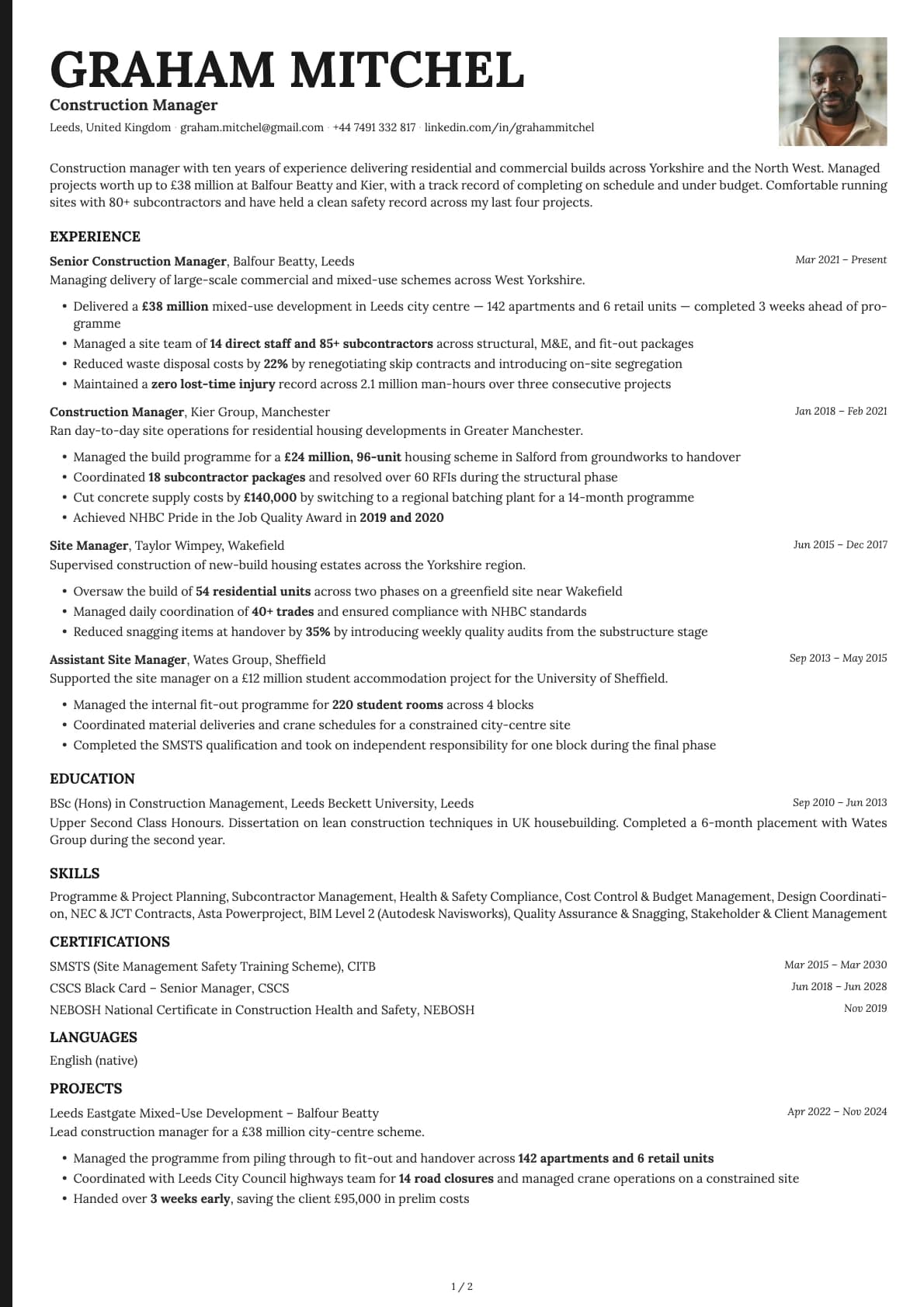
This resume belongs to Graham Mitchel, a Senior Construction Manager at Balfour Beatty in Leeds. Ten years of experience. Projects up to 38 million pounds. He has worked at Balfour Beatty, Kier, Taylor Wimpey, and Wates. Residential, commercial, mixed-use, and student accommodation. What makes this resume work is the consistent thread of delivery. Every project has a value, a result, and a safety metric.
Let us look at how he structures it.
Summary: project value and safety first
A construction manager's summary should answer: How much experience? What size projects? What is your safety record?
Construction manager with ten years of experience delivering residential and commercial builds across Yorkshire and the North West. Managed projects worth up to £38 million at Balfour Beatty and Kier, with a track record of completing on schedule and under budget. Comfortable running sites with 80+ subcontractors and have held a clean safety record across my last four projects.
Three sentences. Years, project values, contractor names, delivery track record, subcontractor volume, and safety record. A hiring manager at a Tier 1 contractor can evaluate this in seconds.
For yours: Give your total years of experience. Name your largest project value. Name the most recognisable contractors you have worked for. Mention your safety record. That is your summary.
Experience: every bullet needs a number
Construction management is a numbers game. The hiring manager wants to see project values, team sizes, programme performance, and cost savings. Anything without a number is a wasted bullet.
Look at the Balfour Beatty entry:
"Delivered a £38 million mixed-use development in Leeds city centre, 142 apartments and 6 retail units, completed 3 weeks ahead of programme"
Project value. Unit count. Early completion. Three data points in one sentence.
"Maintained a zero lost-time injury record across 2.1 million man-hours over three consecutive projects"
This is the most important line on the resume. 2.1 million man-hours with zero LTIs is a serious safety record. In construction, where safety is the first item on every site meeting agenda, this tells the hiring manager that Graham runs a tight site.
"Reduced waste disposal costs by 22% by renegotiating skip contracts and introducing on-site segregation"
Cost control is part of the job. Showing you found savings beyond the programme budget demonstrates commercial awareness.
The formula: Project value + what you delivered + when you delivered it + what you saved or improved. If the project won an award, mention it.
The NHBC Pride in the Job factor
The Kier entry mentions something that housebuilding professionals will notice immediately:
"Achieved NHBC Pride in the Job Quality Award in 2019 and 2020"
NHBC Pride in the Job is the most recognised quality award in UK housebuilding. Winning it once is good. Winning it two years running tells the hiring manager this person consistently builds to a high standard. If you have won this award, or been shortlisted, put it on your resume. It carries weight across every major housebuilder.
The Kier entry also includes a concrete cost saving:
"Cut concrete supply costs by £140,000 by switching to a regional batching plant for a 14-month programme"
That is a specific, verifiable saving. It shows commercial thinking beyond just managing the programme. If you have negotiated better rates with suppliers, found alternative materials, or reduced prelim costs, quantify it.
Career progression: assistant to senior manager
This resume shows a clean career ladder. Assistant Site Manager at Wates, Site Manager at Taylor Wimpey, Construction Manager at Kier, Senior Construction Manager at Balfour Beatty. Each step is a bigger project, a bigger team, and a bigger contractor.
The Wates entry handles the junior role well:
"Managed the internal fit-out programme for 220 student rooms across 4 blocks"
"Completed the SMSTS qualification and took on independent responsibility for one block during the final phase"
Even as an assistant, the resume shows specific responsibility and professional development. The SMSTS mention is important because it is a mandatory qualification for anyone running a site. Completing it early in your career shows initiative.
If you are earlier in your career, focus on what you managed independently, even if it was one block or one trade package. The hiring manager wants to see that you can take ownership.
Certifications: the non-negotiables
Three certifications on this resume, all essential for construction management.
SMSTS (Site Management Safety Training Scheme). This is the baseline qualification for site managers in the UK. Every contractor requires it. If you do not have it, you are not getting on a site as a manager. List the renewal date.
CSCS Black Card (Senior Manager). The CSCS card system is colour-coded by skill level. Black is for senior managers. Gold is for skilled workers. Green is for labourers. At construction manager level, you need the black card. List the card colour and type.
NEBOSH National Certificate in Construction Health and Safety. This goes beyond SMSTS and shows a deeper understanding of H&S legislation and risk assessment. It is increasingly expected for senior construction management roles.
If you hold CIOB membership, mention it. Graham is a member of the Chartered Institute of Building, which adds professional credibility.
Mistakes construction managers make on resumes
Not listing project values. "Managed a large residential scheme" tells the reader nothing. "Managed a £24 million, 96-unit housing scheme" tells them everything. Always include the value.
Weak safety metrics. "Maintained a safe site" is meaningless. "Zero lost-time injuries across 2.1 million man-hours" is specific. If your record is not perfect, you can still show improvement: "Reduced RIDDOR-reportable incidents by 60% across the programme."
Missing CSCS and SMSTS details. These are gatekeeper qualifications. If the recruiter does not see them, your application may be filtered out before a human reads it.
Too much technical detail. A construction manager's resume should focus on delivery, commercial performance, and safety. Leave the structural engineering calculations and M&E specifications to the engineers. Your job is to show you can run a site, manage subcontractors, and hand over on time.
One more thing
Construction management recruitment often happens through agencies and word of mouth. But even when an operations director already knows your name, they will ask for a resume. Make sure it is ready. Keep it to two pages. Lead with your biggest project. Show your safety record. And make sure your CSCS card and SMSTS are current and listed. In this industry, those details matter more than anything you could write in a cover letter.
Build your own version
Open this layout in the builder and swap in your own details. It takes a few minutes.
Free to use. No account needed to start.
Was this resume example helpful?
Rate this example to help us create better content for you.
4.8 average from 171 ratingsRelated resume examples
Civil Engineer
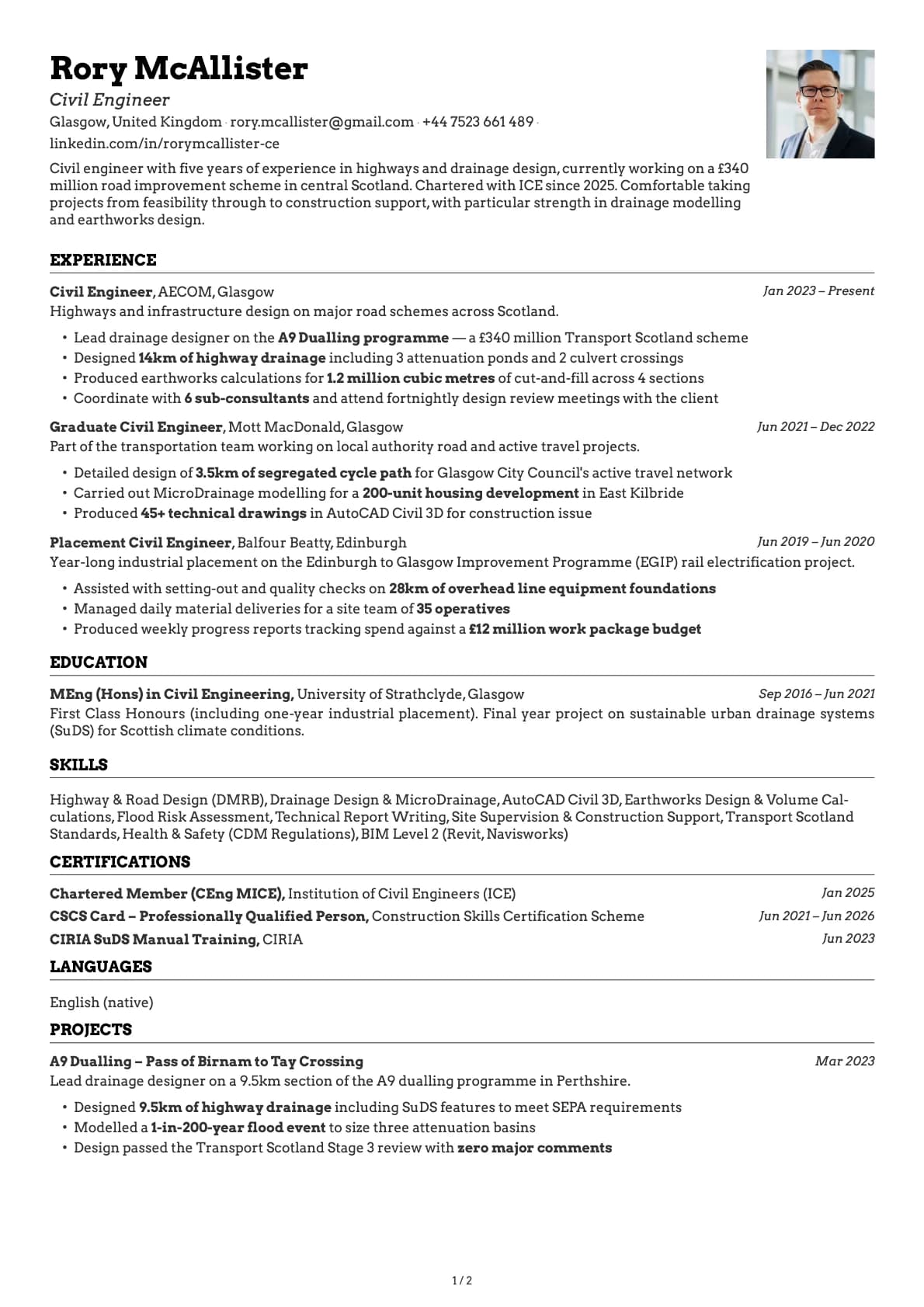
A civil engineer resume example with highways and drainage design experience at AECOM and Mott MacDonald.
Structural Engineer
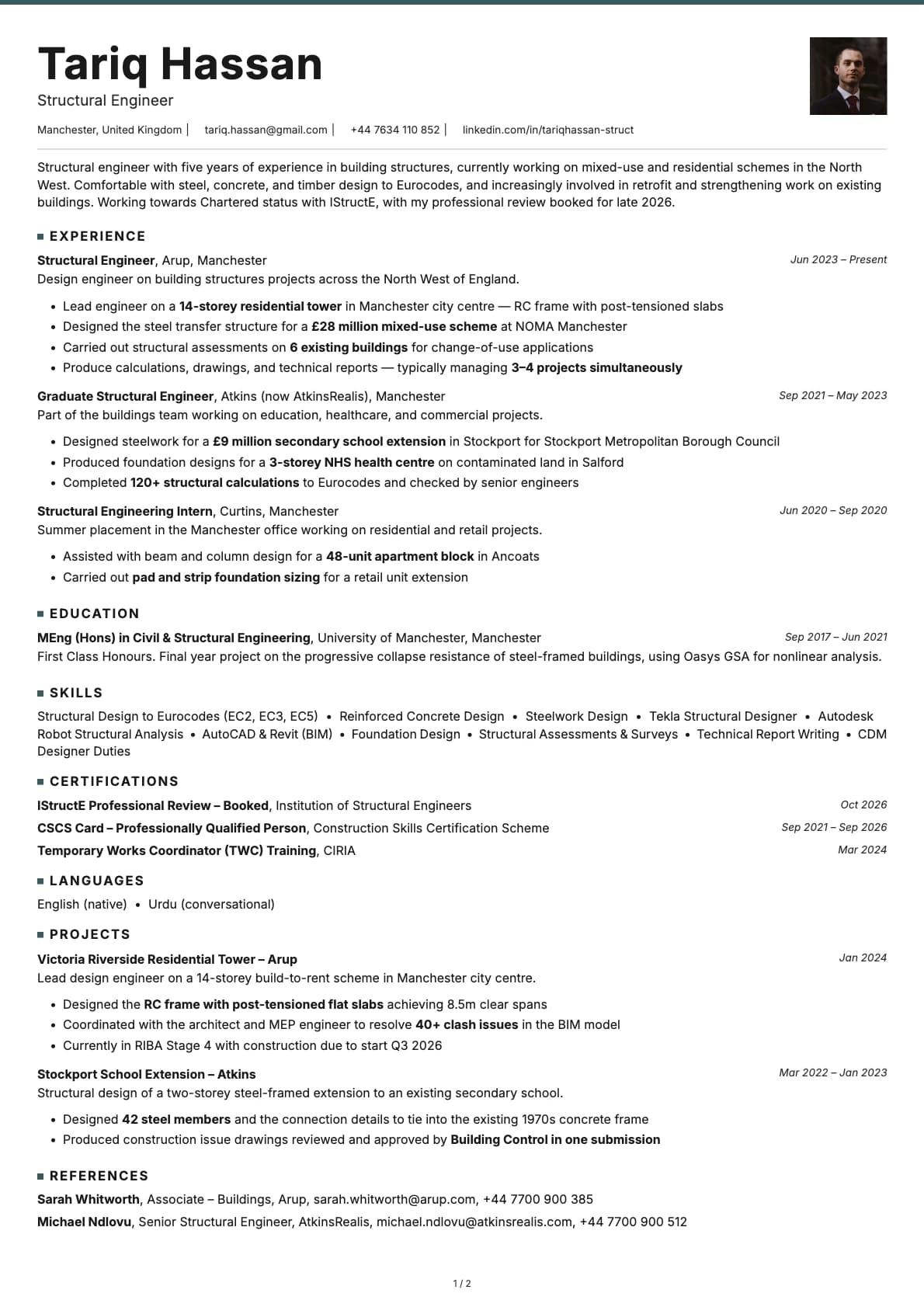
A structural engineer resume example with 5 years of experience at Arup and Atkins.
Electrician
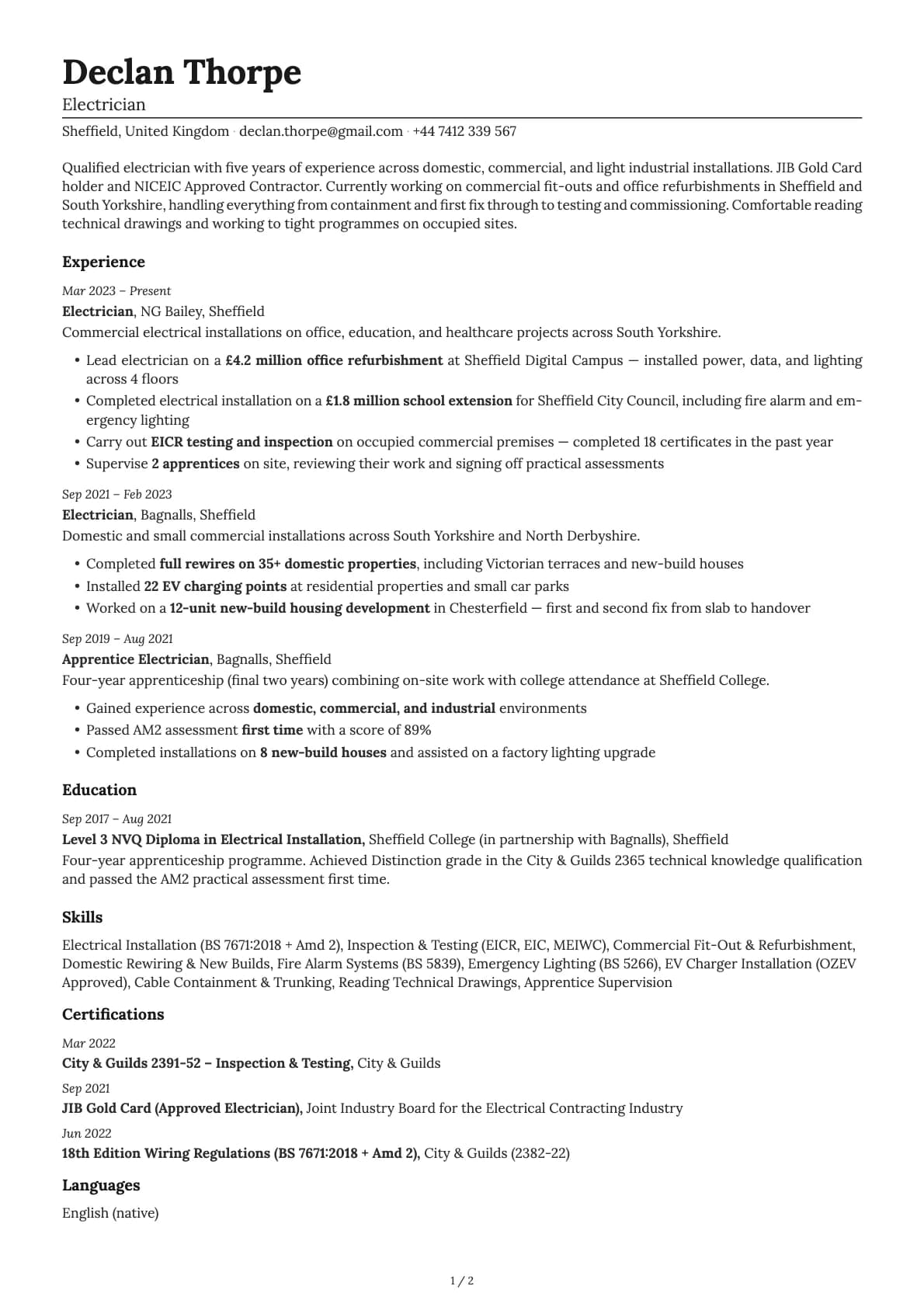
An electrician resume example with commercial and domestic installation experience.
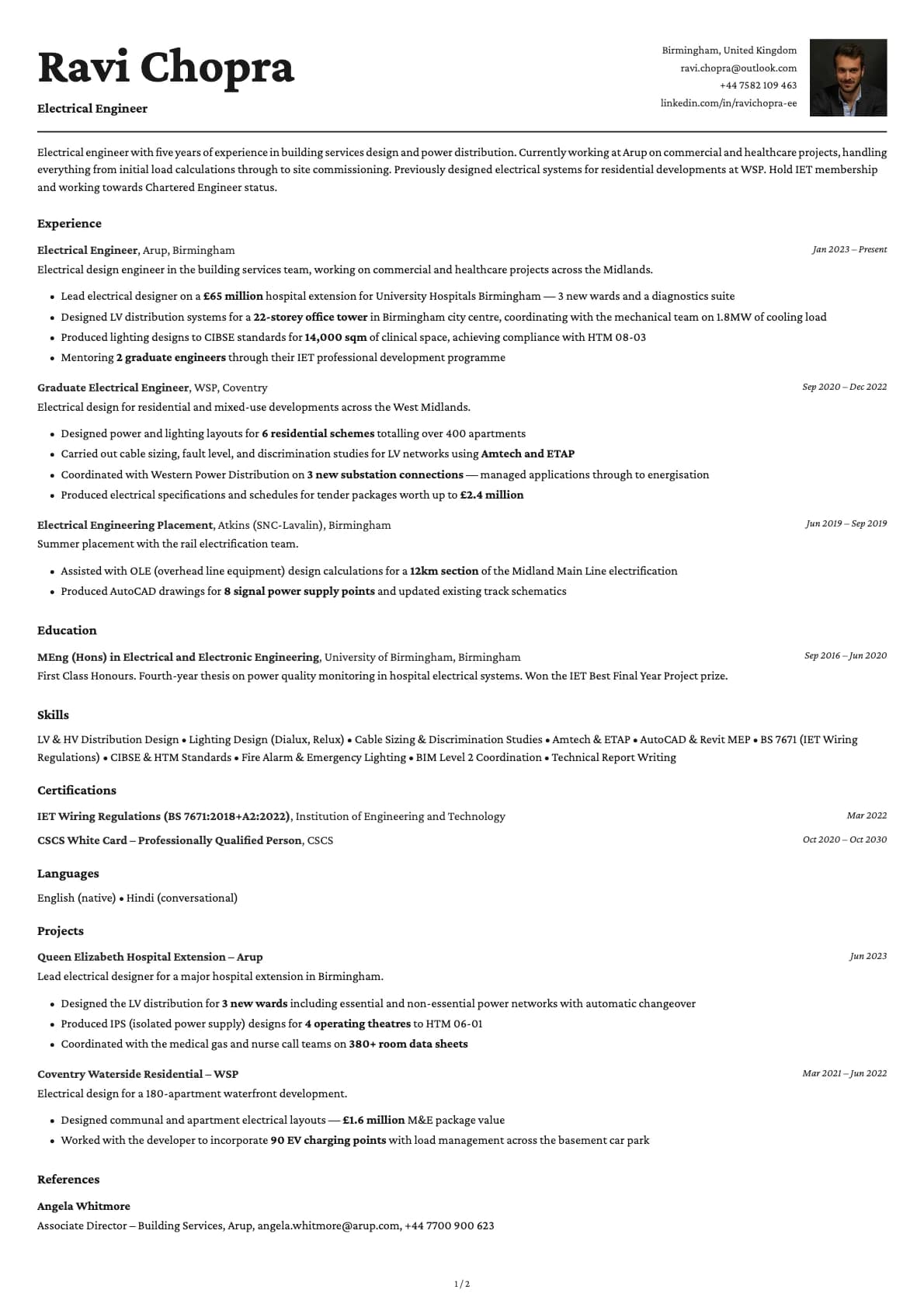
Electrical Engineer
An electrical engineer resume example with building services design experience at Arup and WSP.
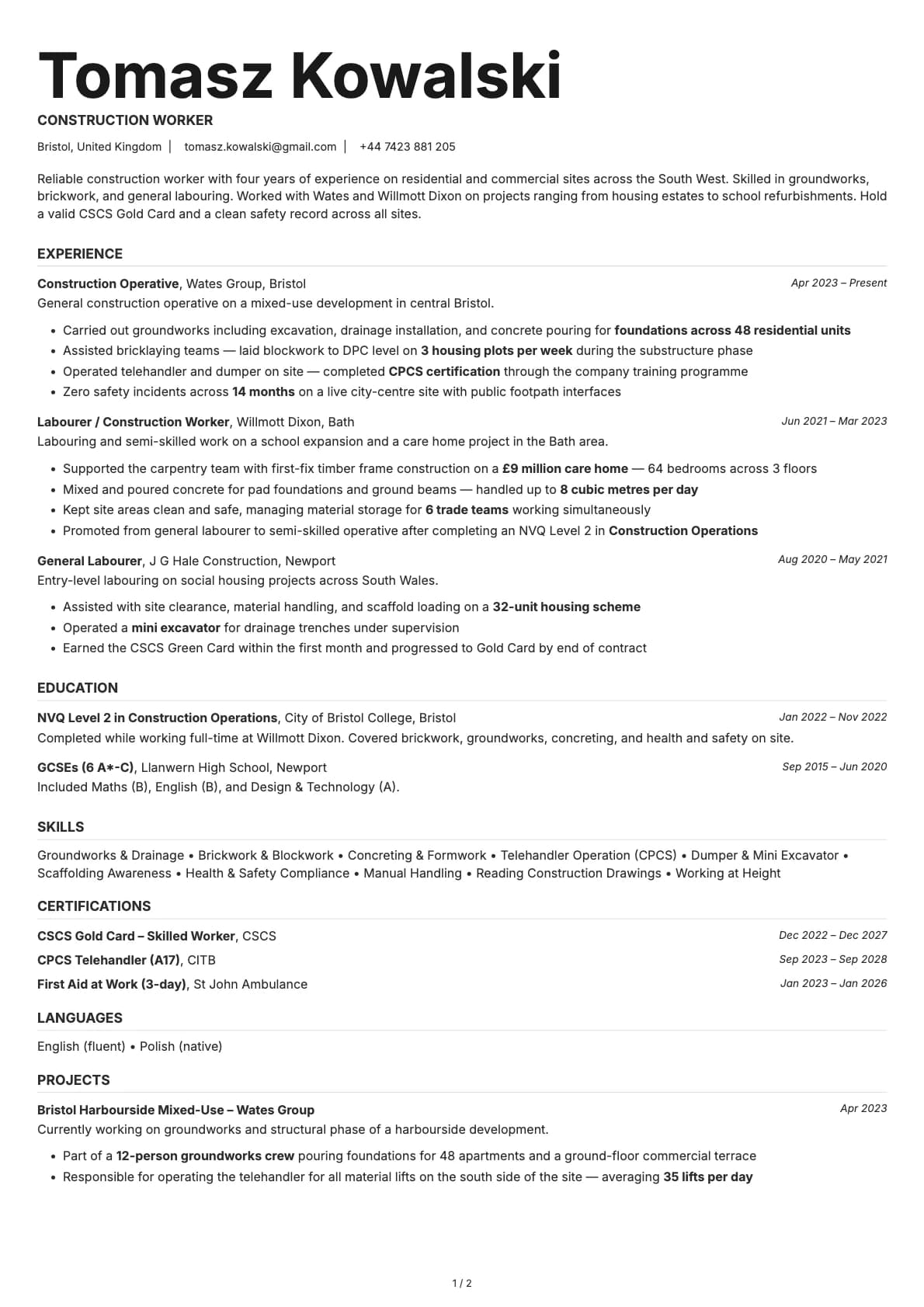
Construction Worker
A construction worker resume example with 4 years of site experience at Wates and Willmott Dixon.
Related articles

AI Is Screening Your Resume Before Any Human Sees It
AI screens most resumes before a human ever reads them. 97.4% of Fortune 500 companies run an ATS. This is what that means for you and what you can do about it.

The Best Resume Builders in 2026, Compared Honestly
Resume.io, Zety, Enhancv, Kickresume, Teal, and Laddro compared honestly: real pricing, free tiers, mobile apps, and where each tool wins. All prices checked in September 2026.

Burnout Recovery: A Real Timeline, Not 'Take a Bubble Bath'
55% of the U.S. workforce is burned out. Recovery takes 3 to 12 months. Here's what that actually looks like, stage by stage.