Structural Engineer Resume Example
A structural engineer resume example with 5 years of experience at Arup and Atkins.

Laddro Team
Free to use. No account needed to start.
Free to use. No account needed to start.
Overview
Structural engineering resumes often read like a list of software packages. Revit, Tekla, Robot, AutoCAD. The problem is that every structural engineer uses these tools. What the hiring manager actually wants to know is: what have you designed, how complex was it, and can you work independently?
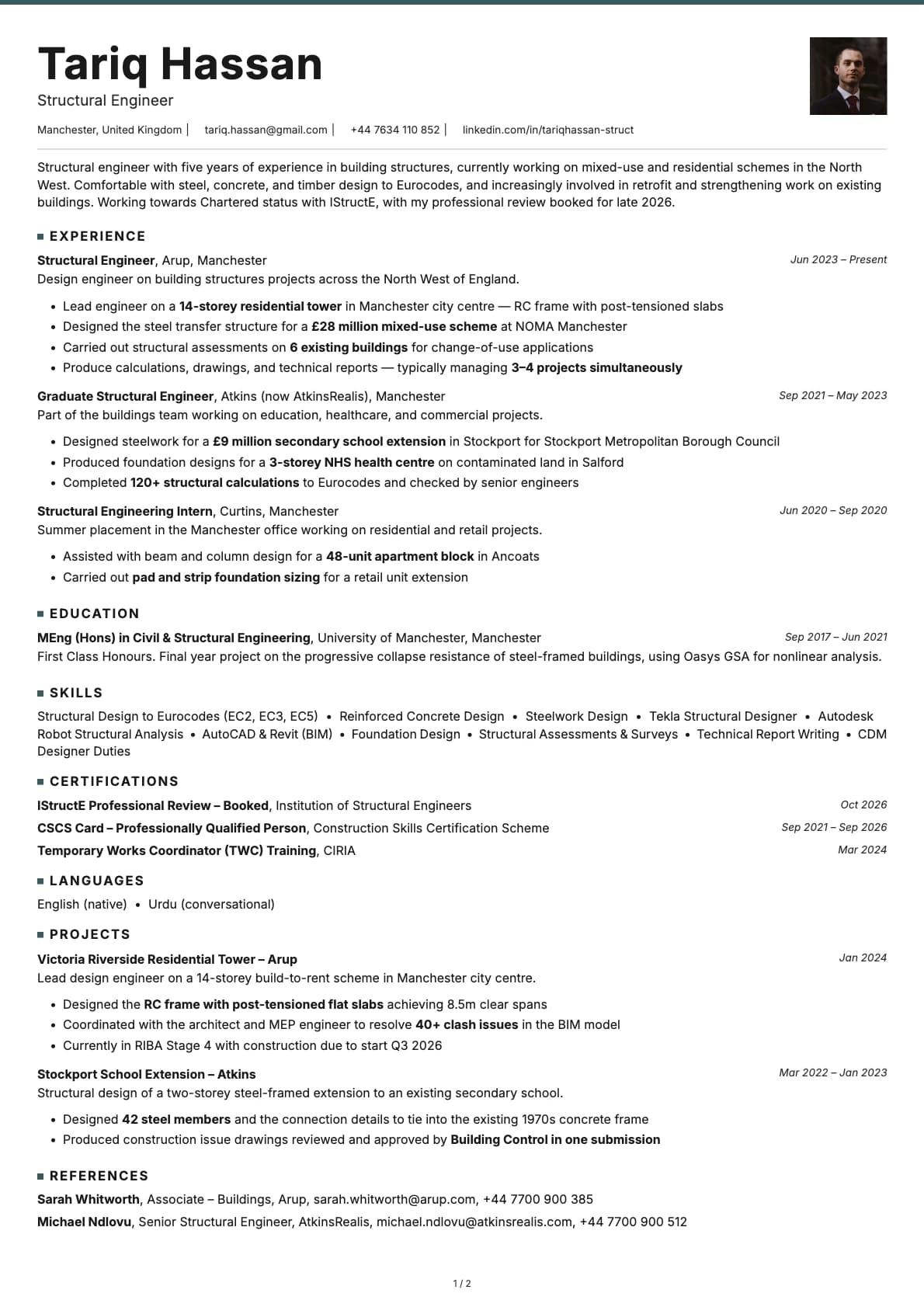
This resume belongs to Tariq, a structural engineer at Arup in Manchester with five years of experience. He previously worked at Atkins and did an internship at Curtins. His resume works because every bullet describes a real project with specific details. A 14-storey residential tower. A £28 million mixed-use scheme. A secondary school extension in Stockport. The recruiter can picture exactly what this person has designed.
Let us break it down so you can write yours the same way.
Your summary should answer: what do you design, and at what level?
Here is Tariq's summary:
Structural engineer with five years of experience in building structures, currently working on mixed-use and residential schemes in the North West. Comfortable with steel, concrete, and timber design to Eurocodes, and increasingly involved in retrofit and strengthening work on existing buildings. Working towards Chartered status with IStructE, with my professional review booked for late 2026.
This works because it tells the reader three things quickly: his experience level (5 years), his sector (building structures), and his materials (steel, concrete, timber to Eurocodes). The mention of IStructE Chartership shows career trajectory without padding.
For yours: State your years of experience, your sector (buildings, bridges, infrastructure), your primary materials, and your Chartership status. That is all you need. Do not list software in the summary.
Describe projects, not responsibilities
This is the biggest mistake on structural engineering resumes. Writing "produced structural calculations and drawings" tells the recruiter nothing they did not already assume. Every structural engineer produces calculations and drawings.
Look at how Tariq describes his Arup work:
Lead engineer on a 14-storey residential tower in Manchester city centre. RC frame with post-tensioned slabs
Designed the steel transfer structure for a £28 million mixed-use scheme at NOMA Manchester
Each bullet names a specific project, states the structural system, and gives a sense of scale. The recruiter now knows this person has designed post-tensioned slabs and transfer structures. That is real information.
The formula: Project type + structural system + scale (storeys, span, value, or load).
For his Atkins role, even as a graduate:
Designed steelwork for a £9 million secondary school extension in Stockport
Produced foundation designs for a 3-storey NHS health centre on contaminated land in Salford
The contaminated land detail is smart. It signals that this was not a straightforward foundation design and required additional geotechnical consideration.
How to handle your graduate and intern roles
Early-career engineers often worry they do not have enough to write about. Tariq's internship at Curtins has just two bullets:
Assisted with beam and column design for a 48-unit apartment block in Ancoats
Carried out pad and strip foundation sizing for a retail unit extension
These are basic tasks, but they are described with enough detail that the recruiter can see real project work. "48-unit apartment block" and "retail unit extension" are specific enough. Compare that with "assisted senior engineers with design calculations." Same work, completely different impression.
Skills: separate software from engineering knowledge
This resume lists both engineering competencies and software tools in a single skills section. It could be improved by grouping them:
- Design: Reinforced Concrete, Steelwork, Foundation Design, Structural Assessments
- Codes: Eurocodes (EC2, EC3, EC5)
- Software: Tekla Structural Designer, Robot, AutoCAD, Revit
- Other: CDM Designer Duties, Technical Report Writing
Grouping helps the recruiter (and the ATS) match your skills against the job specification more easily. If the role asks for "experience with Eurocode design," having "Eurocodes (EC2, EC3, EC5)" as a clear line item is a direct hit.
Chartership and certifications
For structural engineers, your IStructE or ICE status is one of the first things a recruiter checks. Tariq lists his professional review as booked for late 2026. This is the right approach. If you are working towards Chartership, say so and give a timeline.
He also includes his CSCS card (Professionally Qualified Person) and Temporary Works Coordinator training from CIRIA. Both of these are relevant to construction site work and signal that he can operate beyond the design office.
If you have completed any CIRIA, SCI, or IStructE courses, list them. If your CSCS card is current, include it. These details matter for roles that involve site visits and inspections.
Mistakes structural engineers make on their resumes
Listing software without context. "Proficient in Tekla Structural Designer" means nothing on its own. The recruiter wants to know what you designed with it. Use the software names in your experience bullets where possible.
No project values or scales. "Designed a steel frame" could be a garden shed or a 20-storey building. Always include storeys, spans, project values, or tonnages to give the reader a sense of scale.
Ignoring CDM and site experience. Many structural engineering roles require CDM awareness and site inspection capability. If you have carried out site inspections, condition surveys, or temporary works assessments, include them.
Overloading with academic detail. Your degree classification matters. Your individual module grades do not. Keep education brief unless your dissertation is directly relevant to the role.
One more thing
If you are applying to consultancies like Arup, Atkins, or Mott MacDonald, your resume will likely go through an ATS before a human sees it. Use a clean single-column template with no graphics or sidebars. This resume uses Graphite, which is about as straightforward as it gets.
And pay attention to the job description. If it mentions "retrofit" or "existing buildings," make sure those words appear on your resume. If it asks for "BIM experience," write "Revit (BIM)" not just "Revit." Small phrasing choices make the difference between getting shortlisted and getting filtered out.
Build your own version
Open this layout in the builder and swap in your own details. It takes a few minutes.
Free to use. No account needed to start.
Was this resume example helpful?
Rate this example to help us create better content for you.
4.8 average from 112 ratingsRelated resume examples
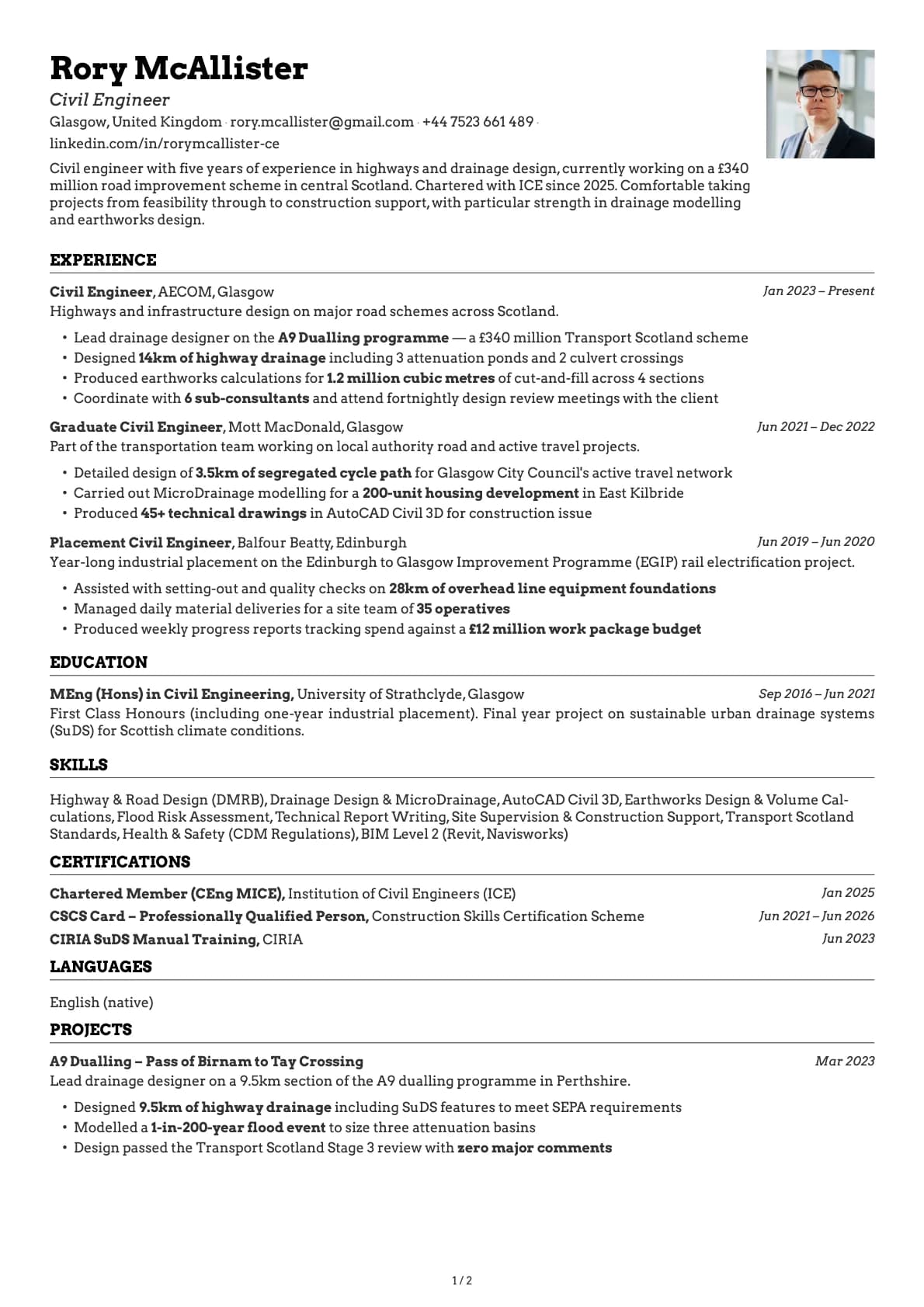
Civil Engineer
A civil engineer resume example with highways and drainage design experience at AECOM and Mott MacDonald.
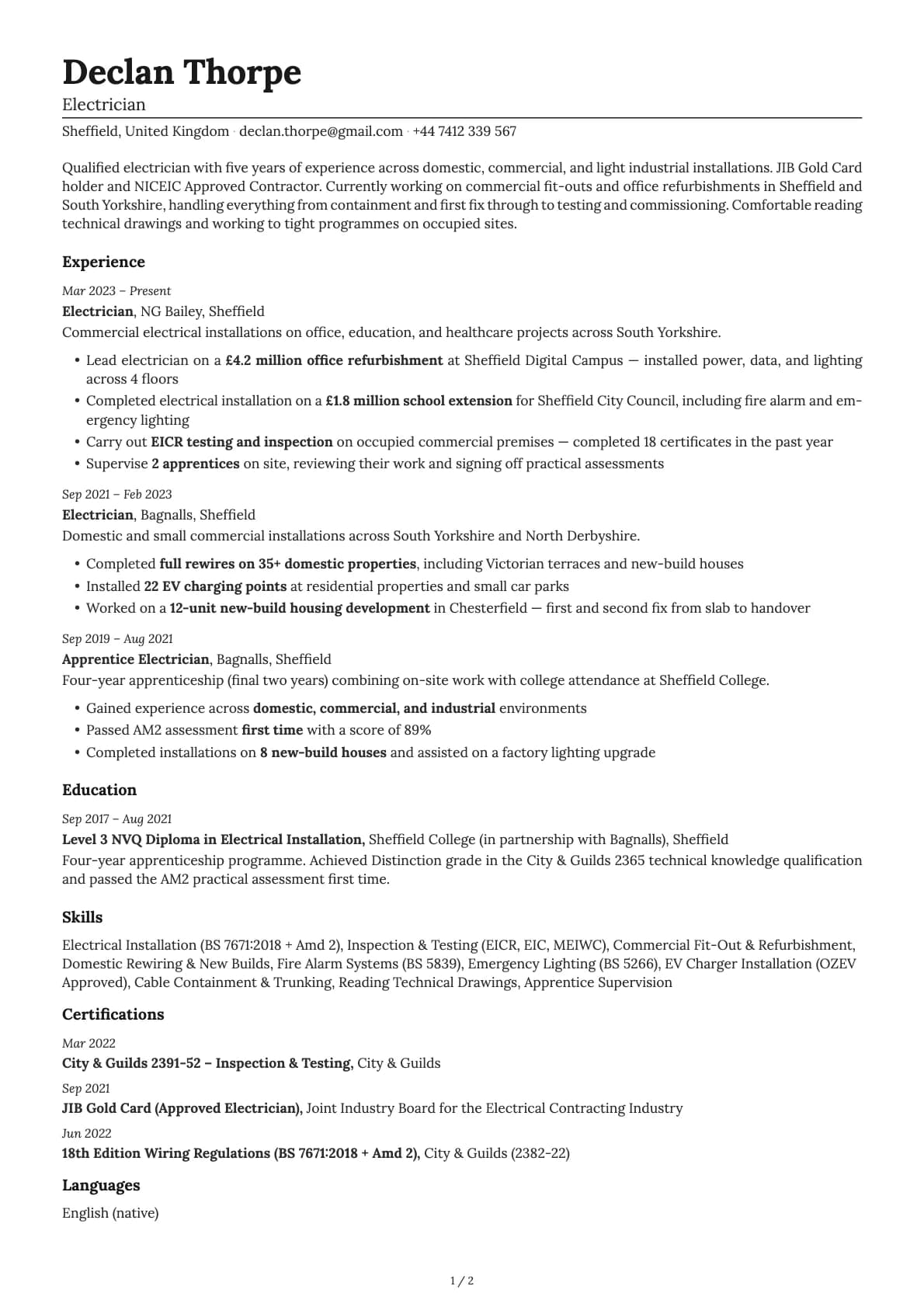
Electrician
An electrician resume example with commercial and domestic installation experience.
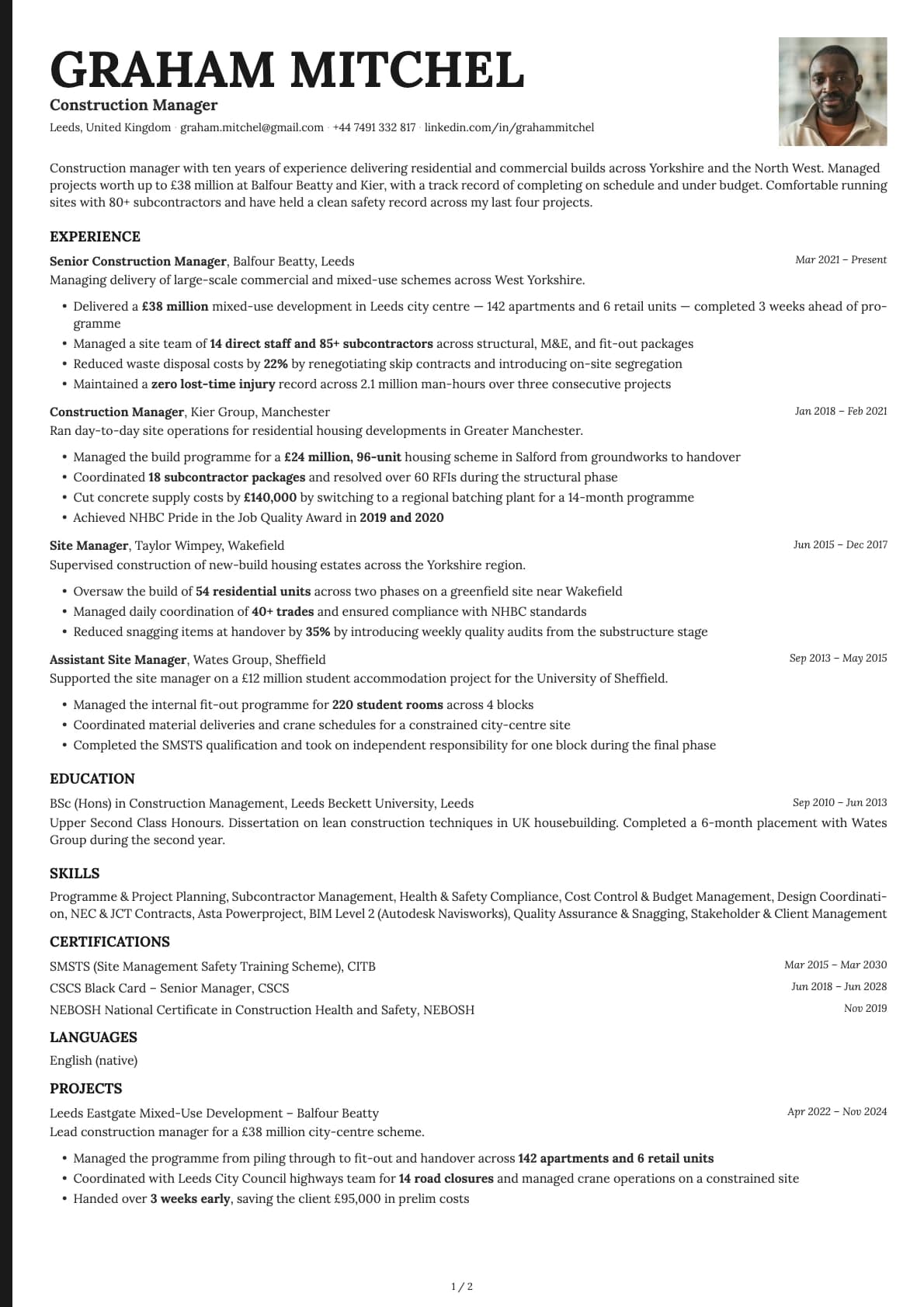
Construction Manager
A construction manager resume example with 10 years of experience delivering projects up to £38 million at Balfour Beatty and Kier.
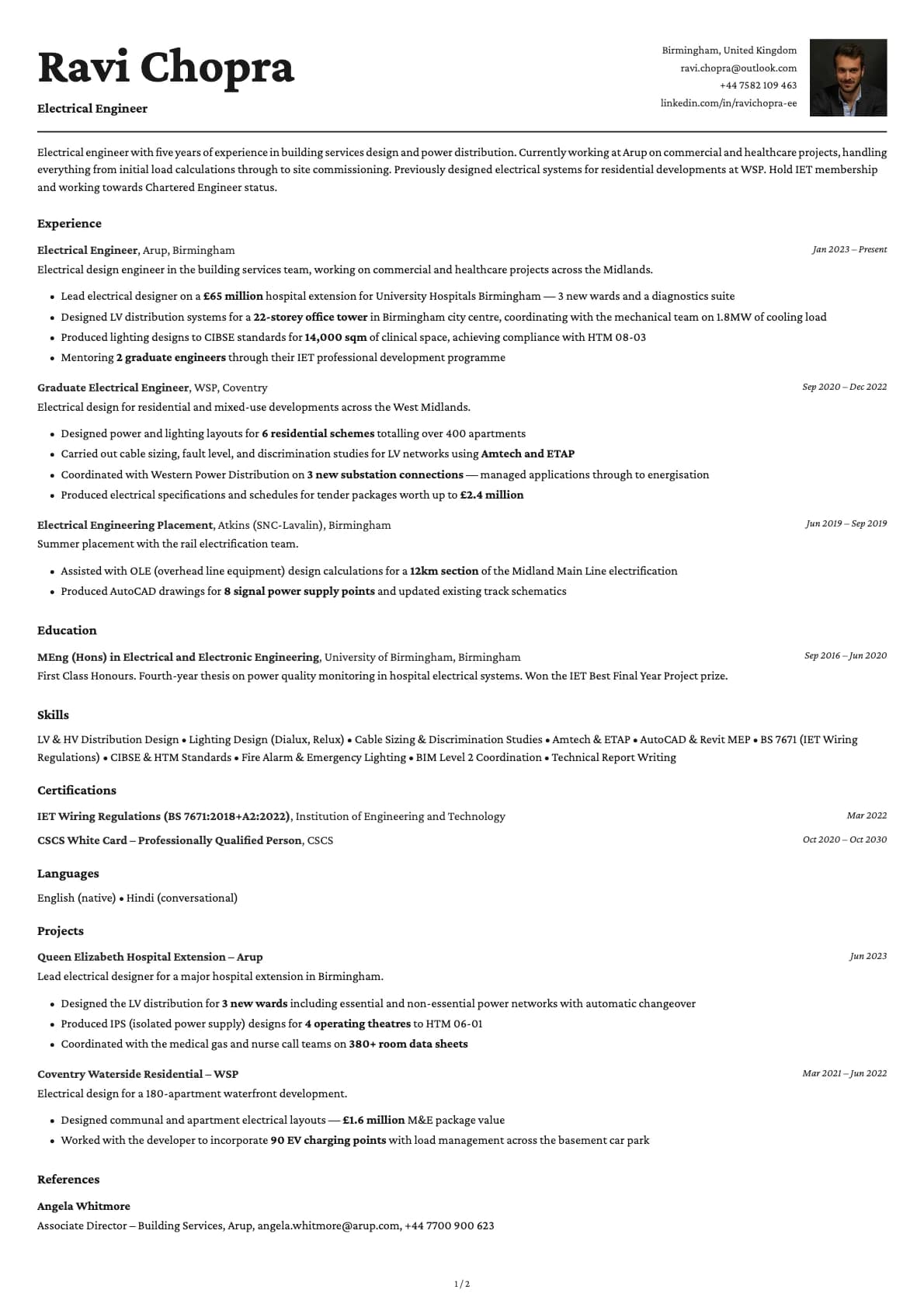
Electrical Engineer
An electrical engineer resume example with building services design experience at Arup and WSP.
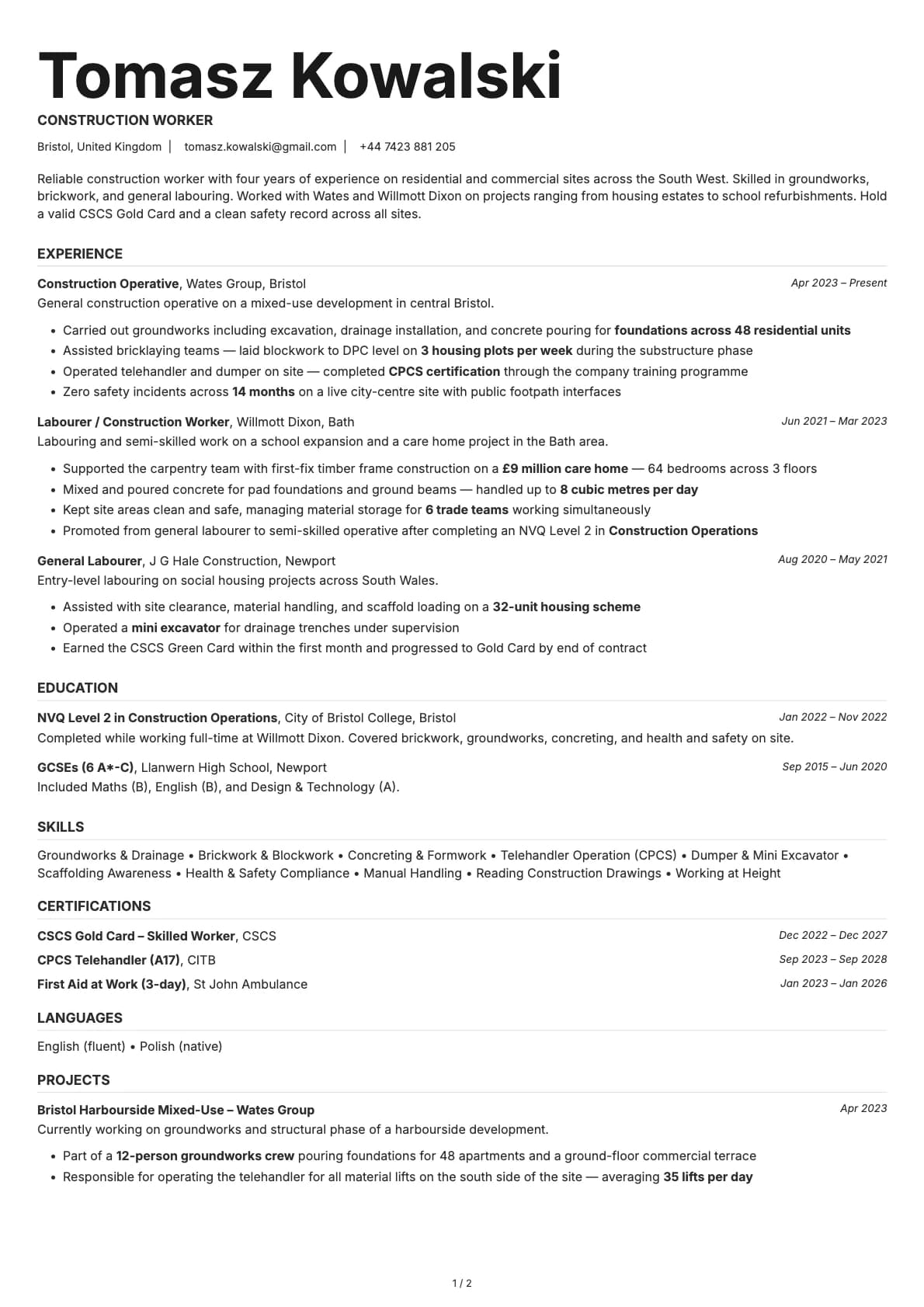
Construction Worker
A construction worker resume example with 4 years of site experience at Wates and Willmott Dixon.
Related articles

AI Is Screening Your Resume Before Any Human Sees It
AI screens most resumes before a human ever reads them. 97.4% of Fortune 500 companies run an ATS. This is what that means for you and what you can do about it.

The Best Resume Builders in 2026, Compared Honestly
Resume.io, Zety, Enhancv, Kickresume, Teal, and Laddro compared honestly: real pricing, free tiers, mobile apps, and where each tool wins. All prices checked in September 2026.

Burnout Recovery: A Real Timeline, Not 'Take a Bubble Bath'
55% of the U.S. workforce is burned out. Recovery takes 3 to 12 months. Here's what that actually looks like, stage by stage.