School Counselor Cover Letter Example
A school counselor cover letter example that conveys student advocacy, guidance program design, and emotional support skills.
Free to use. No account needed to start.
Free to use. No account needed to start.
Overview
School counselor cover letters have a problem that other professions do not face. You need to show two things at once: clinical competence and the ability to connect with young people. Most applicants lean too far in one direction. They either write a dry clinical summary or go heavy on passion statements with nothing concrete behind them.
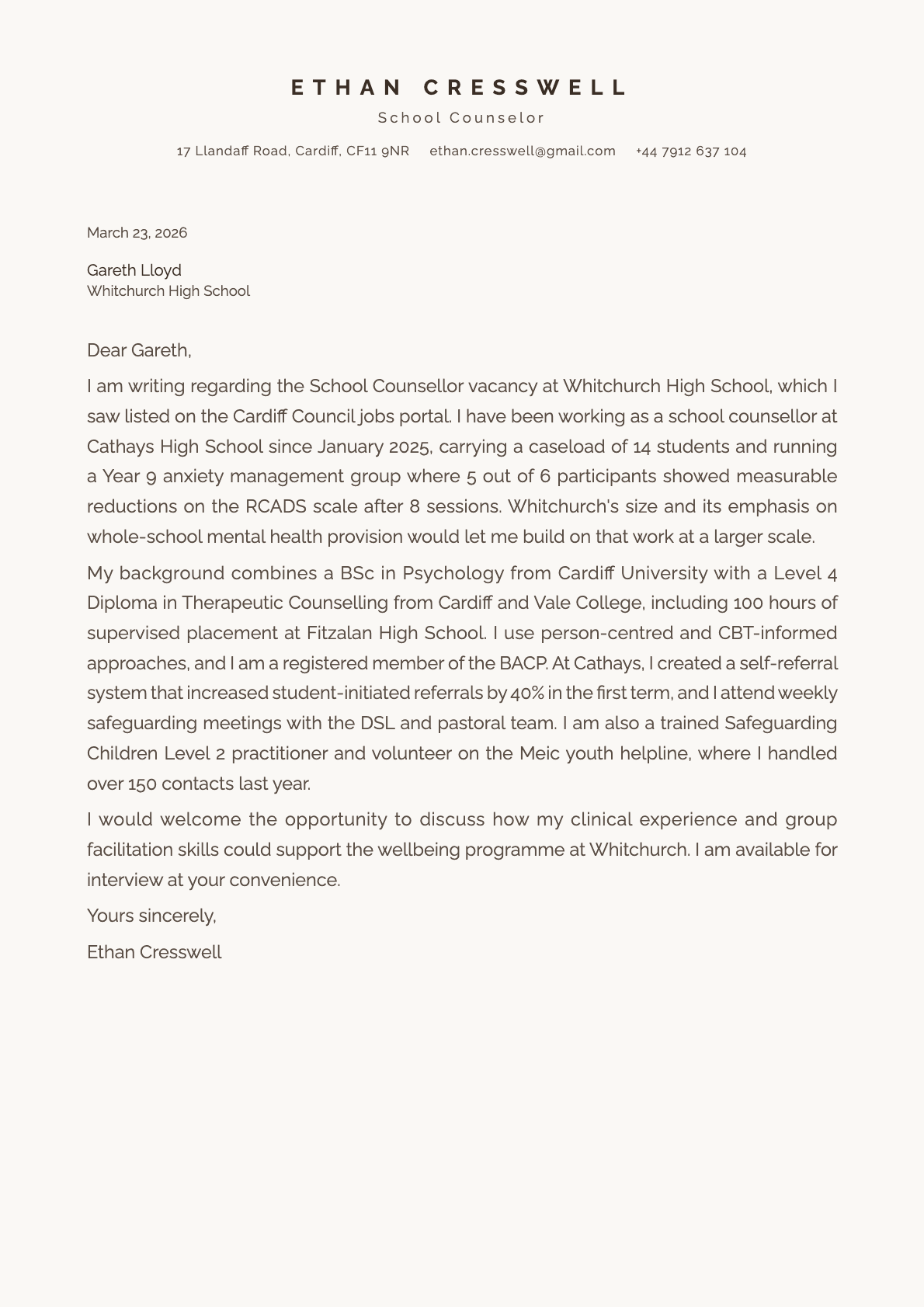
This cover letter, written by Ethan Cresswell for a position at Whitchurch High School in Cardiff, does a good job of balancing both. Let us break down what works and what you can apply to your own letter.
The opening paragraph sets the stage quickly
Ethan opens by naming the specific role, the school, and where he found the listing. Then he gets straight into what he is doing now: working as a school counsellor at Cathays High School with a caseload of 14 students.
The part that makes this opening stand out is the data. He mentions running a Year 9 anxiety management group where 5 out of 6 participants showed measurable reductions on the RCADS scale after 8 sessions. That is the kind of detail that separates a strong candidate from someone who writes "I am keen about supporting student wellbeing."
If you are writing your own school counselor cover letter, think about what you can measure. It does not need to be a clinical scale. Maybe you tracked referral numbers, attendance improvements for students you worked with, or the number of sessions delivered per term.
Qualifications without the laundry list
The middle paragraph is where Ethan walks through his credentials. BSc in Psychology from Cardiff University, Level 4 Diploma in Therapeutic Counselling, 100 hours of supervised placement, BACP registered member. That is a lot of information, but it flows because each qualification connects to the next.
What really works here is how he ties credentials to actions. He does not just list the qualifications and move on. He follows up with a specific achievement: creating a self-referral system that increased student-initiated referrals by 40% in the first term. That tells the reader he does not just hold certificates on paper. He puts that training into practice and measures the results.
The mention of attending weekly safeguarding meetings with the DSL and pastoral team is a smart inclusion. It signals he understands that school counseling is not a solo practice. You work within a wider system of safeguarding and pastoral care, and hiring managers want to know you can do that.
Why volunteer work matters in this field
Ethan mentions volunteering on the Meic youth helpline, where he handled over 150 contacts last year. In school counseling, volunteer work is not just a nice addition. It shows a genuine commitment to young people outside of paid hours, and it demonstrates additional experience with different populations and settings.
If you volunteer in any capacity that involves young people, mental health, or community support, mention it. Be specific about what you did and how much of it you did. "Volunteered at a youth helpline" is vague. "Handled over 150 contacts last year on the Meic youth helpline" tells the reader exactly what kind of exposure you have.
What you can learn from this letter
There are a few principles from this cover letter that apply to any school counselor application:
Lead with what you are doing right now. Your current caseload, your current groups, your current school setting. Hiring managers want to know if you can step into the role and do the work from day one.
Use numbers wherever possible. Caseload size, group outcomes, referral increases, safeguarding meeting frequency. Schools operate on data more than ever, and showing that you think in measurable terms is a real advantage.
Name your therapeutic approach. Ethan mentions person-centred and CBT-informed approaches. This is not jargon for the sake of it. Different schools look for different orientations, and being upfront about yours saves everyone time.
Show you work within a team. School counseling is embedded in a pastoral system. References to safeguarding meetings, DSL collaboration, or work alongside tutors and heads of year all signal that you understand the broader school context.
One thing to watch
The closing paragraph is a bit generic. "I would welcome the opportunity to discuss how my clinical experience and group facilitation skills could support the wellbeing programme" is fine, but it does not add new information. If you have space, use the close to mention something specific about the school. Maybe reference a programme they run, a recent Estyn report, or a known challenge in the local area. It shows you have done your homework.
Template and formatting
This cover letter uses the Ivory template, which keeps things clean and professional without being overly formal. For education roles, that balance is exactly right. You want to look put-together without looking like you are applying to a corporate law firm.
Keep your cover letter to one page. Ethan fits a lot of substance into a tight space, and that is what you should aim for too.
Was this cover letter example helpful?
Rate this example to help us create better content for you.
4.7 average from 112 ratingsBuild your own version
Open this layout in the builder and swap in your own details. It takes a few minutes.
Free to use. No account needed to start.
Related cover letter examples
Teacher
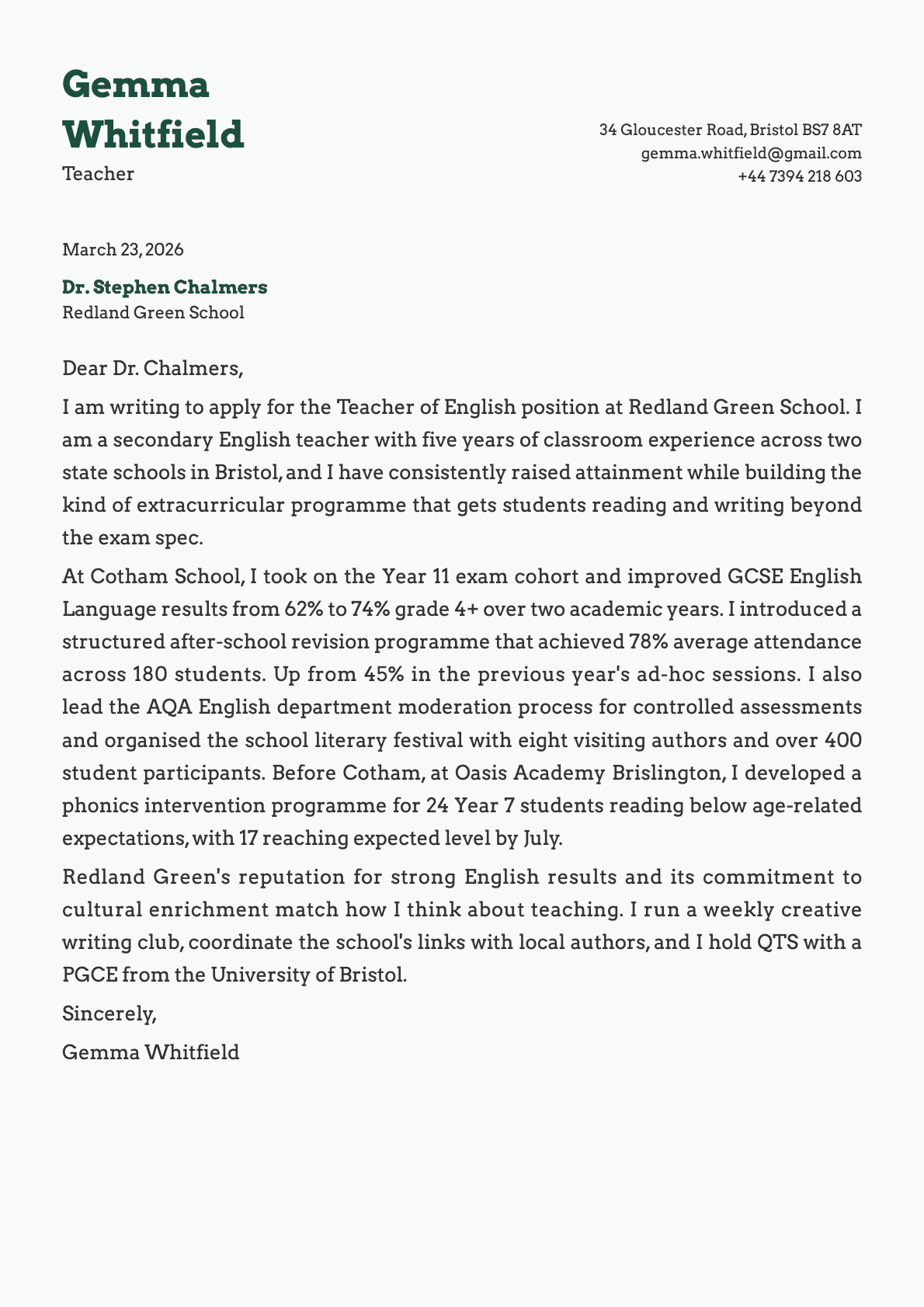
A teacher cover letter example for a secondary English position at Redland Green School.
Teaching Assistant
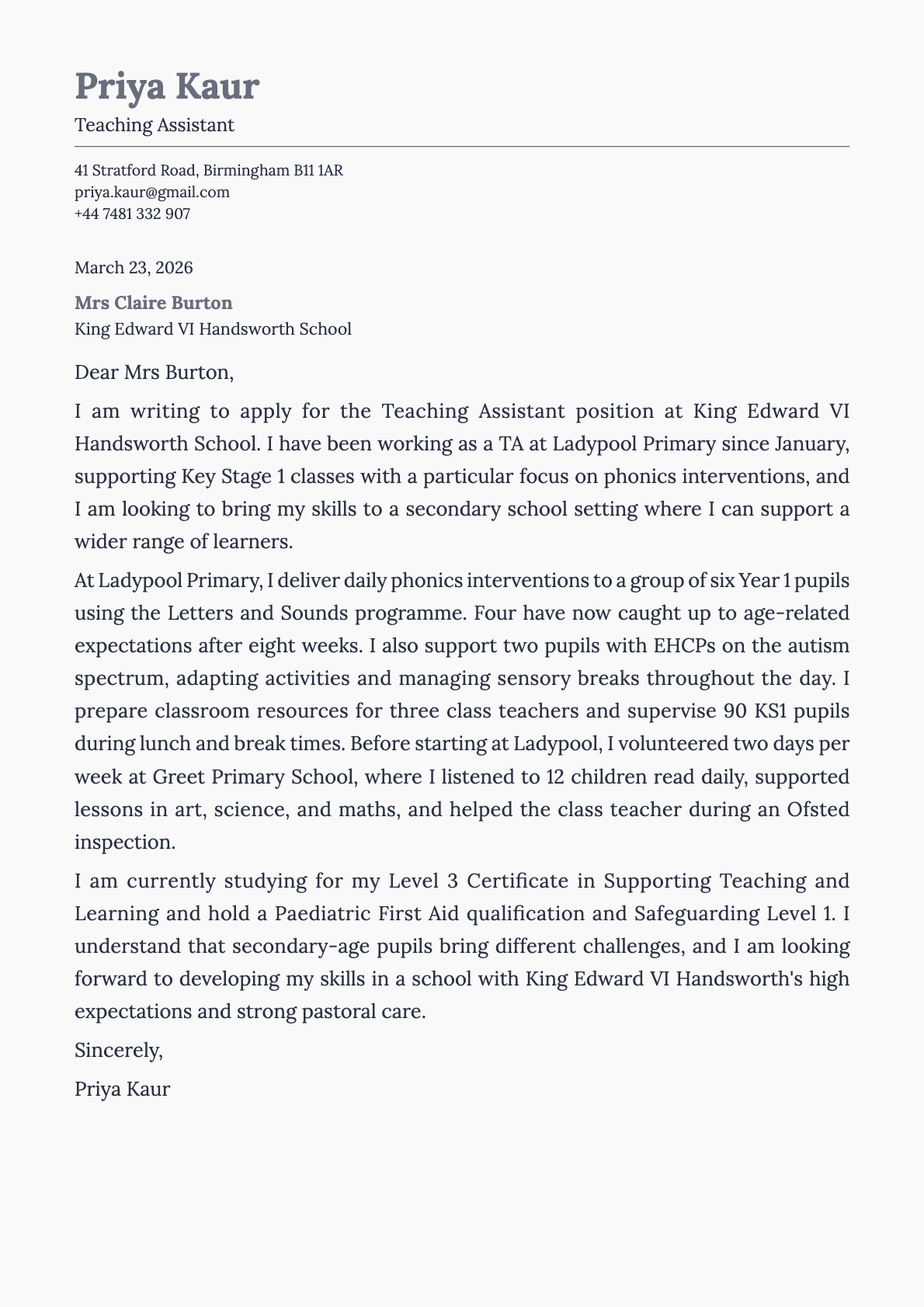
A teaching assistant cover letter example showing how to present phonics intervention results, SEND support experience, and classroom management skills.
School Principal
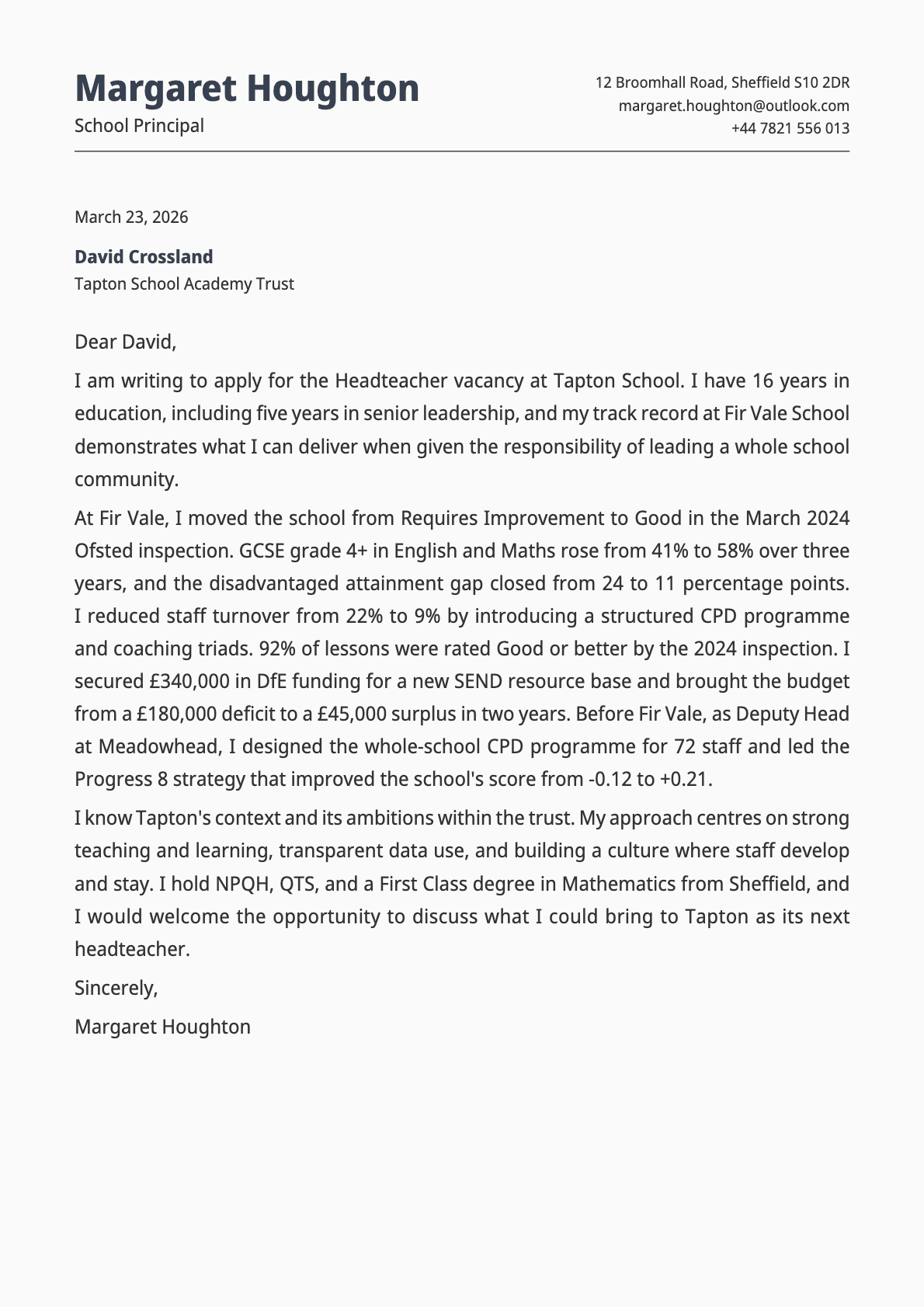
A school principal cover letter example showing how to present Ofsted results, attainment data, budget management.
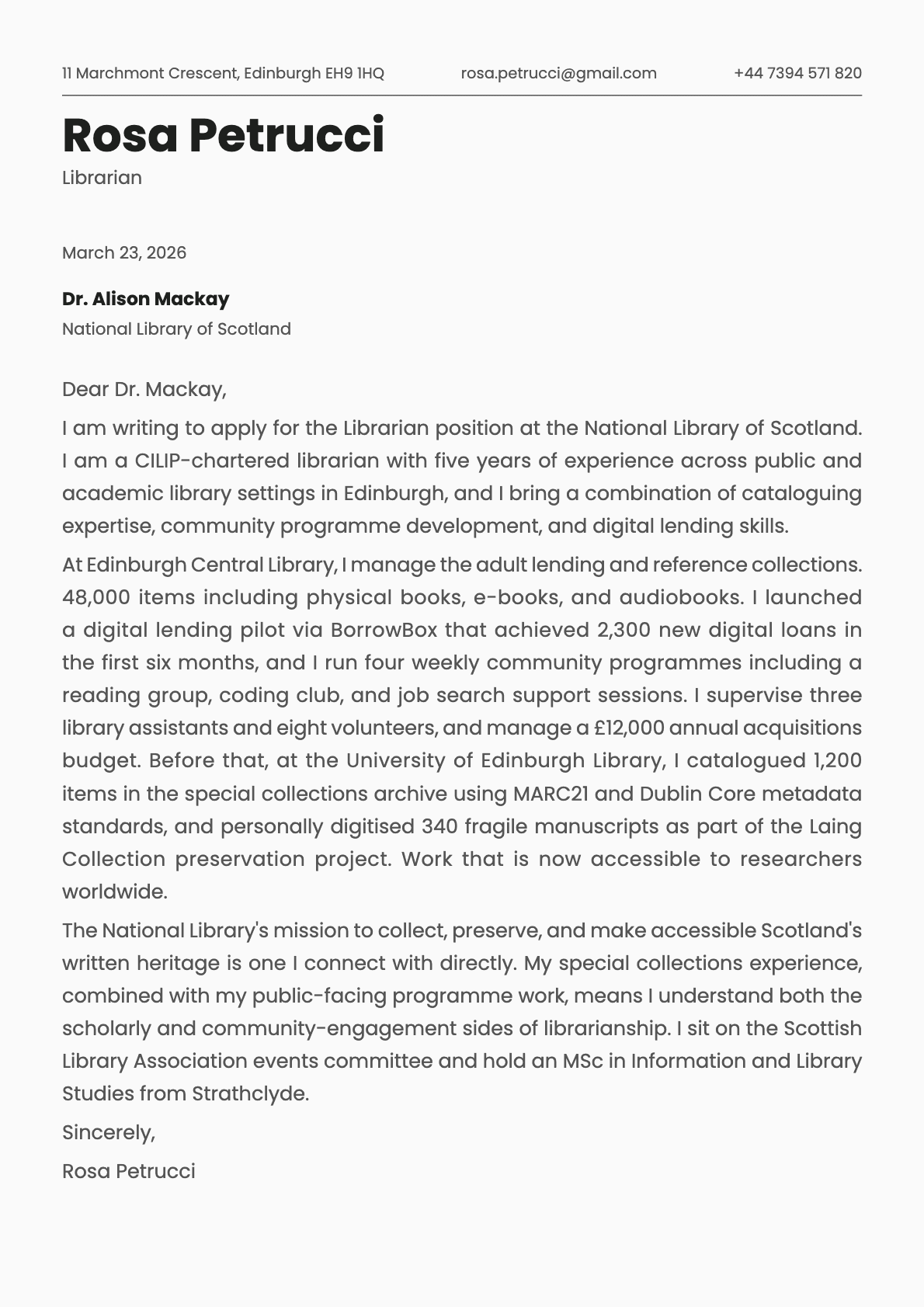
Librarian
A librarian cover letter example showing how to present cataloguing expertise, community programme development, and digital lending skills for a national.
Related articles

AI Is Screening Your Resume Before Any Human Sees It
AI screens most resumes before a human ever reads them. 97.4% of Fortune 500 companies run an ATS. This is what that means for you and what you can do about it.

The Best Resume Builders in 2026, Compared Honestly
Resume.io, Zety, Enhancv, Kickresume, Teal, and Laddro compared honestly: real pricing, free tiers, mobile apps, and where each tool wins. All prices checked in September 2026.

Burnout Recovery: A Real Timeline, Not 'Take a Bubble Bath'
55% of the U.S. workforce is burned out. Recovery takes 3 to 12 months. Here's what that actually looks like, stage by stage.