Resume Builder for Software Engineers
Build a dev resume that passes ATS filters and shows hiring managers what you actually built.
The Software Engineering Resume Problem
Most software engineers would rather write code than write about themselves. That is fair. But the reality is that your resume is the first filter between you and the job, and it is usually read by a recruiter who does not know the difference between React and Redis.
Your resume has to work on two levels. It needs the right keywords so the ATS does not reject it before a human sees it. And it needs to clearly communicate what you built, how you built it, and why it mattered, so the recruiter passes it to the engineering manager.
The good news: if you can write clean documentation, you can write a strong resume. It is the same skill. Be specific, be structured, and cut the fluff.
How to Format Your Tech Stack
One of the most common mistakes on developer resumes is dumping every technology you have ever touched into a massive list. Hiring managers see right through it. If you list 40 technologies, they assume you are competent in none of them.
Group your skills by category and lead with what you use daily:
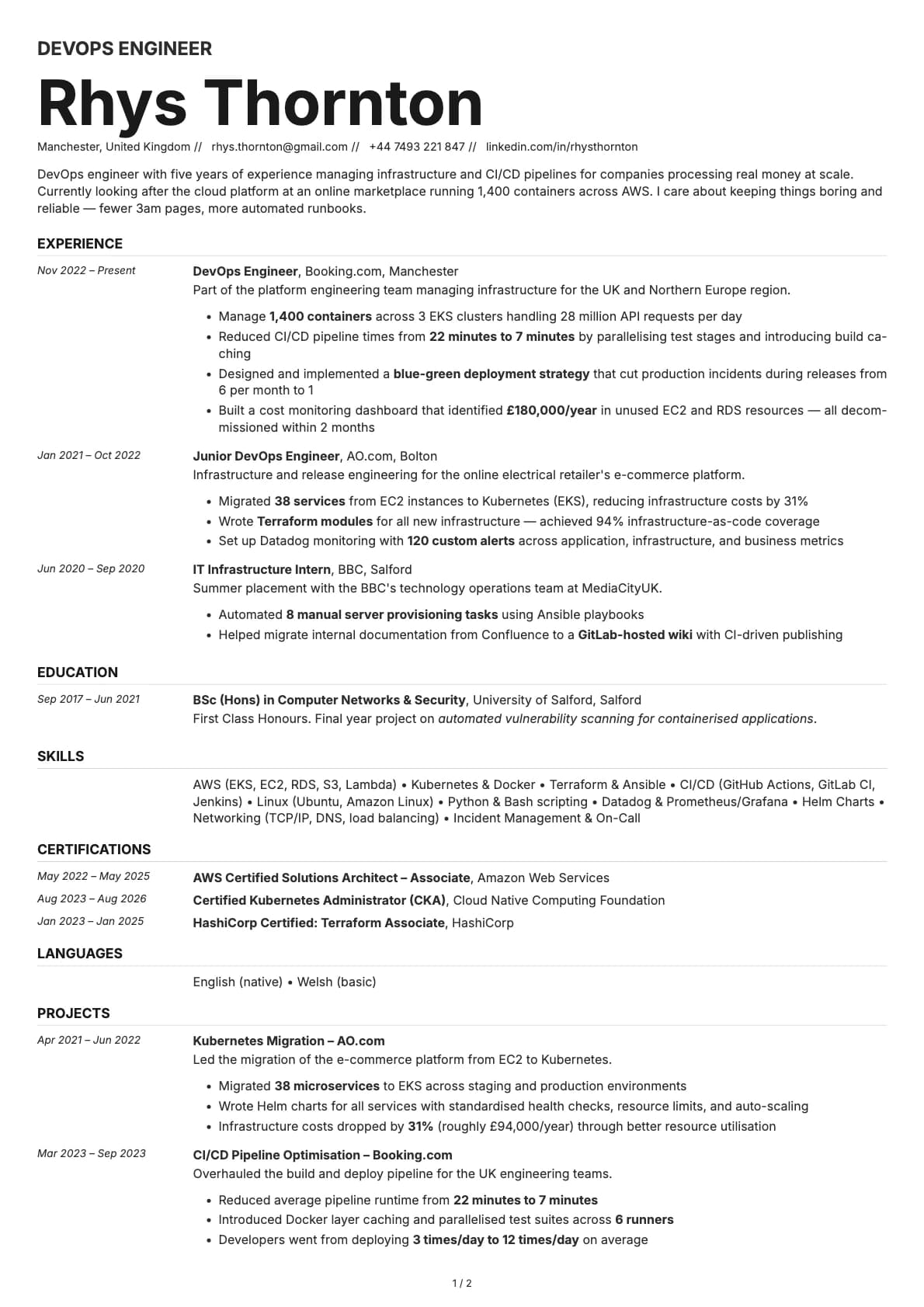
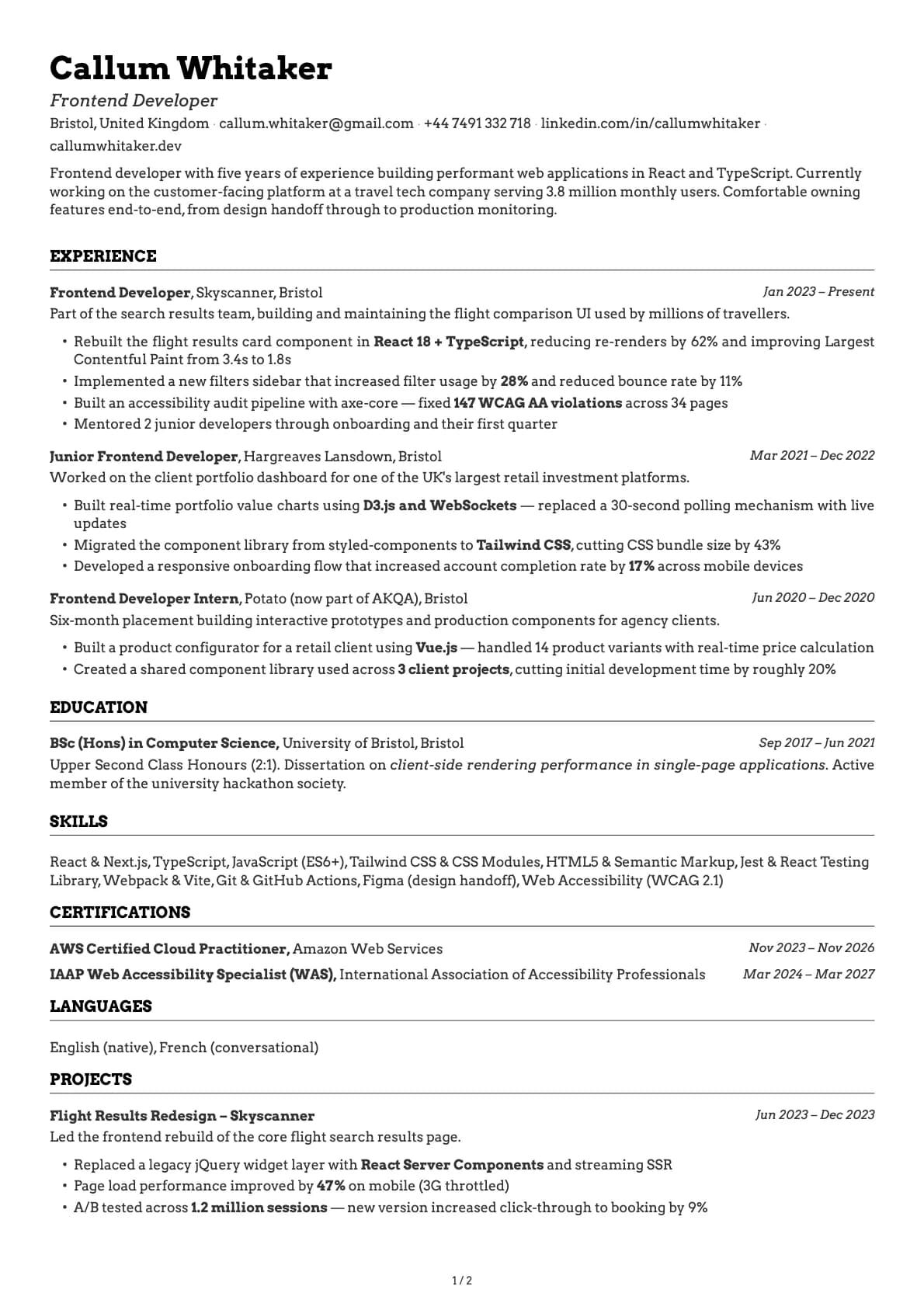
- Languages: Python, TypeScript, Go
- Frontend: React, Next.js, Tailwind CSS
- Backend: Node.js, FastAPI, PostgreSQL, Redis
- Infrastructure: AWS (EC2, S3, Lambda), Docker, Kubernetes, Terraform
- Tools: Git, GitHub Actions, Datadog, Sentry
Keep it honest. If you followed a tutorial on Rust three years ago, leave it off. If you cannot pass a screening question about a technology, it should not be on your resume.
Quantify What You Built
Engineers love to list responsibilities. "Developed microservices architecture" or "Worked on the frontend" says almost nothing. What hiring managers want to know is the impact.
Here are some examples of how to reframe your experience:
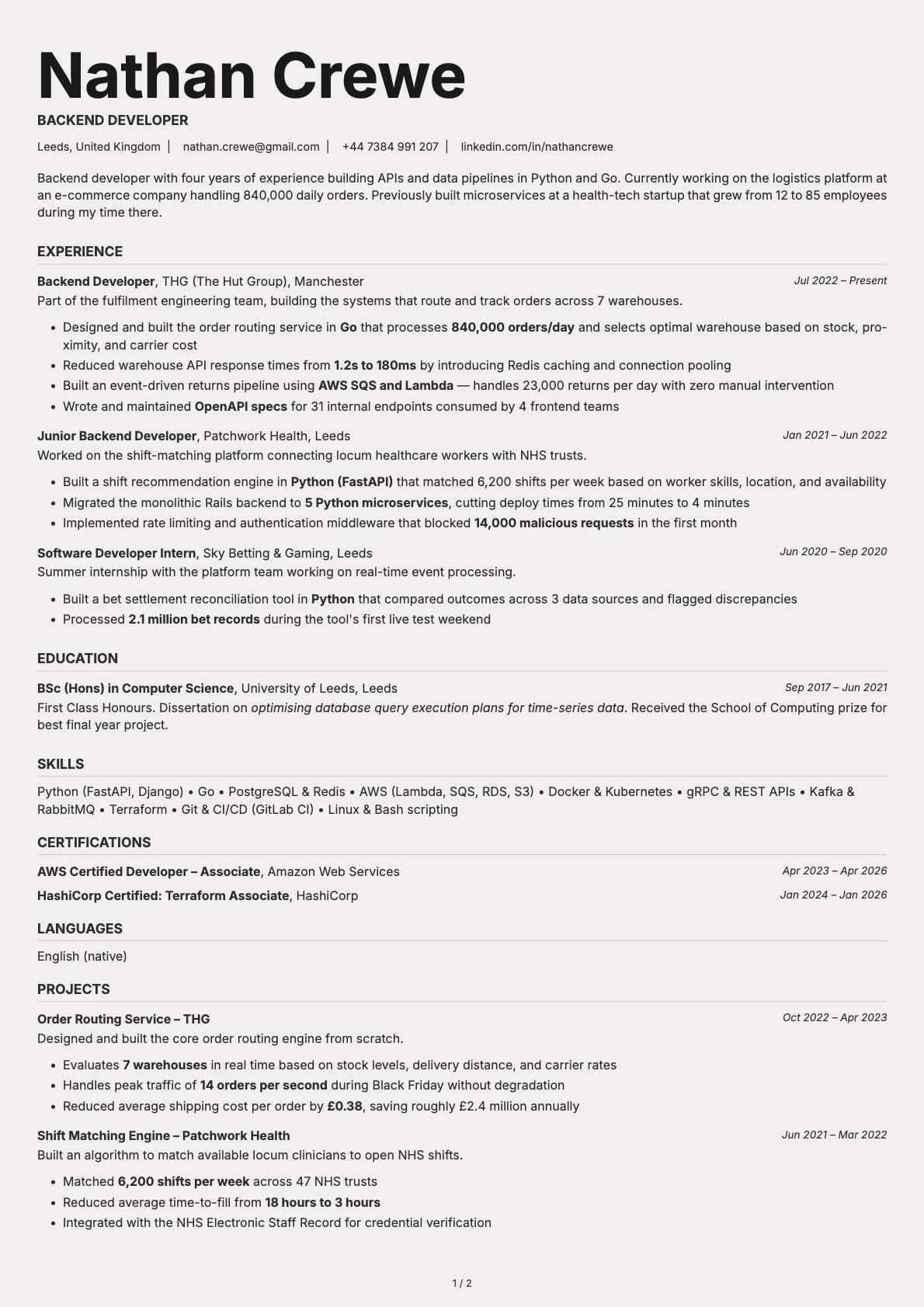
- "Reduced API response time from 800ms to 120ms by implementing caching with Redis, improving user experience for 2M monthly active users"
- "Built a CI/CD pipeline with GitHub Actions that cut deployment time from 45 minutes to 8 minutes"
- "Migrated a monolithic Rails application to microservices, reducing infrastructure costs by 35%"
- "Developed the search feature handling 50K queries per day with Elasticsearch, achieving sub-200ms P95 latency"
If you do not have exact numbers, estimate reasonably. "Thousands of users" is better than nothing. The point is to show scale and outcome, not just activity.
The Projects Section
For early-career developers or anyone making a career switch, a projects section can carry significant weight. Side projects, open source contributions, and even well-scoped personal projects show initiative and real skills.
For each project, include:
- What it does in one sentence
- Your tech stack
- A link to the live project or GitHub repo
- One metric or outcome if possible (downloads, stars, users)
Keep it to 2 or 3 projects. Quality over quantity.
GitHub and Portfolio Links
Include your GitHub profile link in your resume header. Engineering managers will look at it. But be strategic about what they will find there.
Pin your best repositories. Add README files to your top projects. Clean up any repos that are just tutorial follow-alongs or abandoned experiments. Your GitHub is an extension of your resume, so treat it like one.
If you have a personal site or portfolio, link to that as well. A clean portfolio that shows your work with context is more valuable than a GitHub profile full of forked repos.
The ATS vs. Creative Layout Debate
In tech, there is a temptation to make your resume stand out with creative designs, custom layouts, or even interactive web-based resumes. Here is the truth: creativity in layout rarely helps and often hurts.
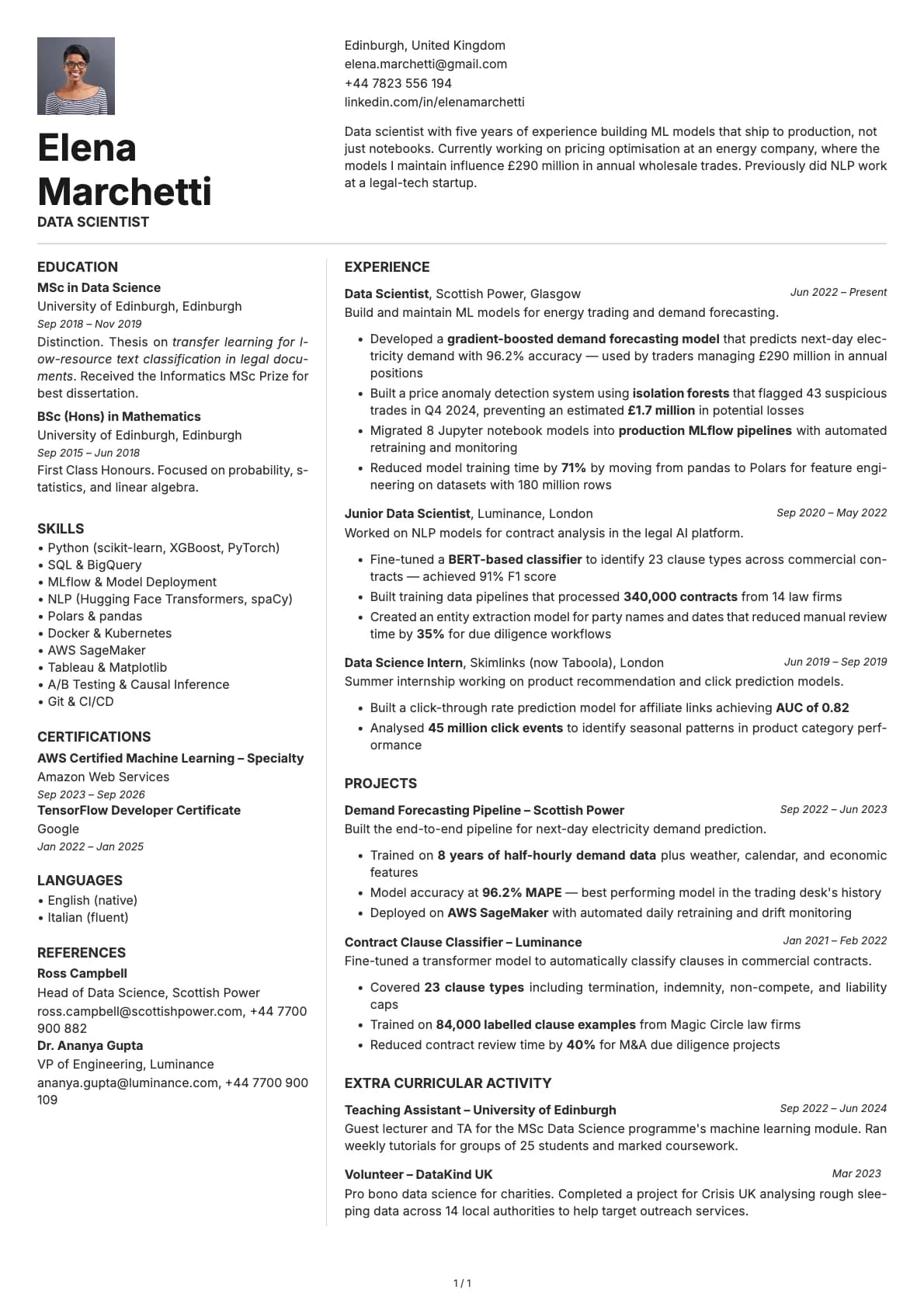
Most tech companies, including the ones you actually want to work at, use ATS platforms. Columns, icons, progress bars for skill levels, and fancy graphics all break when parsed by these systems. Your "90% proficiency in Python" progress bar becomes gibberish text in the recruiter's dashboard.
Stick with a clean, single-column layout. Use clear section headers. Let your content do the work of standing out, not your formatting.
That said, there is one exception. If you are applying to a small startup where you know the founder reviews applications personally, a well-designed PDF can make a positive impression. For everything else, keep it ATS-friendly.
Common Mistakes on Software Engineering Resumes
Listing every technology ever touched. Be selective. Focus on what you actually use and can discuss in an interview.
No metrics anywhere. "Built features" is not a resume bullet. "Built the payment integration that processed $2M in transactions in its first quarter" is.
Ignoring soft skills entirely. Engineering is collaborative. Mention code reviews, mentoring junior developers, cross-team projects, or technical documentation. These matter for senior roles especially.
Using jargon without context. "Implemented event-driven architecture" means nothing to the recruiter doing the first screen. Add a brief result: "Implemented event-driven architecture to handle 10x traffic spikes during peak hours without manual scaling."
A three-page resume with five years of experience. One page if you have under 8 years. Two pages maximum after that. Respect the reader's time.
How Laddro Helps You Build a Dev Resume That Works
Laddro's resume builder is built for people who want a professional resume without spending a weekend on formatting.
ATS-friendly templates. Every template is tested against the ATS platforms used by major tech companies. Your formatting survives the parse, and your keywords land where they should.
Smart keyword suggestions. Laddro's AI reviews your experience and suggests relevant technical terms that match what recruiters search for. It helps you close the gap between how you describe your work and how job postings describe the role.
Fast iteration. Applying to a frontend role and a full-stack role? Duplicate your resume in Laddro and tailor each version in minutes. No more juggling multiple Word documents.
Projects and links built in. Laddro's templates include dedicated sections for projects, GitHub profiles, and portfolio links, so you do not have to hack them into a format that was not designed for it.
Ready to Build Your Software Engineering Resume?
Stop procrastinating on your resume like it is a side project with no deadline. Start building your developer resume with Laddro and get a clean, ATS-tested result in minutes.
Want to see how other engineers have done it? Browse technology and engineering resume examples for real-world inspiration.