Data Scientist Resume Example
A data scientist resume example with ML production experience at Scottish Power and NLP work at Luminance.

Laddro Team
Free to use. No account needed to start.
Free to use. No account needed to start.
Overview
Data scientist resumes often read like academic papers. Long lists of algorithms, frameworks, and acronyms. But hiring managers are not grading a thesis. They want to know: can this person build a model that actually works in production, and does it make the business money?
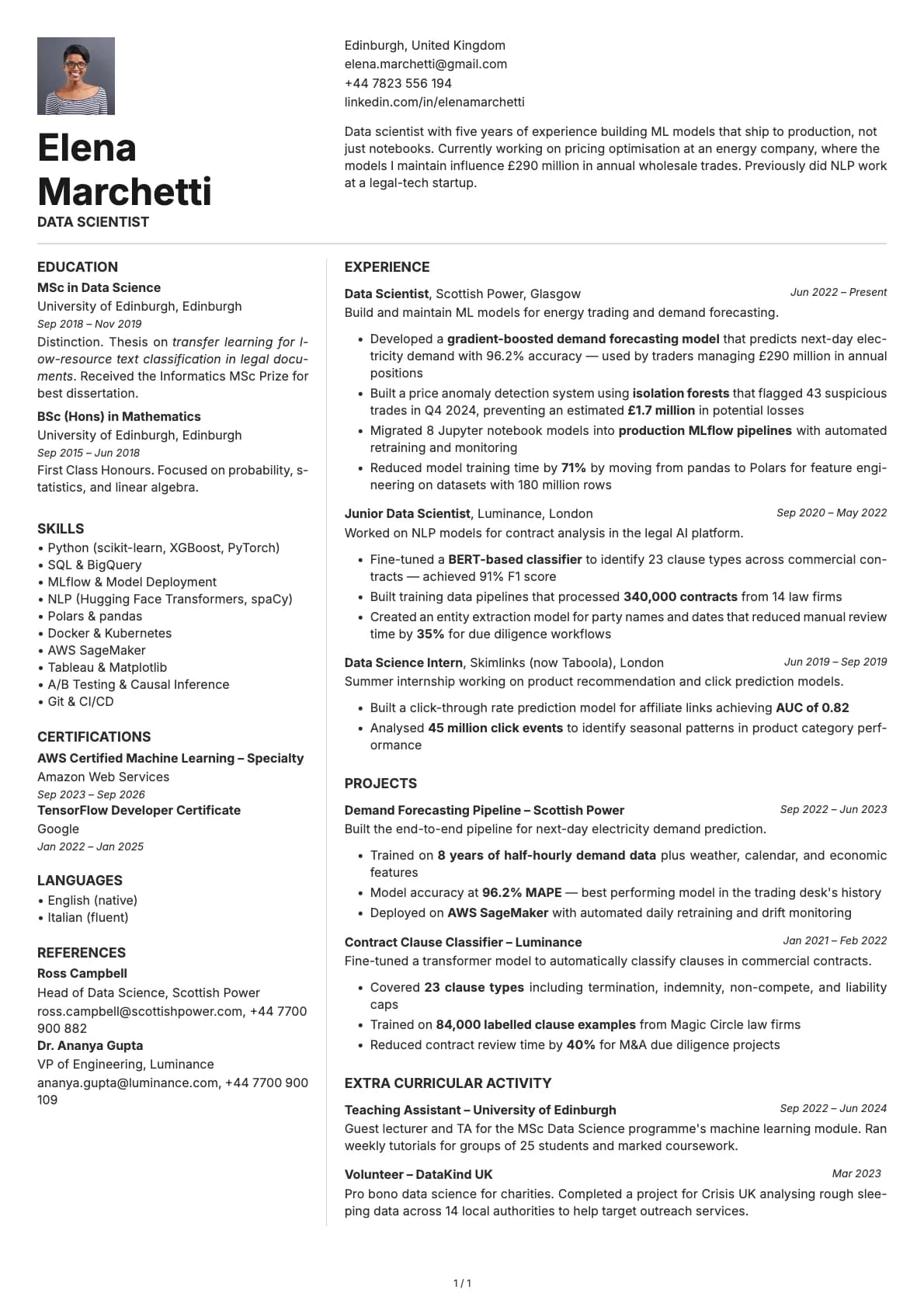
This resume belongs to a data scientist with five years of experience. She currently builds pricing and demand forecasting models at Scottish Power, where the models she maintains influence £290 million in annual wholesale trades. Before that, she did NLP work at Luminance, a legal-tech startup. The resume works because every bullet connects a technical method to a production system to a business outcome.
Summary: production, not notebooks
The summary on this resume does something most data scientist summaries do not. It explicitly states the models ship to production.
Data scientist with five years of experience building ML models that ship to production, not just notebooks. Currently working on pricing optimisation at an energy company, where the models I maintain influence £290 million in annual wholesale trades.
"Ship to production, not just notebooks" is a deliberate line. It tells the hiring manager this person understands the difference between an experiment and a deployed system. The £290 million figure anchors the scale immediately.
For yours: Name the type of models you build, whether they run in production, and the business value they influence. If you work on recommendation systems that serve millions of users, say that. If your forecasts guide purchasing decisions, say that.
Experience: method plus deployment plus outcome
Data science bullets need three parts. The method (what algorithm or approach), the deployment (how it runs in production), and the outcome (what it did for the business).
This resume nails the pattern:
"Developed a gradient-boosted demand forecasting model that predicts next-day electricity demand with 96.2% accuracy, used by traders managing £290 million in annual positions"
Method: gradient boosting. Metric: 96.2% accuracy. Business context: traders use it for £290 million in decisions. All three in one sentence.
Here is another:
"Built a price anomaly detection system using isolation forests that flagged 43 suspicious trades in Q4 2024, preventing an estimated £1.7 million in potential losses"
Same pattern. Algorithm, what it found, and the financial impact. The "43 suspicious trades" detail is important because it proves the system actually catches things in the real world, not just in a test set.
Apply this to your bullets: If you built a recommendation engine, what was the click-through rate improvement? If you trained a classifier, what was the F1 score and who uses the predictions? If you automated a pipeline, how much time did it save?
MLOps is not optional anymore
One of the most valuable bullets on this resume has nothing to do with modelling:
"Migrated 8 Jupyter notebook models into production MLflow pipelines with automated retraining and monitoring"
This tells the hiring manager that this person does not just build models and hand them off. They deploy them, monitor them, and keep them running. MLOps experience is increasingly what separates mid-level data scientists from seniors. If you have deployed models using MLflow, SageMaker, Vertex AI, or even a basic Flask API, mention it.
The performance optimisation bullet is also strong:
"Reduced model training time by 71% by moving from pandas to Polars for feature engineering on datasets with 180 million rows"
This is a practical engineering decision, not a modelling decision. Moving from pandas to Polars shows the person understands performance bottlenecks and can fix them. These details matter more than listing another framework in your skills section.
Education: it matters more here than in most fields
Data science is one of the few fields where your degree and thesis topic genuinely influence hiring. This resume includes an MSc in Data Science from Edinburgh with a thesis on transfer learning for low-resource text classification. That thesis topic directly relates to the NLP work at Luminance.
If your thesis or dissertation is relevant to the roles you are applying for, name it in your education section. If it is not relevant, a brief mention of the degree and grade is enough.
The BSc in Mathematics underneath provides the statistical foundation. For data science roles, a quantitative degree (maths, statistics, physics, computer science, engineering) is still the most common entry point. If your degree is in a different field, focus more heavily on your certifications and project work to demonstrate technical depth.
NLP work: show the data, not just the model
The Luminance role covers NLP work on legal contracts. Look at how the data scale is communicated:
"Built training data pipelines that processed 340,000 contracts from 14 law firms"
"Fine-tuned a BERT-based classifier to identify 23 clause types across commercial contracts, achieved 91% F1 score"
The 340,000 contracts and 14 law firms give the reader a sense of scale. The 23 clause types and 91% F1 score show precision. If you work in NLP, always mention the dataset size, the number of classes or categories, and the evaluation metric.
Mistakes data scientists make on resumes
Listing algorithms instead of applications. "Experienced with random forests, XGBoost, LSTM, and transformer models" belongs in a skills section. Your experience bullets should describe what you built with them and what it achieved.
Not mentioning production deployment. If your models only exist in notebooks, many employers will see that as a gap. Even if your MLOps experience is limited, mention any steps you took toward production: containerisation, API wrappers, automated retraining.
Ignoring the business context. "Achieved 96.2% accuracy" is only meaningful if the reader knows what depends on that accuracy. In this case, it is £290 million in energy trades. Always connect the metric to the stake.
Over-indexing on tools. Python, SQL, and one deep learning framework cover most data science roles. A skills section with 20 libraries suggests you are spreading thin rather than going deep. Keep it focused.
One more thing
The best data science resumes read like a portfolio of shipped products, not a list of experiments. For every model on your resume, ask yourself: is this running somewhere? Is someone using the output to make a decision? If yes, describe the decision. If not, describe the closest thing you have to real-world impact. That is what gets you the interview.
Build your own version
Open this layout in the builder and swap in your own details. It takes a few minutes.
Free to use. No account needed to start.
Was this resume example helpful?
Rate this example to help us create better content for you.
4.9 average from 118 ratingsRelated resume examples
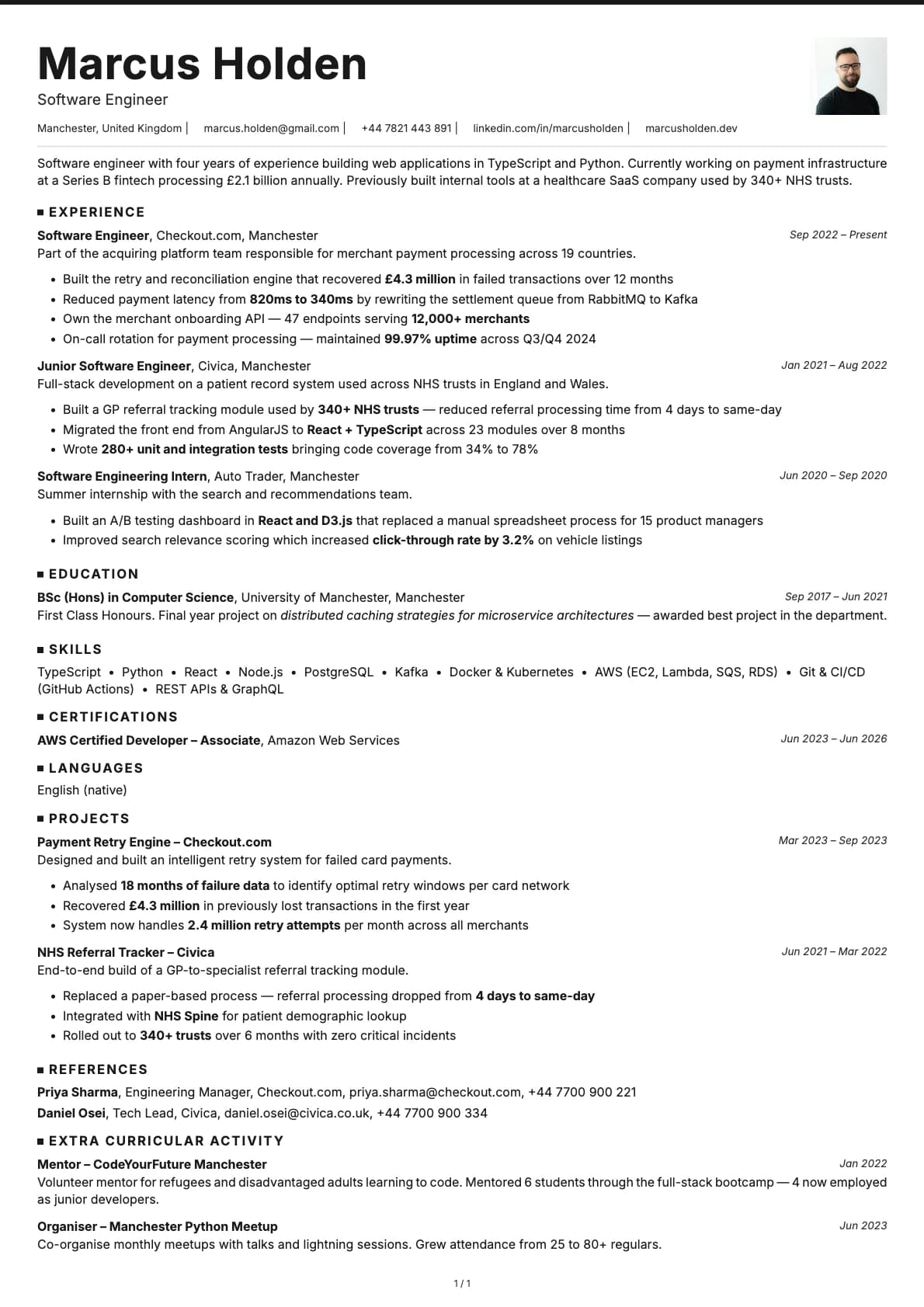
Software Engineer
A software engineer resume example with practical tips on how to write your tech stack, quantify your impact, and get past ATS screening.
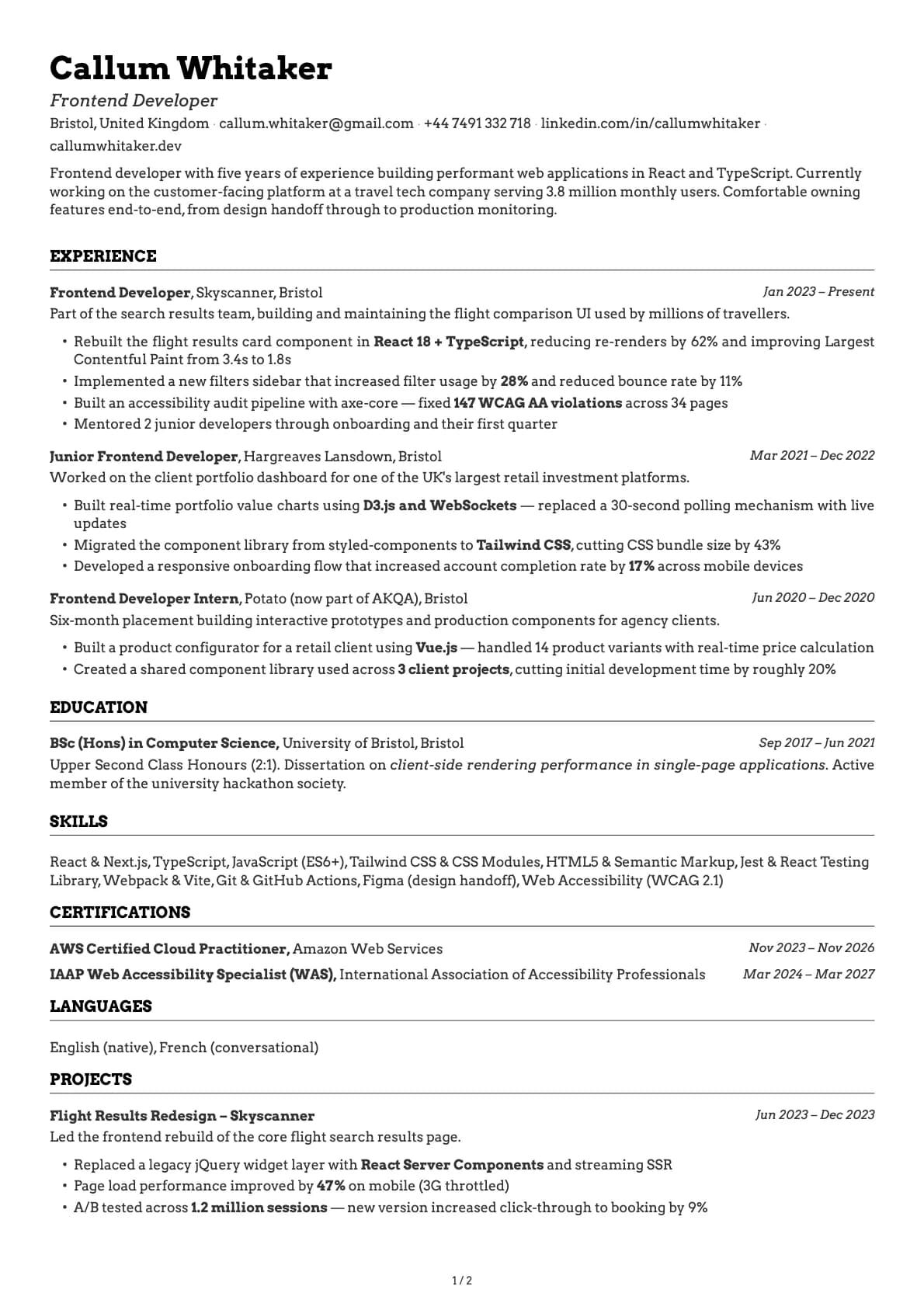
Frontend Developer
A frontend developer resume example with React and TypeScript experience at Skyscanner and Hargreaves Lansdown.
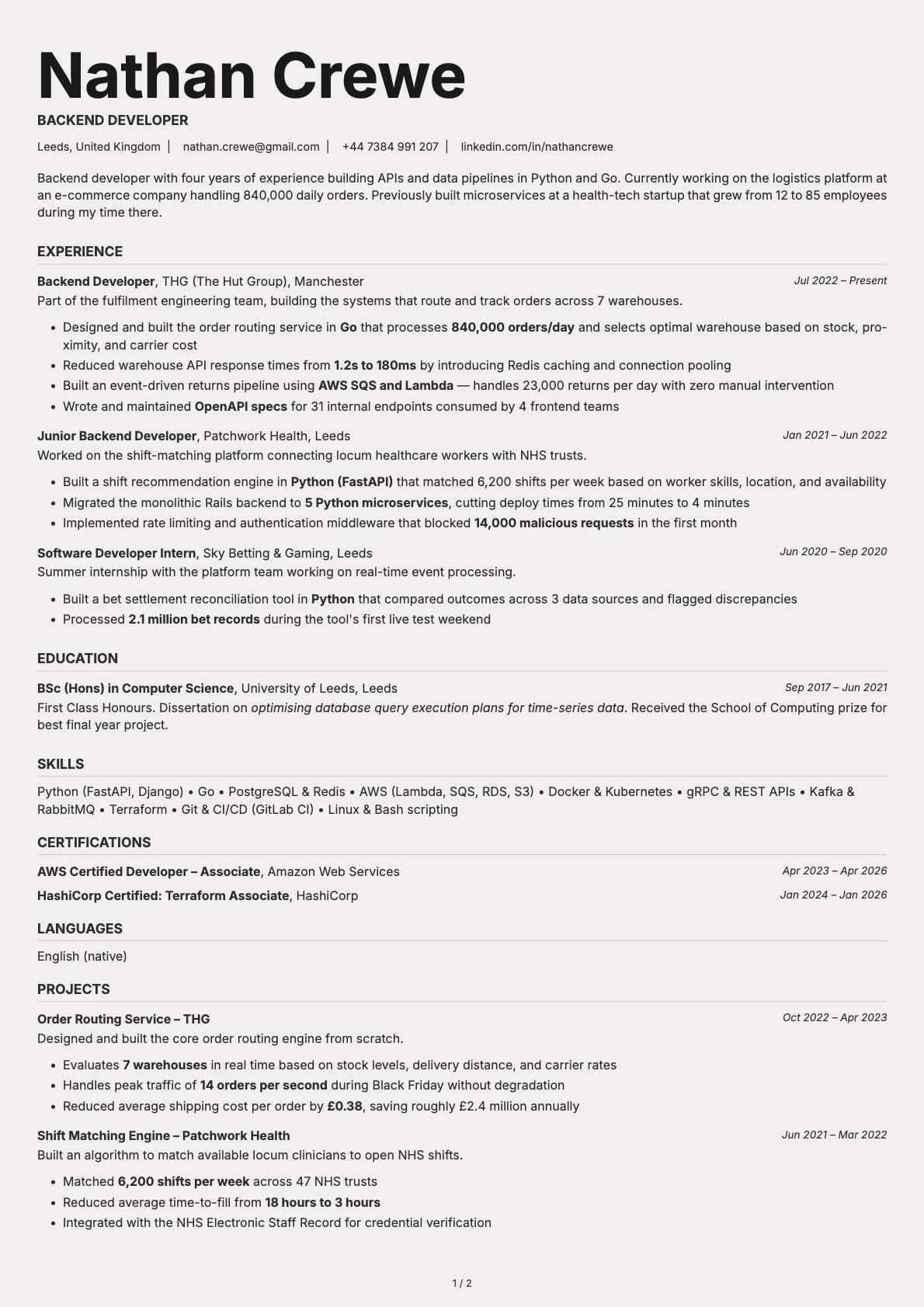
Backend Developer
A backend developer resume example with Go and Python experience, system throughput numbers, and infrastructure projects across e-commerce and health-tech.
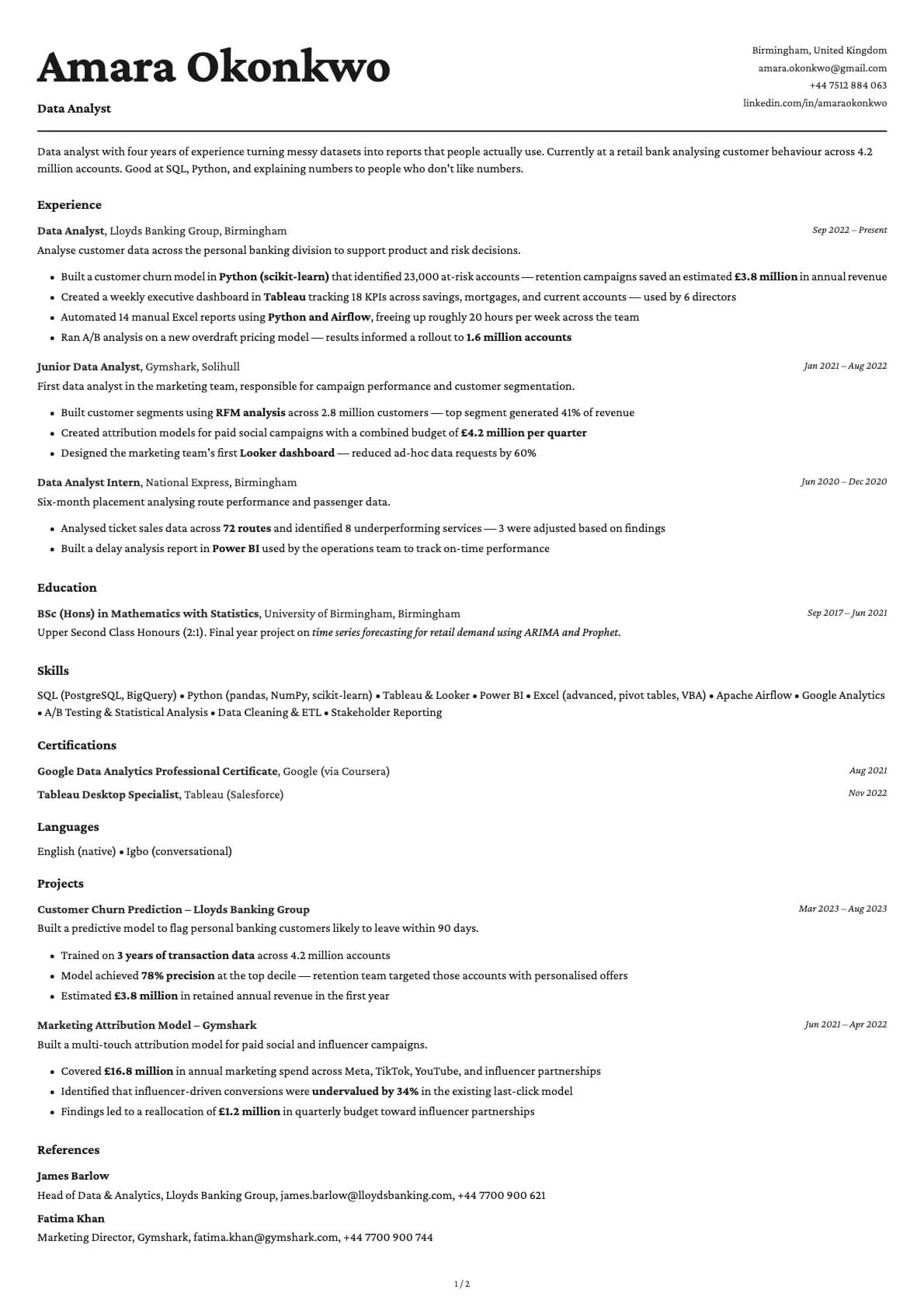
Data Analyst
A data analyst resume example with experience at Lloyds Banking Group and Gymshark.
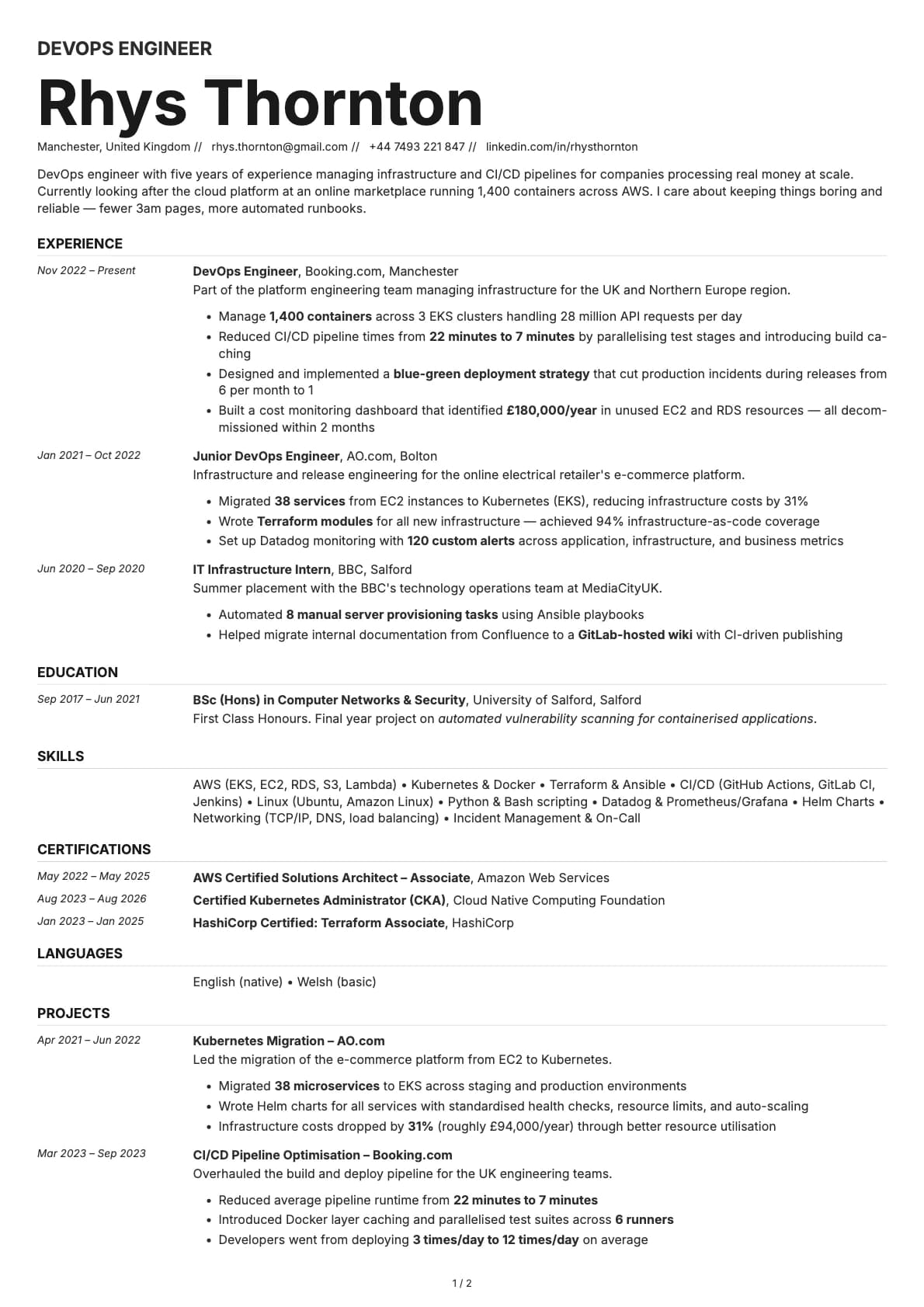
DevOps Engineer
A DevOps engineer resume example with infrastructure experience at Booking.com and AO.com.
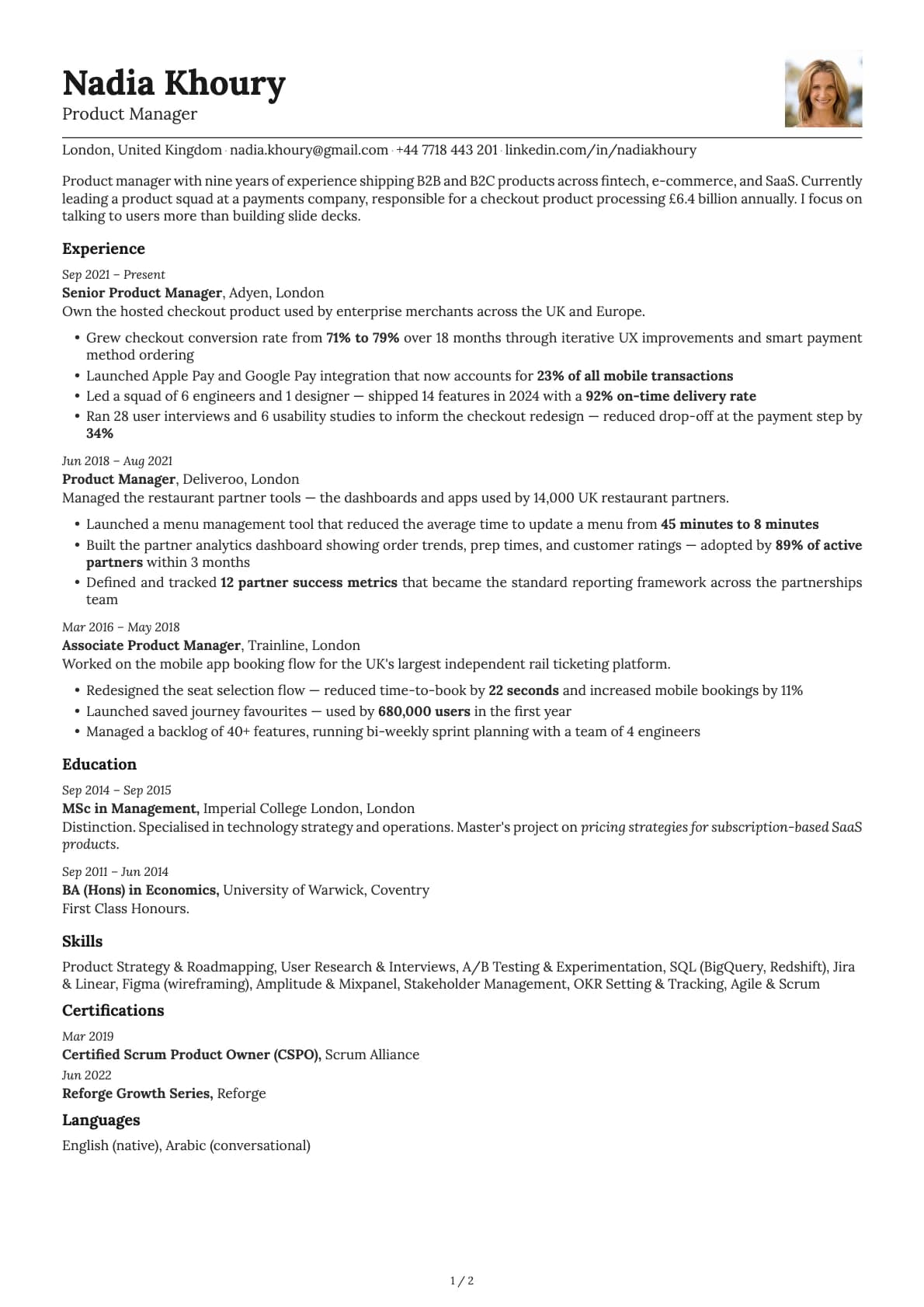
Product Manager
A product manager resume example showing how to present user research, conversion metrics, and feature launches with real business outcomes.
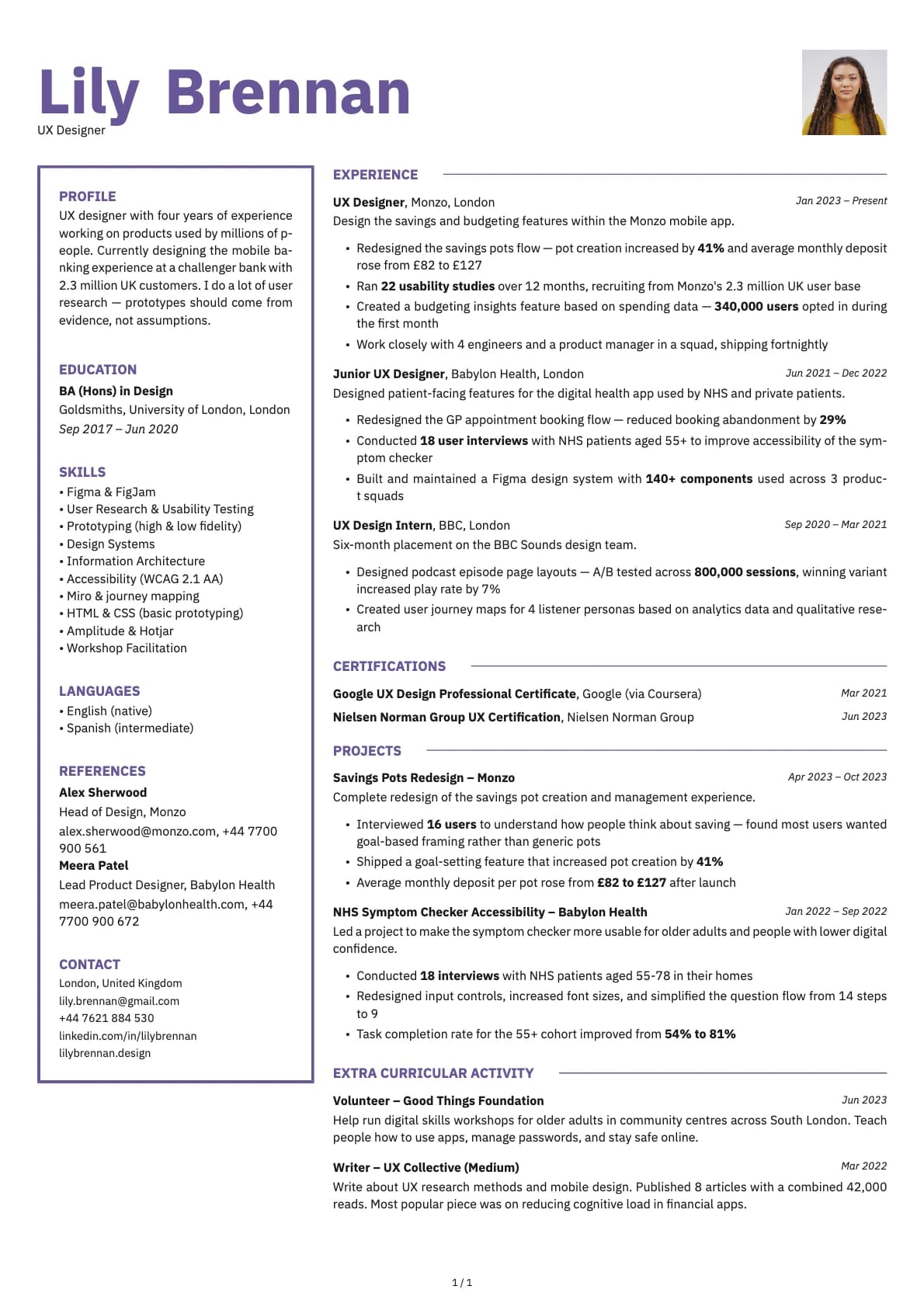
UX Designer
A UX designer resume example with 4 years of product design experience at Monzo and Babylon Health.
QA Engineer
A QA engineer resume example with automated test suite numbers, production bug reduction, and contract testing implementation details.
Cybersecurity Analyst
A cybersecurity analyst resume example with SOC experience at Nationwide and NCC Group.
Web Developer
A web developer resume example with agency and in-house experience building Next.js sites, improving Core Web Vitals, and delivering accessible public.
Mobile Developer
A mobile developer resume example with iOS and Android experience, performance metrics, and real app user numbers.
Help Desk / IT Support Technician
A help desk technician resume example with NHS IT support experience.
IT Project Manager
An IT project manager resume example with cloud migration, programme budgets up to £8.5 million, and PRINCE2/Scrum certifications.
Related articles

AI Is Screening Your Resume Before Any Human Sees It
AI screens most resumes before a human ever reads them. 97.4% of Fortune 500 companies run an ATS. This is what that means for you and what you can do about it.

ATS Resume Checker: How to Format a CV That Gets Past the Filters
Run the free copy and paste test to see what an ATS actually reads on your CV, then fix the tables, columns and headings that quietly get you filtered out.

The Best Resume Builders in 2026, Compared Honestly
Resume.io, Zety, Enhancv, Kickresume, Teal, and Laddro compared honestly: real pricing, free tiers, mobile apps, and where each tool wins. All prices checked in September 2026.