Frontend Developer Resume Example
A frontend developer resume example with React and TypeScript experience at Skyscanner and Hargreaves Lansdown.

Laddro Team
Free to use. No account needed to start.
Free to use. No account needed to start.
Overview
Frontend developer resumes tend to fall into a predictable pattern. A long list of JavaScript frameworks. A summary that says "detail-oriented developer with a track record of delivering high-quality user interfaces." And experience bullets that describe what technology was used without ever saying what happened because of it.
Hiring managers at product companies see dozens of these. The resumes that get interviews are the ones that talk about users, performance, and outcomes.
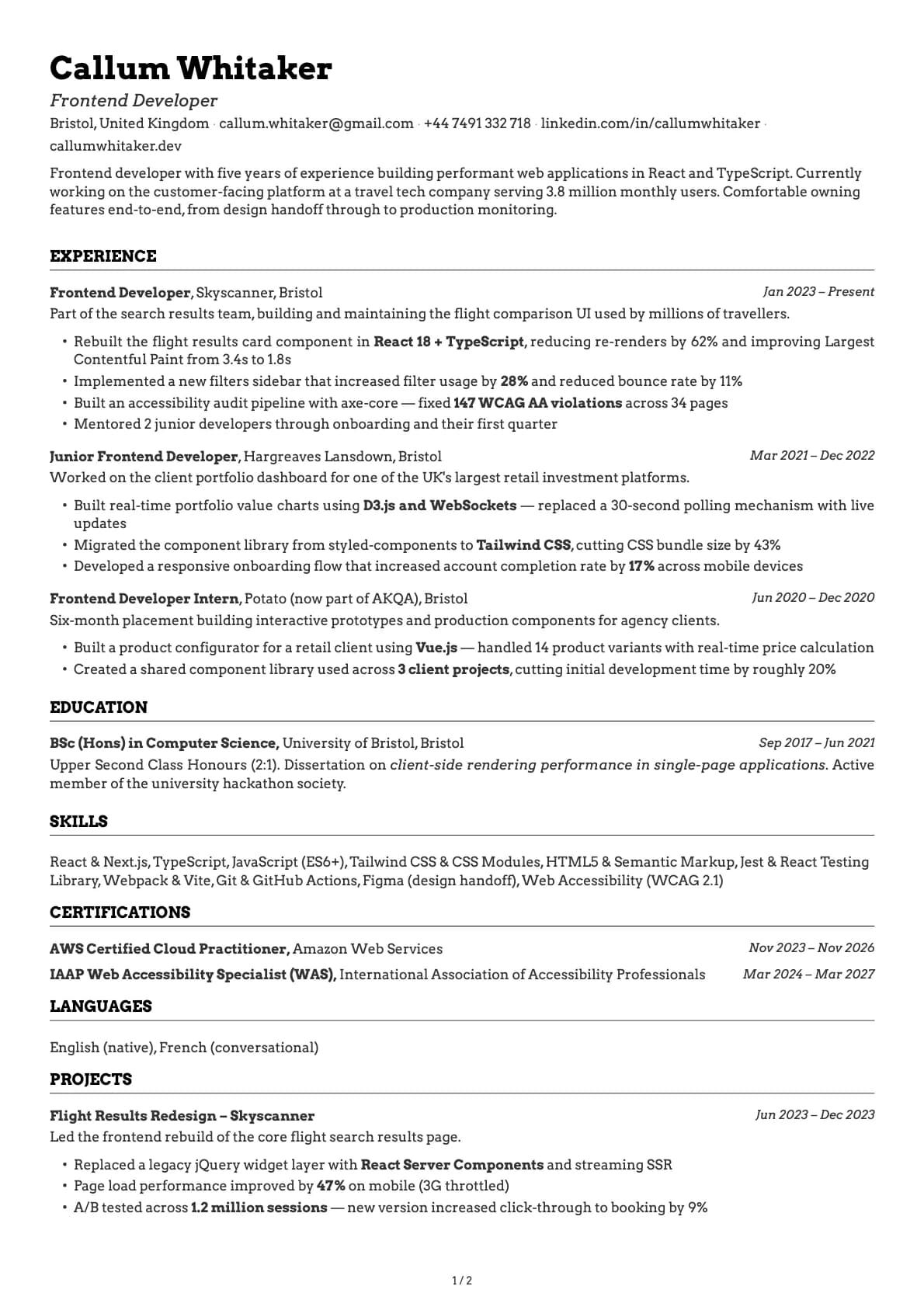
This resume belongs to Callum, a frontend developer with five years of experience based in Bristol. He works at Skyscanner on the flight search results page used by 3.8 million monthly users. Before that, he built the portfolio dashboard at Hargreaves Lansdown. The resume works because every bullet ties a technical decision to a user-facing outcome.
Let us go through what makes this effective and what you should apply to yours.
Your summary: users and scale, not frameworks
The summary on this resume does something that most frontend resumes skip. It talks about the product, not just the code.
Frontend developer with five years of experience building performant web applications in React and TypeScript. Currently working on the customer-facing platform at a travel tech company serving 3.8 million monthly users.
React and TypeScript get a mention, but the real hook is "3.8 million monthly users." That number tells the recruiter this person works at scale, on production code that real people use every day.
For your summary: Name your primary framework (React, Vue, Angular, whatever you actually use daily). Then describe the product, not the codebase. How many users? What does the product do? That context matters more than listing five frameworks.
Writing experience bullets that show user impact
Here is where most frontend devs go wrong. They describe the code change instead of the user outcome.
Weak version: "Rebuilt the search results component using React Server Components."
This resume's version:
Rebuilt the flight results card component in React 18 + TypeScript, reducing re-renders by 62% and improving Largest Contentful Paint from 3.4s to 1.8s
Same work. But now there is a before-and-after performance metric. LCP from 3.4s to 1.8s. A recruiter at any product company understands what that means. Faster pages, better SEO, happier users.
Here is another strong bullet:
Implemented a new filters sidebar that increased filter usage by 28% and reduced bounce rate by 11%
This one is not even about code. It is about a product outcome (more filter usage, less bouncing). The engineering manager reading this sees someone who understands why they are building features, not just how.
The formula: What you built + The technology used + The user or performance metric that changed.
Performance metrics frontend devs should track
If you work on any customer-facing web application, you have access to performance numbers that look great on a resume. Here are the ones to look for:
- Core Web Vitals: LCP, FID/INP, CLS. If you improved any of these, include the before-and-after.
- Bundle size: "Cut CSS bundle size by 43%" (from this resume's Hargreaves Lansdown role).
- Conversion rates: If your UI change led to more sign-ups, more clicks, or fewer drop-offs, that is a product metric.
- Accessibility: "Fixed 147 WCAG AA violations across 34 pages" is both a number and a quality signal.
You do not need all of these. But picking two or three and including the actual numbers makes your resume stand out against someone who just wrote "improved page performance."
The skills section: focused, not exhaustive
This resume lists 10 skills: React & Next.js, TypeScript, JavaScript (ES6+), Tailwind CSS & CSS Modules, HTML5, Jest & React Testing Library, Webpack & Vite, Git & GitHub Actions, Figma, and Web Accessibility (WCAG 2.1).
Notice what is NOT here. No "Agile/Scrum." No "problem-solving." No backend frameworks listed just because the candidate once read a tutorial. Each skill is something this person uses regularly in their frontend work.
One smart inclusion: Figma (design handoff). Listing Figma tells the recruiter this person can work with designers directly, read design specs, and translate them to code. That is a practical frontend skill.
Another one: Web Accessibility (WCAG 2.1). Accessibility is becoming a real hiring factor, especially at companies that serve large public audiences. If you have accessibility experience, list it.
Projects: expand your best work
The projects section lets you tell the full story of your strongest work. This resume highlights the Flight Results Redesign at Skyscanner:
Replaced a legacy jQuery widget layer with React Server Components and streaming SSR. Page load performance improved by 47% on mobile. A/B tested across 1.2 million sessions. New version increased click-through to booking by 9%.
That is a four-line case study. Legacy tech replaced, performance improved, tested at scale, business outcome delivered. If you have led or significantly contributed to a similar project, give it its own section and include the numbers.
What about your first developer role?
If you are early in your career, look at the intern role at Potato:
Built a product configurator for a retail client using Vue.js. Handled 14 product variants with real-time price calculation.
Created a shared component library used across 3 client projects, cutting initial development time by roughly 20%.
No massive user numbers. But the bullets are specific about what was built and what impact it had. A shared component library that saved 20% development time is a strong talking point even for a senior interview.
For your first role, focus on what you built, how it was used, and any time or effort it saved. If the project shipped to real users, say so.
Mistakes frontend developers make on their resumes
Listing every framework you have ever touched. If you list React, Vue, Angular, Svelte, and Solid, the recruiter does not know which one you are actually strong in. List the ones you use daily and can interview on.
No performance numbers. If you work on web applications and do not mention a single Web Vital, bundle size, or load time, you are leaving out the most concrete evidence of your skill. Check your browser DevTools or your company's monitoring dashboards. The numbers are there.
Skipping testing. "Jest & React Testing Library" on your skills list tells the recruiter you write tests. Many frontend devs do not list testing at all, which raises the question of whether they write any.
Ignoring accessibility. If you have done any accessibility work (screen reader testing, WCAG audits, ARIA implementation), include it. It is increasingly a hiring requirement, and most candidates do not mention it.
One last thing
Include a link to your personal site or GitHub if the code is good. This resume lists callumwhitaker.dev. A recruiter might check it. If your portfolio is out of date or your GitHub is full of abandoned tutorial projects, leave the link off. But if you have a clean site with one or two solid projects, it can be the thing that moves you from "maybe" to "interview."
Build your own version
Open this layout in the builder and swap in your own details. It takes a few minutes.
Free to use. No account needed to start.
Was this resume example helpful?
Rate this example to help us create better content for you.
4.8 average from 189 ratingsRelated resume examples
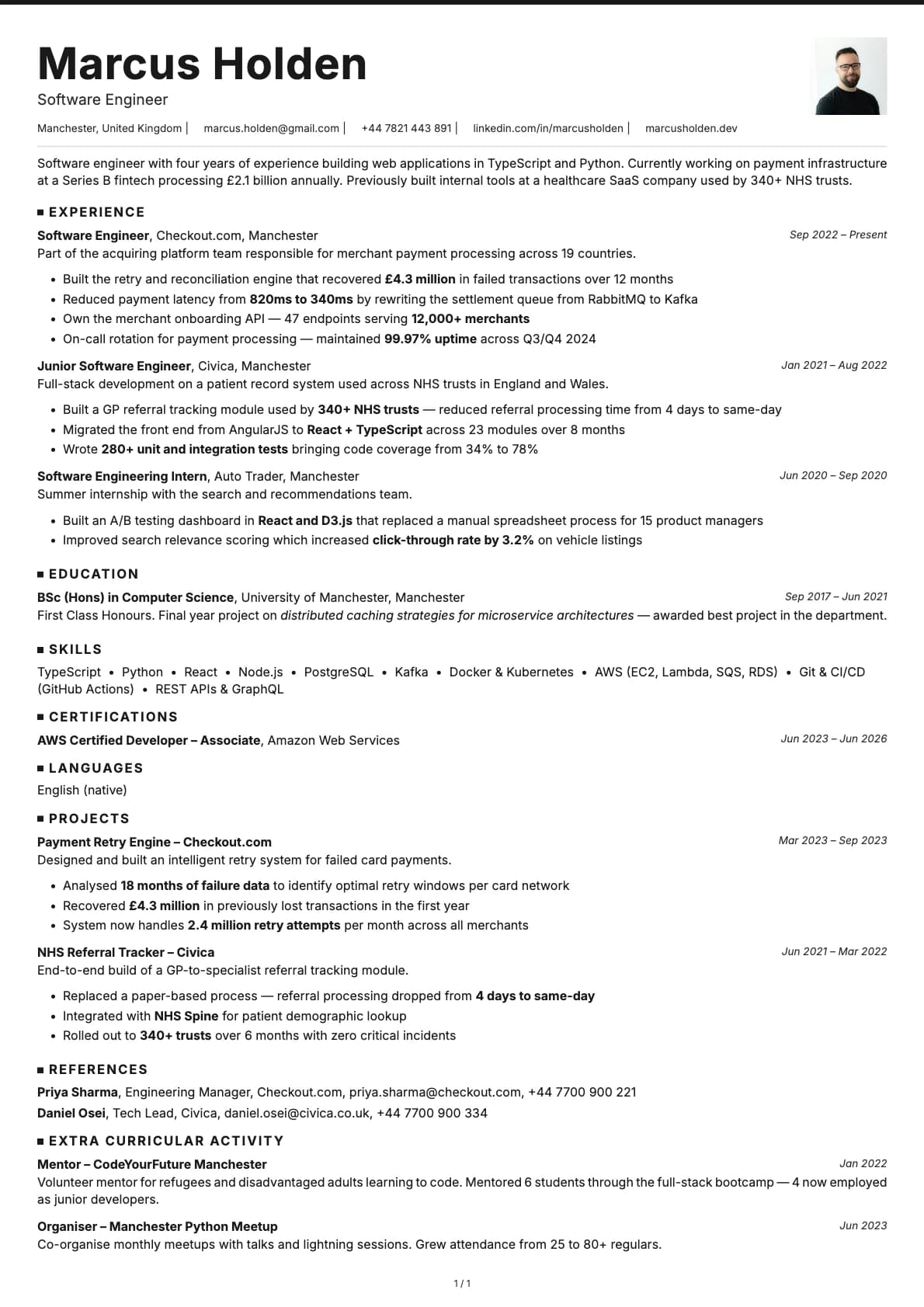
Software Engineer
A software engineer resume example with practical tips on how to write your tech stack, quantify your impact, and get past ATS screening.
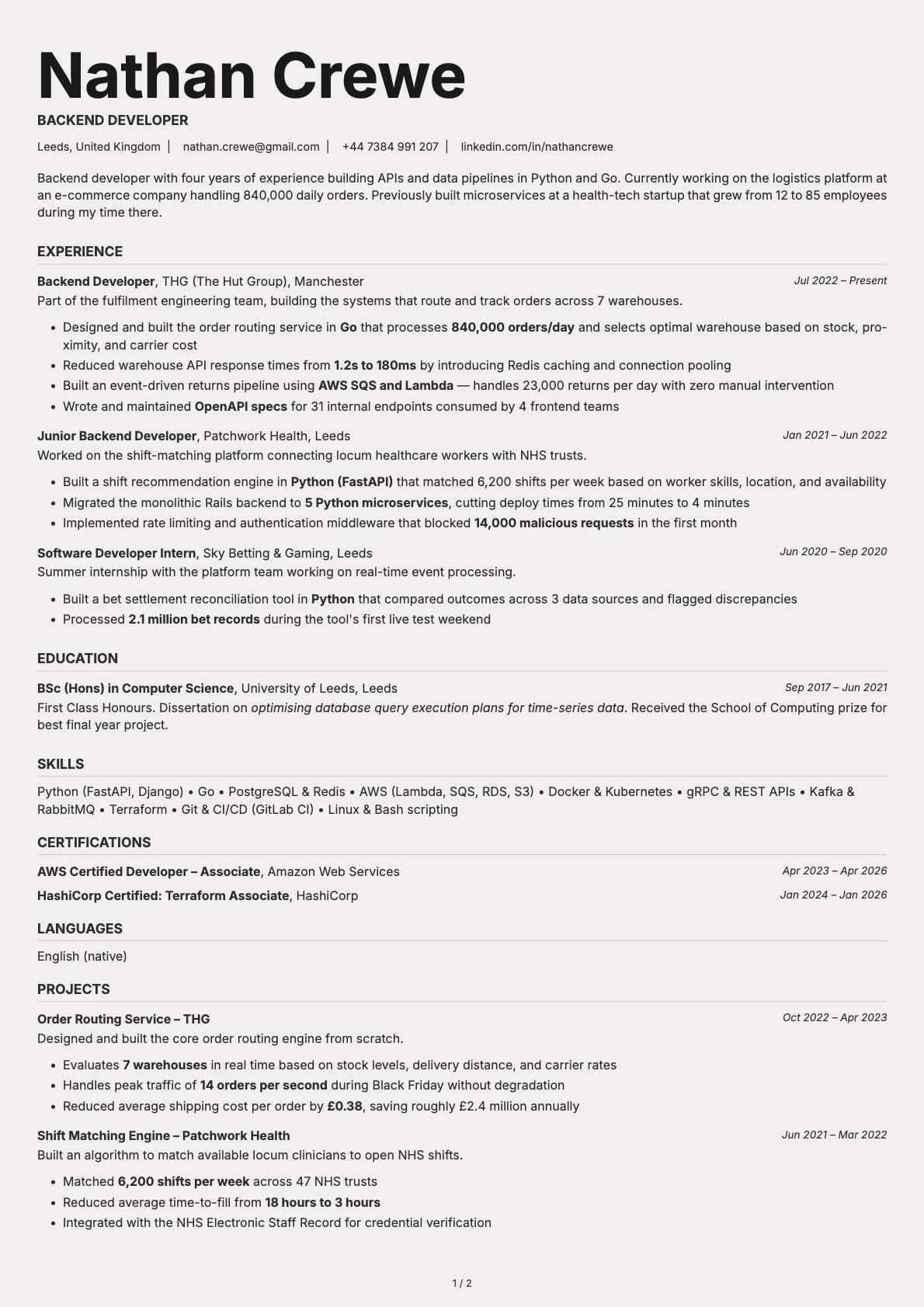
Backend Developer
A backend developer resume example with Go and Python experience, system throughput numbers, and infrastructure projects across e-commerce and health-tech.
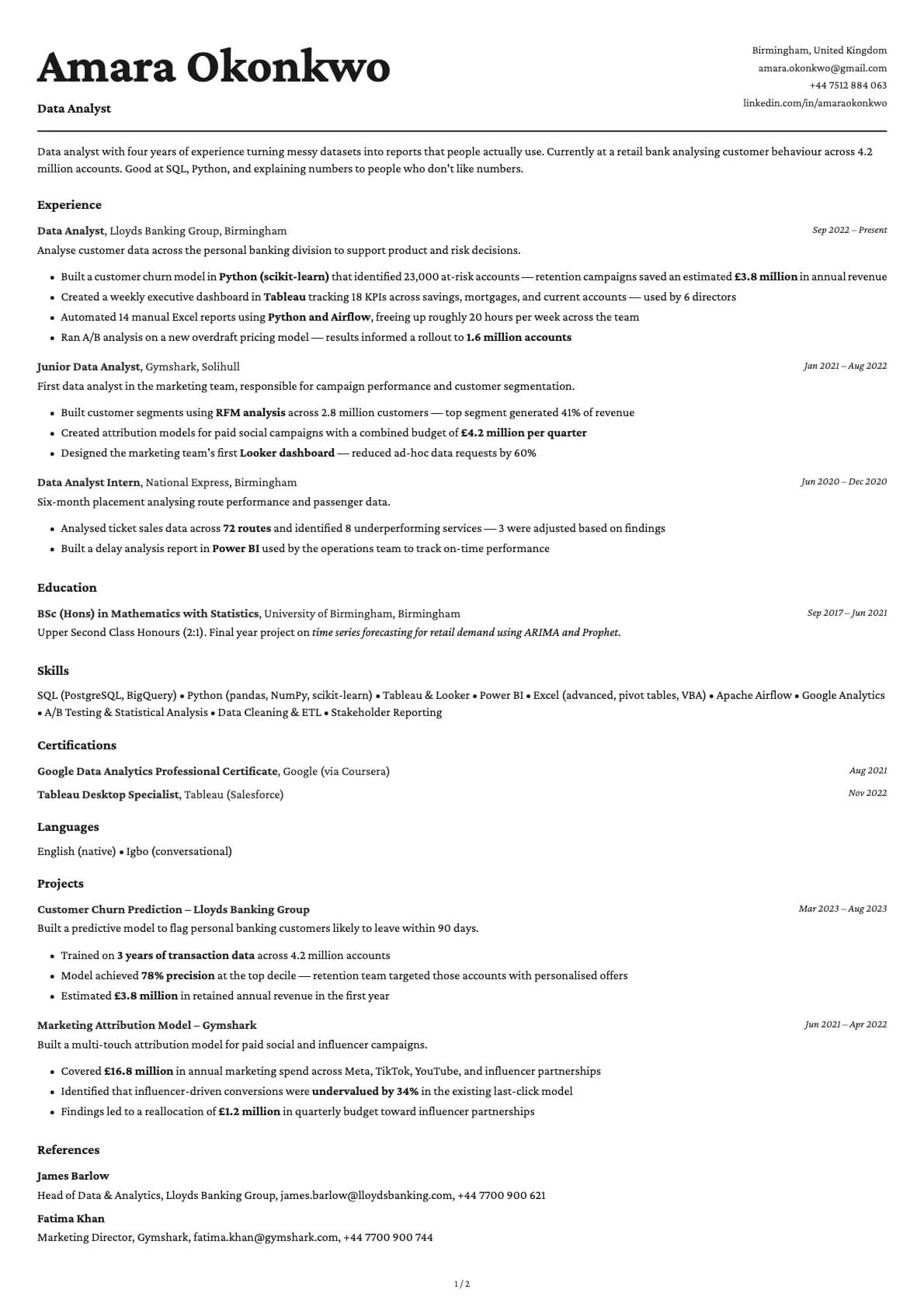
Data Analyst
A data analyst resume example with experience at Lloyds Banking Group and Gymshark.
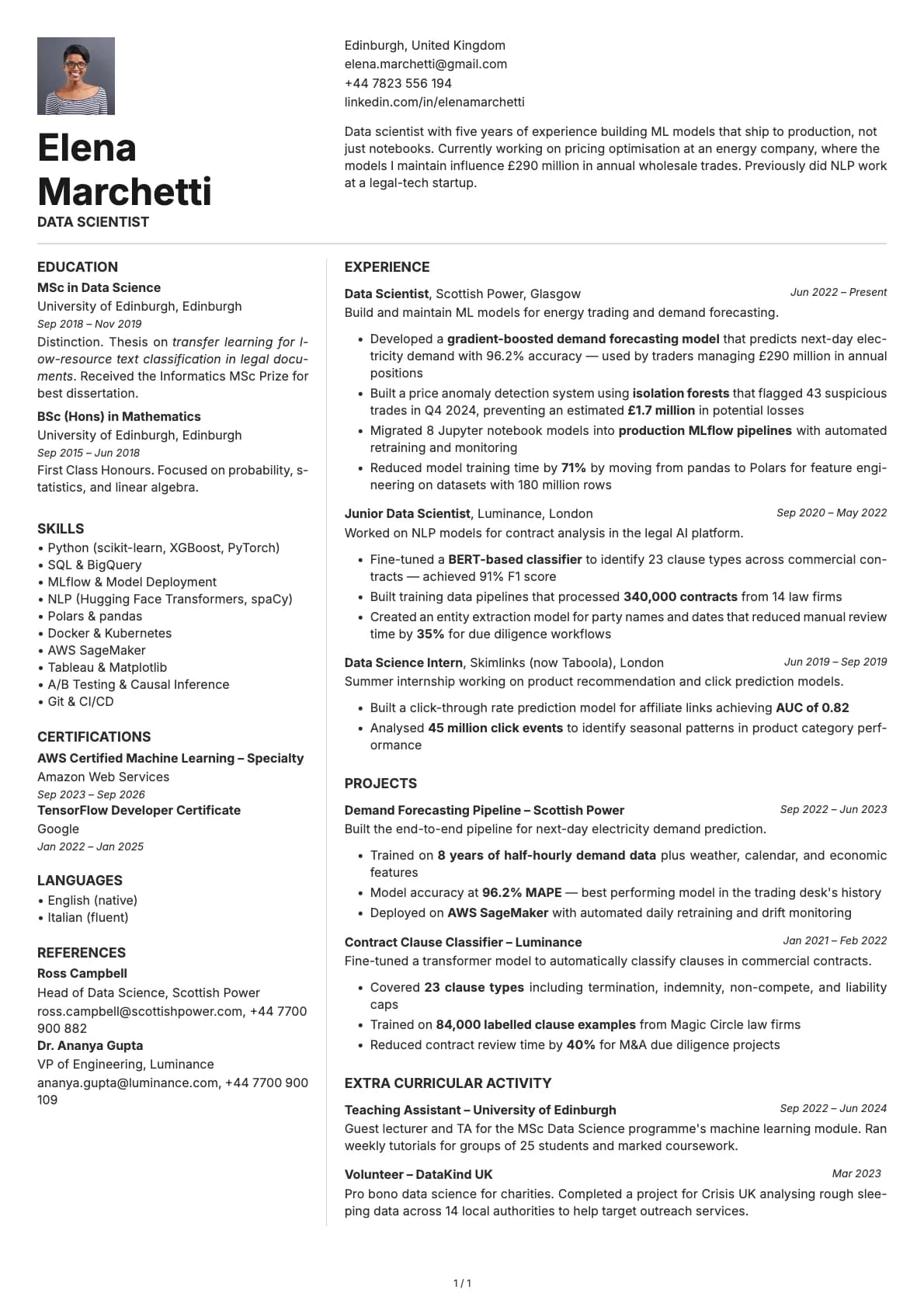
Data Scientist
A data scientist resume example with ML production experience at Scottish Power and NLP work at Luminance.
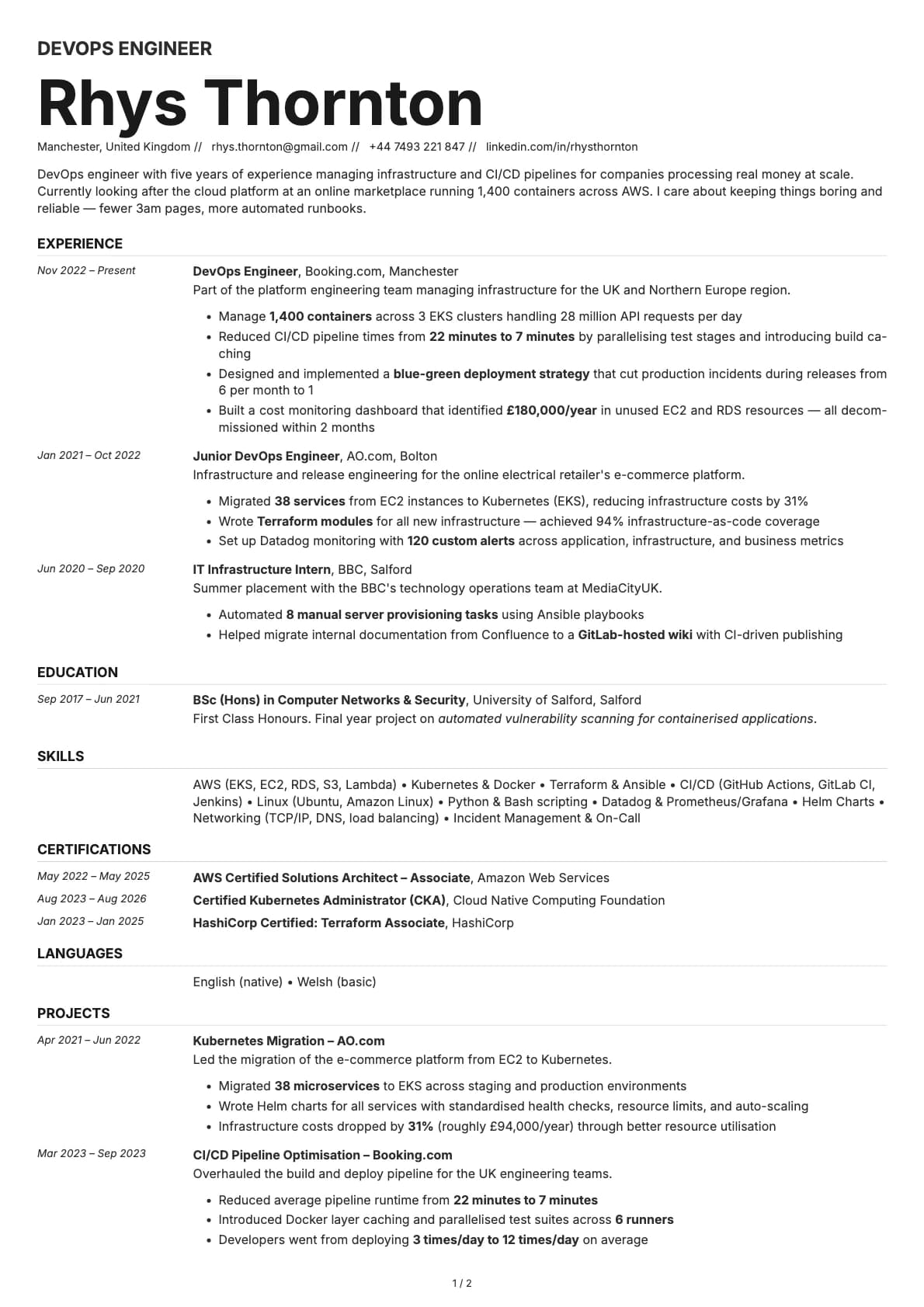
DevOps Engineer
A DevOps engineer resume example with infrastructure experience at Booking.com and AO.com.
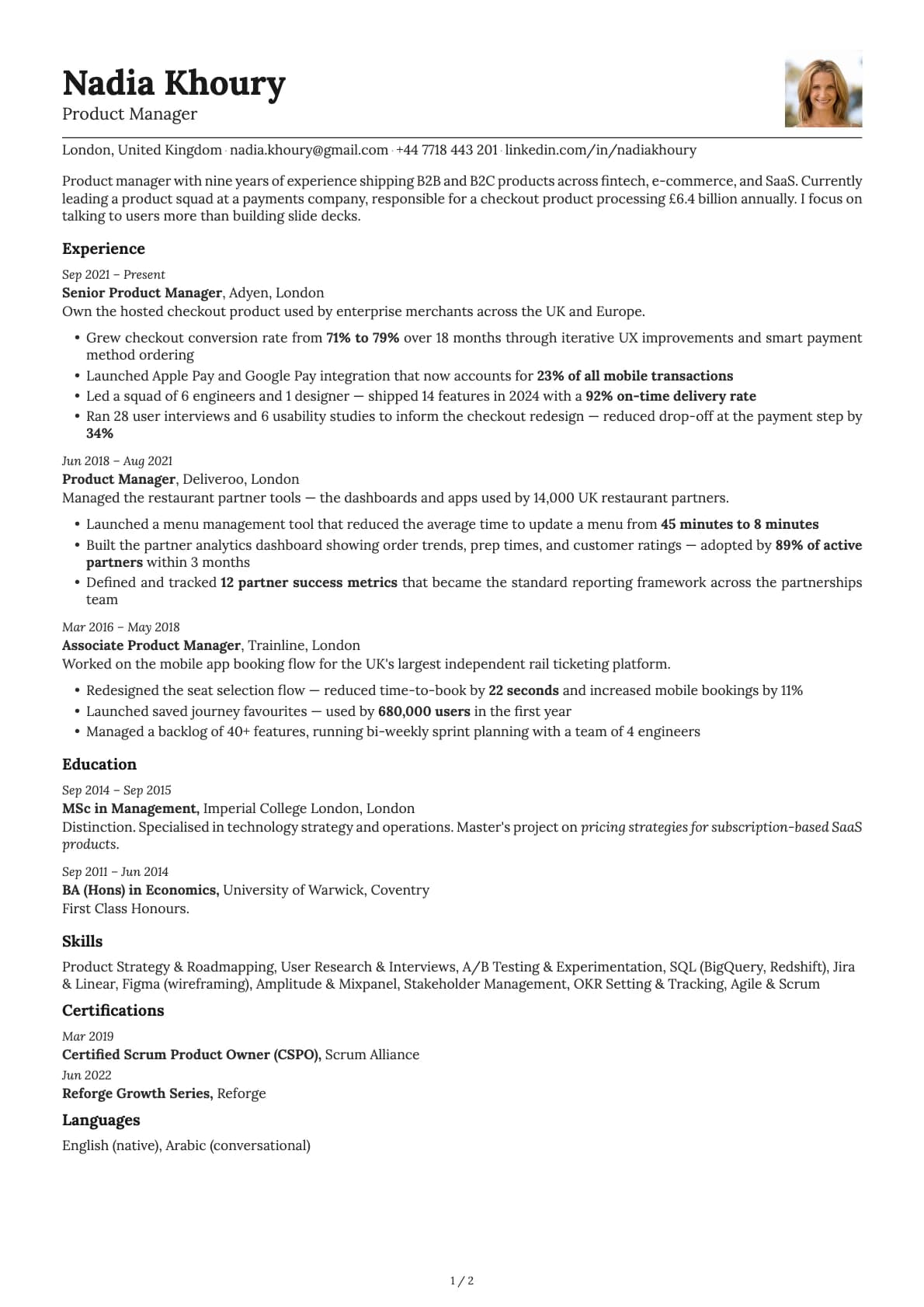
Product Manager
A product manager resume example showing how to present user research, conversion metrics, and feature launches with real business outcomes.
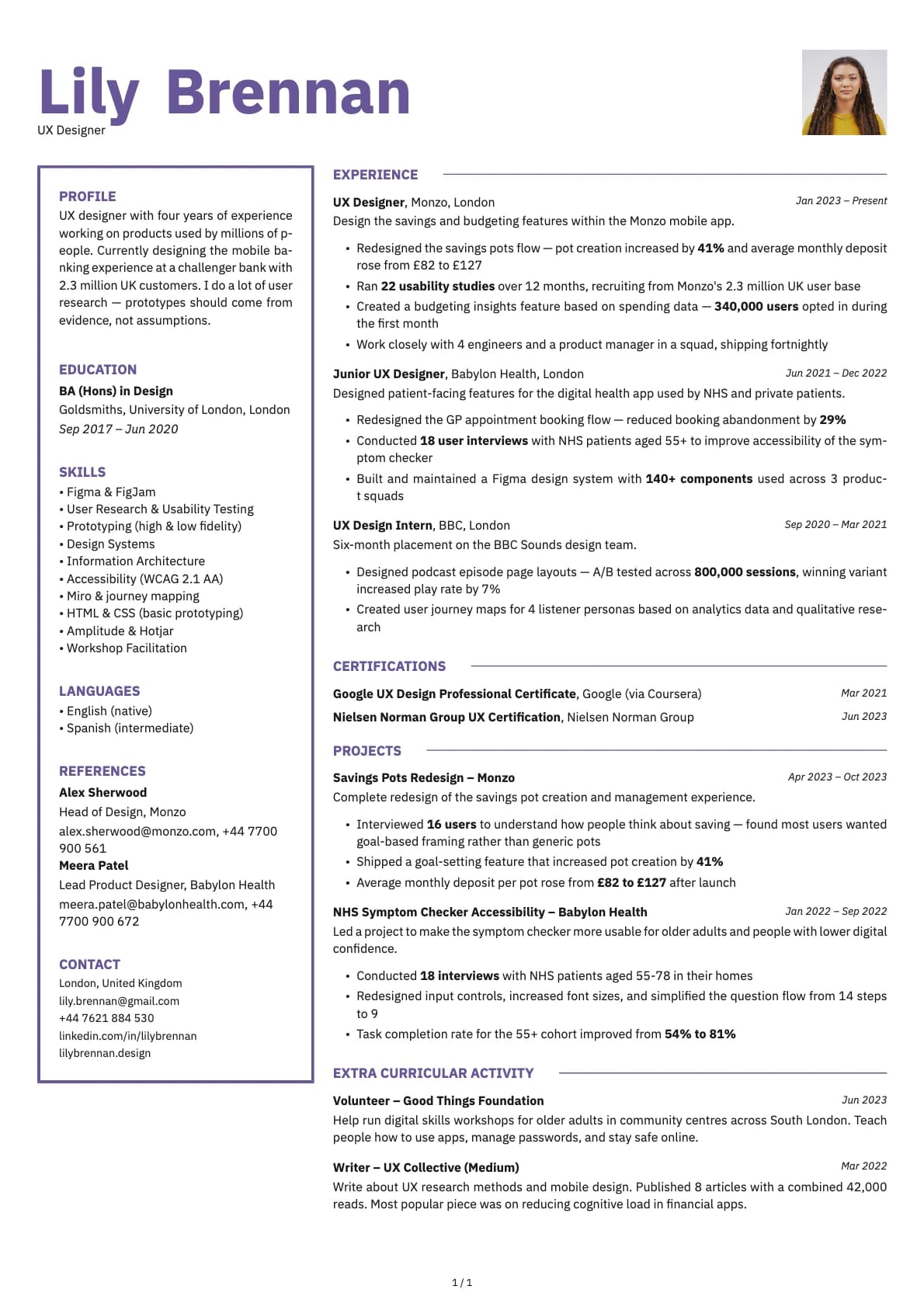
UX Designer
A UX designer resume example with 4 years of product design experience at Monzo and Babylon Health.
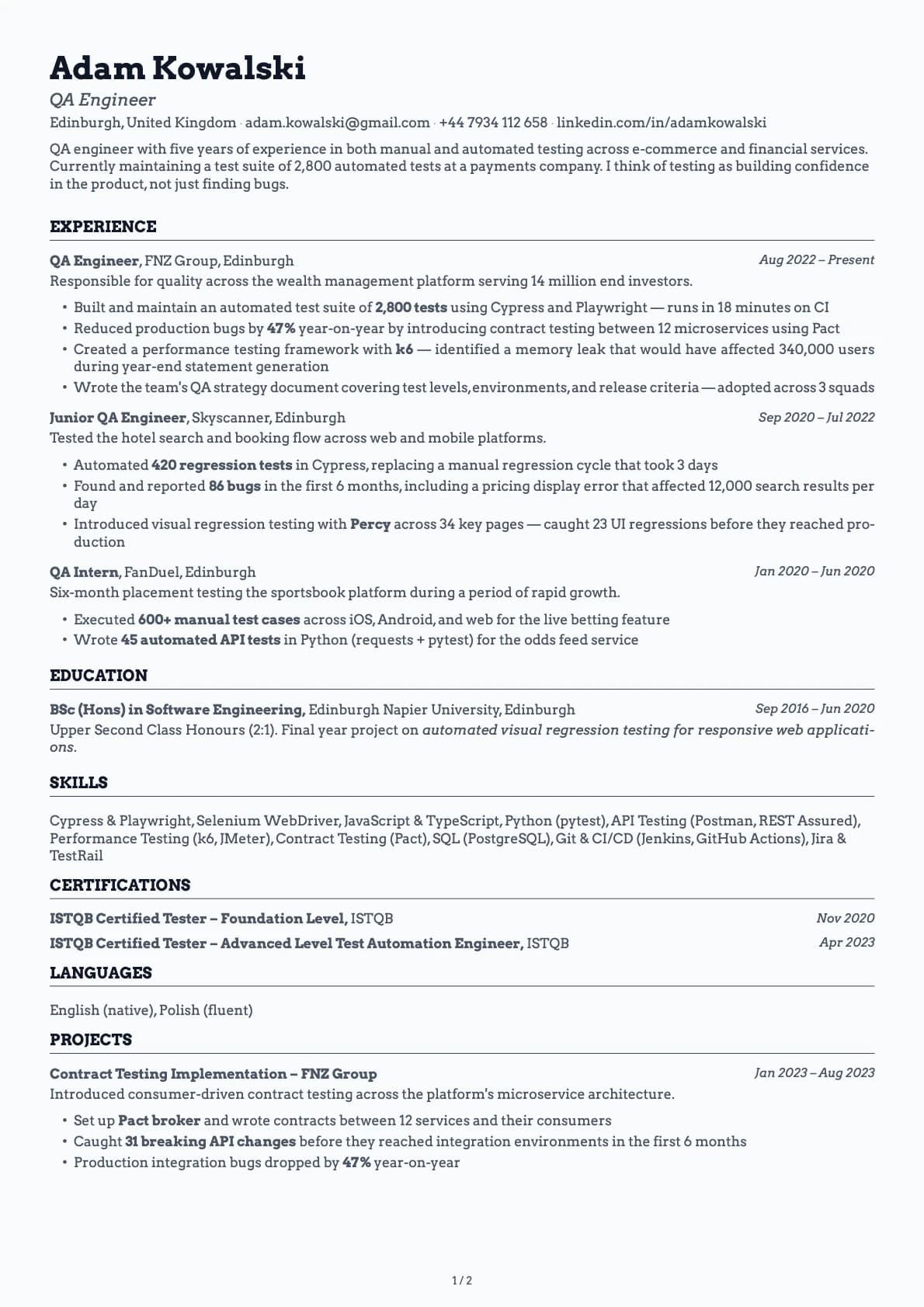
QA Engineer
A QA engineer resume example with automated test suite numbers, production bug reduction, and contract testing implementation details.
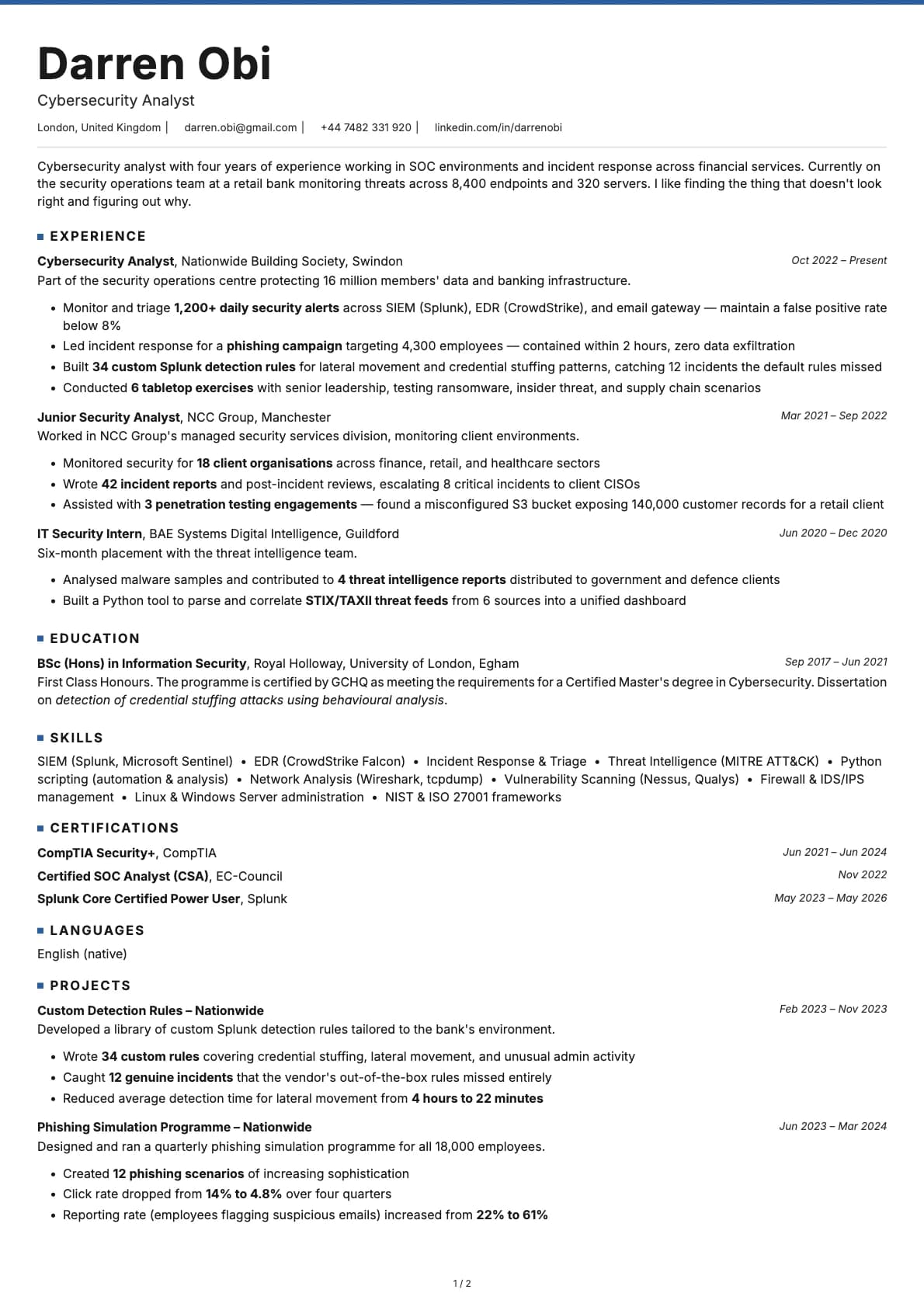
Cybersecurity Analyst
A cybersecurity analyst resume example with SOC experience at Nationwide and NCC Group.
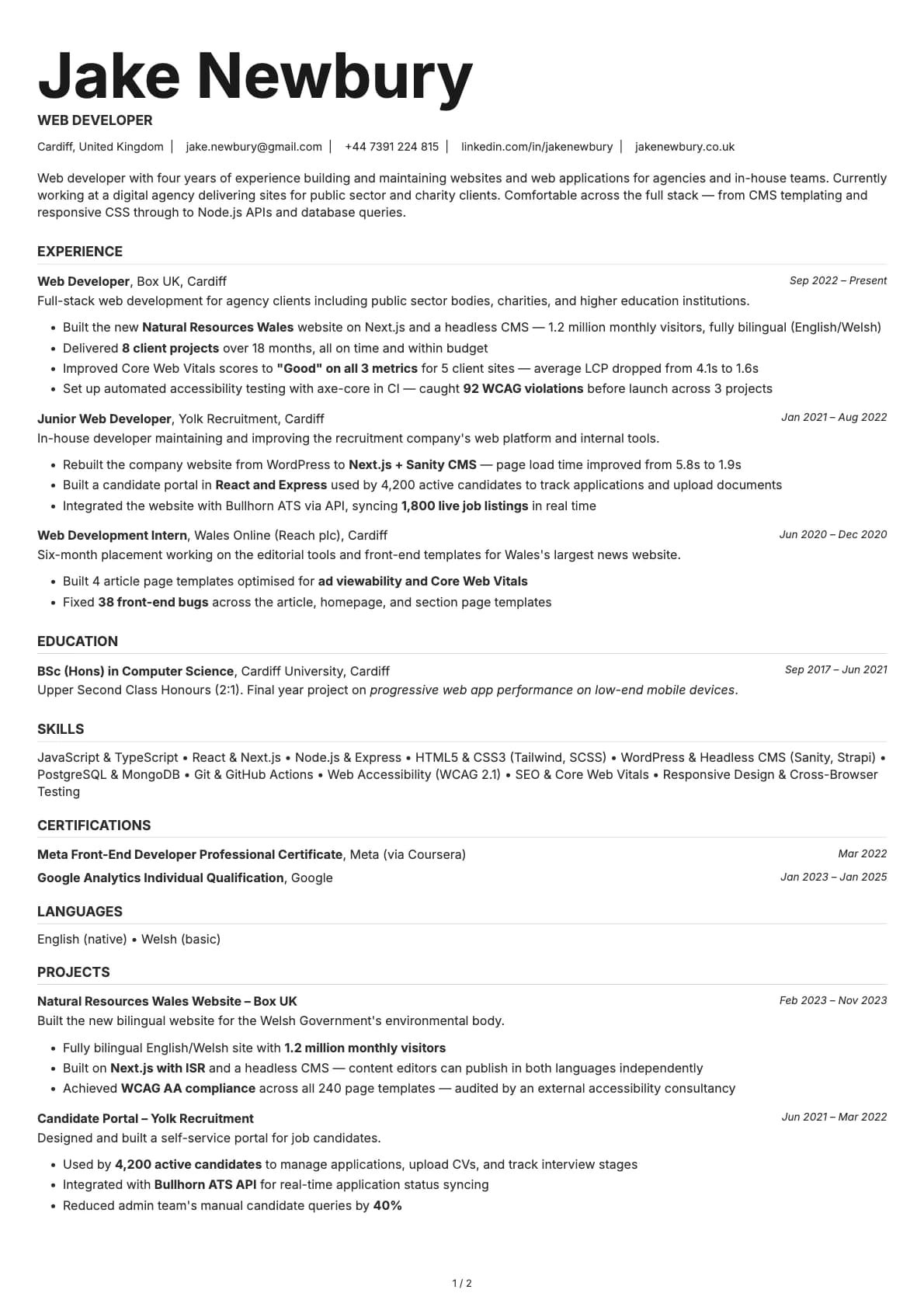
Web Developer
A web developer resume example with agency and in-house experience building Next.js sites, improving Core Web Vitals, and delivering accessible public.
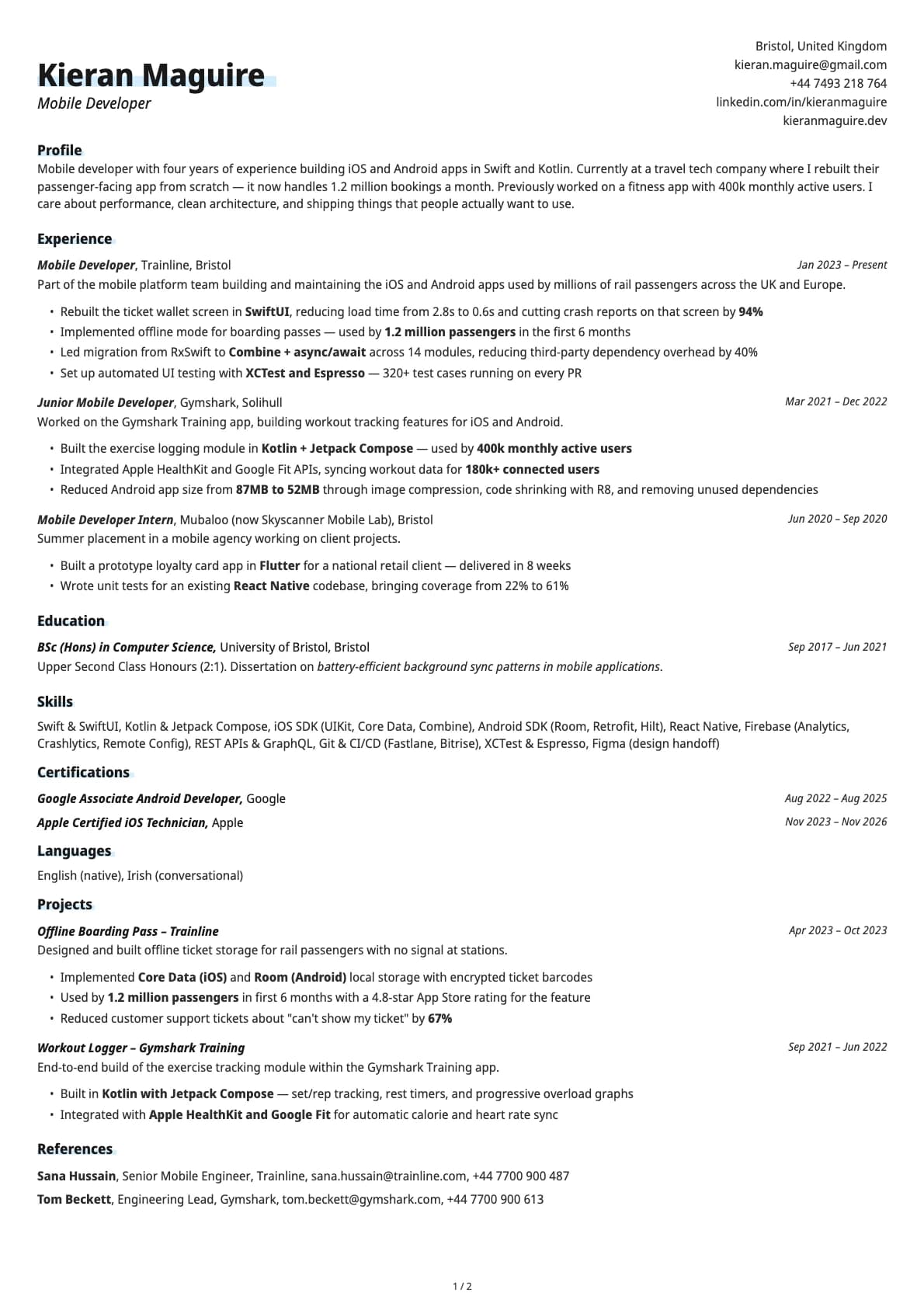
Mobile Developer
A mobile developer resume example with iOS and Android experience, performance metrics, and real app user numbers.
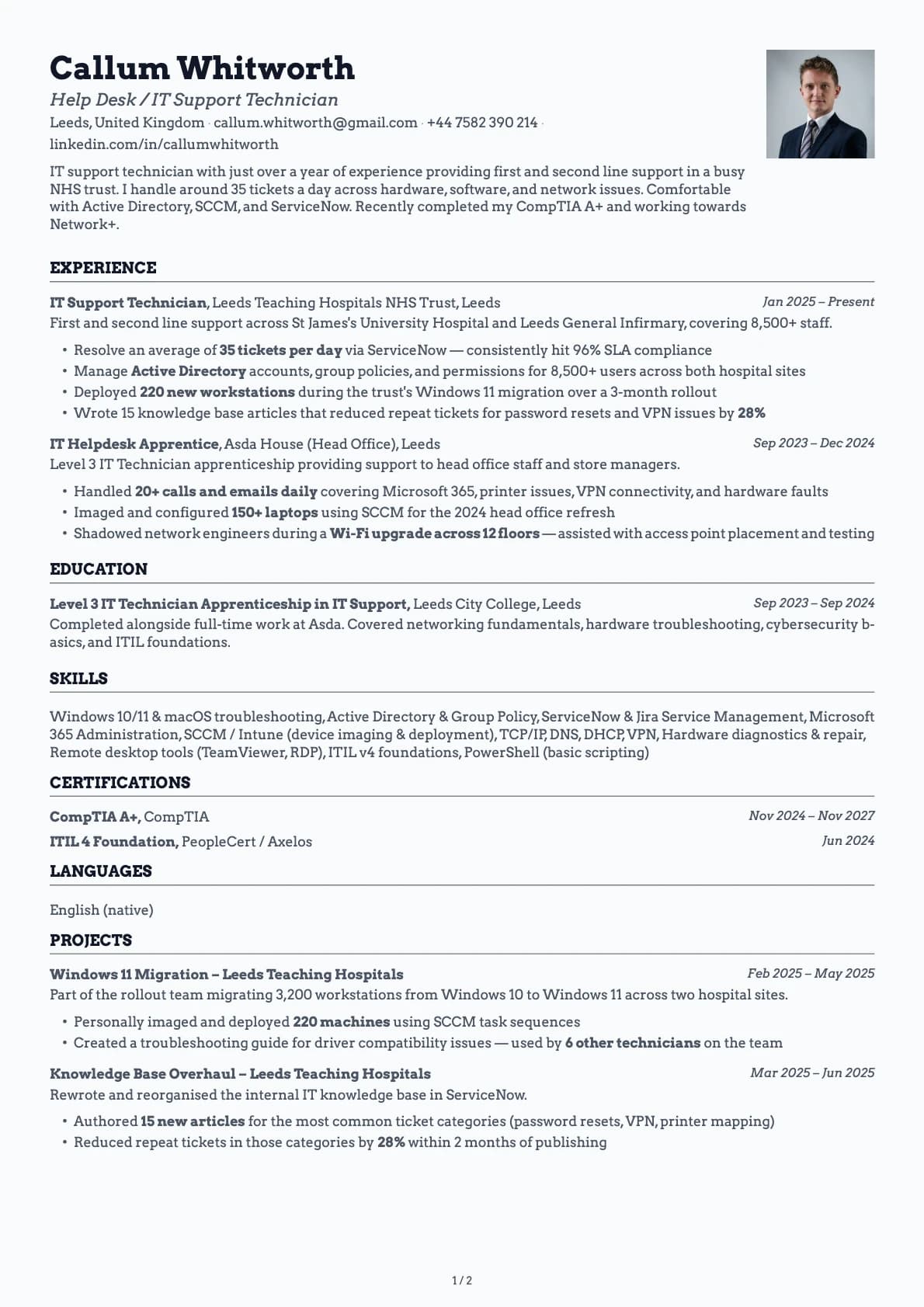
Help Desk / IT Support Technician
A help desk technician resume example with NHS IT support experience.
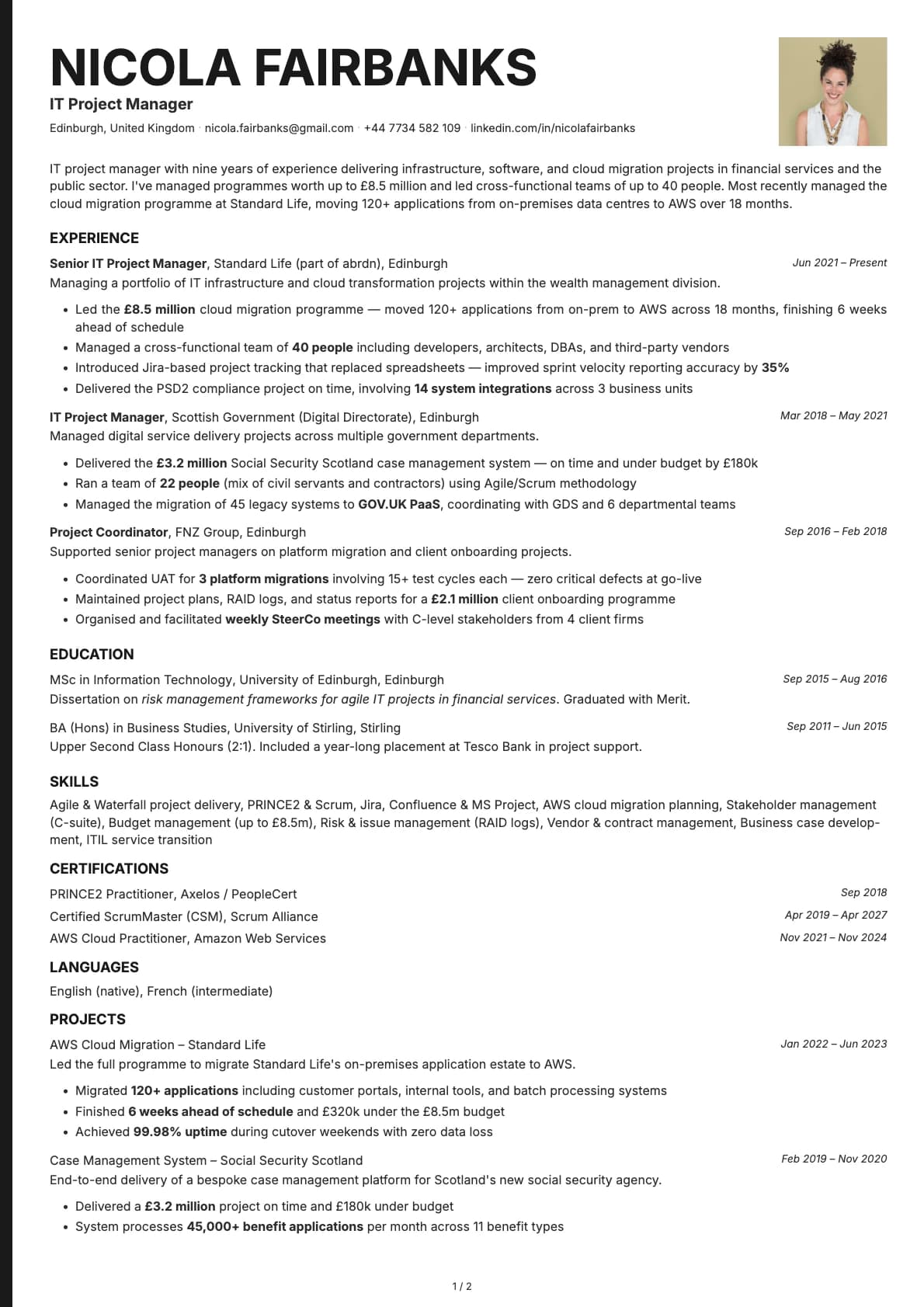
IT Project Manager
An IT project manager resume example with cloud migration, programme budgets up to £8.5 million, and PRINCE2/Scrum certifications.
Related articles

AI Is Screening Your Resume Before Any Human Sees It
AI screens most resumes before a human ever reads them. 97.4% of Fortune 500 companies run an ATS. This is what that means for you and what you can do about it.

ATS Resume Checker: How to Format a CV That Gets Past the Filters
Run the free copy and paste test to see what an ATS actually reads on your CV, then fix the tables, columns and headings that quietly get you filtered out.

The Best Resume Builders in 2026, Compared Honestly
Resume.io, Zety, Enhancv, Kickresume, Teal, and Laddro compared honestly: real pricing, free tiers, mobile apps, and where each tool wins. All prices checked in September 2026.