Learning & Development Manager Resume Example
An L&D manager resume example with programme design, LMS implementation, and training ROI metrics. See how to present eight years of L&D experience.

Laddro Team
Free to use. No account needed to start.
Free to use. No account needed to start.
Overview
L&D manager resumes have a specific problem. The work is often described in terms that sound good but prove nothing. "Developed training programmes." "Facilitated workshops." "Created learning content." These phrases tell the reader what you did but not whether it worked.
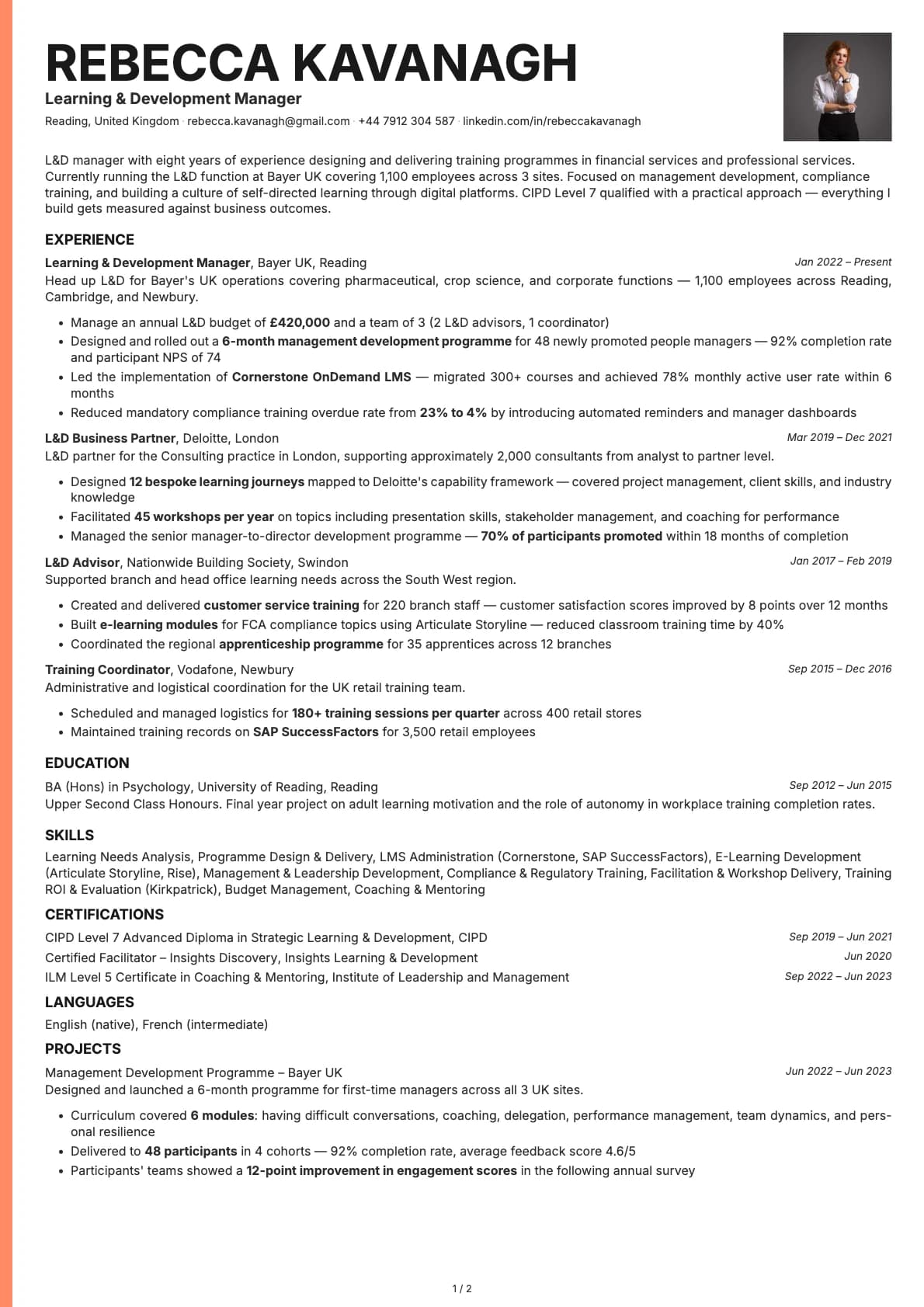
This resume belongs to Rebecca, L&D Manager at Bayer UK in Reading. She has eight years of experience across Vodafone, Nationwide Building Society, Deloitte, and now Bayer. She manages an annual L&D budget of 420,000, runs a team of 3, and her management development programme had a 92% completion rate and an NPS of 74. Before Bayer, she designed 12 learning journeys at Deloitte and built e-learning modules at Nationwide that cut classroom time by 40%.
What makes this resume work is the measurement. Every programme has a completion rate, a satisfaction score, a business outcome, or all three.
Your summary: function, scope, and measurement
L&D managers report to HR directors, and HR directors care about business impact. Your summary needs to show that you think the same way.
Rebecca's:
L&D manager with eight years of experience designing and delivering training programmes in financial services and professional services. Currently running the L&D function at Bayer UK covering 1,100 employees across 3 sites. Focused on management development, compliance training, and building a culture of self-directed learning through digital platforms. CIPD Level 7 qualified with a practical approach, everything I build gets measured against business outcomes.
She names the industries, the current company and headcount, her three focus areas, and her CIPD level. The last sentence ("everything I build gets measured against business outcomes") is a positioning statement. It tells the reader she is not the kind of L&D person who designs nice workshops and never checks whether they worked.
Your formula: Years and industries. Current company, headcount, and number of sites. 2-3 focus areas. CIPD level. One sentence about your approach to measurement.
Programme design with measurable outcomes
The biggest differentiator on an L&D resume is showing that your programmes produced results. Not just that you ran them, but that something changed because of them.
From Rebecca's current role:
"Designed and rolled out a 6-month management development programme for 48 newly promoted people managers, 92% completion rate and participant NPS of 74"
"Led the implementation of Cornerstone OnDemand LMS, migrated 300+ courses and achieved 78% monthly active user rate within 6 months"
"Reduced mandatory compliance training overdue rate from 23% to 4% by introducing automated reminders and manager dashboards"
The first bullet shows programme design with completion and satisfaction data. The second shows a technology implementation with a usage metric. The third shows a process improvement with a clear before and after number.
The pattern that works: What you designed/built + who it was for + the metric that proves it worked.
Not every programme will have dramatic ROI numbers. But you can almost always measure completion rates, satisfaction scores, or whether the problem you set out to solve actually got better.
Show your facilitation alongside your design
L&D managers often split their time between designing programmes and delivering them. Your resume should show both.
From Rebecca's time at Deloitte:
"Facilitated 45 workshops per year on topics including presentation skills, stakeholder management, and coaching for performance"
"Managed the senior manager-to-director development programme, 70% of participants promoted within 18 months of completion"
The first bullet proves she can stand in front of a room and deliver. 45 workshops a year is roughly one a week. The second shows that the programme she managed actually produced promotions. 70% of participants promoted is a strong number. If your programmes lead to promotions, internal moves, or performance improvements, say so.
LMS and e-learning: name the platforms
L&D is increasingly digital, and hiring managers want to know which platforms you have worked with. Rebecca names Cornerstone OnDemand, SAP SuccessFactors, and Articulate Storyline. She does not just list them. She shows what she did with them.
The Cornerstone LMS migration is a full project in her resume: 300+ courses migrated, learning pathways rebuilt for 14 job families, 78% monthly active user rate. The Articulate Storyline work at Nationwide reduced classroom training time by 40%.
If you have implemented an LMS, migrated content, or built e-learning modules, include the numbers. How many courses? How many users? What was the adoption rate? These are the metrics that prove an LMS implementation was successful, not just completed.
Earlier roles: show the progression
Rebecca started as a Training Coordinator at Vodafone, scheduling 180+ training sessions per quarter for 3,500 retail employees. Then she was an L&D Advisor at Nationwide, creating customer service training and building e-learning content. Then L&D Business Partner at Deloitte, designing learning journeys for 2,000 consultants. Now L&D Manager at Bayer, running the whole function.
Each role is a step up. The Vodafone role was logistics. Nationwide was content creation. Deloitte was strategic partnership. Bayer is leadership. The resume makes this progression visible through the scope and complexity of each role.
If your career path follows a similar arc, make sure each entry shows the increase in responsibility. Bigger audiences, more strategic work, larger budgets.
Certifications that matter in L&D
Rebecca holds three: CIPD Level 7 Advanced Diploma in Strategic Learning & Development, Certified Facilitator for Insights Discovery, and ILM Level 5 Certificate in Coaching & Mentoring.
CIPD Level 7 is the standard for L&D managers and senior L&D roles in the UK. The Insights Discovery certification shows she can deliver psychometric-based workshops, which is a specific and valued skill. The ILM coaching certificate adds another dimension, showing she can coach managers one-to-one as well as design group programmes.
If you facilitate specific psychometric or behavioural tools (Insights, MBTI, Hogan, Strengths Profile), include the certification. These are specific capabilities that many L&D roles require and not everyone has.
Mistakes L&D managers make on their resumes
No measurement at all. If your resume says "designed and delivered training programmes" without a single number, the reader has no idea whether those programmes were good. Completion rates, NPS scores, engagement data, promotion rates, performance improvements. Pick something.
Listing every workshop topic. You do not need to list 15 workshop titles. Group them by theme or pick the 3-4 most relevant to the role you are applying for. "Facilitated 45 workshops per year on topics including presentation skills, stakeholder management, and coaching" is more effective than a full catalogue.
Ignoring the business context. L&D does not exist in a vacuum. Rebecca's compliance training reduction from 23% to 4% matters because overdue compliance training is a business risk. Her management programme matters because participants' teams showed a 12-point engagement improvement. Always connect the training to a business outcome.
Not mentioning budget. If you manage an L&D budget, include the figure. "Manage an annual L&D budget of 420,000" tells the reader you can be trusted with money and that you make spending decisions, not just training decisions.
One more thing
L&D is shifting from classroom training to blended and digital learning. If your resume only talks about workshops you facilitated in person, it looks outdated. Show that you work across formats: e-learning, LMS platforms, virtual delivery, coaching, and self-directed learning. Rebecca's resume covers all of these. That range signals someone who can build a modern L&D function, not just run training days.
Build your own version
Open this layout in the builder and swap in your own details. It takes a few minutes.
Free to use. No account needed to start.
Was this resume example helpful?
Rate this example to help us create better content for you.
4.7 average from 91 ratingsRelated resume examples
HR Manager
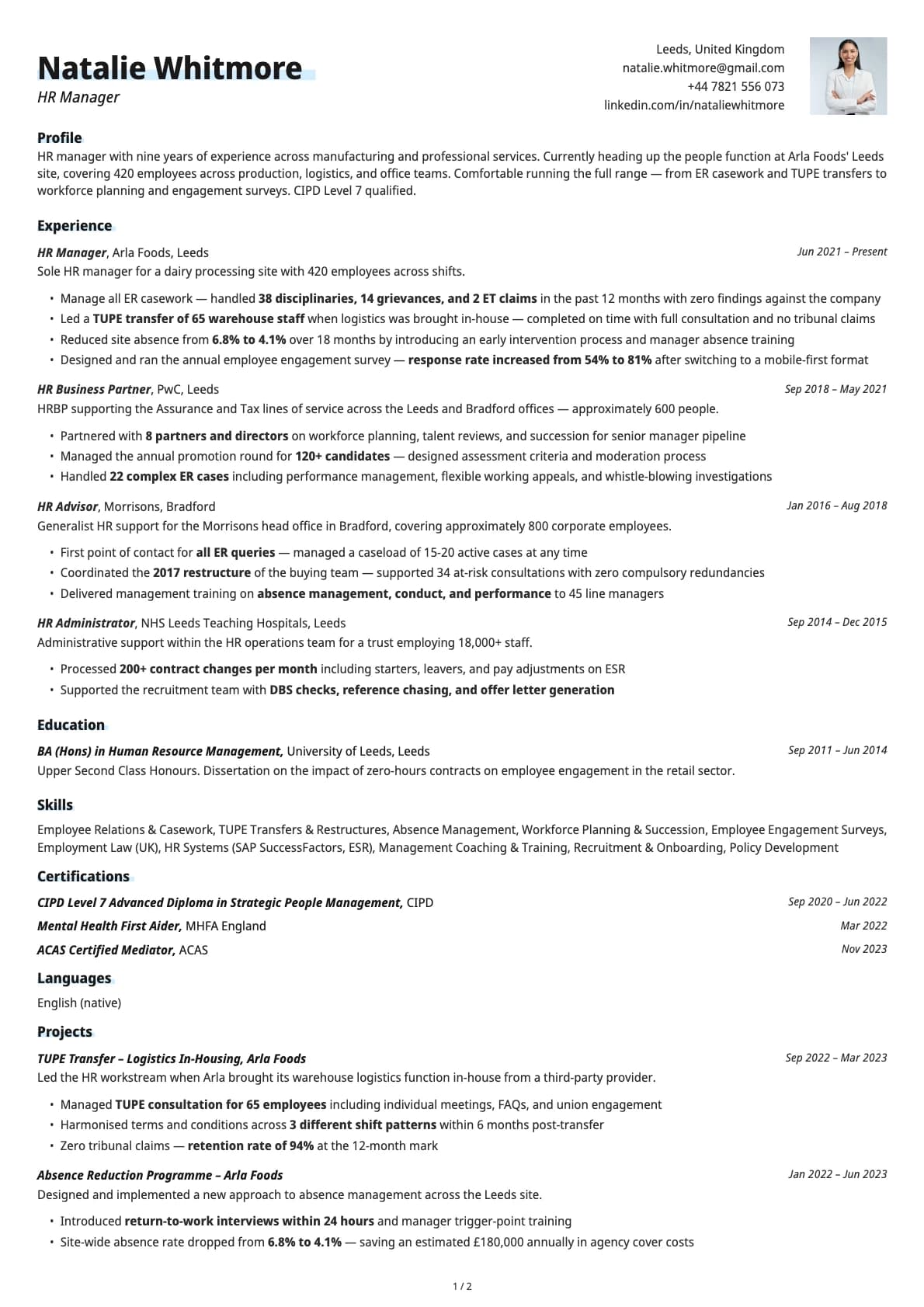
An HR manager resume example with ER casework numbers, TUPE experience, and absence reduction results.
Recruiter
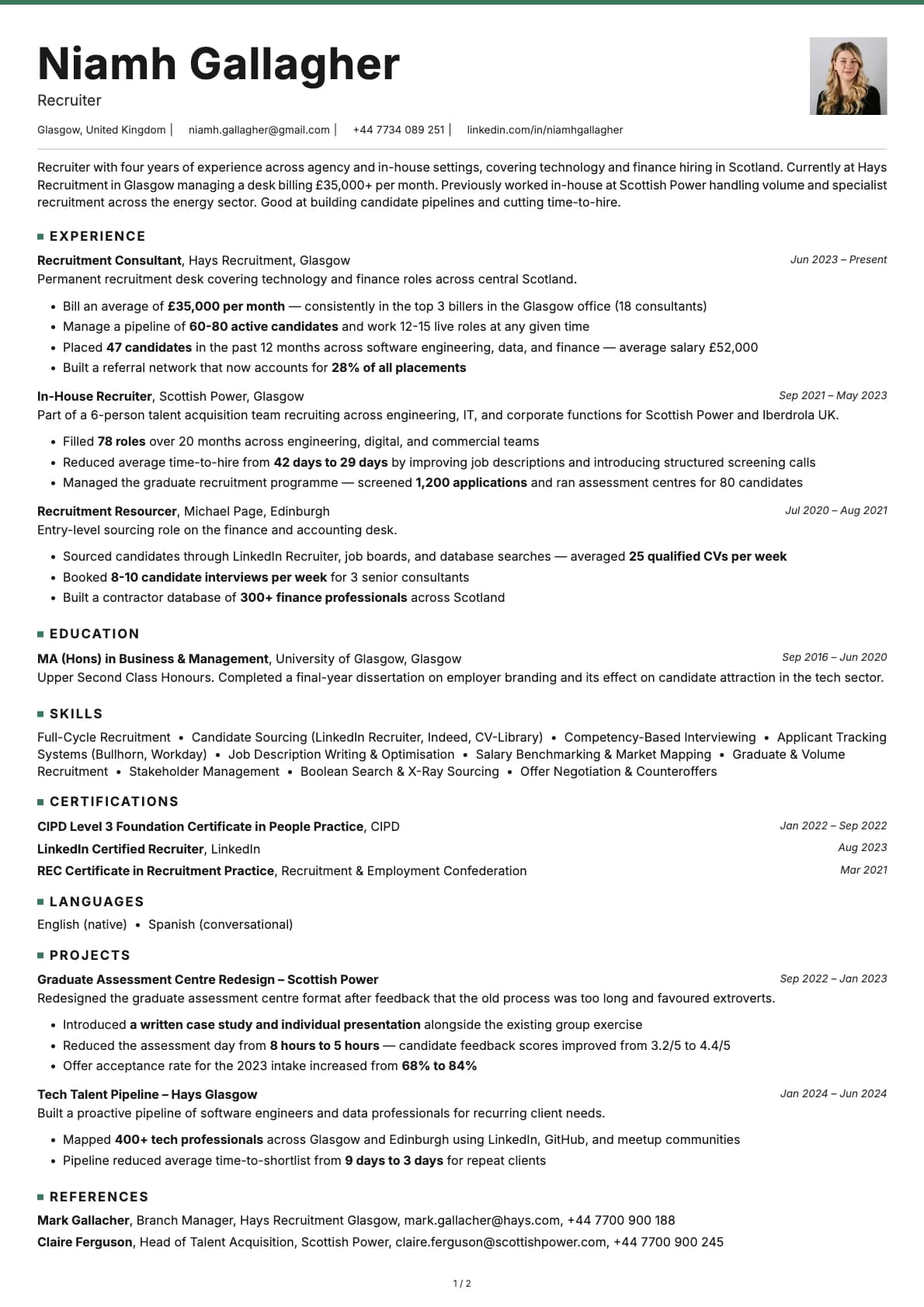
A recruiter resume example with agency and in-house experience, billing numbers, and candidate pipeline metrics.
HR Director
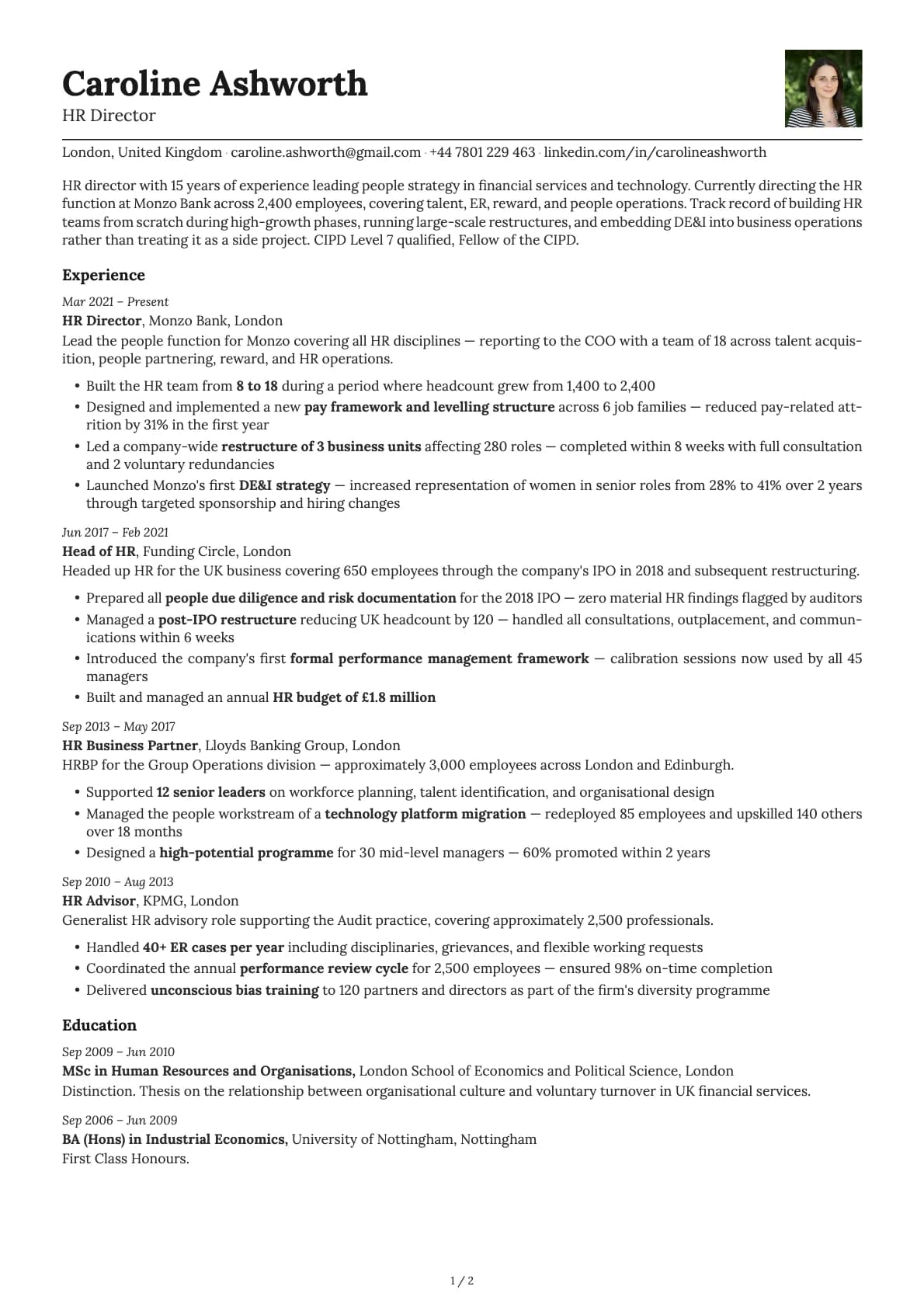
An HR director resume example with 15 years in financial services and tech. See how to present people strategy, restructures, and DE&I outcomes.
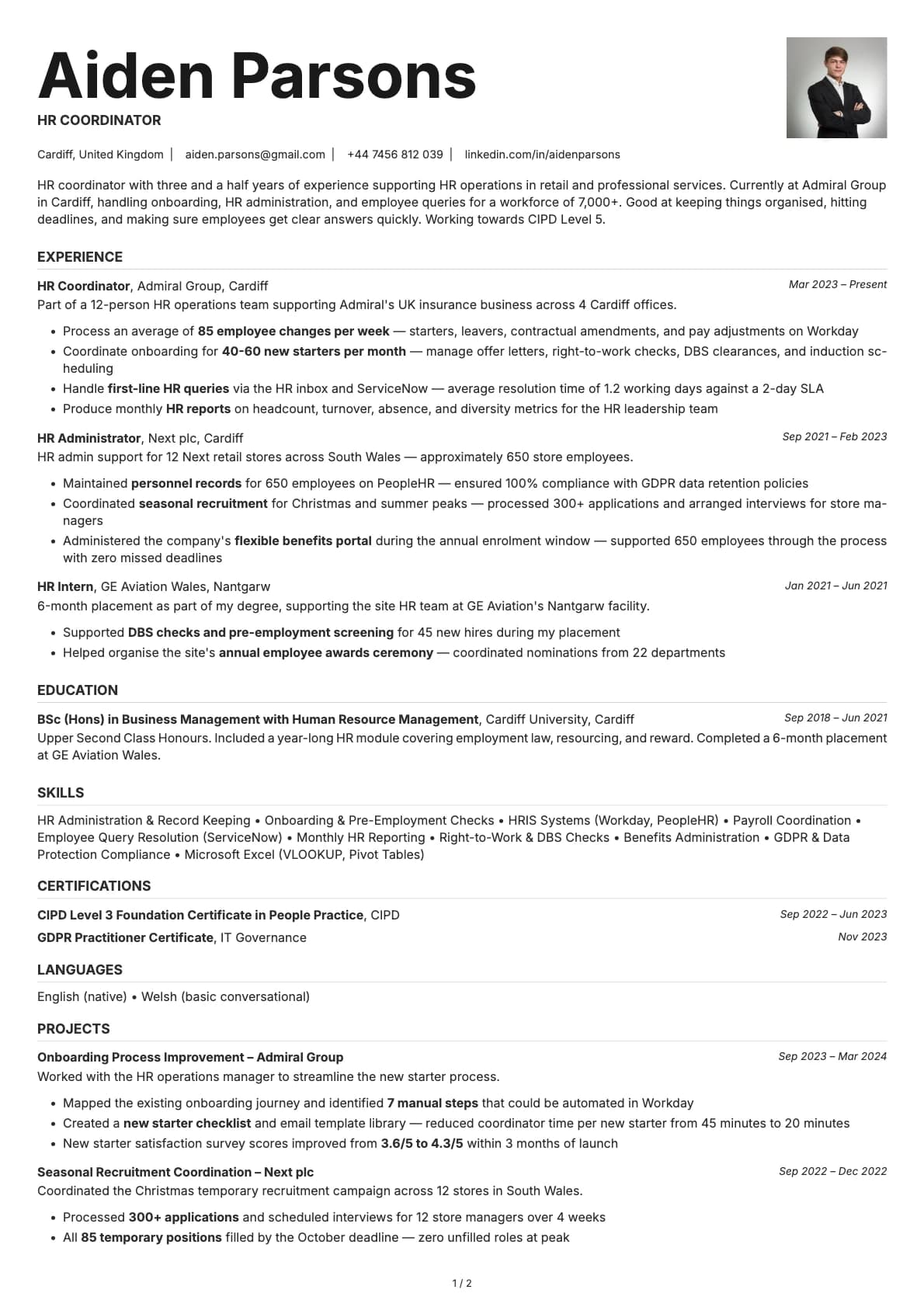
HR Coordinator
An HR coordinator resume example with onboarding metrics, HRIS experience, and HR reporting.
Related articles

AI Is Screening Your Resume Before Any Human Sees It
AI screens most resumes before a human ever reads them. 97.4% of Fortune 500 companies run an ATS. This is what that means for you and what you can do about it.

The Best Resume Builders in 2026, Compared Honestly
Resume.io, Zety, Enhancv, Kickresume, Teal, and Laddro compared honestly: real pricing, free tiers, mobile apps, and where each tool wins. All prices checked in September 2026.

Burnout Recovery: A Real Timeline, Not 'Take a Bubble Bath'
55% of the U.S. workforce is burned out. Recovery takes 3 to 12 months. Here's what that actually looks like, stage by stage.