HR Manager Resume Example
An HR manager resume example with ER casework numbers, TUPE experience, and absence reduction results.

Laddro Team
Free to use. No account needed to start.
Free to use. No account needed to start.
Overview
HR manager resumes tend to fall into one of two traps. Either they read like a policy document ("responsible for all HR activities across the site") or they focus entirely on soft skills ("strong communicator with a talent for building relationships"). Neither tells the hiring manager what you actually did or what happened because of it.
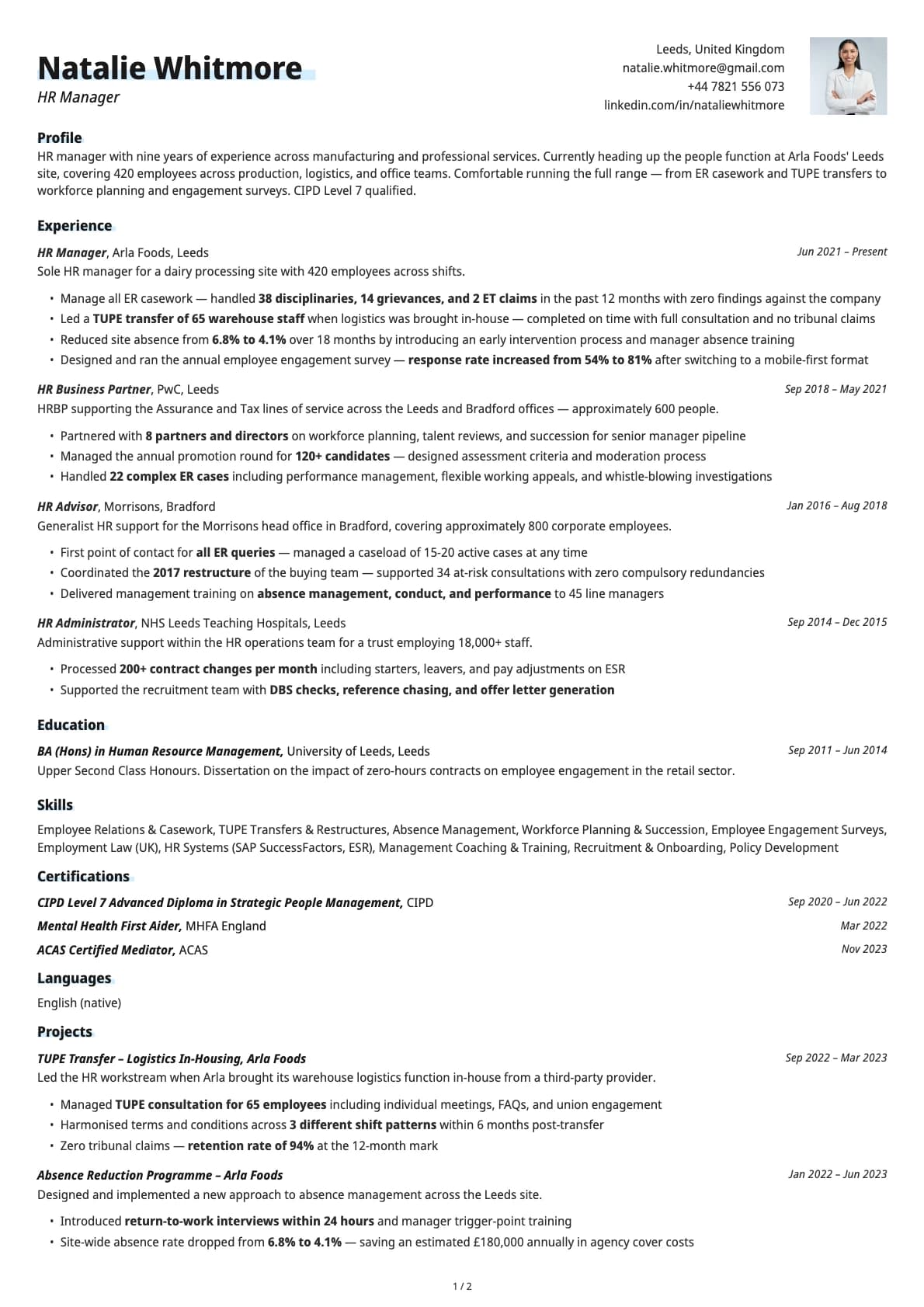
This resume belongs to Natalie, HR Manager at Arla Foods in Leeds. She has nine years of experience, starting as an HR administrator at NHS Leeds, moving through an advisor role at Morrisons, an HRBP position at PwC, and now managing the entire HR function for a 420-employee manufacturing site. What makes this resume work is the specifics: ER casework numbers, TUPE transfer details, absence reduction percentages, and engagement survey results.
Your summary should show range and seniority
An HR manager does everything. ER, recruitment, workforce planning, engagement, policy. Your summary needs to reflect that range without turning into a laundry list.
Natalie's:
HR manager with nine years of experience across manufacturing and professional services. Currently heading up the people function at Arla Foods' Leeds site, covering 420 employees across production, logistics, and office teams. Comfortable running the full range, from ER casework and TUPE transfers to workforce planning and engagement surveys. CIPD Level 7 qualified.
She names the industries, the current site and headcount, the breadth of her work, and her qualification. The phrase "the full range" signals generalist capability, which is exactly what most HR manager roles need.
Your formula: Years of experience and industries. Current company, headcount, and team types. What you cover. CIPD level.
ER casework needs numbers, not descriptions
Employee relations is usually the biggest part of an HR manager's job. But most resumes just say "managed employee relations." That could mean anything from one grievance a year to fifty disciplinaries.
Natalie's approach:
"Manage all ER casework, handled 38 disciplinaries, 14 grievances, and 2 ET claims in the past 12 months with zero findings against the company"
One bullet. Three types of case. Specific numbers. And the outcome (zero findings). A hiring manager reading this knows exactly what kind of caseload to expect. They can compare it against their own site and decide if Natalie has the right experience.
If you handle ER, count your cases. Break them down by type. And always mention the outcomes, especially if they went in the company's favour. "Zero findings" or "zero tribunal claims" is a powerful line on any HR resume.
TUPE and restructures deserve their own spotlight
If you have managed a TUPE transfer or a restructure, give it proper detail. These are high-stakes, high-skill projects that not every HR manager has done. They are a differentiator.
From Natalie's resume:
"Led a TUPE transfer of 65 warehouse staff when logistics was brought in-house, completed on time with full consultation and no tribunal claims"
And from her project section, more detail: consultation for 65 employees, harmonised terms across 3 shift patterns, 94% retention at the 12-month mark.
This is the kind of bullet that gets you shortlisted. TUPE is complex. Getting it done with zero claims and 94% retention shows someone who knows employment law and can manage people through change.
Absence management with real results
Every HR job ad mentions absence management. But very few resumes show actual results. Natalie's does:
"Reduced site absence from 6.8% to 4.1% over 18 months by introducing an early intervention process and manager absence training"
The project section adds more detail: return-to-work interviews within 24 hours, trigger-point training for managers, and an estimated annual saving of 180,000 in agency cover costs.
Notice the structure: a clear before and after number (6.8% to 4.1%), what she did to achieve it (early intervention, training), and a business outcome (cost savings). This is the format that works for any process improvement.
Showing progression from admin to manager
Natalie's career goes from HR administrator at NHS Leeds to HR advisor at Morrisons to HRBP at PwC to HR manager at Arla. That is a textbook HR career path. And the resume makes each step visible.
The NHS role focused on volume: 200+ contract changes per month, DBS checks, offer letters. The Morrisons role introduced ER casework and a restructure. The PwC role added workforce planning, promotions, and complex casework. And the Arla role brings it all together with full site responsibility.
If your career has followed a similar path, make sure each role shows a step up. More responsibility, bigger decisions, larger teams. The reader should see clear growth from one role to the next.
Certifications for HR managers
Natalie holds three certifications: CIPD Level 7 Advanced Diploma, Mental Health First Aider, and ACAS Certified Mediator. The CIPD Level 7 is expected at manager level. The MHFA is increasingly common and shows awareness of workplace wellbeing. The ACAS mediator certification is less common and stands out because mediation is a specific, practical skill that directly applies to ER work.
If you are an HR manager without CIPD Level 7, it is worth starting. For most senior HR roles, Level 5 is the minimum and Level 7 is preferred. And if you have any specialist certifications (mediation, coaching, employment law), list them. They add depth to a generalist profile.
Common mistakes on HR manager resumes
Being too generic. "Managed all aspects of HR" tells the reader nothing. Replace it with specific functions and numbers. Which aspects? How many employees? What were the results?
No engagement data. If you run engagement surveys, include the numbers. Natalie's response rate went from 54% to 81%. That is a result worth showing. Even if your engagement scores are not perfect, showing improvement proves you are doing something about it.
Forgetting to mention the workforce size. Hiring managers need to know scale. Managing HR for 50 people is a different job from managing HR for 500. Put the headcount in your summary and in your experience bullets.
Not showing the business case. HR managers need to demonstrate commercial thinking. The absence reduction saved 180,000 in agency costs. The TUPE transfer avoided tribunal claims. Frame your achievements in terms the business cares about: money saved, risk avoided, time reduced.
One more thing
If you are moving from professional services (like PwC or Deloitte) into industry, or vice versa, address it in how you describe your experience. Professional services HR is partner-led, matrix-structured, and very process-driven. Manufacturing HR is site-based, unionised (sometimes), and much more hands-on. Showing that you can work in both environments is a strong signal.
Build your own version
Open this layout in the builder and swap in your own details. It takes a few minutes.
Free to use. No account needed to start.
Was this resume example helpful?
Rate this example to help us create better content for you.
4.8 average from 167 ratingsRelated resume examples
Recruiter
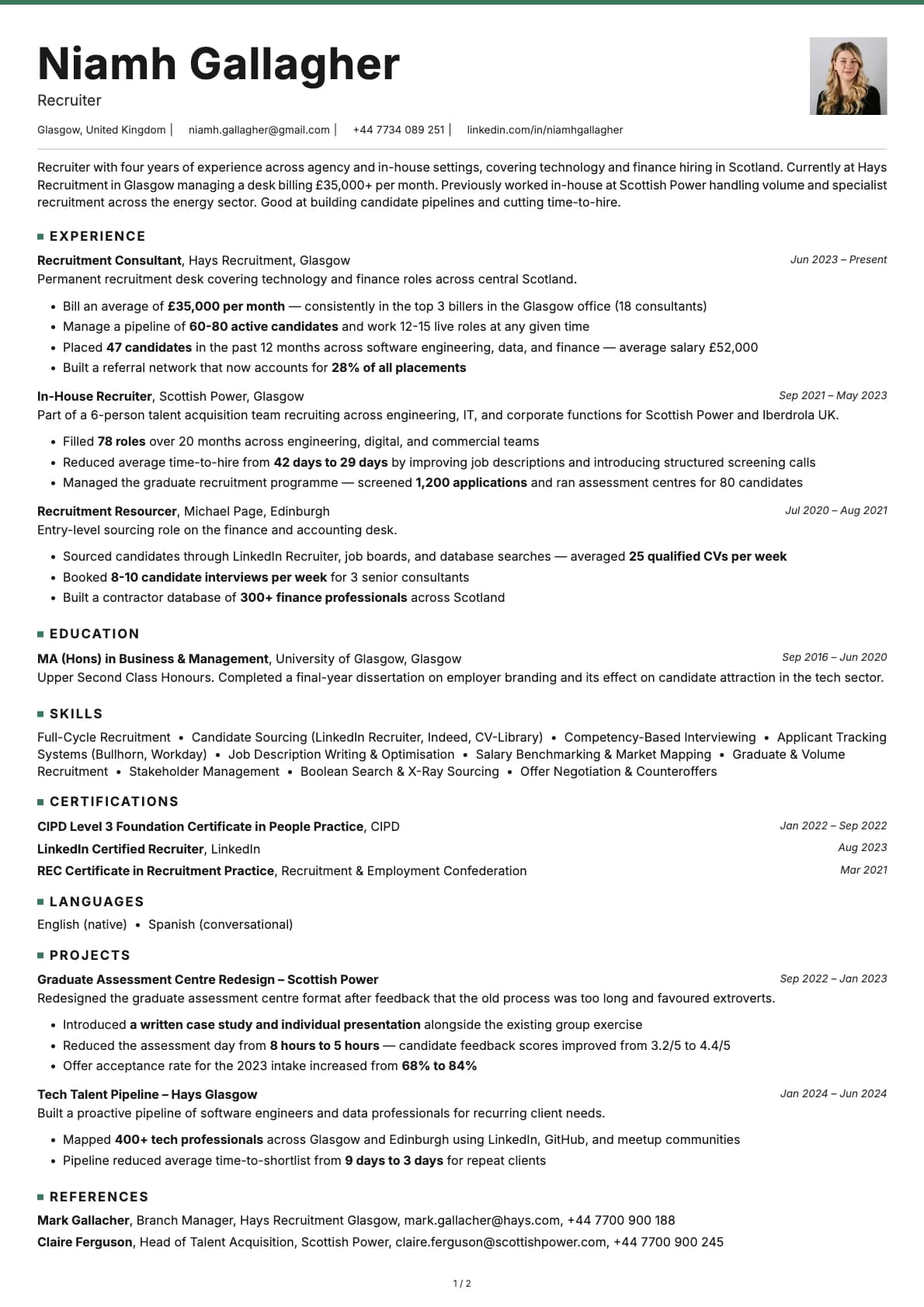
A recruiter resume example with agency and in-house experience, billing numbers, and candidate pipeline metrics.
Learning & Development Manager
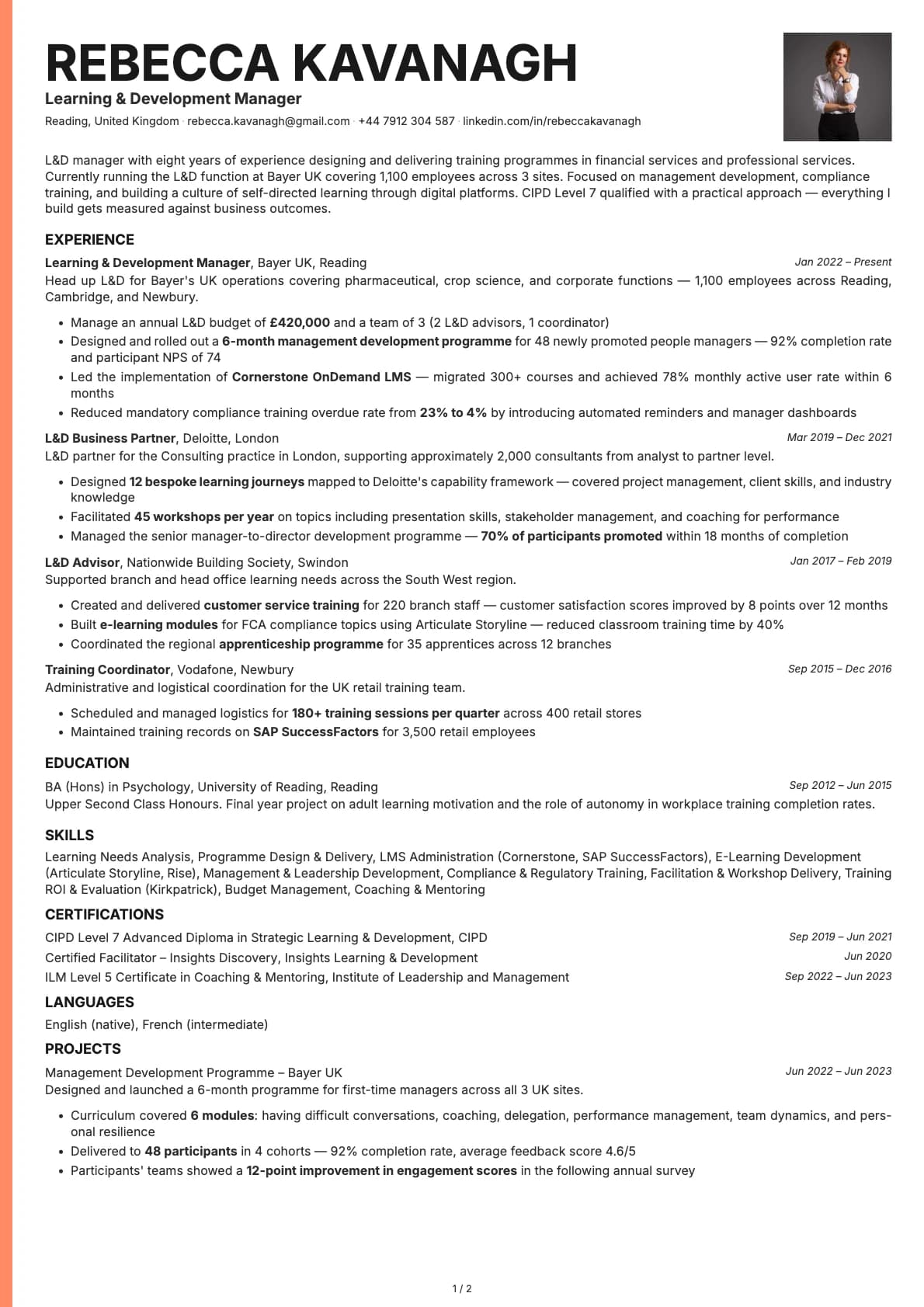
An L&D manager resume example with programme design, LMS implementation, and training ROI metrics. See how to present eight years of L&D experience.
HR Director
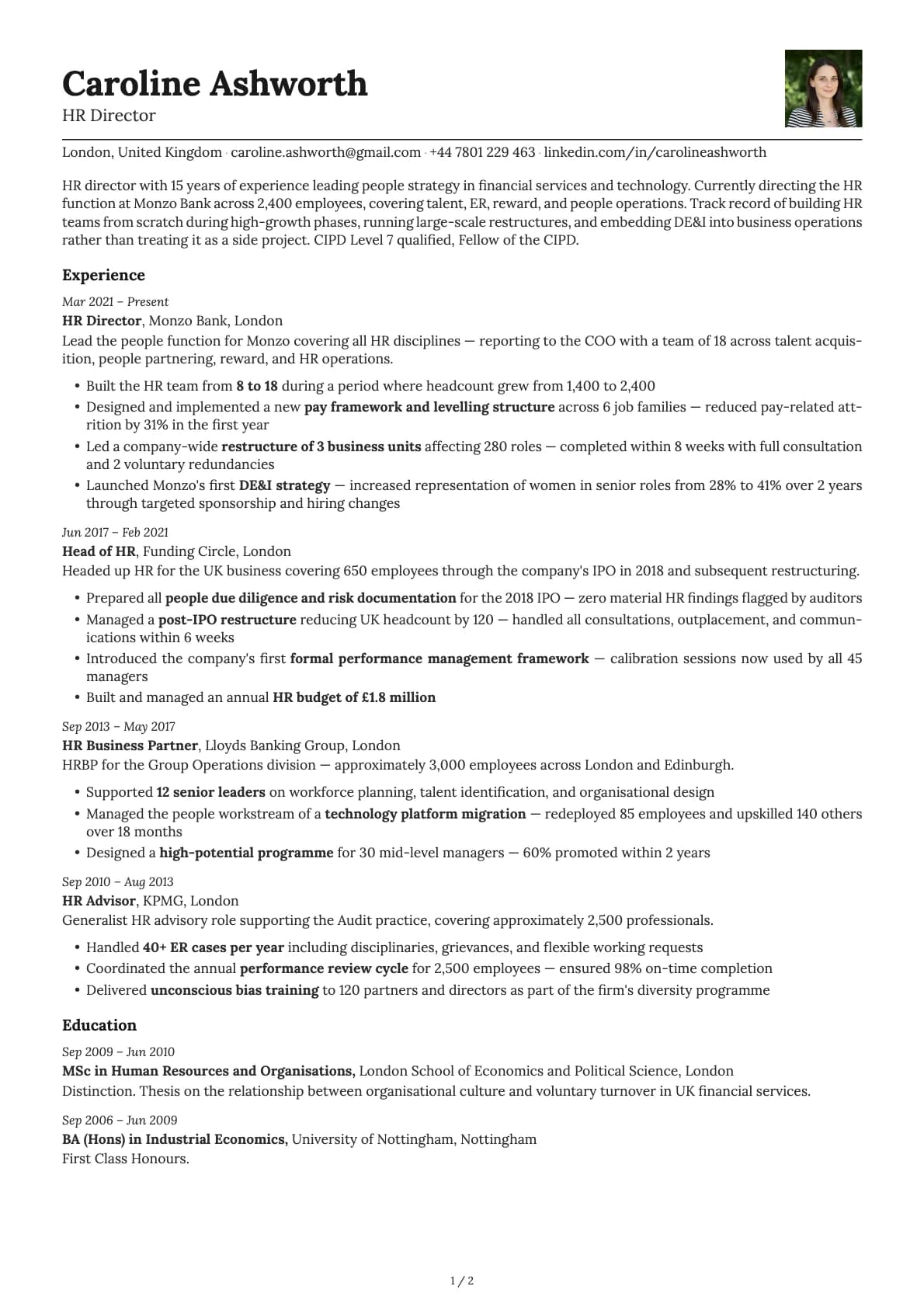
An HR director resume example with 15 years in financial services and tech. See how to present people strategy, restructures, and DE&I outcomes.
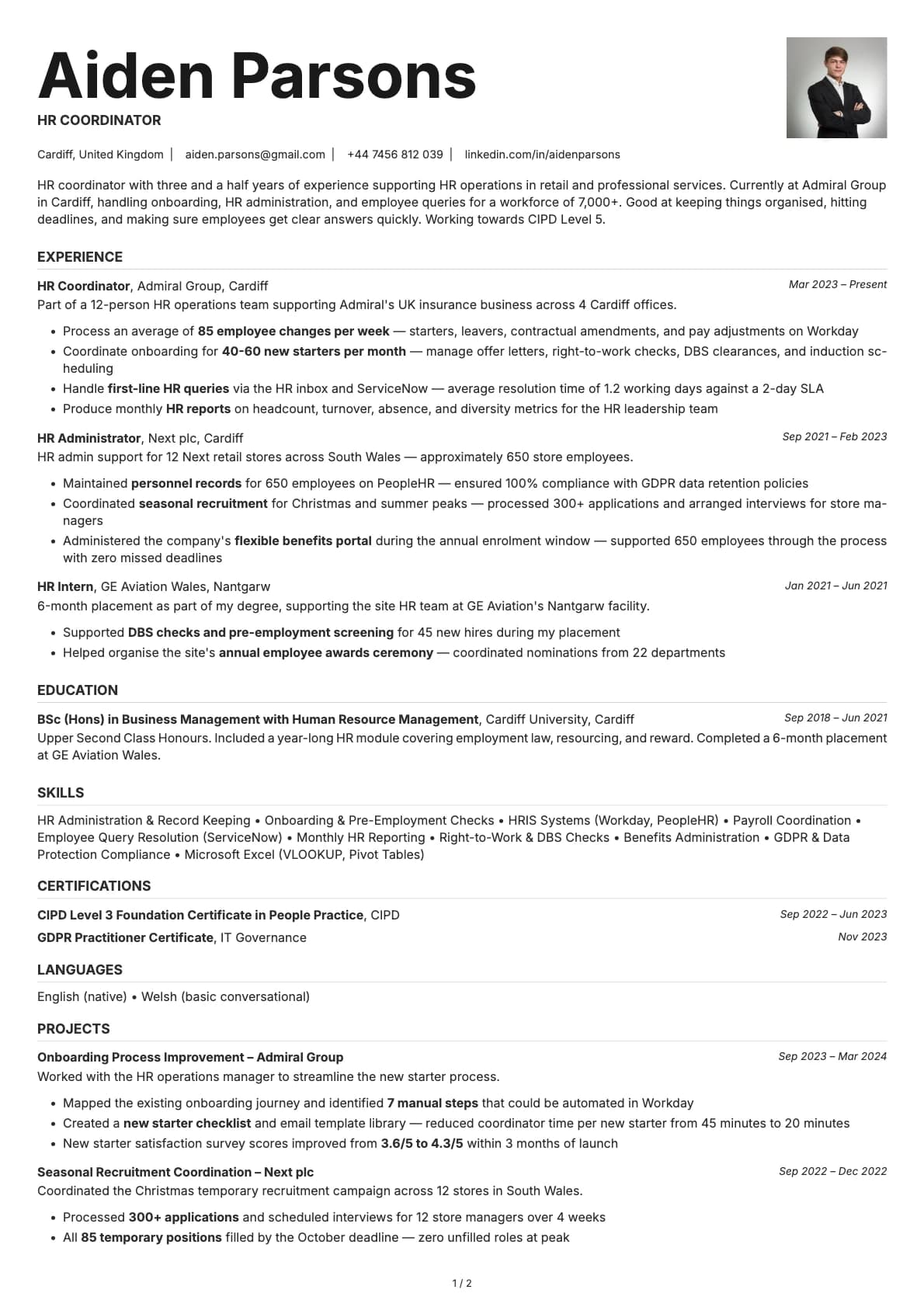
HR Coordinator
An HR coordinator resume example with onboarding metrics, HRIS experience, and HR reporting.
Related articles

AI Is Screening Your Resume Before Any Human Sees It
AI screens most resumes before a human ever reads them. 97.4% of Fortune 500 companies run an ATS. This is what that means for you and what you can do about it.

The Best Resume Builders in 2026, Compared Honestly
Resume.io, Zety, Enhancv, Kickresume, Teal, and Laddro compared honestly: real pricing, free tiers, mobile apps, and where each tool wins. All prices checked in September 2026.

Burnout Recovery: A Real Timeline, Not 'Take a Bubble Bath'
55% of the U.S. workforce is burned out. Recovery takes 3 to 12 months. Here's what that actually looks like, stage by stage.