Logistics Coordinator Resume Example
A logistics coordinator resume example with delivery KPIs, routing software experience, and exception management numbers.

Laddro Team
Free to use. No account needed to start.
Free to use. No account needed to start.
Overview
Logistics coordinator resumes often read like a list of software names and vague responsibilities. "Coordinated deliveries" and "managed logistics operations" appear on almost every one. The hiring manager already knows that is the job. They need to know how well you did it.
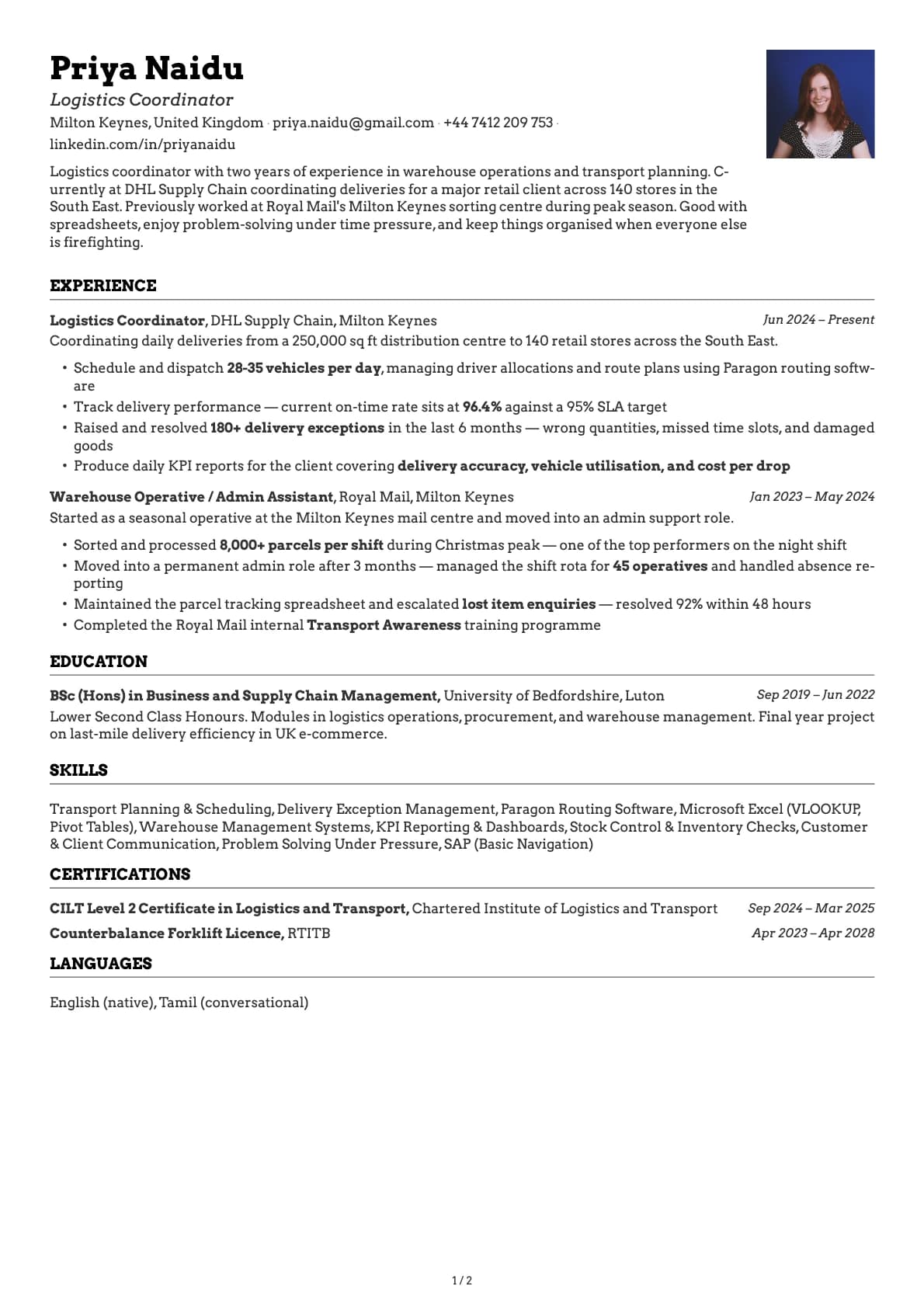
This resume belongs to Priya Naidu, a logistics coordinator with two years of experience. She works at DHL Supply Chain, coordinating deliveries from a 250,000 sq ft distribution centre to 140 retail stores. Before that, she worked at Royal Mail's Milton Keynes sorting centre. She is early in her career, but the resume reads like someone who understands what matters in logistics: on-time rates, exception handling, and keeping clients informed.
Let us look at what works here and how you can apply the same approach.
Your summary should name the operation you run
In logistics, scale matters. A recruiter needs to picture your operation within the first few seconds. How many vehicles? How many drops? What kind of client?
Here is Priya's summary:
Logistics coordinator with two years of experience in warehouse operations and transport planning. Currently at DHL Supply Chain coordinating deliveries for a major retail client across 140 stores in the South East.
That is specific. The recruiter now knows: she works at DHL (brand recognition), handles 140 stores (decent scale for a coordinator role), and covers the South East (geographic scope). Compare that with "logistics coordinator with experience in supply chain management." Same job, zero information.
Your version: State your years of experience, name your employer or industry, and describe the size of the operation you support.
Experience bullets need KPIs
Logistics is a numbers game. If you are not including delivery rates, vehicle counts, and exception volumes, your resume is weaker than it should be.
Look at these bullets from Priya's DHL role:
"Schedule and dispatch 28-35 vehicles per day, managing driver allocations and route plans using Paragon routing software"
"Track delivery performance. Current on-time rate sits at 96.4% against a 95% SLA target"
"Raised and resolved 180+ delivery exceptions in the last 6 months"
Each bullet has a number. The first shows daily volume. The second shows she tracks performance against a target (and is beating it). The third shows she handles problems, not just smooth days.
The formula: What you manage + the volume + the outcome or target.
If you do not have access to formal KPIs, estimate. "Coordinated approximately 20 deliveries per day" is still better than "coordinated deliveries."
What if your previous role was not in logistics?
Priya's first job was as a warehouse operative at Royal Mail. Not a logistics role. But she writes about it in a way that shows transferable skills:
"Managed the shift rota for 45 operatives and handled absence reporting"
"Maintained the parcel tracking spreadsheet and escalated lost item enquiries. Resolved 92% within 48 hours"
She does not pretend it was a logistics coordination role. She just pulls out the parts that are relevant: scheduling people, tracking parcels, resolving problems. If your background includes warehouse, admin, or customer service work, do the same thing. Find the logistics-adjacent tasks and describe them with numbers.
Skills: name the software
This resume lists Paragon routing software, SAP, and specific Excel functions (VLOOKUP, Pivot Tables). That is smart. Logistics employers want to know which systems you can use on day one.
If you use any TMS (transport management system), WMS (warehouse management system), or routing software, list it by name. "Paragon," "Manhattan WMS," "SAP TM," or "Descartes" are all keywords that recruiters and ATS systems scan for.
And do not underestimate Excel. In many logistics operations, Excel is still the backbone of daily reporting. Listing "VLOOKUP, Pivot Tables" tells the recruiter you are beyond the basics.
Certifications show you are building a career, not just filling a job
Priya has a CILT Level 2 Certificate and a counterbalance forklift licence. Neither is a senior qualification. But they show she is investing in the profession.
If you are working towards your CILT membership, list it. If you have a forklift licence, include it with the issuing body and expiry date. In logistics, practical certifications carry real weight because they directly affect what tasks you are allowed to perform on site.
Mistakes that cost interviews in logistics
Not mentioning SLA performance. If you hit your delivery targets, say so. If you exceeded them, even better. "96.4% on-time against a 95% SLA" is the kind of line that gets you shortlisted.
Ignoring exception handling. Every supply chain has problems. Showing that you resolve them (and how many) is more impressive than pretending everything runs perfectly. "Raised and resolved 180+ delivery exceptions" tells the recruiter you are reliable when things go wrong.
Writing "team player" instead of describing actual teamwork. Name the people you work with. "Produce daily KPI reports for the client" is teamwork in action. "Strong team player" is filler.
Using a flashy template. Logistics hiring managers are practical people. They want clear information, not design. This resume uses Emerald, a clean single-column layout. Keep it simple.
One more thing
If you are applying to a 3PL like DHL, XPO, or Kuehne+Nagel, the job posting will almost always mention a specific client or sector. Tailor your resume to match. If the role is for a retail logistics coordinator, lead with your retail experience. If it is FMCG, lead with that. Logistics coordinators are often hired for a specific contract, not for the company in general. Match your resume to the contract you are applying for.
Build your own version
Open this layout in the builder and swap in your own details. It takes a few minutes.
Free to use. No account needed to start.
Was this resume example helpful?
Rate this example to help us create better content for you.
4.7 average from 98 ratingsRelated resume examples
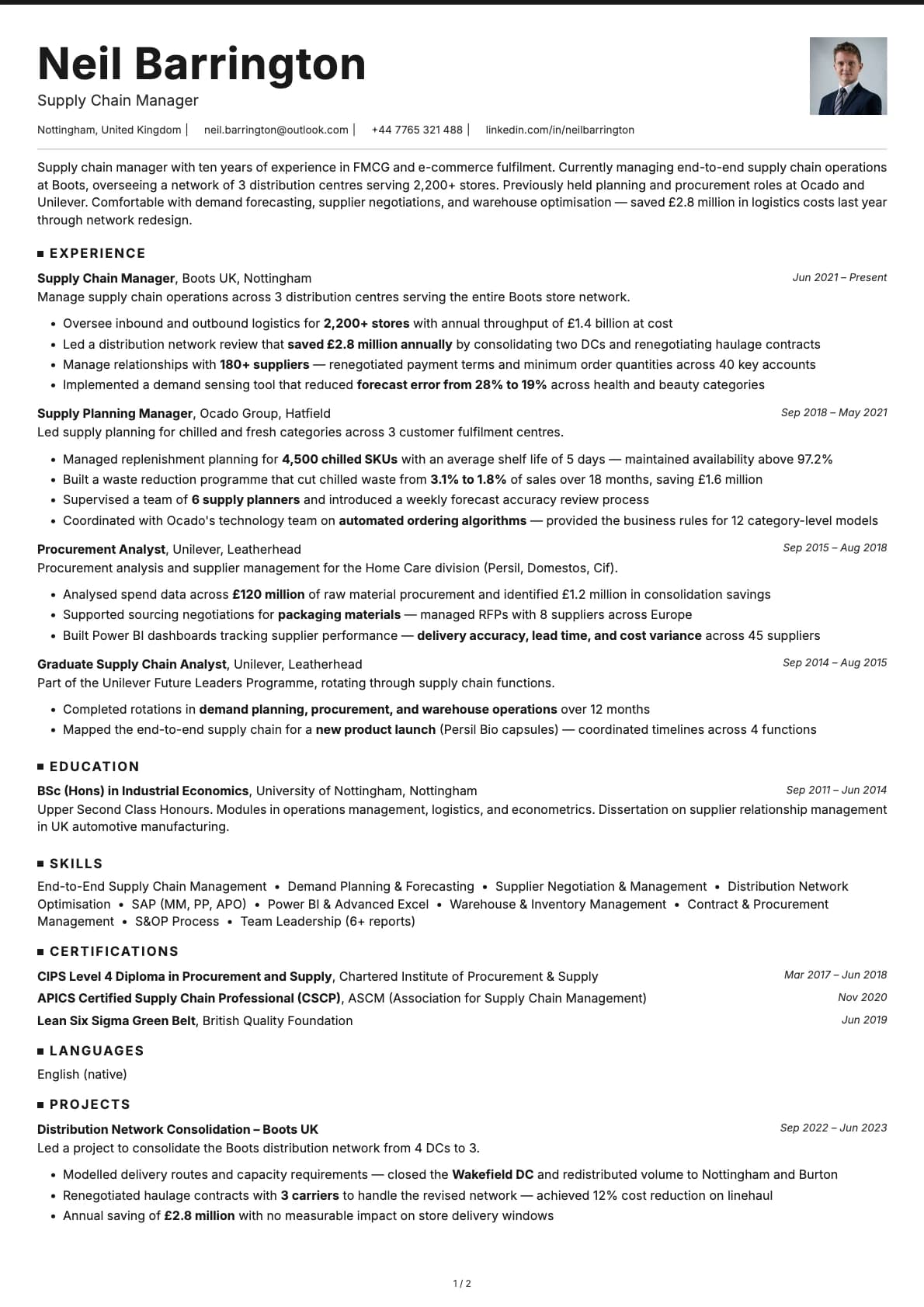
Supply Chain Manager
A supply chain manager resume example with 10 years of FMCG experience at Boots, Ocado, and Unilever.
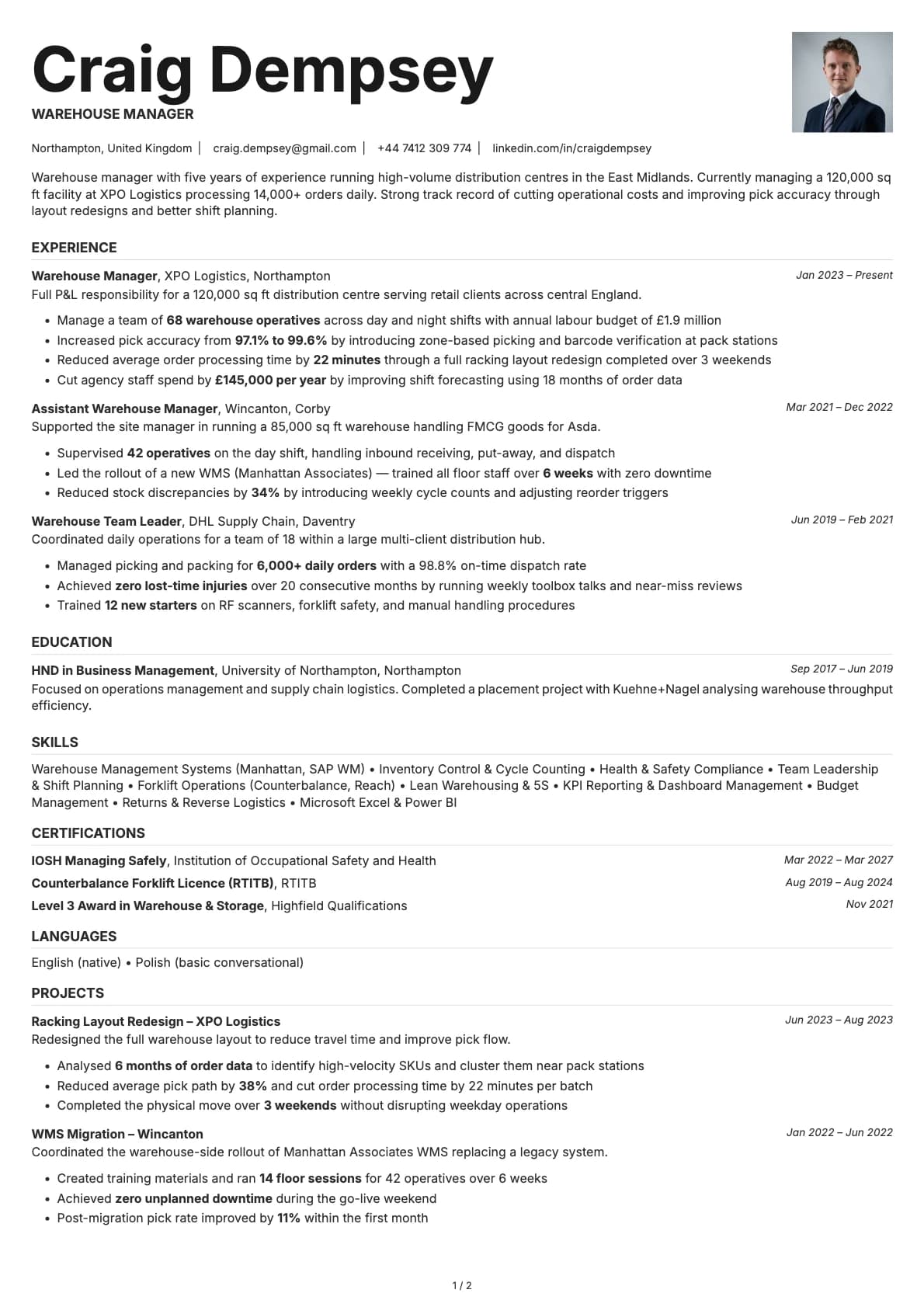
Warehouse Manager
A warehouse manager resume example with P&L ownership, leadership of 68 operatives, and measurable gains in pick accuracy and cost reduction.
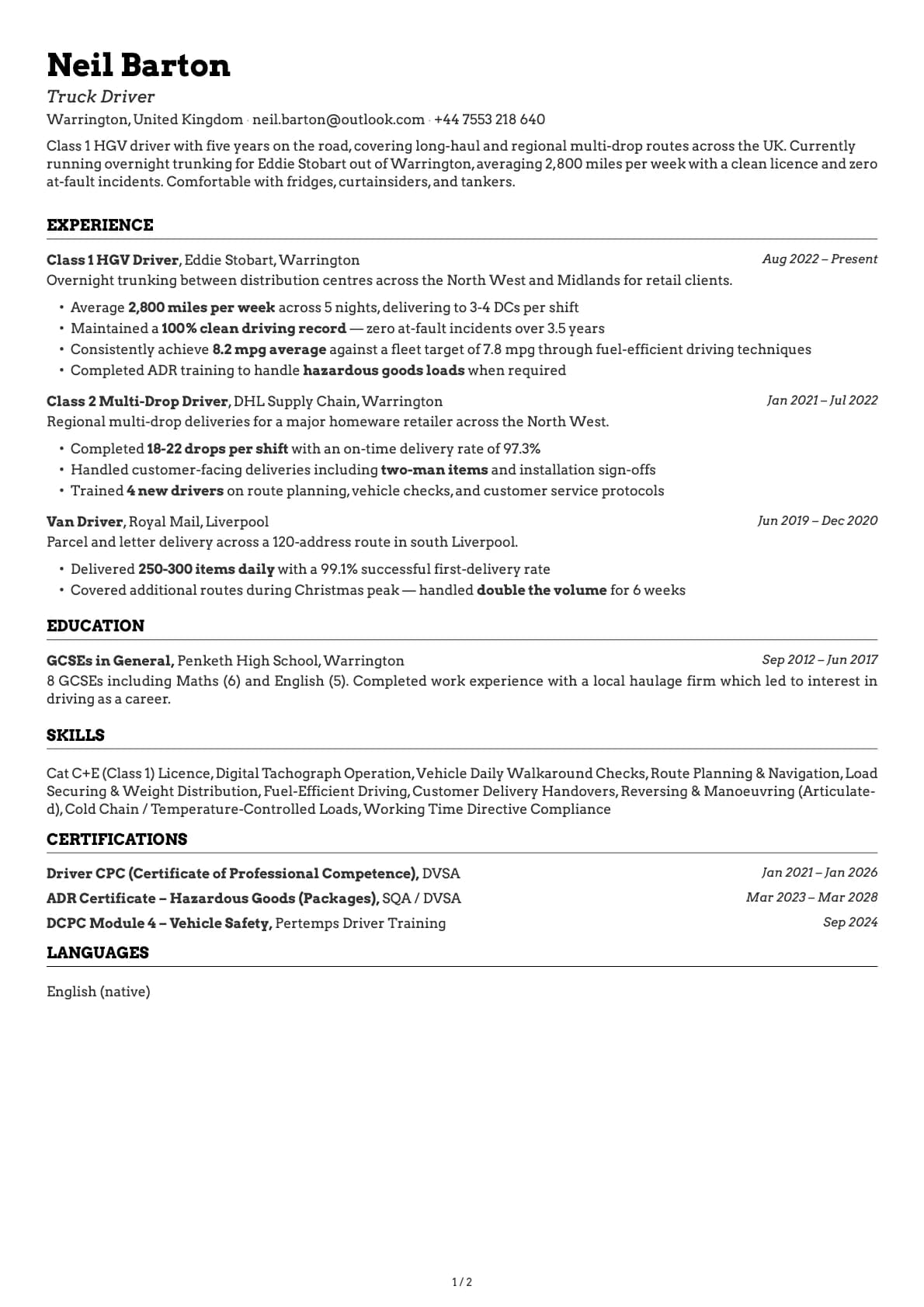
Truck Driver
A truck driver resume example with 5 years of Class 1 HGV experience at Eddie Stobart and DHL.
Warehouse Worker
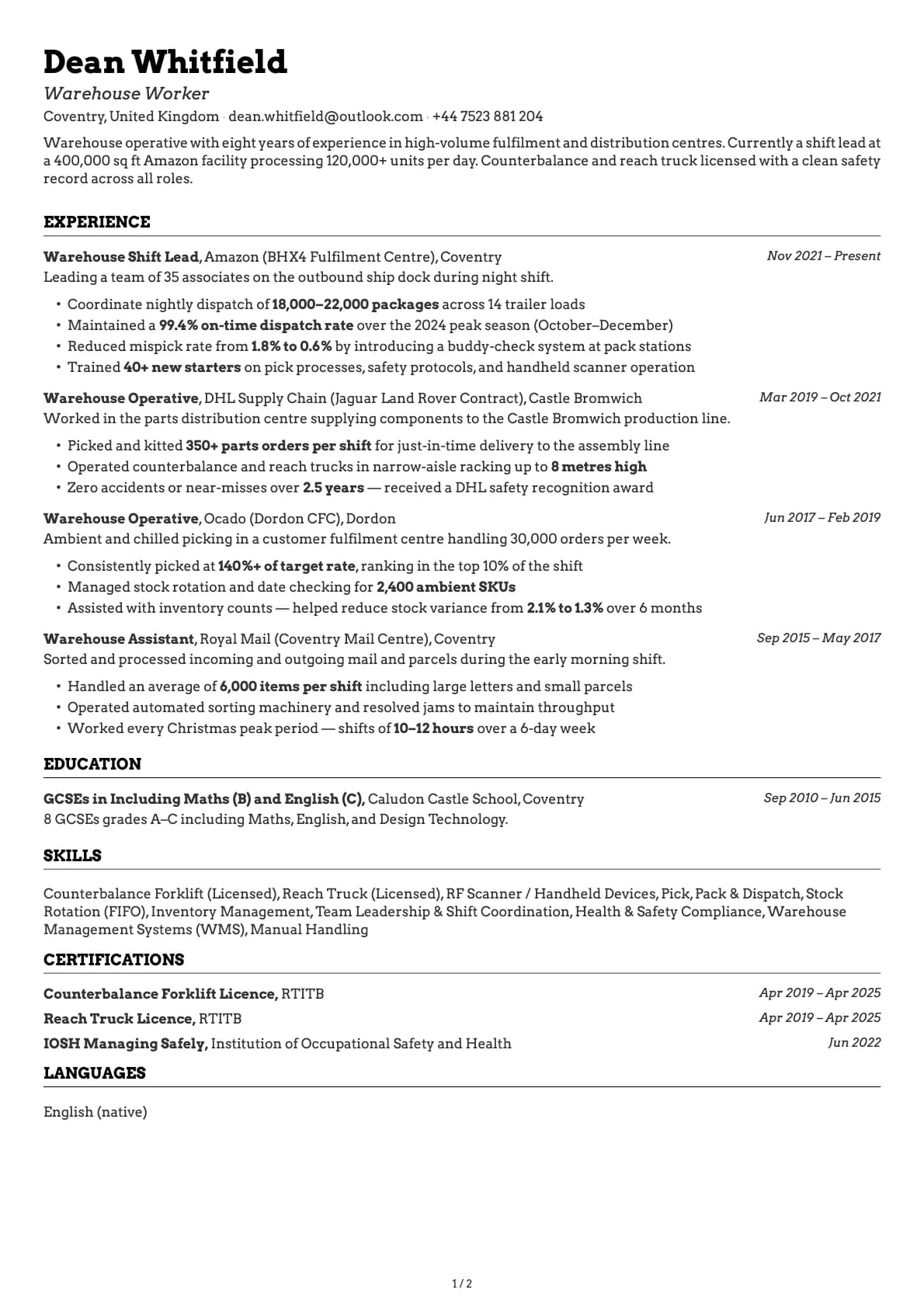
A warehouse worker resume example with 8 years across Amazon, DHL, and Ocado. See how to present pick rates, safety records, and forklift licences.
Related articles

AI Is Screening Your Resume Before Any Human Sees It
AI screens most resumes before a human ever reads them. 97.4% of Fortune 500 companies run an ATS. This is what that means for you and what you can do about it.

The Best Resume Builders in 2026, Compared Honestly
Resume.io, Zety, Enhancv, Kickresume, Teal, and Laddro compared honestly: real pricing, free tiers, mobile apps, and where each tool wins. All prices checked in September 2026.

Burnout Recovery: A Real Timeline, Not 'Take a Bubble Bath'
55% of the U.S. workforce is burned out. Recovery takes 3 to 12 months. Here's what that actually looks like, stage by stage.