Truck Driver Resume Example
A truck driver resume example with 5 years of Class 1 HGV experience at Eddie Stobart and DHL.

Laddro Team
Free to use. No account needed to start.
Free to use. No account needed to start.
Overview
A lot of drivers think they do not need a resume. Just show your licence, your CPC card, and your tacho card. But if you want to move to a better fleet, get onto nights with higher pay, or work for a company that actually maintains its trucks, you need a resume that shows more than just "I can drive."
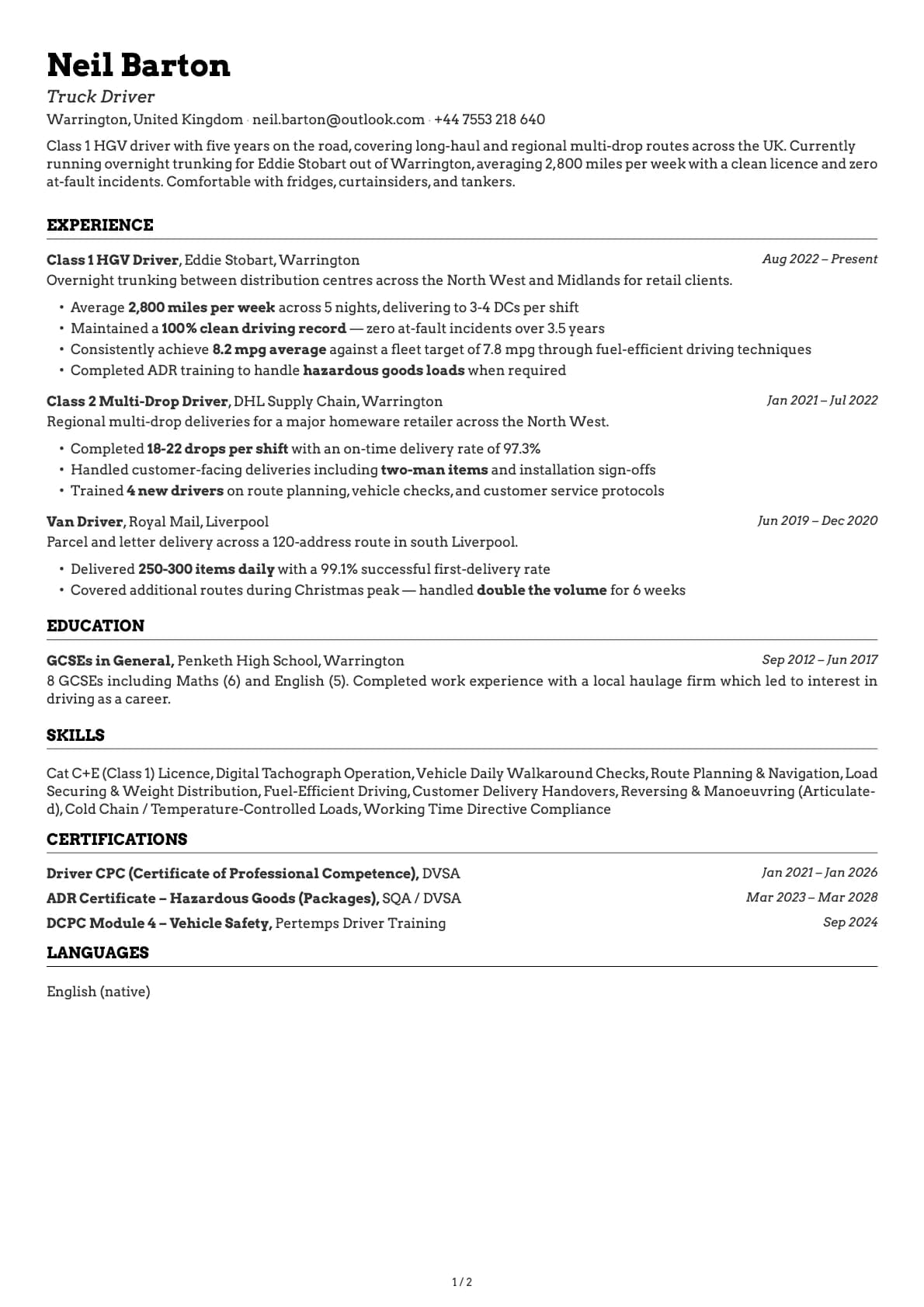
This resume belongs to Neil, a Class 1 HGV driver based in Warrington with five years on the road. He currently runs overnight trunking for Eddie Stobart and previously did multi-drop work at DHL and parcel delivery at Royal Mail. What makes this resume work is the numbers. Miles per week, fuel efficiency, delivery rates, clean driving record. These are the things transport managers actually care about.
Here is how to write a driver resume that gets you hired at the fleet you actually want to work for.
Your summary: licence class, mileage, and safety record
Here is Neil's summary:
Class 1 HGV driver with five years on the road, covering long-haul and regional multi-drop routes across the UK. Currently running overnight trunking for Eddie Stobart out of Warrington, averaging 2,800 miles per week with a clean licence and zero at-fault incidents. Comfortable with fridges, curtainsiders, and tankers.
Three sentences. The transport manager reading this knows: his licence class (C+E), his current operation (overnight trunking at Eddie Stobart), his weekly mileage (2,800), his safety record (clean, zero incidents), and the trailer types he can handle.
For yours: Lead with your licence class. State your years of driving, your current operation type (trunking, multi-drop, tramping, same-day), and your weekly or annual mileage. Then mention your safety record and the vehicle types you are comfortable with.
How to describe your driving experience
Driving resumes often just say "delivered goods to customers." That is every driver's job. What separates you is your numbers.
Neil's Eddie Stobart bullets:
Average 2,800 miles per week across 5 nights, delivering to 3-4 DCs per shift
Maintained a 100% clean driving record. Zero at-fault incidents over 3.5 years
Consistently achieve 8.2 mpg average against a fleet target of 7.8 mpg
Three bullets. Each one gives the transport manager something specific to evaluate. The mileage shows workload. The clean record shows reliability. The fuel figure shows he drives efficiently, which saves the company money.
That fuel number is particularly smart. Most drivers do not track their mpg, and those who do rarely put it on a resume. If you consistently beat the fleet average, that is a selling point worth including.
The formula for driver bullets: What you drive + Where you go + How much/how often + Your safety or efficiency metric.
Multi-drop and earlier roles: show the progression
Neil's DHL role was multi-drop rather than trunking:
Completed 18-22 drops per shift with an on-time delivery rate of 97.3%
Trained 4 new drivers on route planning, vehicle checks, and customer service protocols
The drops-per-shift number shows pace and workload. The on-time rate shows reliability. And the training bullet shows he was trusted enough to mentor new starters, which signals he was one of the better drivers at the depot.
Even his Royal Mail role (which was van work, not HGV) has useful detail:
Delivered 250-300 items daily with a 99.1% successful first-delivery rate
If your career started in vans or light commercial vehicles before moving to Class 2 or Class 1, include those roles. The progression from van to rigid to artic tells a clear story of career development.
Certifications: this section is critical for drivers
For truck drivers, your certifications are not optional extras. They are legal requirements. Neil lists:
- Driver CPC (with expiry date)
- ADR Certificate for hazardous goods
- DCPC Module 4 for vehicle safety
Your Driver CPC must be current. If it is expired or close to expiry, that is a red flag. List the expiry date so the transport manager can see it is valid without asking.
ADR certification is a genuine differentiator. Not every driver has it, and companies that handle hazardous loads pay more. If you have ADR (any class), put it prominently on your resume.
Other certifications worth including: FORS (Fleet Operator Recognition Scheme) training, banksman/slinger training, forklift licence (counterbalance or reach), HIAB crane operation. Each one opens up different types of work.
Skills: what transport managers are actually looking for
Neil's skills section includes practical items: Cat C+E Licence, Digital Tachograph Operation, Vehicle Daily Walkaround Checks, Load Securing & Weight Distribution, Fuel-Efficient Driving.
These are not flashy. But they are exactly what a transport manager scans for. Can you do your own walkaround checks properly? Do you understand load securing? Can you operate a digital tacho without issues?
If you have experience with specific vehicle types (fridges, curtainsiders, tankers, flat-beds, low-loaders), list them. Fleet operators often need drivers for specific trailer types and will search for those terms.
Mistakes truck drivers make on their resumes
Not listing your licence class clearly. Your licence category should be one of the first things visible on the page. C+E, C, C1. Do not make the transport manager hunt for it.
No safety record. If you have a clean licence and zero at-fault incidents, say so. This is one of the most important hiring criteria for fleet operators. Insurance costs are directly tied to driver records.
Ignoring fuel efficiency. If you drive efficiently, it saves the fleet money. If you beat the fleet average, that is a quantifiable achievement. Put it on the resume.
Missing CPC expiry date. An out-of-date CPC means you cannot legally drive commercially. Always include the expiry date so there is no question about your compliance status.
No mention of vehicle types. "HGV driver" does not tell the transport manager whether you can handle a fridge unit or a tanker. Be specific about the trailer types you have operated.
One more thing
This resume uses Emerald, a simple single-column layout. For driving roles, you do not need a fancy template. In fact, a clean and straightforward resume is a better fit for the industry. Transport managers are not looking for design flair. They are looking for the right licence, a clean record, and proof you can do the miles safely and efficiently.
If you are applying to a specific fleet, check what they specialise in. If they run temperature-controlled logistics, make sure "cold chain" and "temperature-controlled loads" appear on your resume. If they do hazmat, lead with your ADR. Small adjustments like these make the difference between your resume landing in the "maybe" pile or the "interview" pile.
Build your own version
Open this layout in the builder and swap in your own details. It takes a few minutes.
Free to use. No account needed to start.
Was this resume example helpful?
Rate this example to help us create better content for you.
4.7 average from 89 ratingsRelated resume examples
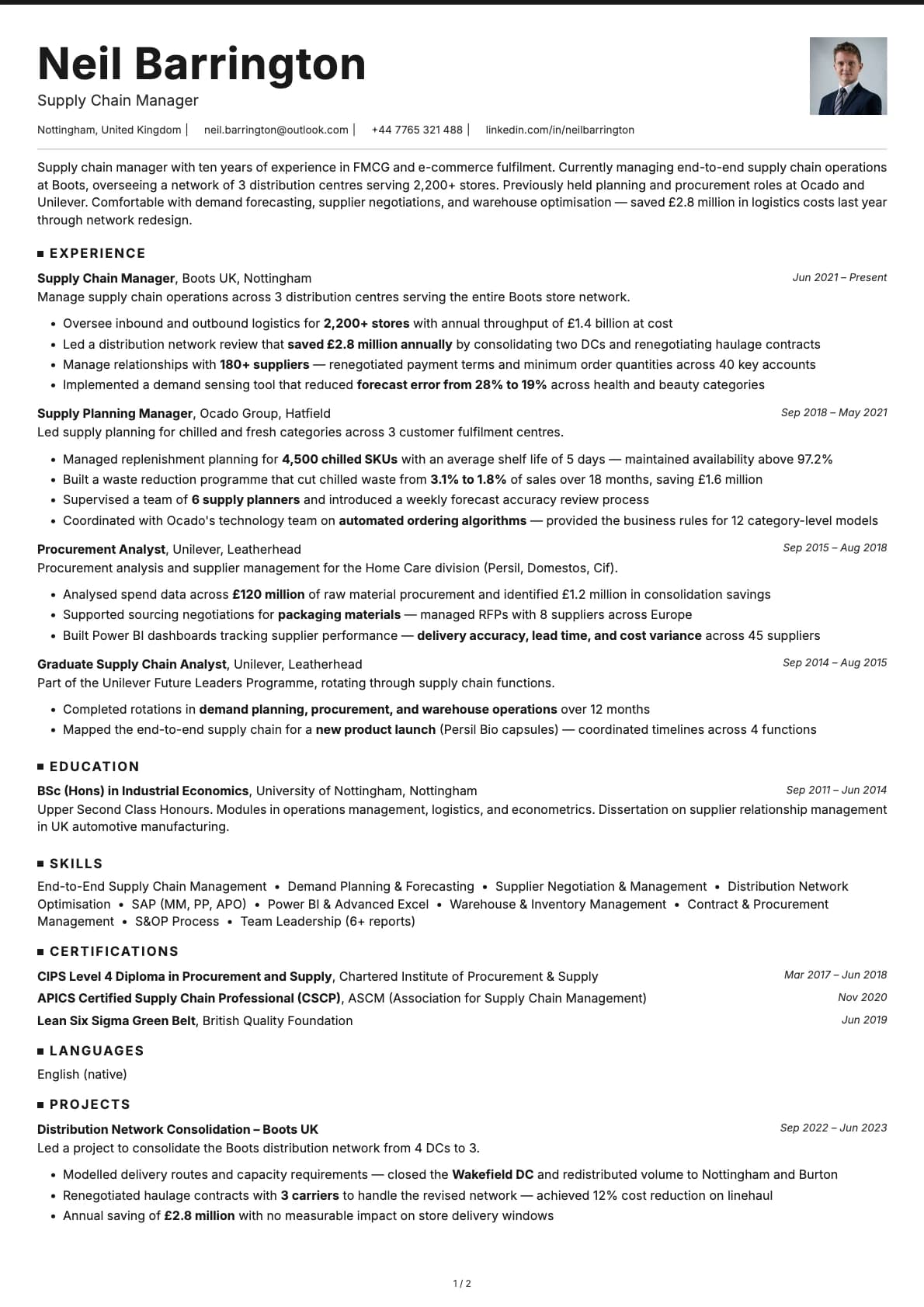
Supply Chain Manager
A supply chain manager resume example with 10 years of FMCG experience at Boots, Ocado, and Unilever.
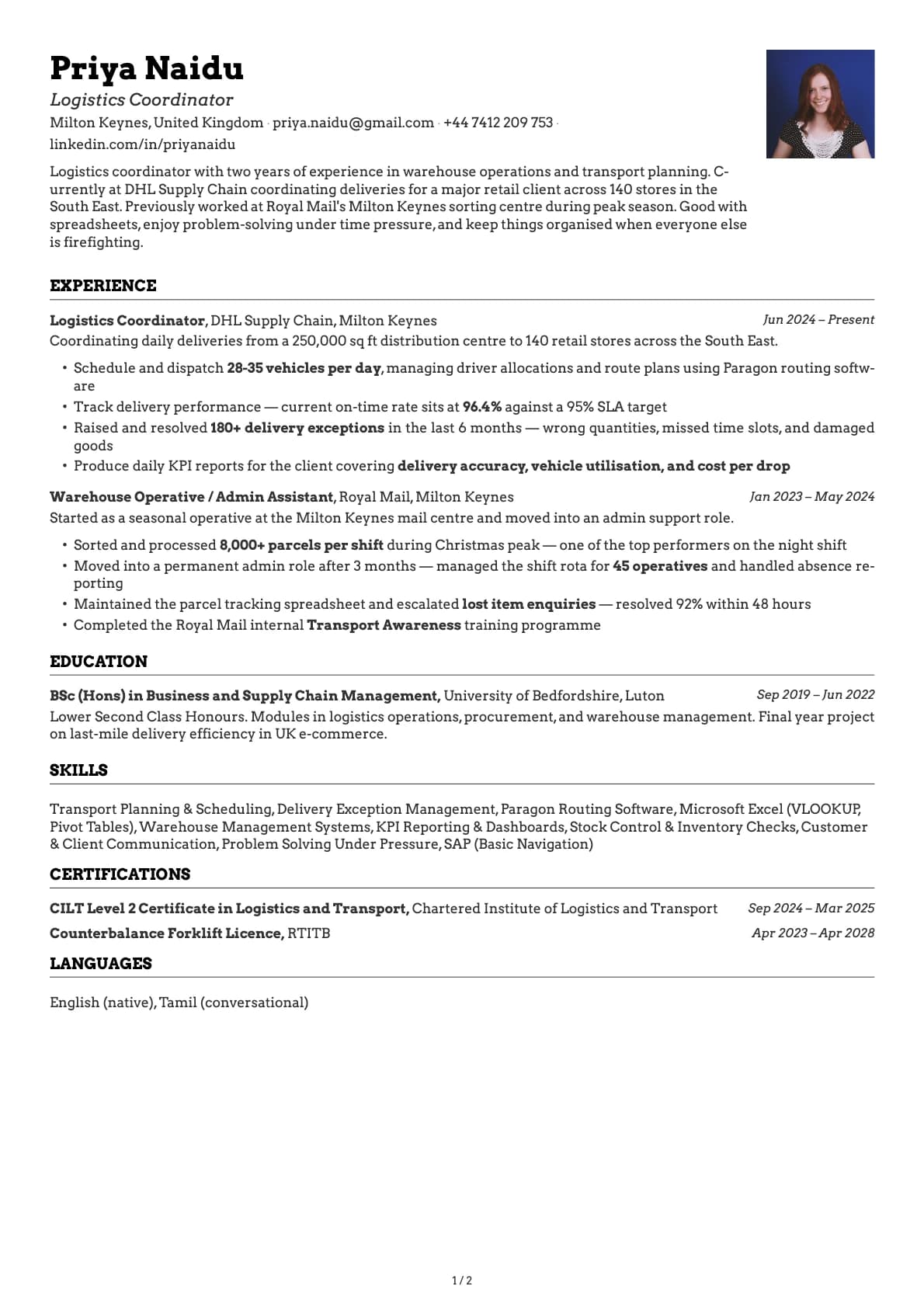
Logistics Coordinator
A logistics coordinator resume example with delivery KPIs, routing software experience, and exception management numbers.
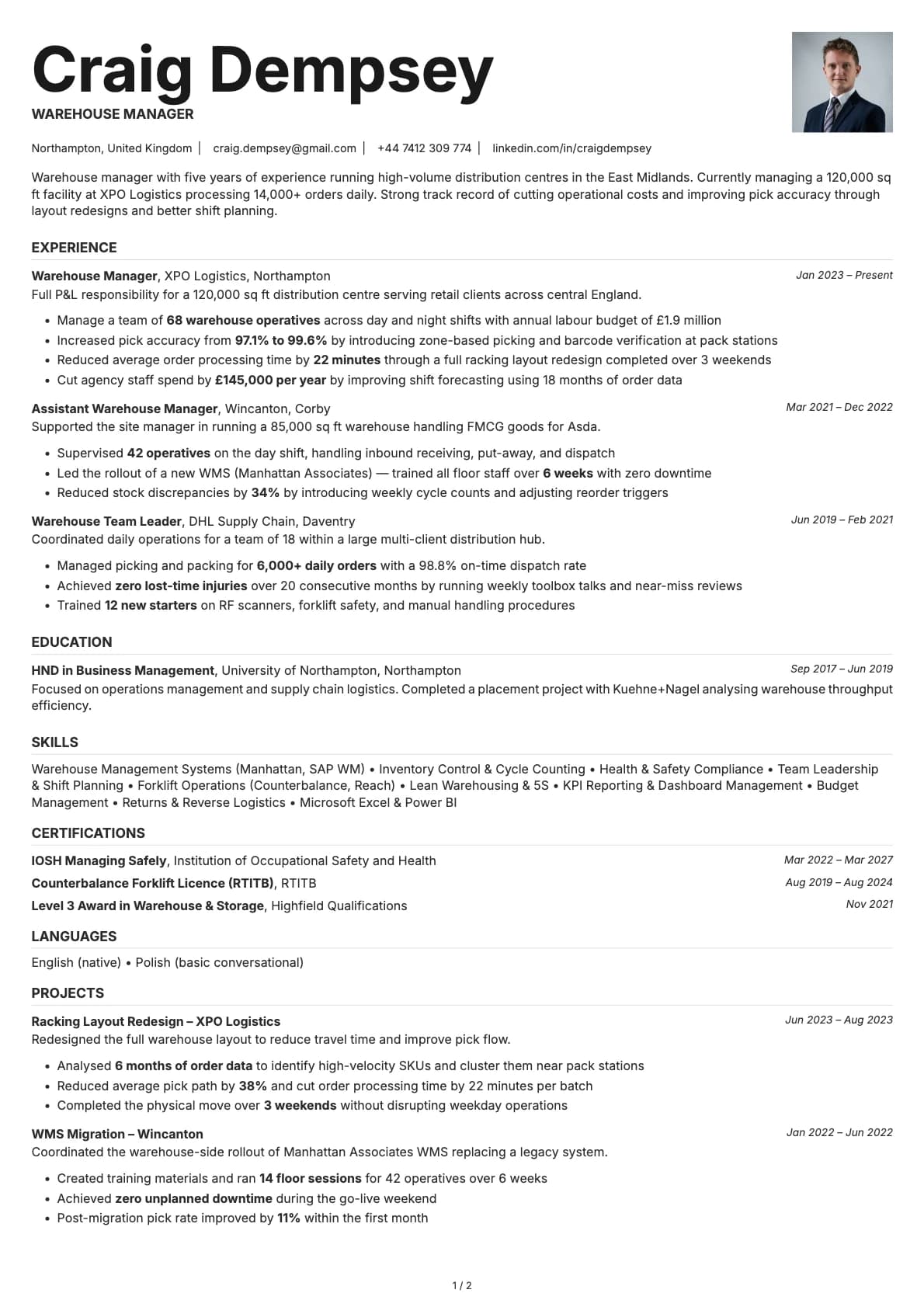
Warehouse Manager
A warehouse manager resume example with P&L ownership, leadership of 68 operatives, and measurable gains in pick accuracy and cost reduction.
Warehouse Worker
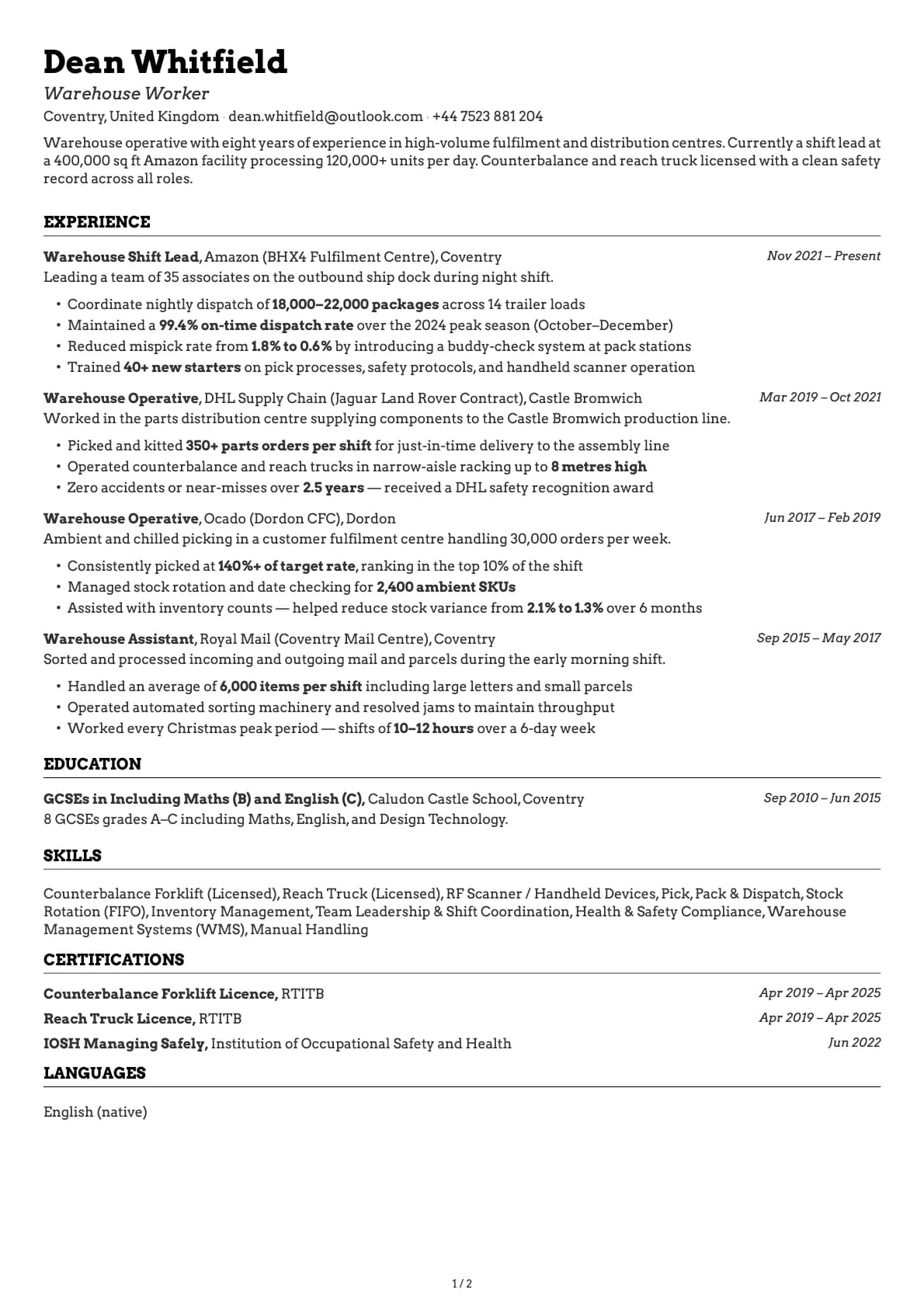
A warehouse worker resume example with 8 years across Amazon, DHL, and Ocado. See how to present pick rates, safety records, and forklift licences.
Related articles

AI Is Screening Your Resume Before Any Human Sees It
AI screens most resumes before a human ever reads them. 97.4% of Fortune 500 companies run an ATS. This is what that means for you and what you can do about it.

The Best Resume Builders in 2026, Compared Honestly
Resume.io, Zety, Enhancv, Kickresume, Teal, and Laddro compared honestly: real pricing, free tiers, mobile apps, and where each tool wins. All prices checked in September 2026.

Burnout Recovery: A Real Timeline, Not 'Take a Bubble Bath'
55% of the U.S. workforce is burned out. Recovery takes 3 to 12 months. Here's what that actually looks like, stage by stage.