Warehouse Worker Resume Example
A warehouse worker resume example with 8 years across Amazon, DHL, and Ocado. See how to present pick rates, safety records, and forklift licences.

Laddro Team
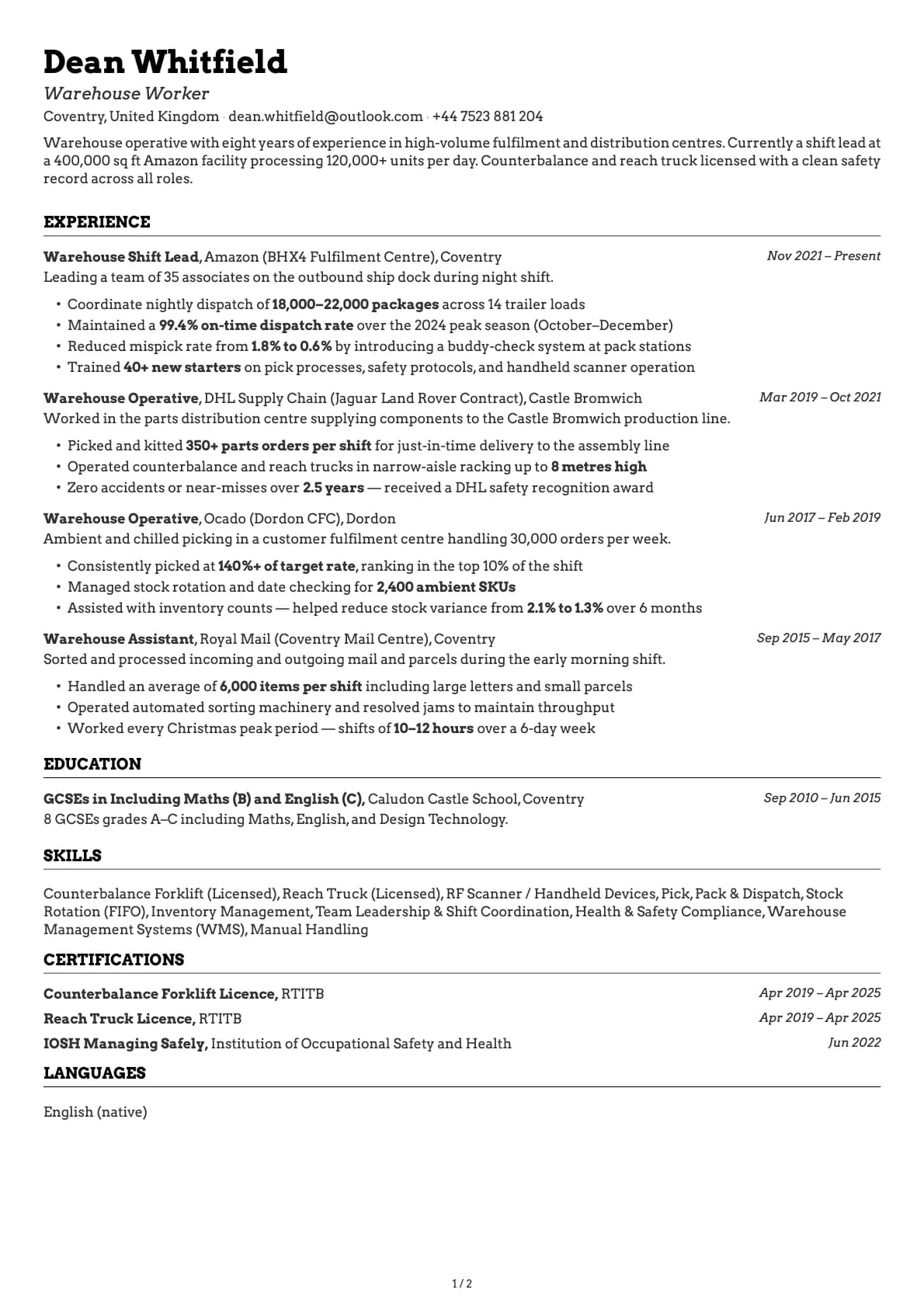
Free to use. No account needed to start.
Free to use. No account needed to start.
Overview
A lot of warehouse workers think their job is too "hands-on" for a resume to matter. You show up, you pick, you pack, you go home. But when 200 people apply for the same shift lead role, the resume is what gets you into the interview room. And most warehouse resumes are terrible. They say "picked and packed orders" and leave it at that.
This resume belongs to Dean Whitfield. He has eight years of warehouse experience across four employers: Royal Mail, Ocado, DHL Supply Chain (on the Jaguar Land Rover contract), and Amazon. He is currently a shift lead at Amazon's BHX4 fulfilment centre in Coventry, coordinating 35 associates on the night shift.
What makes this resume stand out is that Dean treats every role like it has measurable output. Because it does. Pick rates, dispatch volumes, mispick percentages, safety records. These numbers already exist in your daily work. You just need to put them on paper.
Your summary should state your speed and your safety
Warehouse hiring managers care about two things above everything: can you keep up with the pace, and will you do it safely? Dean's summary covers both:
Warehouse operative with eight years of experience in high-volume fulfilment and distribution centres. Currently a shift lead at a 400,000 sq ft Amazon facility processing 120,000+ units per day. Counterbalance and reach truck licensed with a clean safety record across all roles.
Three sentences. Years of experience, current facility scale, and licences plus safety record. No wasted words.
For your own summary: Write how long you have worked in warehouses. Name your current or most recent facility and give one number that shows its size (sq footage, daily orders, or units processed). Then mention your forklift licence if you have one and your safety record if it is clean. Done.
How to write experience bullets when "it is all the same job"
This is the biggest challenge for warehouse workers. Every role involves picking, packing, and dispatching. So how do you make each job look different on paper?
The answer is specifics. Look at Dean's Ocado entry:
"Consistently picked at 140%+ of target rate, ranking in the top 10% of the shift"
That is not "picked orders." That is a performance metric with a ranking. Every warehouse has pick rate targets. If you beat yours, say by how much. If you do not know the exact percentage, estimate conservatively. Were you regularly one of the fastest on your shift? That is worth writing down.
Now look at the DHL entry:
"Picked and kitted 350+ parts orders per shift for just-in-time delivery to the assembly line"
Different type of warehouse, different specifics. This was automotive parts for Jaguar Land Rover. Just-in-time delivery means there is zero room for error. The recruiter reading this understands that immediately.
The formula: What you did + how much of it + what standard you hit. "Picked 350+ parts orders per shift" is better than "picked orders." "Maintained 99.4% on-time dispatch rate" is better than "dispatched orders on time."
Safety records are your secret weapon
In warehousing, a clean safety record is not just nice to have. It directly affects a company's insurance premiums, their HSE record, and their client contracts. If you have one, put it front and centre.
Dean's DHL entry includes this:
"Zero accidents or near-misses over 2.5 years. Received a DHL safety recognition award."
That line is worth more than any soft skill you could list. It tells the hiring manager: this person will not cause incidents, will not cost us money, and takes the work seriously.
Even if you have not received a formal award, think about your record. Have you gone a full year without an incident? Two years? Have you led any toolbox talks or safety briefings? Have you been a first aider? Dean lists his first aider role in his extra-curricular section, which is a smart move. It reinforces the safety theme.
If your record is not perfect, focus on what you learned. "Completed additional manual handling training after a near-miss in 2022" is honest and shows you take safety seriously.
Certifications: forklift licences go first
For warehouse roles, your forklift licence is often the single most important line on your resume. It can be the difference between getting shortlisted or not.
Dean lists both his counterbalance and reach truck licences from RTITB, plus his IOSH Managing Safely qualification. These are listed with dates, which matters because hiring managers need to check validity.
One thing to watch: Dean's licences show an expiry of April 2025. If you are reading this and your licence is near expiry, renew it before you start applying. An expired RTITB licence is an immediate reason to skip your application.
If you do not have a forklift licence yet, consider getting one before your next job search. RTITB counterbalance courses run 3 to 5 days and cost around £200 to £400. For the number of doors it opens in warehouse work, it is one of the best investments you can make.
The projects section is not just for office jobs
Most warehouse workers do not think to include a projects section. But Dean does, and it works. His peak season planning project at Amazon shows he was trusted with responsibility beyond his daily role:
"Helped recruit and onboard 85 seasonal associates over a 6-week ramp-up. Redesigned the dock loading sequence, cutting average trailer turnaround from 45 minutes to 32 minutes."
And his mispick reduction initiative:
"Reduced outbound mispick rate from 1.8% to 0.6% within 4 months. Process was adopted across 3 other shift teams."
These entries prove Dean is not just following instructions. He is spotting problems and fixing them. If you have ever suggested a change to a process, trained a group of new starters during peak, or helped with a stocktake improvement, that is project material.
Mistakes warehouse workers make on their resumes
Listing duties instead of output. "Picked and packed orders in a warehouse environment" tells the recruiter nothing. They already know what warehouse workers do. Replace it with a number: how many orders per shift, what pick rate, what accuracy percentage.
Leaving off forklift and equipment details. Do not just say "forklift licensed." Specify counterbalance, reach, or both. Mention the certifying body (RTITB or ITSSAR). Include the date range. Some roles specifically require one type over the other.
Ignoring the education section. Dean only has GCSEs, and that is fine. He lists them with grades. Many warehouse workers leave education off entirely, which can look like an oversight. Even if your qualifications are basic, include them. It fills a gap and shows completeness.
Using a fancy template. Warehouse roles almost always go through an ATS before a human sees them. Sidebars, icons, and graphics can confuse these systems. Dean's resume uses Emerald, a single-column layout that ATS software reads cleanly. Keep it simple.
One more thing
If you are applying for a step up (warehouse operative to shift lead, or shift lead to supervisor), your resume needs to show you have already been doing parts of the next role. Dean's resume does this well. Even in his operative roles at DHL and Ocado, he mentions training new starters, managing stock rotation, and hitting top performance metrics. By the time you read his Amazon shift lead entry, the promotion makes complete sense.
Look at the job advert for the role you want. Find the responsibilities listed. Then check your resume. Can you point to at least one bullet that matches each responsibility? If not, think about whether you have done that work informally and add it. The gap between your current title and the next one is often smaller than you think.
Build your own version
Open this layout in the builder and swap in your own details. It takes a few minutes.
Free to use. No account needed to start.
Was this resume example helpful?
Rate this example to help us create better content for you.
4.6 average from 198 ratingsRelated resume examples
Supply Chain Manager
A supply chain manager resume example with 10 years of FMCG experience at Boots, Ocado, and Unilever.
Logistics Coordinator
A logistics coordinator resume example with delivery KPIs, routing software experience, and exception management numbers.
Warehouse Manager
A warehouse manager resume example with P&L ownership, leadership of 68 operatives, and measurable gains in pick accuracy and cost reduction.
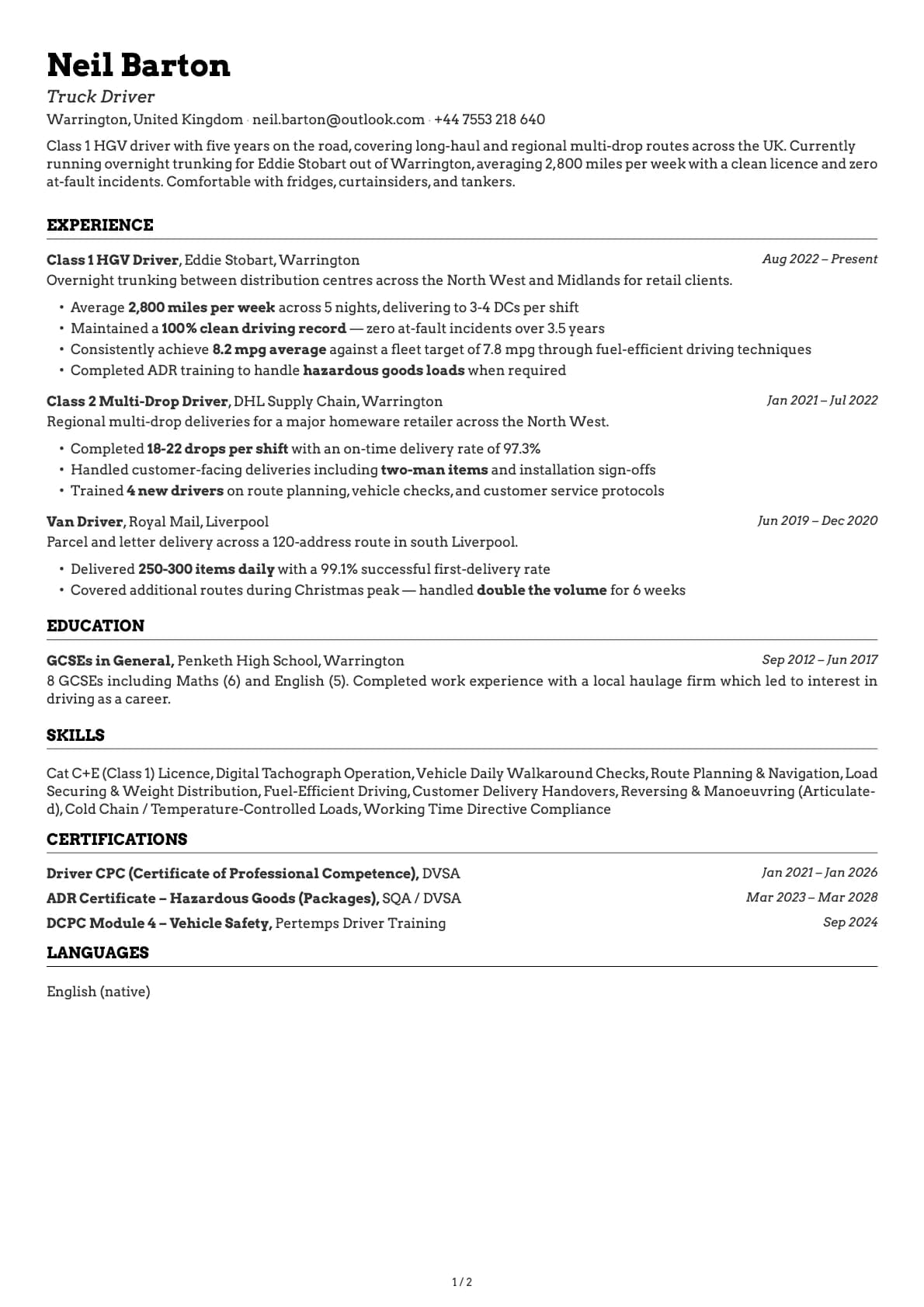
Truck Driver
A truck driver resume example with 5 years of Class 1 HGV experience at Eddie Stobart and DHL.
Related articles

AI Is Screening Your Resume Before Any Human Sees It
AI screens most resumes before a human ever reads them. 97.4% of Fortune 500 companies run an ATS. This is what that means for you and what you can do about it.

The Best Resume Builders in 2026, Compared Honestly
Resume.io, Zety, Enhancv, Kickresume, Teal, and Laddro compared honestly: real pricing, free tiers, mobile apps, and where each tool wins. All prices checked in September 2026.

Burnout Recovery: A Real Timeline, Not 'Take a Bubble Bath'
55% of the U.S. workforce is burned out. Recovery takes 3 to 12 months. Here's what that actually looks like, stage by stage.