Account Executive Resume Example
An account executive resume example with SaaS sales experience, quota attainment figures, and pipeline numbers that actually make hiring managers pick up.

Laddro Team
Free to use. No account needed to start.
Free to use. No account needed to start.
Overview
Sales hiring managers are not reading your resume to learn about your personality. They want to know one thing: can you close? And the only way to prove that on paper is with numbers. Quota attainment. Deal sizes. Pipeline generated. Win rates.
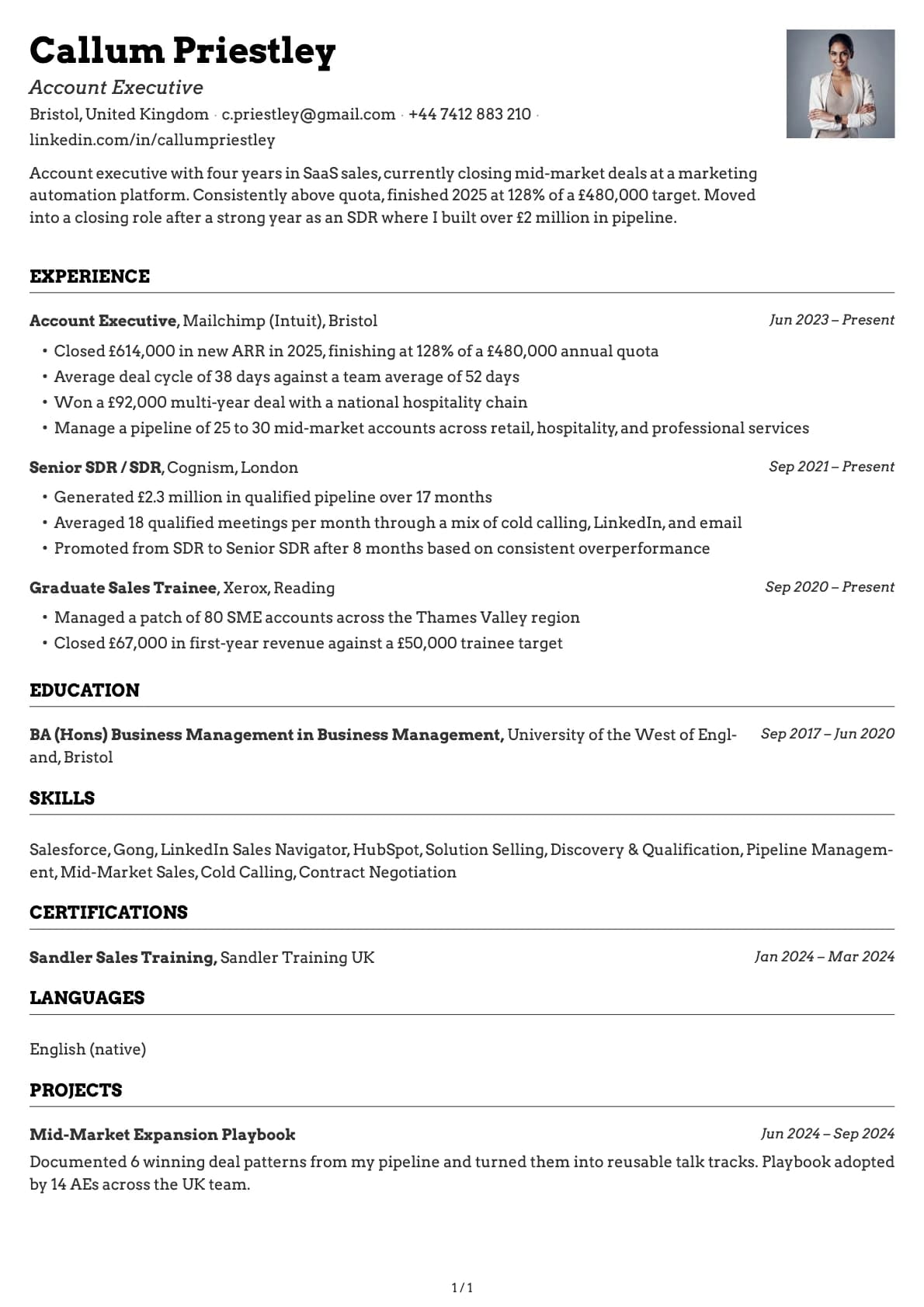
This resume belongs to Callum Priestley, an account executive with four years in SaaS sales. He is currently closing mid-market deals at Mailchimp (Intuit) in Bristol and finished 2025 at 128% of a £480,000 target. Before that, he was an SDR at Cognism where he built over £2.3 million in pipeline in 17 months.
The resume works because it reads like a scorecard. Every bullet has a number. Let us break down how you can do the same.
Your summary needs to be a highlight reel
Sales managers skim. They might spend 10 seconds on your summary before deciding whether to keep reading. So your summary needs to answer three things fast: what do you sell, how long have you been doing it, and what is your best number?
Here is Callum's:
Account executive with four years in SaaS sales, currently closing mid-market deals at a marketing automation platform. Consistently above quota, finished 2025 at 128% of a £480,000 target. Moved into a closing role after a strong year as an SDR where I built over £2 million in pipeline.
Three sentences. No fluff. The reader immediately knows this person sells SaaS, hits target, and earned the closing seat by performing as an SDR first.
Your version: State what you sell (SaaS, media, financial services). State how long. Then drop your single best number. If you have not hit quota yet, use pipeline generated or meetings booked instead.
How to write experience bullets that sell you
The biggest mistake AEs make on their resume is describing their job instead of their performance. "Managed a portfolio of mid-market accounts" tells the reader nothing about whether you were any good at it.
Look at how Callum handles his current role at Mailchimp:
Closed £614,000 in new ARR in 2025, finishing at 128% of a £480,000 annual quota
Average deal cycle of 38 days against a team average of 52 days
Won a £92,000 multi-year deal with a national hospitality chain
Every bullet has a number and a benchmark. It is not just "I closed deals." It is "I closed this much, against this target, and faster than my peers."
The formula: What you did + The number + The context. Context means quota, team average, company record, or time period. Without context, numbers float in space.
What about your SDR or early career roles?
If you moved from SDR to AE (like most people in SaaS), do not downplay that experience. It shows progression and proves you can generate your own pipeline.
Callum's SDR role at Cognism has three bullets:
Generated £2.3 million in qualified pipeline over 17 months
Averaged 18 qualified meetings per month through a mix of cold calling, LinkedIn, and email
Promoted from SDR to Senior SDR after 8 months based on consistent overperformance
The promotion bullet is smart. It tells the hiring manager this person ramps fast and gets noticed. If you earned an early promotion or a title change, put it on the resume. It is one of the strongest signals a junior seller can show.
And for his graduate sales trainee role at Xerox? Two bullets. One about patch size (80 SME accounts), one about beating target (£67,000 closed against a £50,000 trainee target). Quick, clean, relevant.
Skills: tools matter in sales
In sales hiring, the CRM you know can matter as much as your closing ability. If a company uses Salesforce and you have three years on it, that is one less thing to train. If they use HubSpot, same idea.
Callum lists Salesforce, Gong, and LinkedIn Sales Navigator. These are the tools that mid-market SaaS sales teams actually use. He also lists "Solution Selling" and "Discovery & Qualification" which are sales methodologies, not vague soft skills.
One thing to note: Callum has Sandler Sales Training as a certification. If you have completed any structured sales training (Sandler, MEDDIC, Challenger, SPIN), list it. Sales leaders know these frameworks and it tells them you speak the same language.
Projects and extracurriculars: the overlooked section
Most AE resumes skip this. But look at what Callum includes:
Mid-Market Expansion Playbook. Documented 6 winning deal patterns from my pipeline and turned them into reusable talk tracks. Playbook adopted by 14 AEs across the UK team.
This is not just "I closed deals." It is "I helped the entire team close more deals." That signals leadership and commercial thinking, which is exactly what a company looks for before promoting someone to Senior AE or Team Lead.
If you have ever built a playbook, run an internal training session, or piloted a new territory, put it on the resume.
Mistakes that kill AE resumes
No numbers. This is the biggest one. If your resume does not have a quota attainment percentage, a pipeline figure, or a deal size somewhere in the first three bullets, most sales managers will move on.
Listing responsibilities instead of results. "Responsible for managing mid-market accounts" is a job description, not a resume bullet. Replace it with what you actually achieved in those accounts.
Including a LinkedIn URL when it contradicts your resume. If your LinkedIn says you were an SDR for 18 months but your resume says 12, that is a red flag. Make sure they match.
Overcomplicating the format. Sales resumes should be clean and fast to scan. No sidebars, no graphics, no two-column layouts. Callum uses Emerald, a single-column template that puts numbers front and centre. That is all you need.
One last tip
Before you submit, read the job description and count the keywords. If they say "mid-market," your resume should say "mid-market." If they say "full-cycle," make sure that phrase appears. If they mention a specific CRM, name it.
Sales hiring often involves a recruiter screen before the hiring manager even sees your resume. That recruiter is matching keywords. Make it easy for them.
Build your own version
Open this layout in the builder and swap in your own details. It takes a few minutes.
Free to use. No account needed to start.
Was this resume example helpful?
Rate this example to help us create better content for you.
4.7 average from 142 ratingsRelated resume examples
Sales Manager
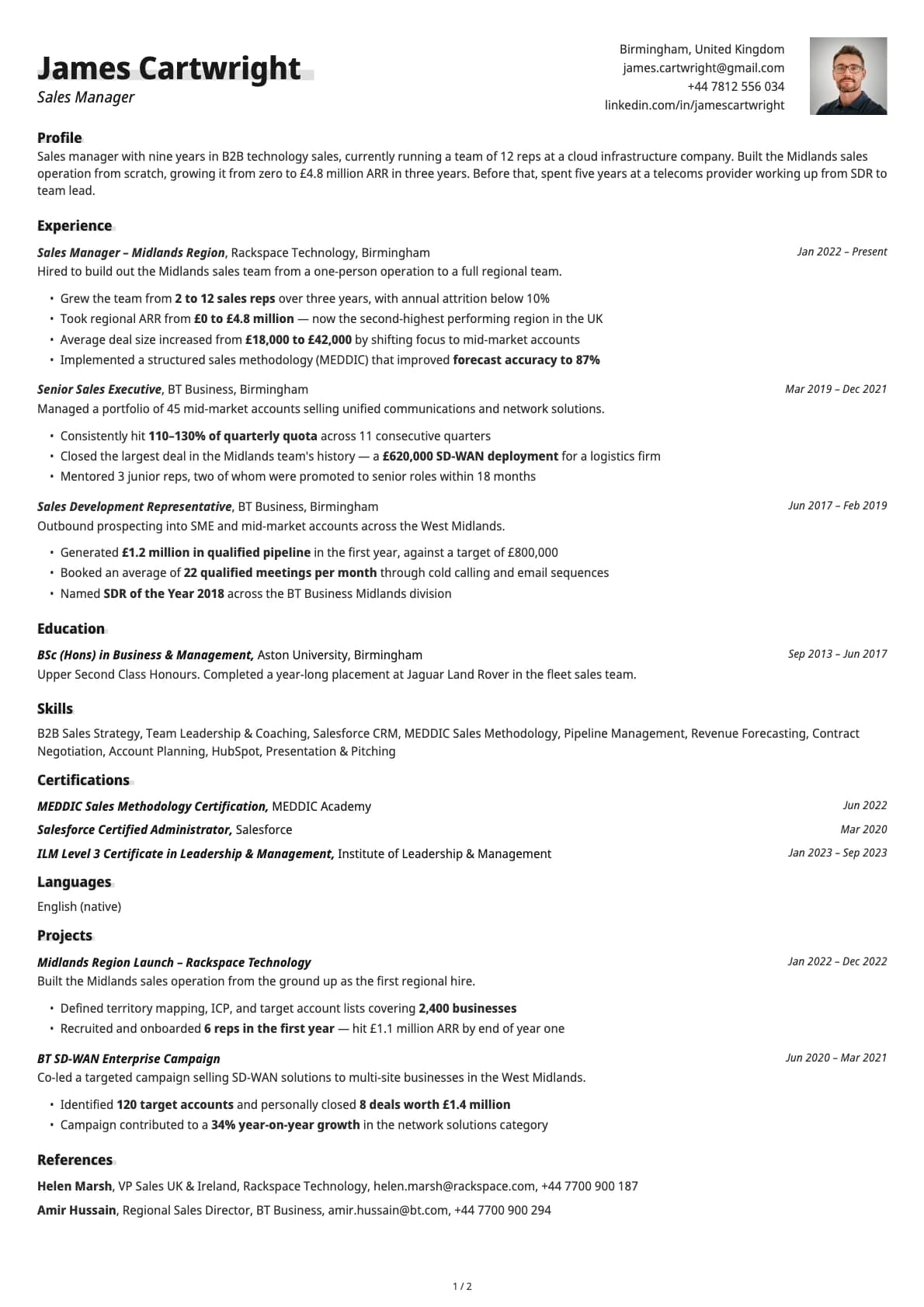
A sales manager resume example with ARR growth, team scaling, and quota attainment numbers.
Retail Manager
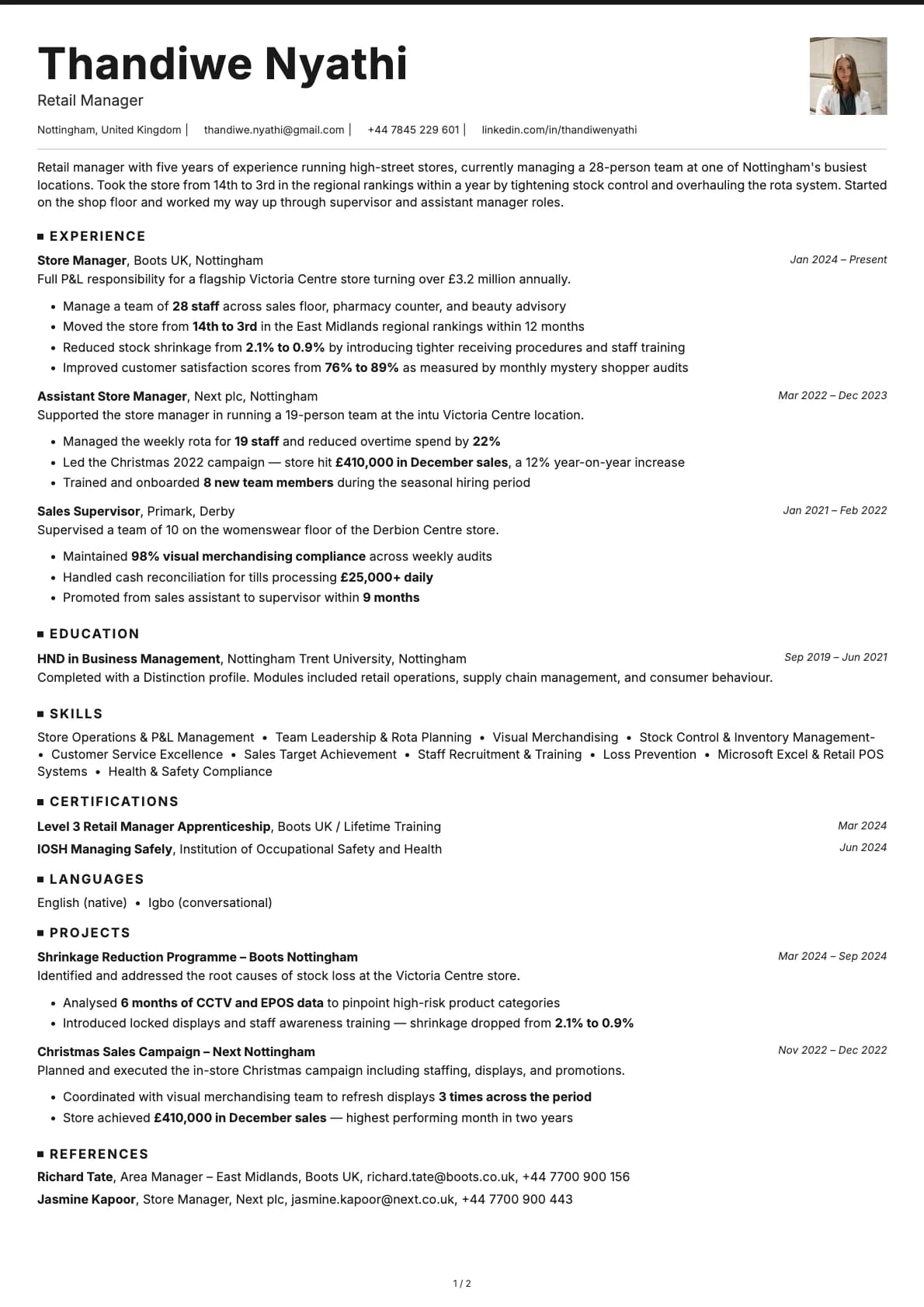
A retail manager resume example showing store rankings, shrinkage reduction, and team leadership.
Real Estate Agent
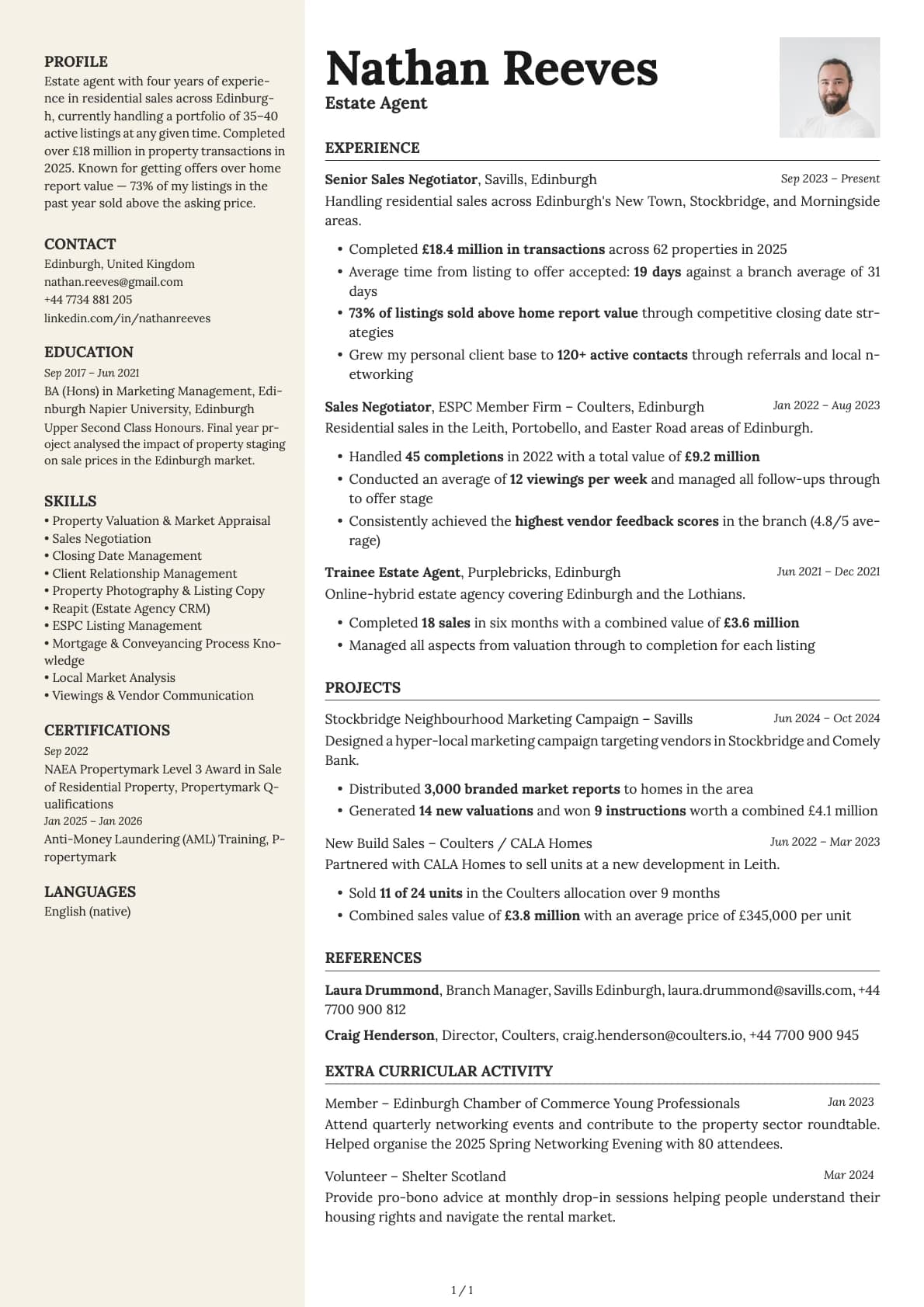
A real estate agent resume example with transaction volumes, local market strategies, and sales metrics from residential property in Edinburgh.
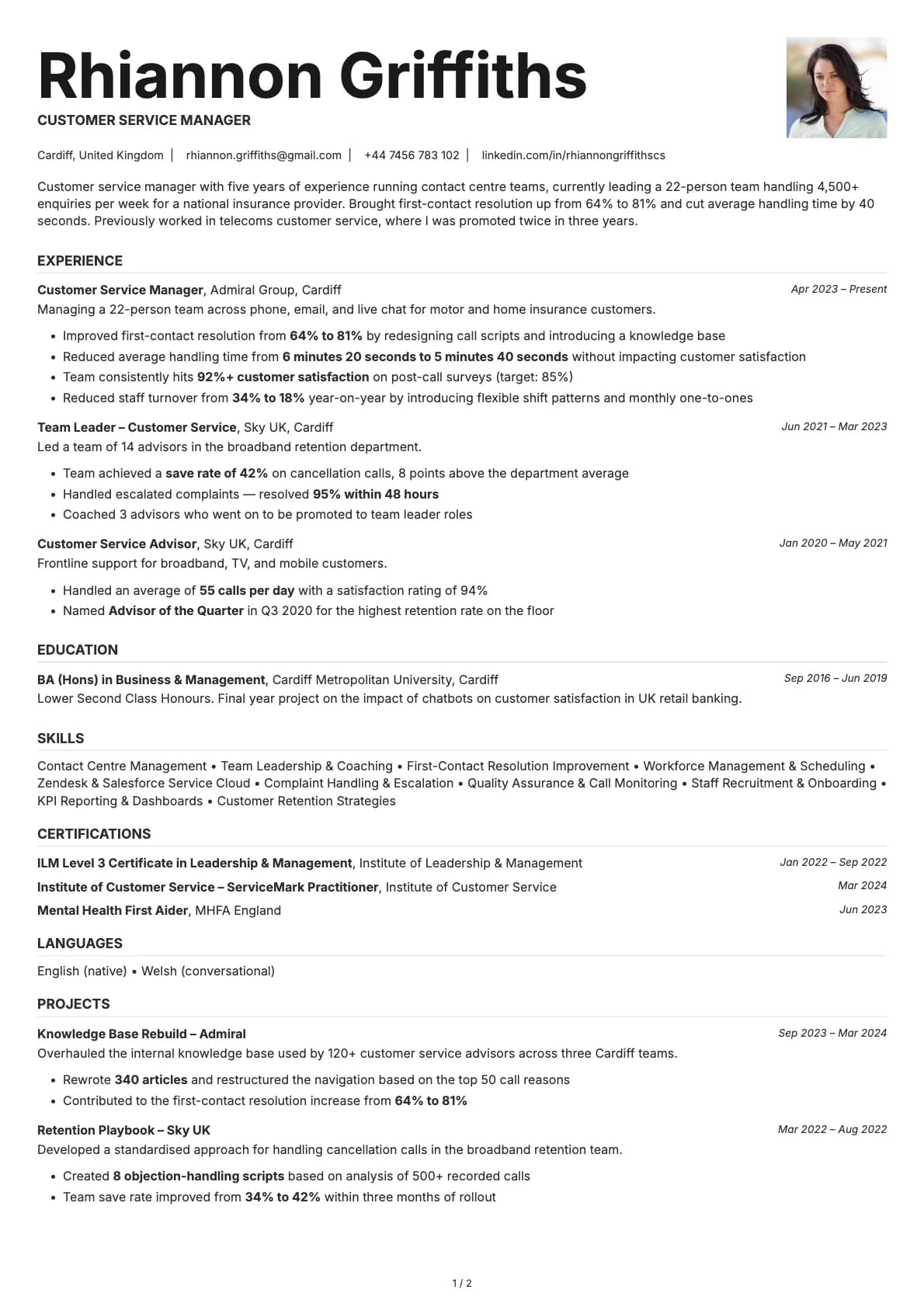
Customer Service Manager
A customer service manager resume example with contact centre experience at Admiral and Sky.
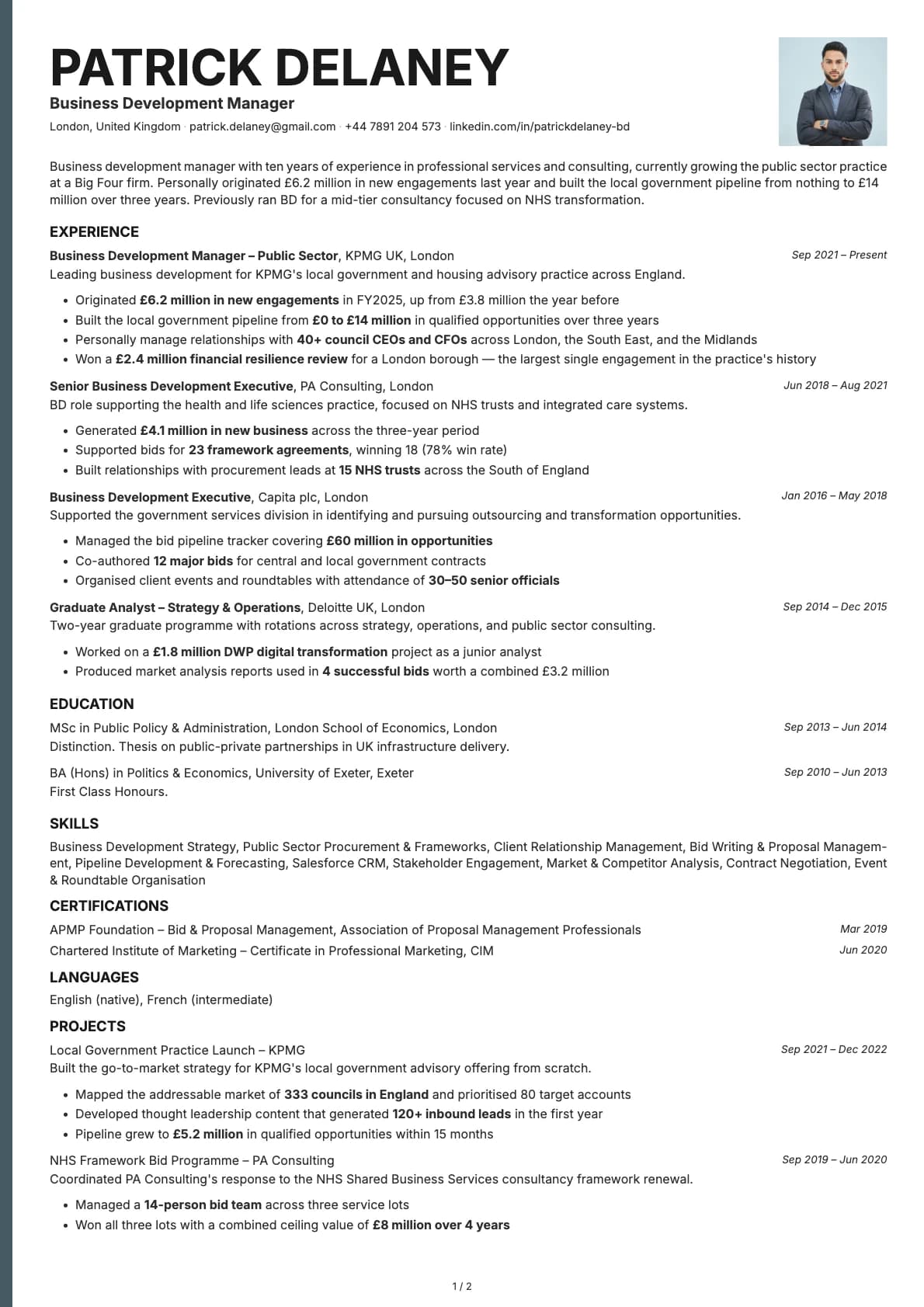
Business Development Manager
A business development manager resume example from professional services with £6.2 million in originated engagements, pipeline building, and public.
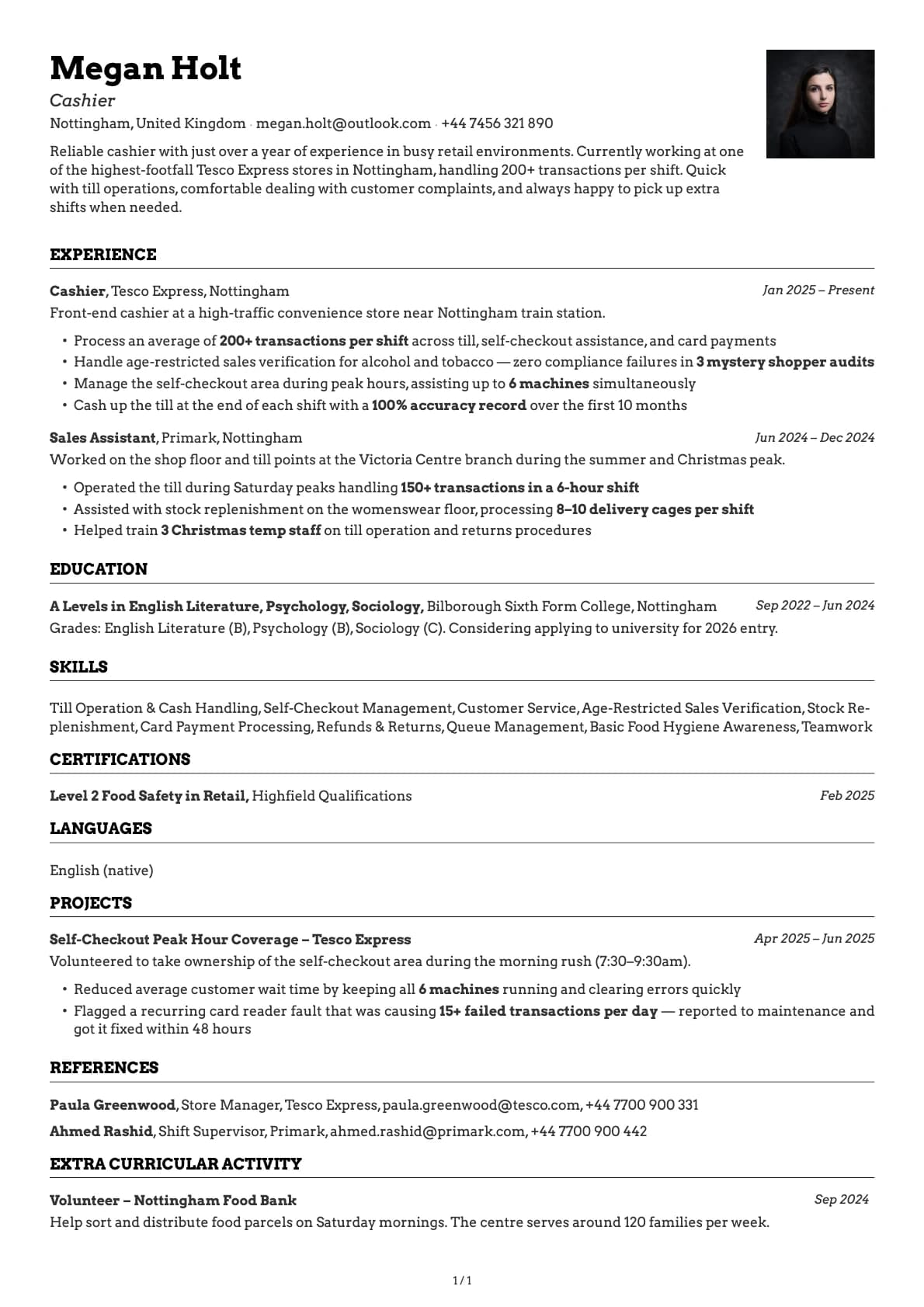
Cashier
A cashier resume example with real retail experience at Tesco and Primark. See how to present transaction volumes, till accuracy, and compliance records.
Related articles

AI Is Screening Your Resume Before Any Human Sees It
AI screens most resumes before a human ever reads them. 97.4% of Fortune 500 companies run an ATS. This is what that means for you and what you can do about it.

The Best Resume Builders in 2026, Compared Honestly
Resume.io, Zety, Enhancv, Kickresume, Teal, and Laddro compared honestly: real pricing, free tiers, mobile apps, and where each tool wins. All prices checked in September 2026.

Burnout Recovery: A Real Timeline, Not 'Take a Bubble Bath'
55% of the U.S. workforce is burned out. Recovery takes 3 to 12 months. Here's what that actually looks like, stage by stage.