Customer Service Manager Resume Example
A customer service manager resume example with contact centre experience at Admiral and Sky.

Laddro Team
Free to use. No account needed to start.
Free to use. No account needed to start.
Overview
Customer service manager resumes tend to fall into one of two traps. Either they read like a frontline advisor resume with a fancier job title, or they are stuffed with buzzwords about "delivering exceptional customer experiences" without a single number to back it up.
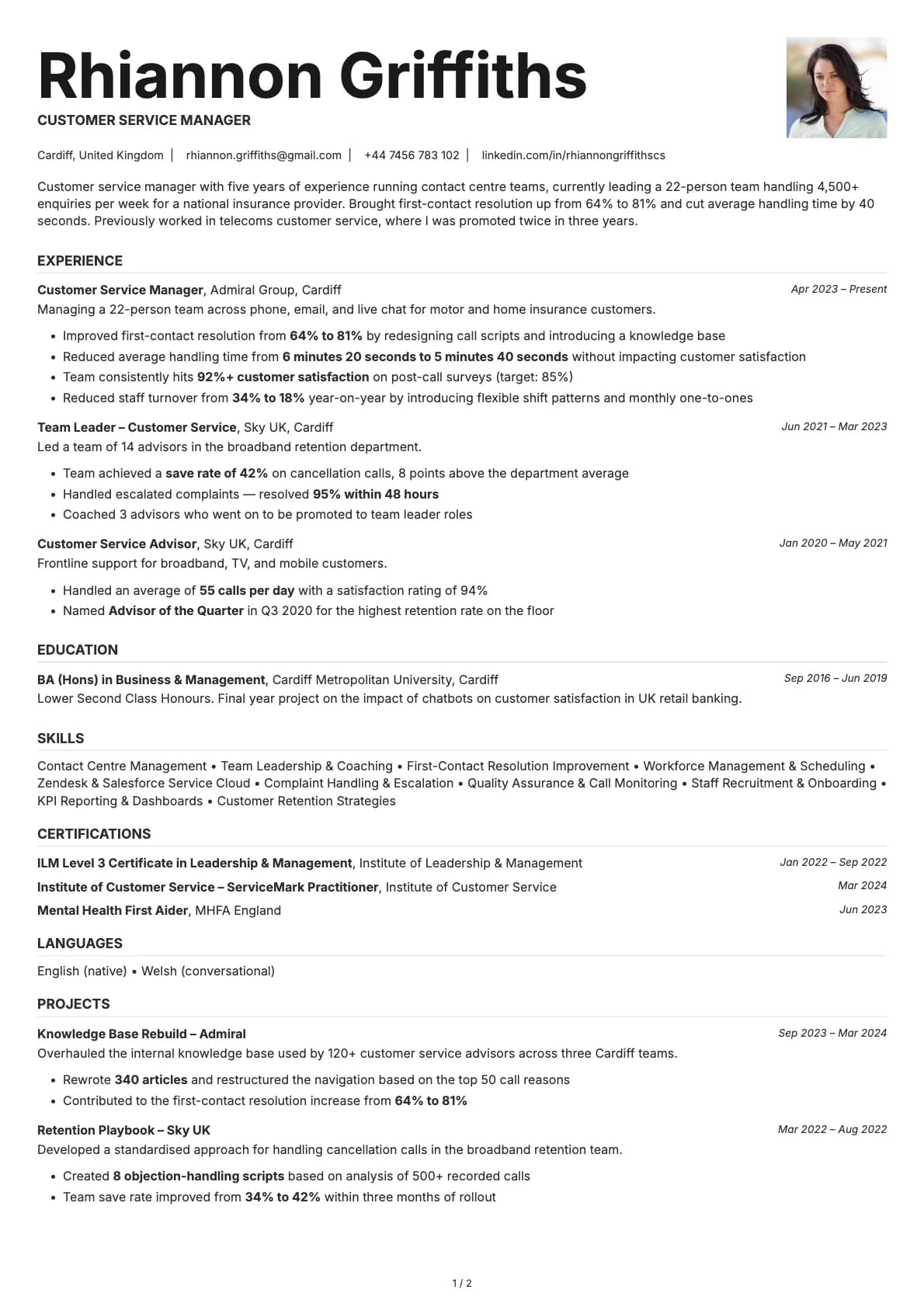
This resume avoids both. It belongs to a customer service manager with five years of experience, currently leading a 22-person team at Admiral Group in Cardiff. Before that, she worked her way up from advisor to team leader at Sky. The resume is full of numbers: first-contact resolution rates, handling times, satisfaction scores, staff turnover figures. It reads like someone who runs their team by the data, which is exactly what hiring managers want to see.
Your summary needs to prove you manage, not just serve
A customer service manager summary should answer: How big is your team? What kind of operation do you run? And what have you improved?
Here is what this resume does:
Customer service manager with five years of experience running contact centre teams, currently leading a 22-person team handling 4,500+ enquiries per week for a national insurance provider. Brought first-contact resolution up from 64% to 81% and cut average handling time by 40 seconds.
Four sentences. Team size, volume, and two measurable improvements. The reader immediately knows this person manages a real operation at meaningful scale.
For your resume: State your team size and the volume of contacts your team handles. Then pick your best 1-2 improvements and express them as before-and-after numbers.
Experience bullets: before and after, always
The strongest bullets on a customer service manager resume show what changed because of your actions. Not what your job was, but what got better.
Look at these:
"Improved first-contact resolution from 64% to 81% by redesigning call scripts and introducing a knowledge base"
"Reduced staff turnover from 34% to 18% year-on-year by introducing flexible shift patterns and monthly one-to-ones"
Each one follows the same pattern: metric improved from X to Y, here is how I did it. This is so much more useful than "managed team performance" or "responsible for improving customer satisfaction."
The "how" matters too. Redesigning call scripts and building a knowledge base shows operational thinking. Introducing flexible shifts shows people management. The hiring manager can picture exactly what this person does day to day.
The formula: Metric + before number + after number + what you changed to get there.
Show your progression from frontline to management
One of the strongest things about this resume is the career path. It starts as a customer service advisor at Sky, moves to team leader, then to manager at Admiral. That tells the hiring manager this person understands every level of the operation.
The advisor role is only two bullets long:
"Handled an average of 55 calls per day with a satisfaction rating of 94%"
"Named Advisor of the Quarter in Q3 2020 for the highest retention rate on the floor"
Short, but it establishes credibility. This person was good at the job before they managed it. If you have a similar progression, do not skip your early roles. Keep them brief but include one standout number or achievement.
Projects show operational thinking
This resume includes two projects: a knowledge base rebuild at Admiral and a retention playbook at Sky. Both show the person going beyond their day-to-day responsibilities to solve a systemic problem.
The knowledge base project is a good example:
"Rewrote 340 articles and restructured the navigation based on the top 50 call reasons"
That tells the reader this person analysed the data, identified the root cause of poor first-contact resolution, and fixed it. The retention playbook shows the same thing: analysing 500+ recorded calls and creating objection-handling scripts that improved save rates from 34% to 42%.
If you have ever built a process, written a training guide, redesigned a workflow, or led a team project, put it on your resume. These projects are what separate a manager from a senior advisor.
Skills: tools and systems matter
Hiring managers for customer service manager roles care about which platforms you know. This resume lists Zendesk and Salesforce Service Cloud. If you have experience with Genesys, Five9, Freshdesk, or any other contact centre platform, list it. Switching systems is expensive and time-consuming, so companies prefer candidates who already know their stack.
Also note the inclusion of "Workforce Management & Scheduling." This is a specific, operational skill that says this person can handle rotas, forecast volumes, and manage capacity. Much more useful than listing "leadership" as a skill.
Mistakes that hold back customer service managers
Writing "managed a team" without saying how big. Team size is the first thing a hiring manager looks for. "Led a 22-person team handling 4,500+ enquiries per week" is specific. "Managed a customer service team" tells them nothing.
No mention of staff development. At manager level, you are expected to grow your people. This resume mentions coaching 3 advisors who went on to be promoted. If you have trained, mentored, or promoted anyone, include it.
Listing customer satisfaction without a number. "Maintained high customer satisfaction" is meaningless without a percentage. "Team consistently hits 92%+ customer satisfaction on post-call surveys (target: 85%)" gives the reader something to evaluate.
Ignoring turnover and retention. Contact centres have notoriously high turnover. If you have reduced it, that is one of the most valuable things you can put on your resume. This person took turnover from 34% to 18%. That saves thousands in recruitment and training costs.
One more thing
Customer service management is a numbers game. Every aspect of the job can be measured: resolution rates, handling times, satisfaction scores, turnover, adherence, utilisation. Your resume should reflect that. If you do not have specific numbers, start tracking them now. Even a few months of data gives you something concrete to put on your next application.
Build your own version
Open this layout in the builder and swap in your own details. It takes a few minutes.
Free to use. No account needed to start.
Was this resume example helpful?
Rate this example to help us create better content for you.
4.7 average from 143 ratingsRelated resume examples
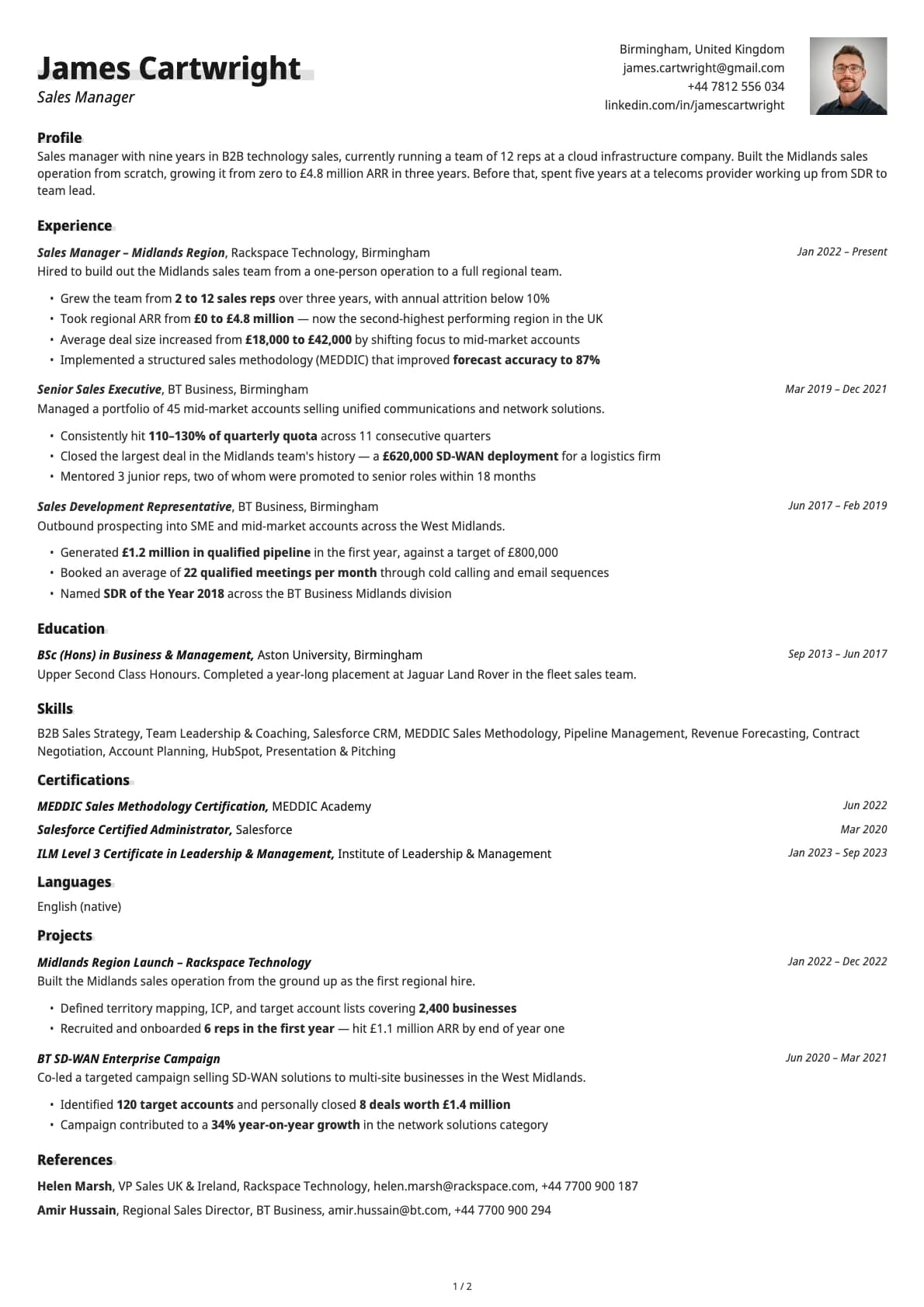
Sales Manager
A sales manager resume example with ARR growth, team scaling, and quota attainment numbers.
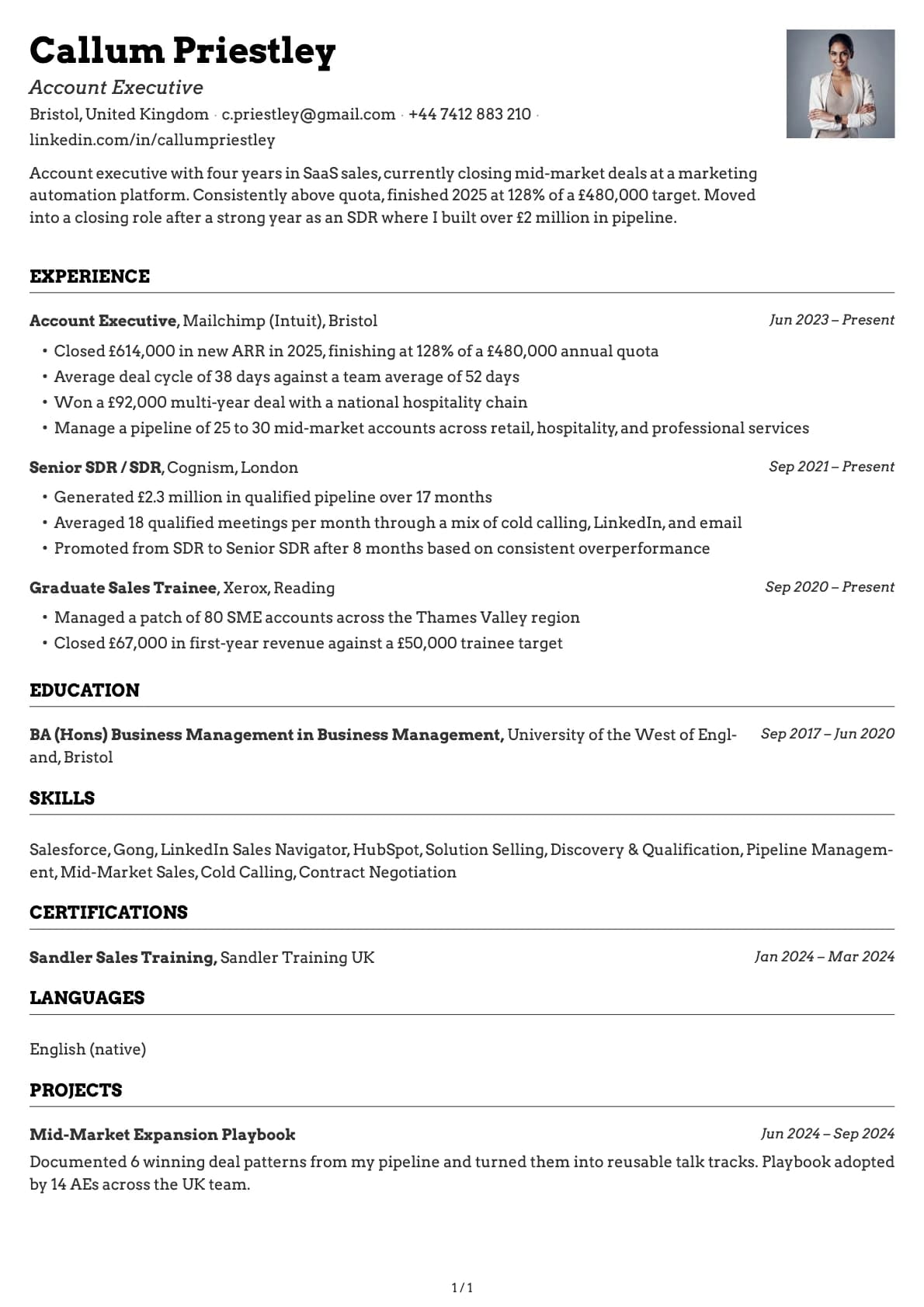
Account Executive
An account executive resume example with SaaS sales experience, quota attainment figures, and pipeline numbers that actually make hiring managers pick up.
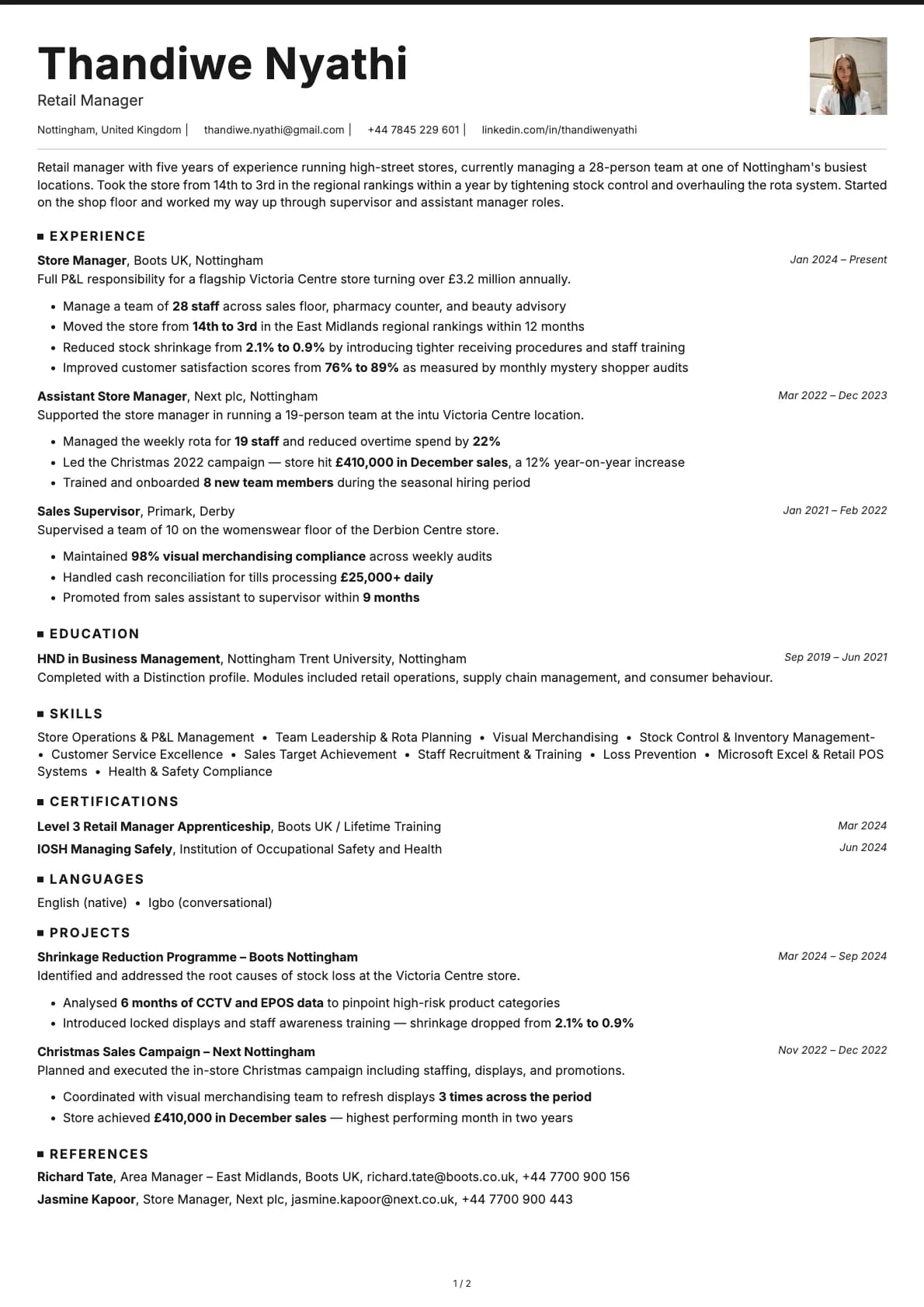
Retail Manager
A retail manager resume example showing store rankings, shrinkage reduction, and team leadership.
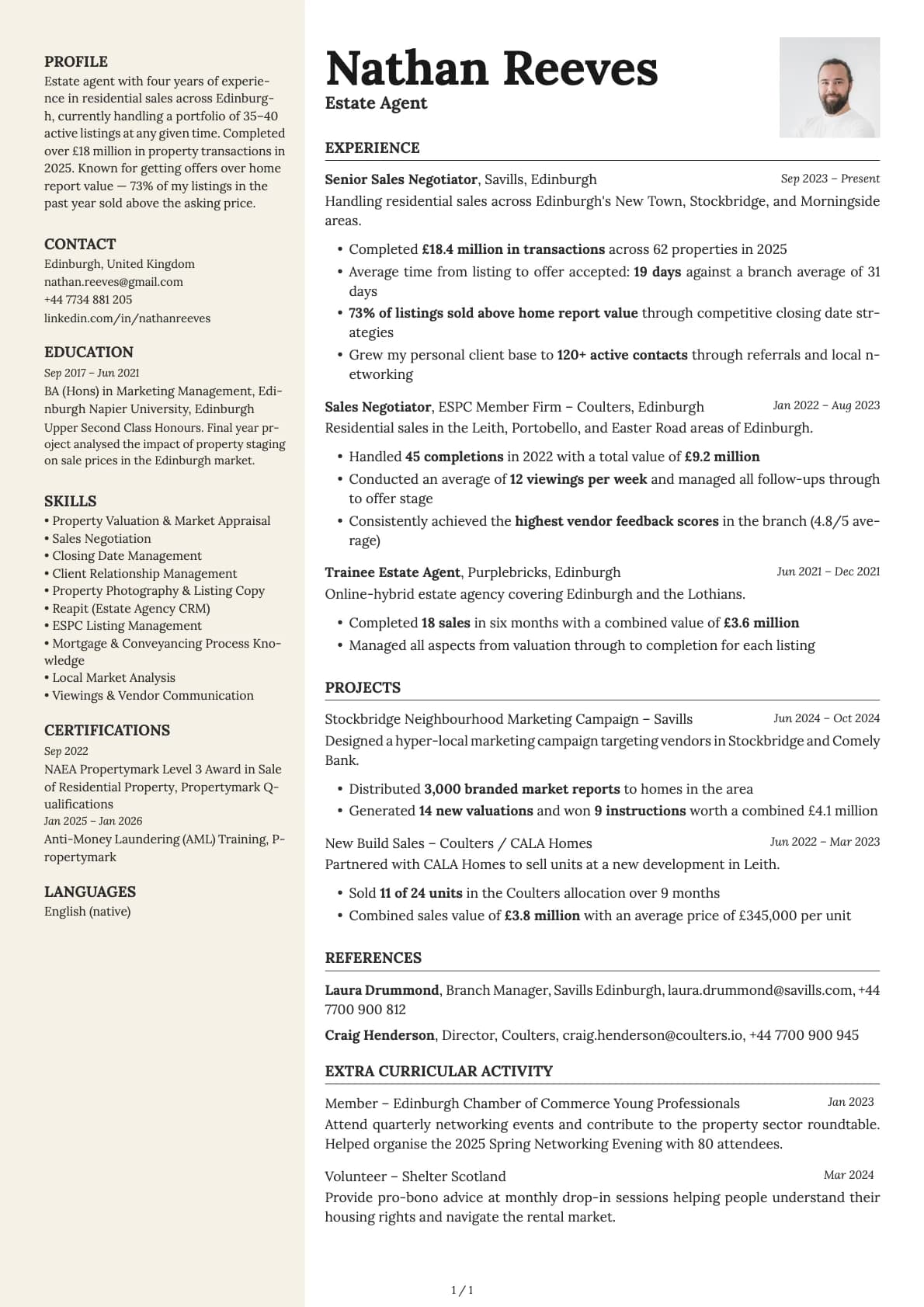
Real Estate Agent
A real estate agent resume example with transaction volumes, local market strategies, and sales metrics from residential property in Edinburgh.
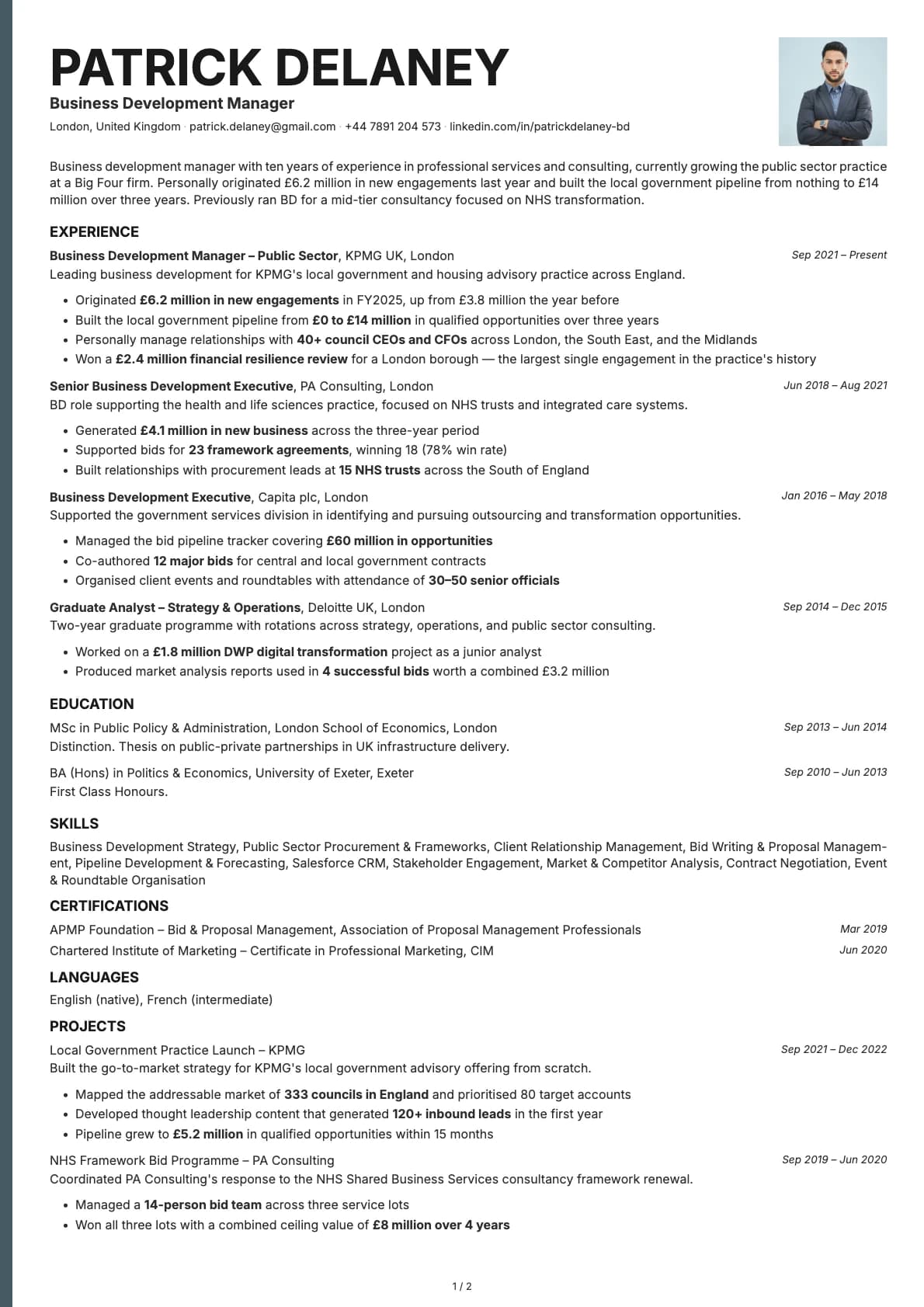
Business Development Manager
A business development manager resume example from professional services with £6.2 million in originated engagements, pipeline building, and public.
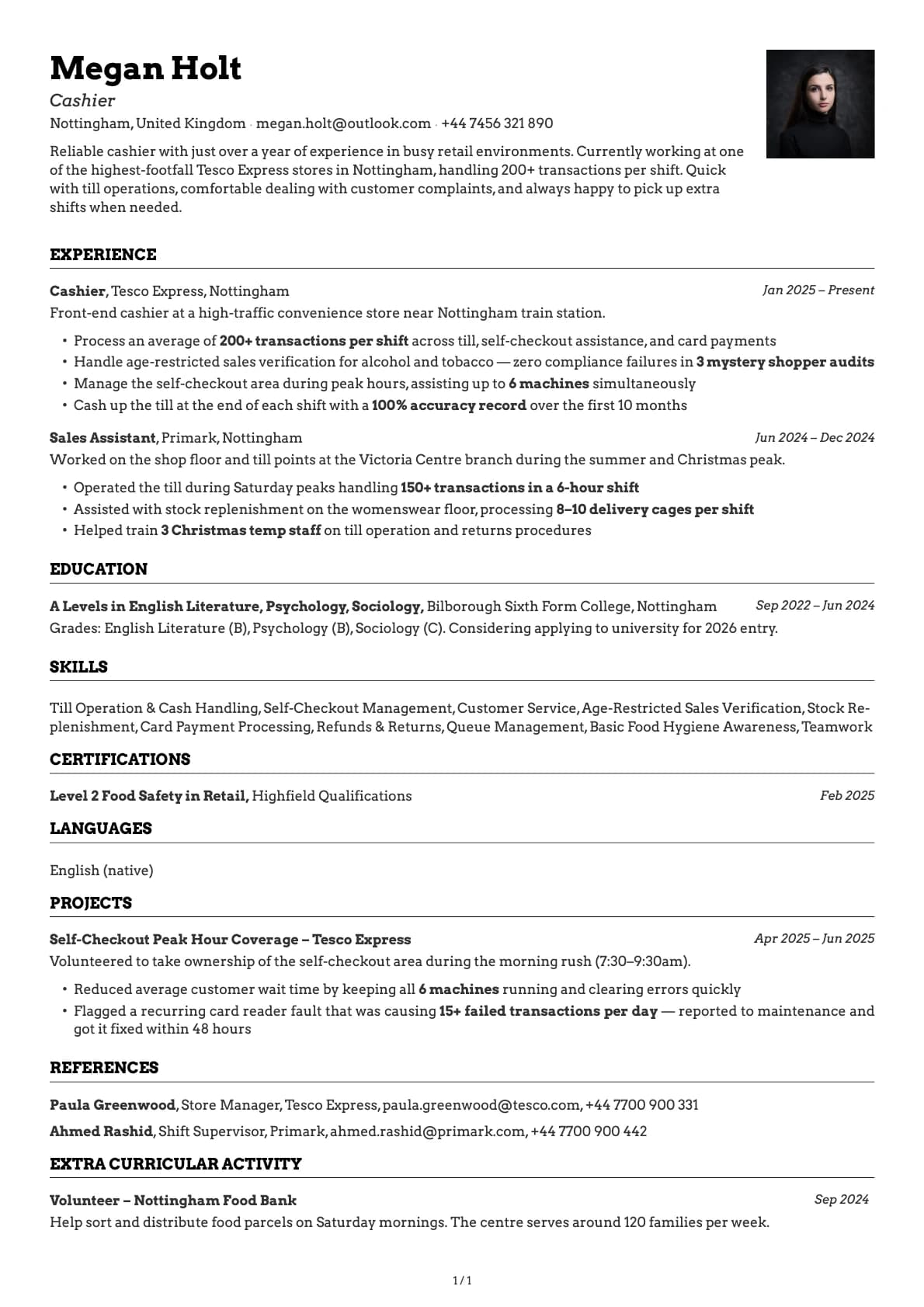
Cashier
A cashier resume example with real retail experience at Tesco and Primark. See how to present transaction volumes, till accuracy, and compliance records.
Related articles

AI Is Screening Your Resume Before Any Human Sees It
AI screens most resumes before a human ever reads them. 97.4% of Fortune 500 companies run an ATS. This is what that means for you and what you can do about it.

The Best Resume Builders in 2026, Compared Honestly
Resume.io, Zety, Enhancv, Kickresume, Teal, and Laddro compared honestly: real pricing, free tiers, mobile apps, and where each tool wins. All prices checked in September 2026.

Burnout Recovery: A Real Timeline, Not 'Take a Bubble Bath'
55% of the U.S. workforce is burned out. Recovery takes 3 to 12 months. Here's what that actually looks like, stage by stage.