Executive Assistant Resume Example
An executive assistant resume example supporting C-suite leaders in financial services.

Laddro Team
Free to use. No account needed to start.
Free to use. No account needed to start.
Overview
Executive assistant resumes have a credibility problem. The job involves a huge amount of invisible work. You keep things running, prevent problems before they happen, and make senior leaders more effective. But when it comes time to write a resume, most EAs end up with bullet points like "provided administrative support to senior management." That could mean anything from making coffee to managing a £180 million deal process.
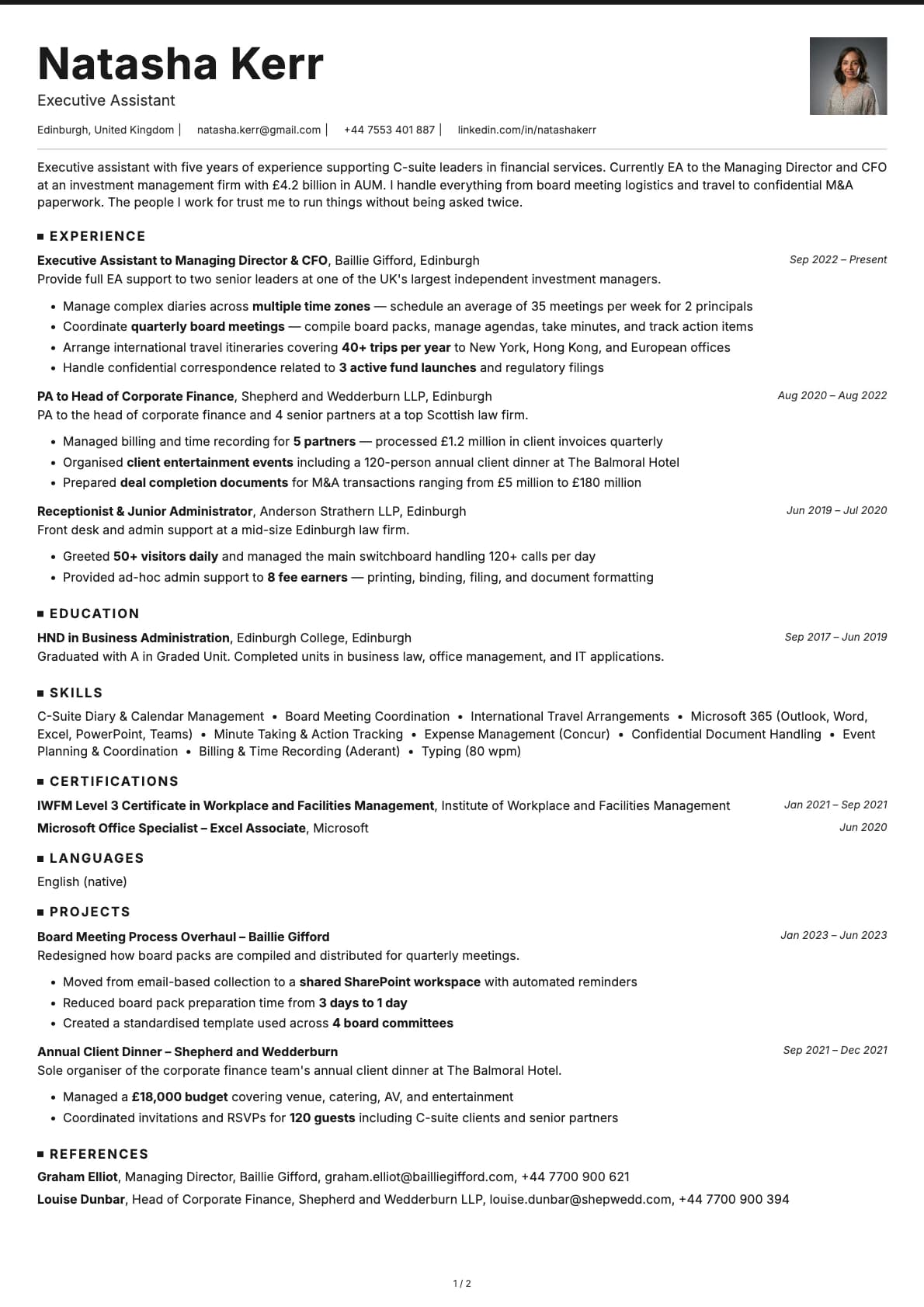
This resume belongs to Natasha, an executive assistant with five years of experience in Edinburgh's financial and legal sectors. She currently supports the Managing Director and CFO at Baillie Gifford, one of the UK's largest investment managers. Before that, she was PA to the head of corporate finance at a top Scottish law firm. The resume works because it turns invisible work into visible achievements using numbers, names, and specific processes.
Let us break down what you should take from this example.
Name who you support and why it matters
The most important thing on an EA resume is who you work for. Not just their title, but the context around it.
From this resume's summary:
Currently EA to the Managing Director and CFO at an investment management firm with £4.2 billion in AUM.
One sentence and the recruiter already knows: this person supports two senior executives, the company manages serious money, and she is trusted at the highest level. That is more powerful than "EA to senior leadership" because it gives scale.
For your summary: Name the titles of the people you support. Add one detail about the company that shows scale (revenue, headcount, AUM, number of offices). Then mention the most complex part of your work. Keep it to three or four sentences.
Turn daily tasks into measurable bullets
EA work is repetitive by nature. You manage diaries, book travel, handle correspondence. But the way you describe these tasks makes all the difference.
Here is a weak version: "Managed senior leaders' calendars."
Here is the version from this resume:
Manage complex diaries across multiple time zones. Schedule an average of 35 meetings per week for 2 principals.
Same task. But now there is a number (35 meetings), a complexity factor (multiple time zones), and a scope (2 principals). The recruiter can picture the workload.
Another example:
Arrange international travel itineraries covering 40+ trips per year to New York, Hong Kong, and European offices
The number of trips, the destinations, and the word "international" all add weight. If you book travel, count up how many trips you arrange in a year and list the key destinations.
The formula: The routine task + A number that shows volume + A detail that shows complexity.
Board meetings: your secret weapon
If you coordinate board meetings, this is one of the most impressive things you can put on an EA resume. Board coordination involves managing senior stakeholders, handling confidential material, keeping to strict deadlines, and often minute-taking.
From this resume:
Coordinate quarterly board meetings. Compile board packs, manage agendas, take minutes, and track action items.
And from the projects section:
Moved from email-based collection to a shared SharePoint workspace with automated reminders. Reduced board pack preparation time from 3 days to 1 day.
That project bullet is excellent. It takes a routine process (compiling a board pack), shows the problem (3 days of manual work), explains the solution (SharePoint workspace), and gives the result (1 day). If you have ever improved a process, even a small one, write it up like this.
Confidential work: how to mention it without saying too much
EAs often handle sensitive information. You cannot name specific deals or share financial details. But you can indicate the level of trust.
Handle confidential correspondence related to 3 active fund launches and regulatory filings
This tells the recruiter: this person is trusted with market-sensitive information. She knows what fund launches and regulatory filings involve. That signals seniority without breaking any confidentiality.
If you handle confidential work, find a way to indicate the type (M&A, legal, regulatory, HR) and the volume without revealing specifics.
Skills: show the tools, not the traits
This resume lists 10 skills. Almost all are practical: diary management, board coordination, travel arrangements, Microsoft 365, minute taking, Concur, document handling, event planning, billing software, and typing speed.
Notice what is NOT listed: "excellent communication skills," "attention to detail," "strong organisational skills." Every EA can claim those. Instead, list the tools and processes you actually use. Concur, Aderant, SAP, SharePoint, Oracle. If you type at 80 wpm, include it. That is a verifiable skill that not everyone has.
The career progression from receptionist to C-suite EA
This resume shows a clear path: receptionist at a law firm, then PA to partners, then EA to an MD and CFO. Each step up came with a bigger scope of work and more senior principals.
If you have a similar progression, make sure the trajectory is visible. Describe each role at the appropriate level. The receptionist role mentions "50+ visitors daily" and "120+ calls per day." The PA role mentions "£1.2 million in client invoices." The EA role mentions "£4.2 billion in AUM." The numbers scale with the seniority.
Mistakes that hold EAs back
Describing yourself as "just an admin." If you manage board meetings, handle M&A documents, and coordinate international travel for C-suite executives, that is not admin. Describe the actual responsibility.
Not mentioning the company or industry. An EA at a 20-person startup and an EA at Baillie Gifford are doing very different jobs. The company name and industry give essential context.
Leaving out events you have organised. If you have planned a 120-person client dinner at The Balmoral Hotel on an £18,000 budget (like this resume shows), that is event management. Include it.
Using a creative template. EA roles in finance and law expect a polished, conservative presentation. This resume uses Graphite, a clean single-column layout. Let the content do the work.
One last thing
Your references matter more in EA roles than in most other professions. An EA's value is built on trust, and a strong reference from a principal you supported can make or break an application. Keep your references current, and make sure the people you list would actually speak highly of you if called.
Build your own version
Open this layout in the builder and swap in your own details. It takes a few minutes.
Free to use. No account needed to start.
Was this resume example helpful?
Rate this example to help us create better content for you.
4.8 average from 168 ratingsRelated resume examples
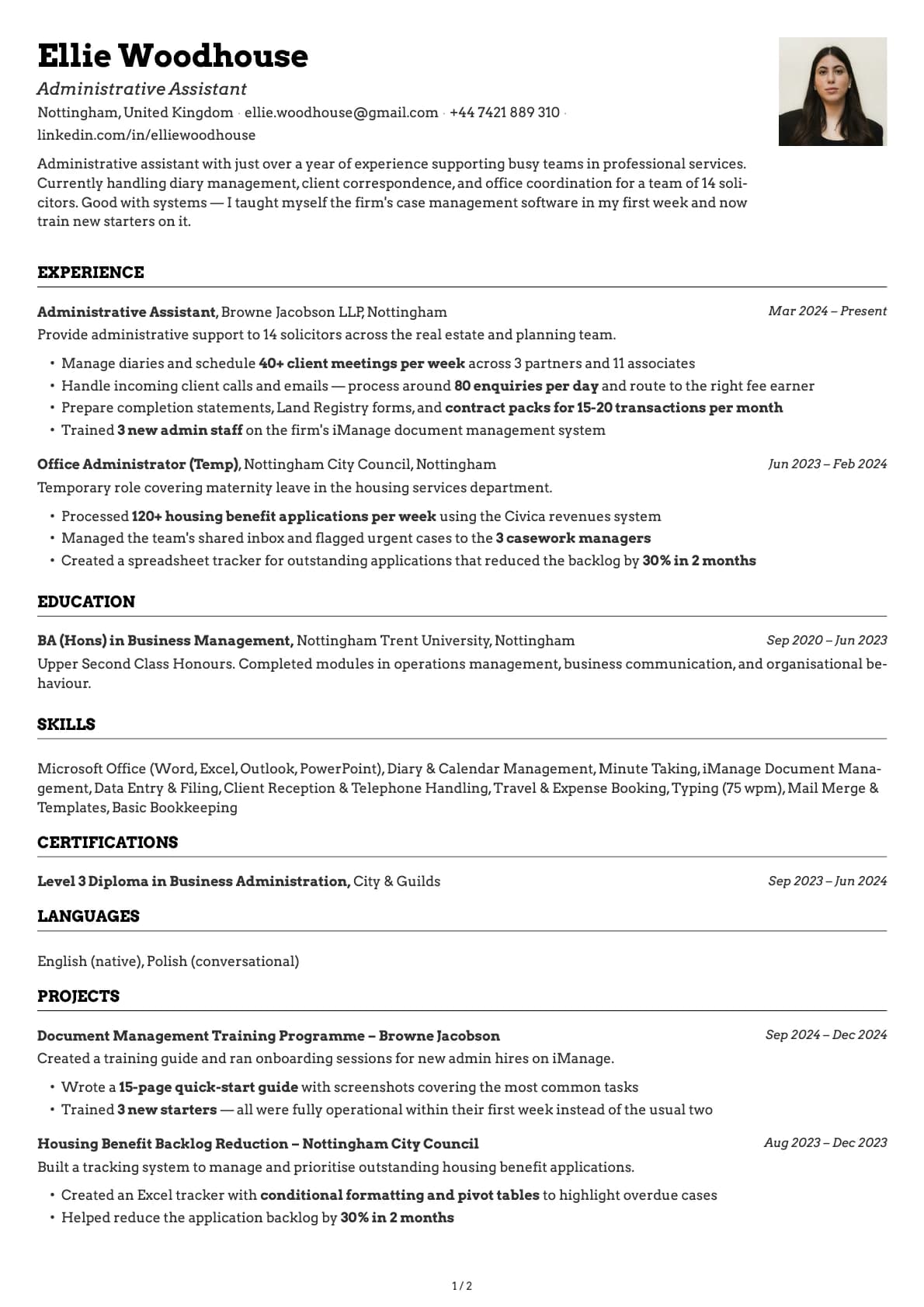
Administrative Assistant
An administrative assistant resume example with law firm experience, showing how to present volume of work, systems knowledge.
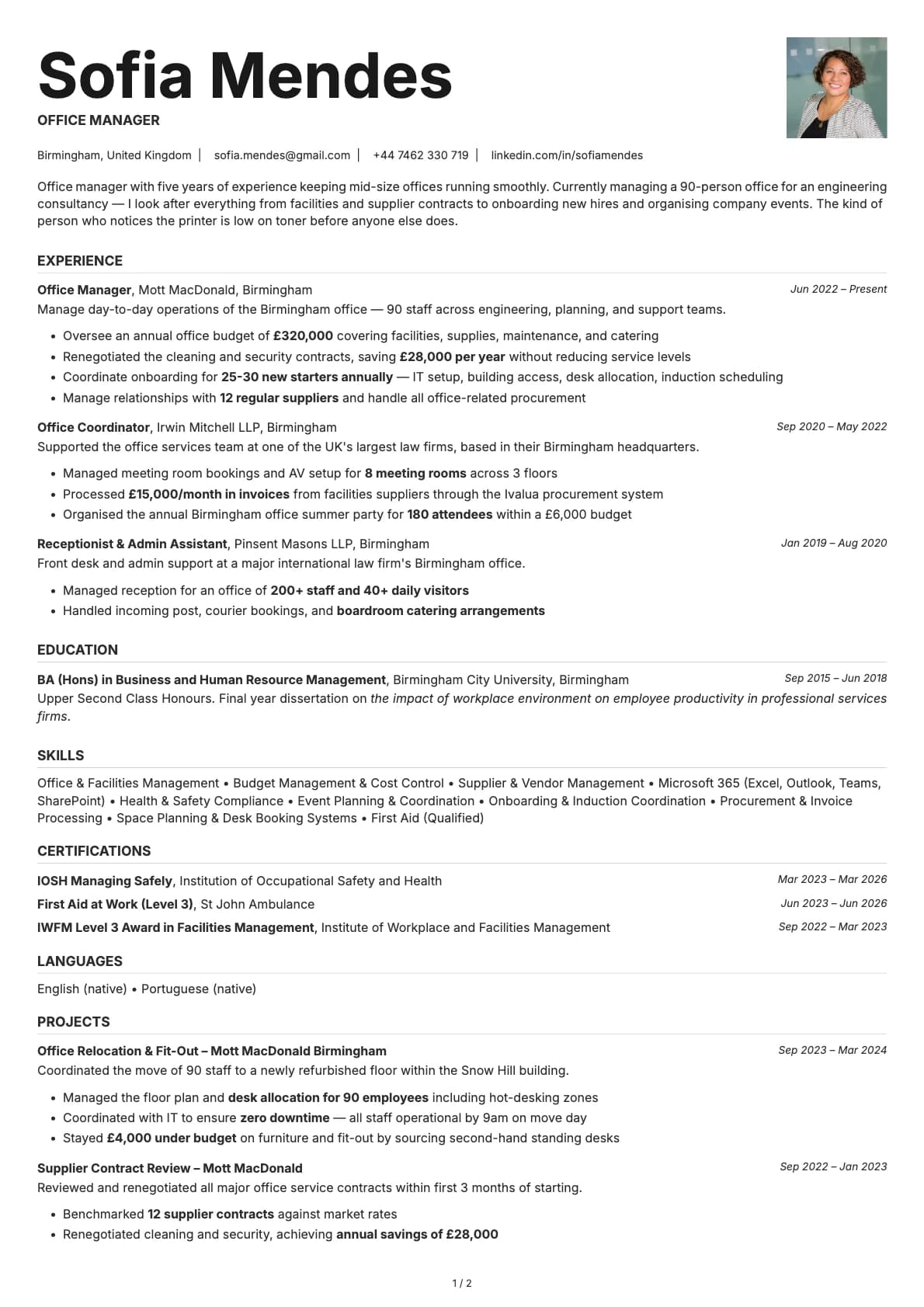
Office Manager
An office manager resume example with budget management, supplier negotiations, and onboarding coordination.
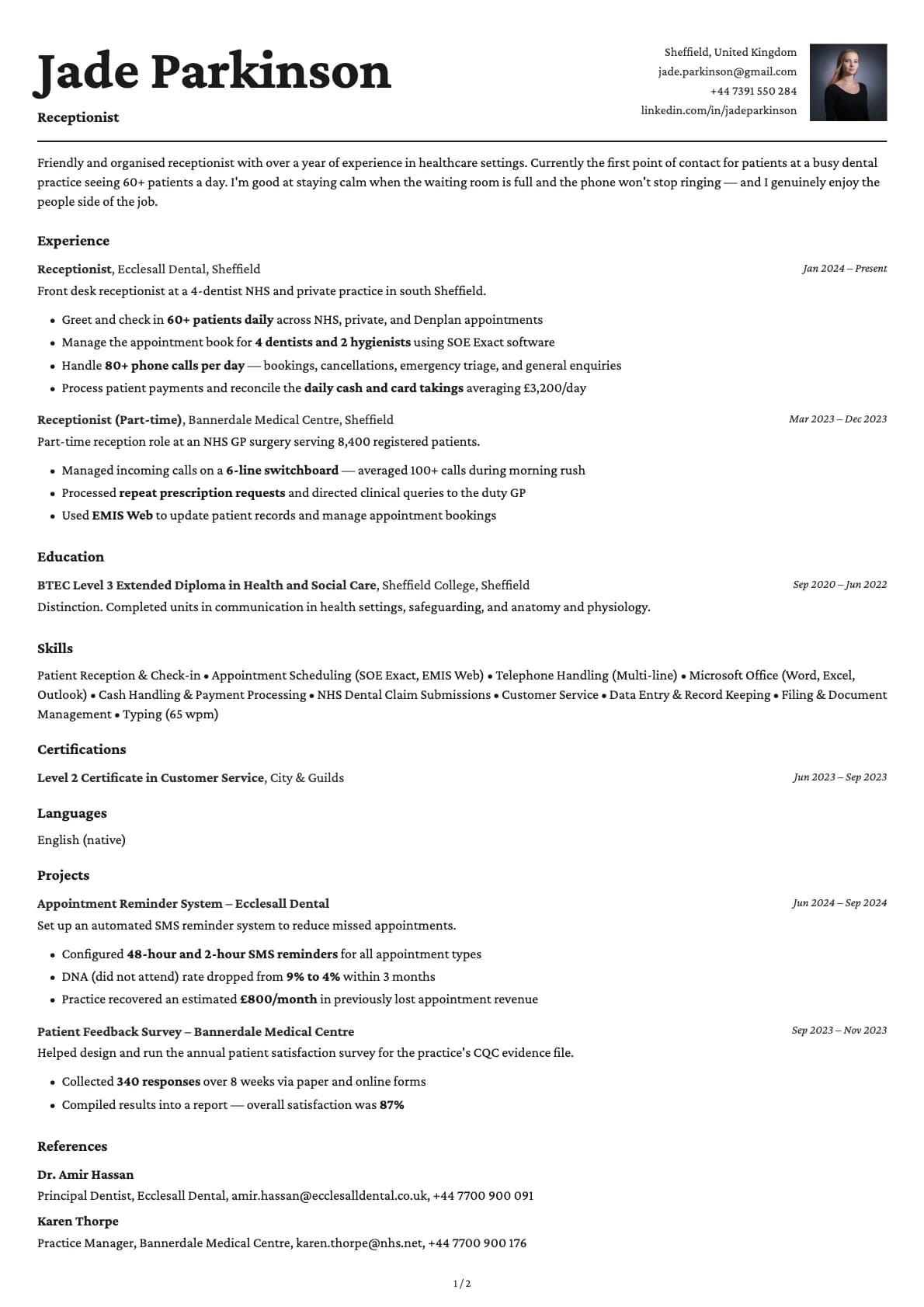
Receptionist
A receptionist resume example from a healthcare setting with patient volumes, phone handling stats, and a process improvement that cut missed.
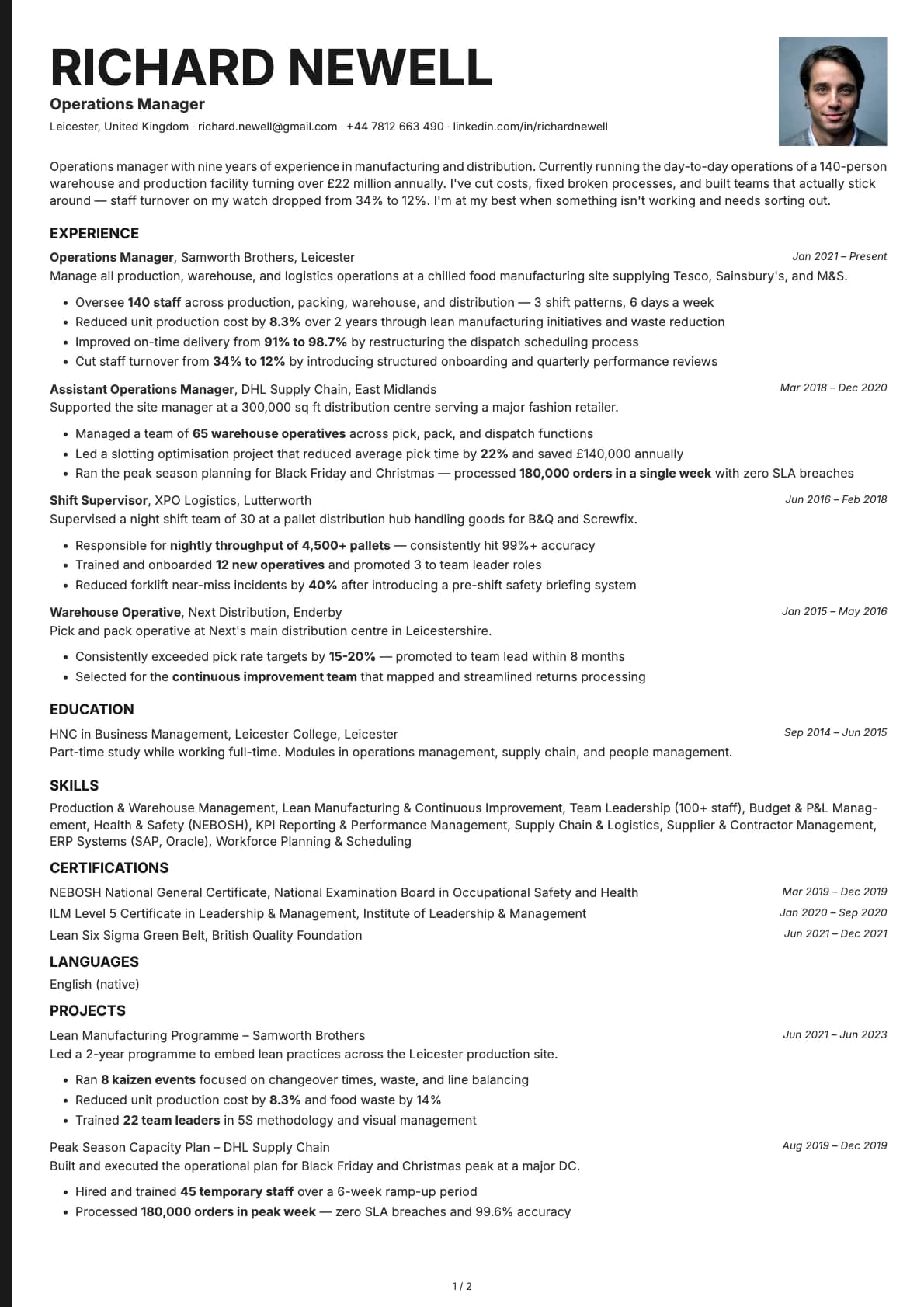
Operations Manager
An operations manager resume example with production KPIs, lean manufacturing results, and team leadership numbers.
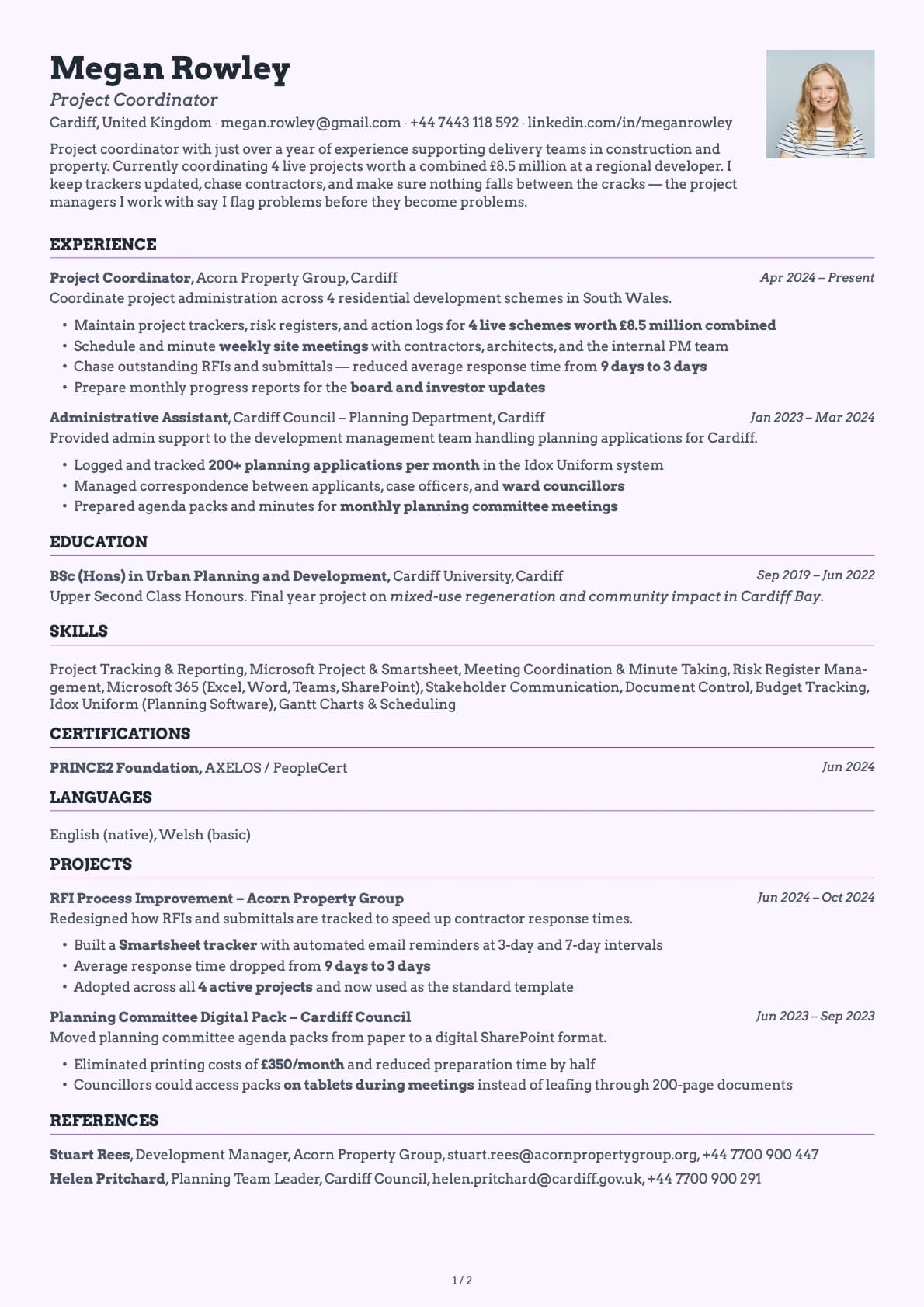
Project Coordinator
A project coordinator resume example with construction project tracking, process improvements, and real cost savings from an early-career professional.
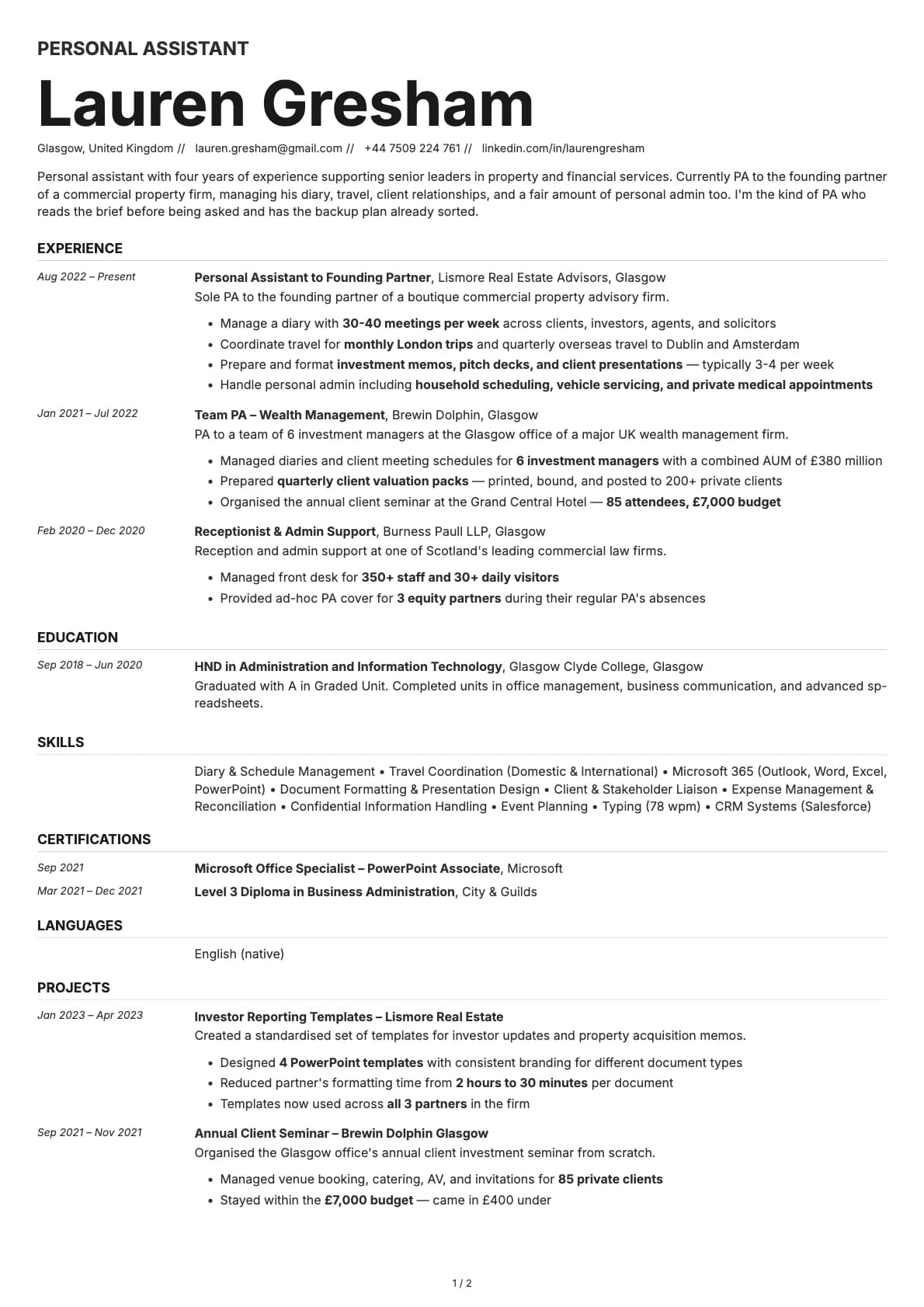
Personal Assistant
A personal assistant resume example showing how to present diary management, event coordination, and executive support with real numbers.
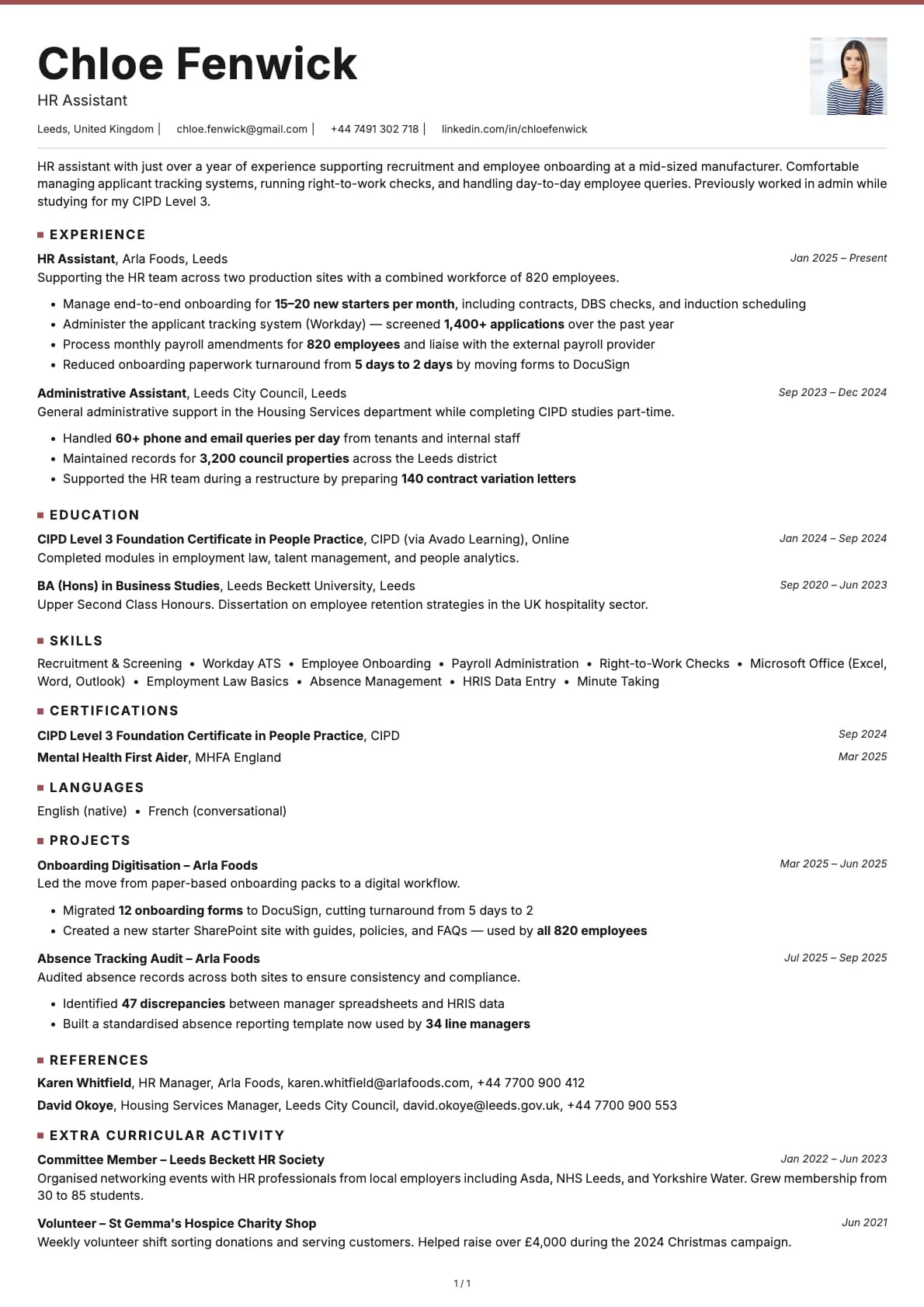
HR Assistant
An HR assistant resume example with onboarding metrics, ATS screening numbers, and a CIPD Level 3 qualification.
Related articles

AI Is Screening Your Resume Before Any Human Sees It
AI screens most resumes before a human ever reads them. 97.4% of Fortune 500 companies run an ATS. This is what that means for you and what you can do about it.

The Best Resume Builders in 2026, Compared Honestly
Resume.io, Zety, Enhancv, Kickresume, Teal, and Laddro compared honestly: real pricing, free tiers, mobile apps, and where each tool wins. All prices checked in September 2026.

Burnout Recovery: A Real Timeline, Not 'Take a Bubble Bath'
55% of the U.S. workforce is burned out. Recovery takes 3 to 12 months. Here's what that actually looks like, stage by stage.