Event Manager Resume Example
An event manager resume example with conference and wedding planning experience.

Laddro Team
Free to use. No account needed to start.
Free to use. No account needed to start.
Overview
Event management resumes tend to fall into two categories. There are the ones that read like a party planning Pinterest board, all enthusiasm and zero specifics. And there are the ones that look like they were written by a project manager, full of bullet points about "stakeholder engagement" and "cross-functional collaboration." Neither works well.
The good ones sit somewhere in the middle. They show you can plan, deliver, and measure events using real numbers.
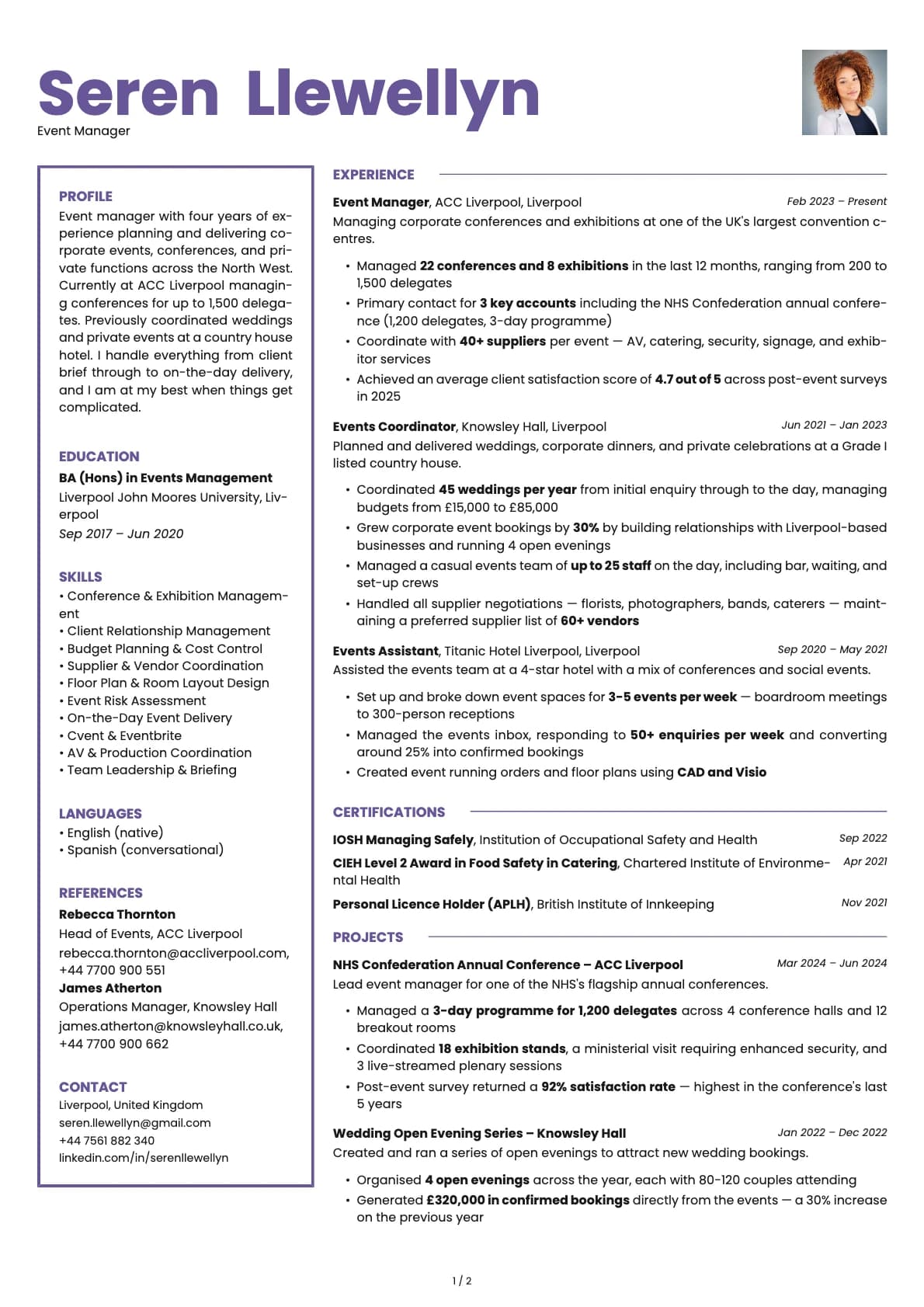
This resume belongs to Seren, an event manager with four years of experience based in Liverpool. She currently manages conferences and exhibitions at ACC Liverpool, one of the UK's largest convention centres. Before that, she coordinated weddings and private events at Knowsley Hall. The resume works because it treats events like business projects: there are delegate numbers, budgets, supplier counts, and satisfaction scores.
Here is how to build a resume like this for your own event career.
Your summary should answer: how big, how many, and what kind?
Event management is broad. Someone running 50-person board meetings is doing a completely different job from someone managing a 1,500-delegate conference. Your summary needs to tell the recruiter exactly where you sit on that spectrum.
From this resume:
Event manager with four years of experience planning and delivering corporate events, conferences, and private functions across the North West. Currently at ACC Liverpool managing conferences for up to 1,500 delegates.
Two sentences. The recruiter now knows: four years of experience, corporate and private events, conferences up to 1,500 people, venue-side experience at a major convention centre. That is enough context to decide whether to keep reading.
For yours: State your experience, name the event types you handle, give your largest event size, and name your current venue or company if it is recognisable.
Writing experience bullets with real scale
The biggest problem with event manager resumes is vague bullets. "Coordinated events from planning through to delivery" could describe anyone from a volunteer organiser to a director.
Here is what specific looks like:
Managed 22 conferences and 8 exhibitions in the last 12 months, ranging from 200 to 1,500 delegates
That tells the recruiter exactly how many events you run per year and the size range. Volume matters in events. If you handle 30 events a year, say 30.
Another strong bullet:
Coordinate with 40+ suppliers per event. AV, catering, security, signage, and exhibitor services.
Naming the supplier types shows the complexity of the events you manage. A 40-supplier event is operationally very different from a 5-supplier one.
The formula: Number of events + Delegate/guest range + Number of suppliers or team size + Any notable clients or outcomes.
Budgets are your best friend
In events, budgets tell the story of your responsibility level. This resume uses them throughout:
Coordinated 45 weddings per year from initial enquiry through to the day, managing budgets from £15,000 to £85,000
Managed a casual events team of up to 25 staff on the day
The budget range is especially useful because it shows the candidate can scale up and down. A £15,000 wedding and an £85,000 wedding require very different approaches, and saying you handled both shows flexibility.
If you manage event budgets, include the range. If you manage overall venue revenue, even better. The project in this resume that generated "£320,000 in confirmed bookings" from four open evenings is a perfect example of tying events to business outcomes.
Client satisfaction and feedback scores
Events are a service industry. If you have feedback scores, use them.
Achieved an average client satisfaction score of 4.7 out of 5 across post-event surveys in 2025
And from the NHS conference project:
Post-event survey returned a 92% satisfaction rate. Highest in the conference's last 5 years.
These numbers are hard to argue with. If you collect post-event feedback (and you should), summarise the best results on your resume.
Certifications that event employers look for
This resume lists three certifications that are directly relevant to the role: IOSH Managing Safely, CIEH Level 2 Food Safety, and a Personal Licence (APLH).
These might seem like small things, but they matter. Many event venues require the person running the event to hold a personal licence. Health and safety training (IOSH) shows you understand risk assessments, which is a legal requirement for any public event. Food safety certification is relevant if your events involve catering.
If you hold any of these, list them. If you do not, they are all relatively quick to obtain and they fill gaps in your resume nicely.
Earlier roles: show the progression
The events assistant role at Titanic Hotel Liverpool shows a typical entry point:
Set up and broke down event spaces for 3-5 events per week. Boardroom meetings to 300-person receptions.
Managed the events inbox, responding to 50+ enquiries per week and converting around 25% into confirmed bookings
Even at the assistant level, there are numbers to use. Enquiry volume, conversion rate, event frequency. These show the recruiter that you were doing real work, not just carrying chairs.
Mistakes that lose you interviews
Not naming the event types. "Corporate events" covers everything from a team away-day to a 3,000-person exhibition. Be specific. Conferences, weddings, exhibitions, product launches, gala dinners. Name the ones you actually do.
Forgetting the on-the-day delivery. Planning is only half the job. If you manage events on the day (team briefings, supplier coordination, troubleshooting), make sure that comes through in your bullets.
Leaving out supplier management. The ability to manage multiple vendors simultaneously is a core skill. If you maintain a preferred supplier list, coordinate with caterers, AV companies, and security, say so and include the numbers.
Using an over-designed template. Events people sometimes go for visually heavy resumes. Resist the urge. A clean layout that is easy to scan will always outperform a beautiful PDF that an ATS cannot read.
One more thing
If you have worked on a well-known event, name it. The NHS Confederation annual conference is immediately recognisable in the events industry. If you have managed events for a known brand or at a recognisable venue, that name does some of the selling for you. Do not hide it in a generic bullet.
Build your own version
Open this layout in the builder and swap in your own details. It takes a few minutes.
Free to use. No account needed to start.
Was this resume example helpful?
Rate this example to help us create better content for you.
4.8 average from 131 ratingsRelated resume examples
Hotel Manager
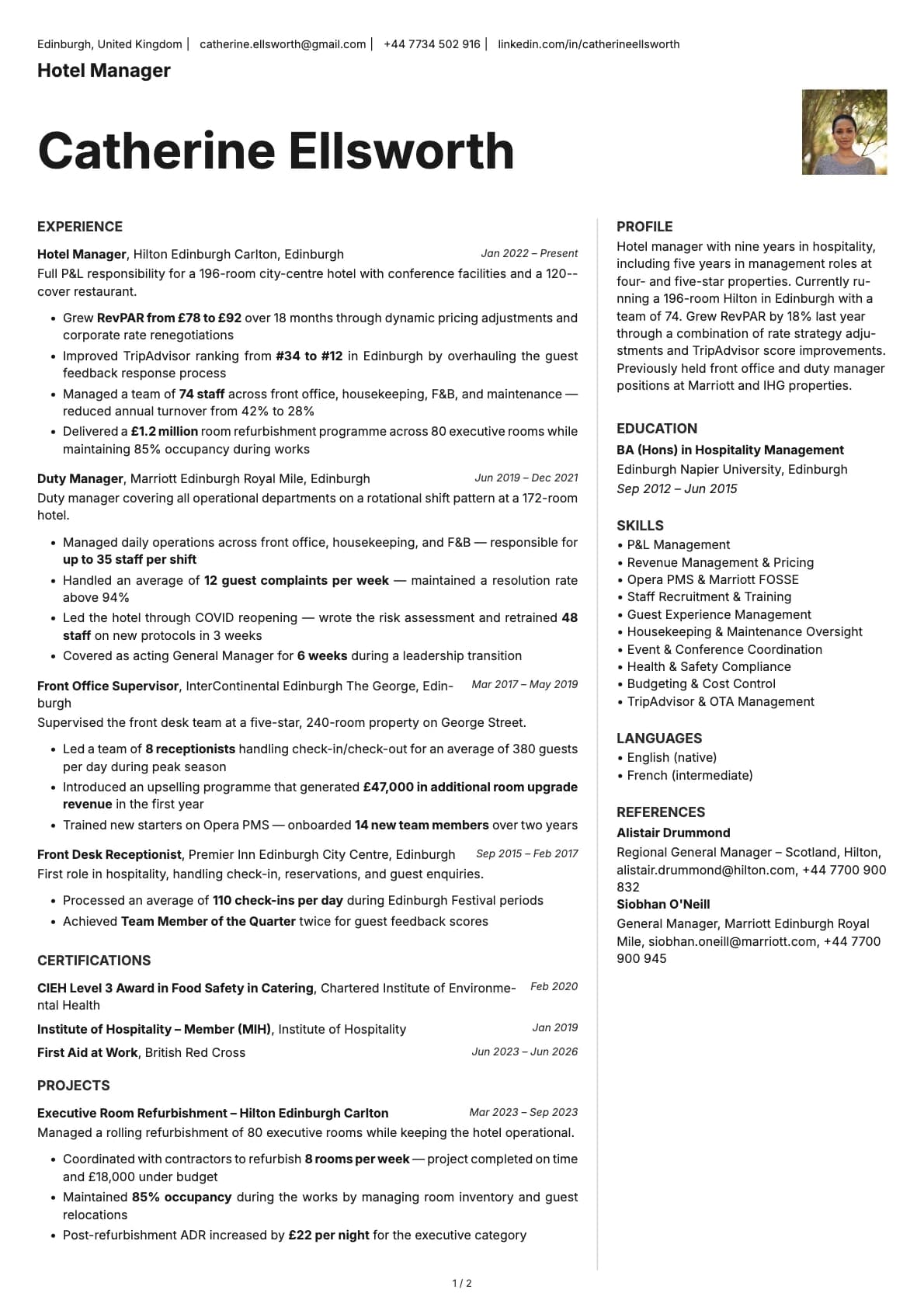
A hotel manager resume example with P&L ownership at a 196-room Hilton. See how to present RevPAR growth, team management, and guest satisfaction.
Chef
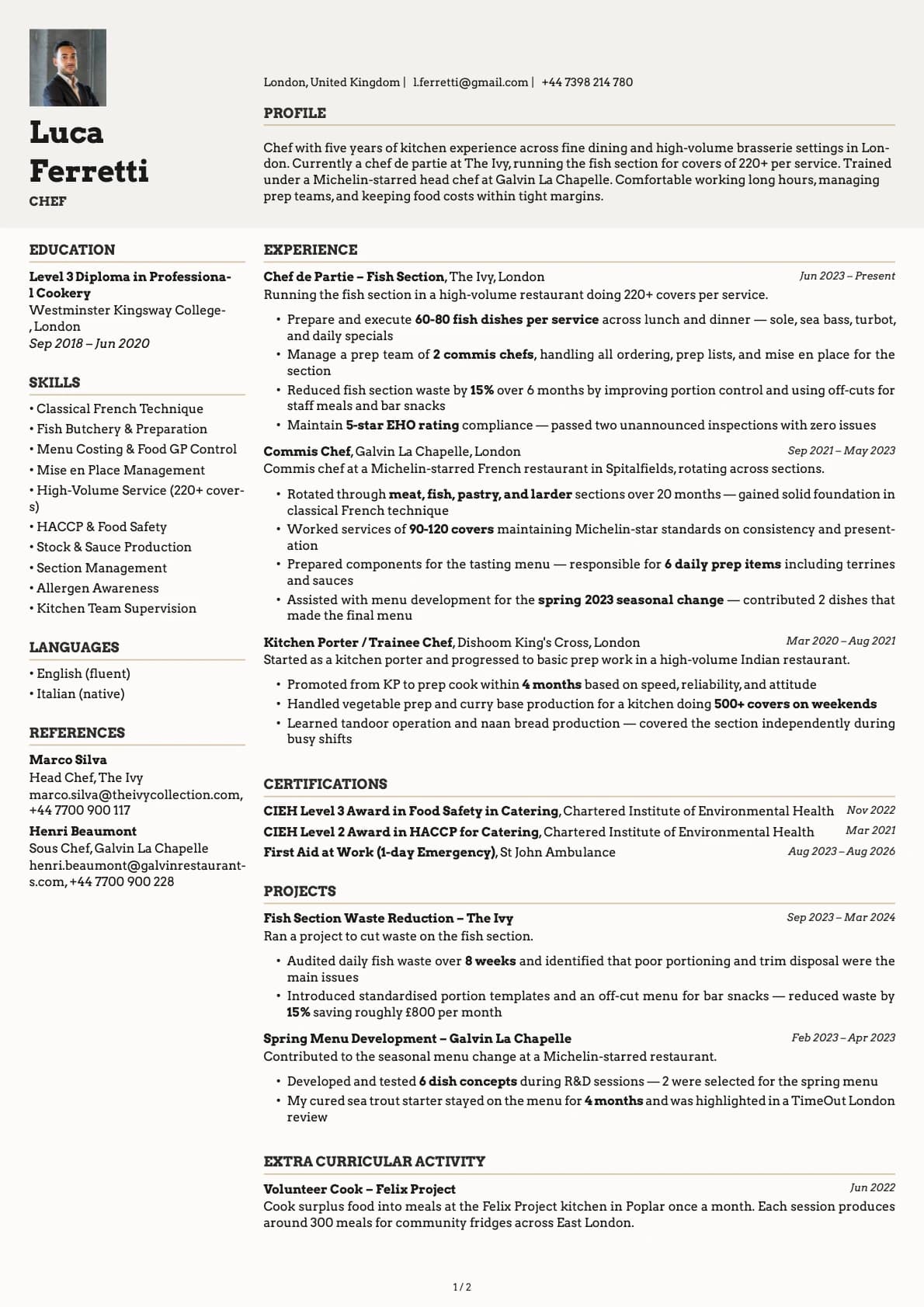
A chef resume example with fine dining and high-volume experience at The Ivy and Galvin La Chapelle.
Bartender
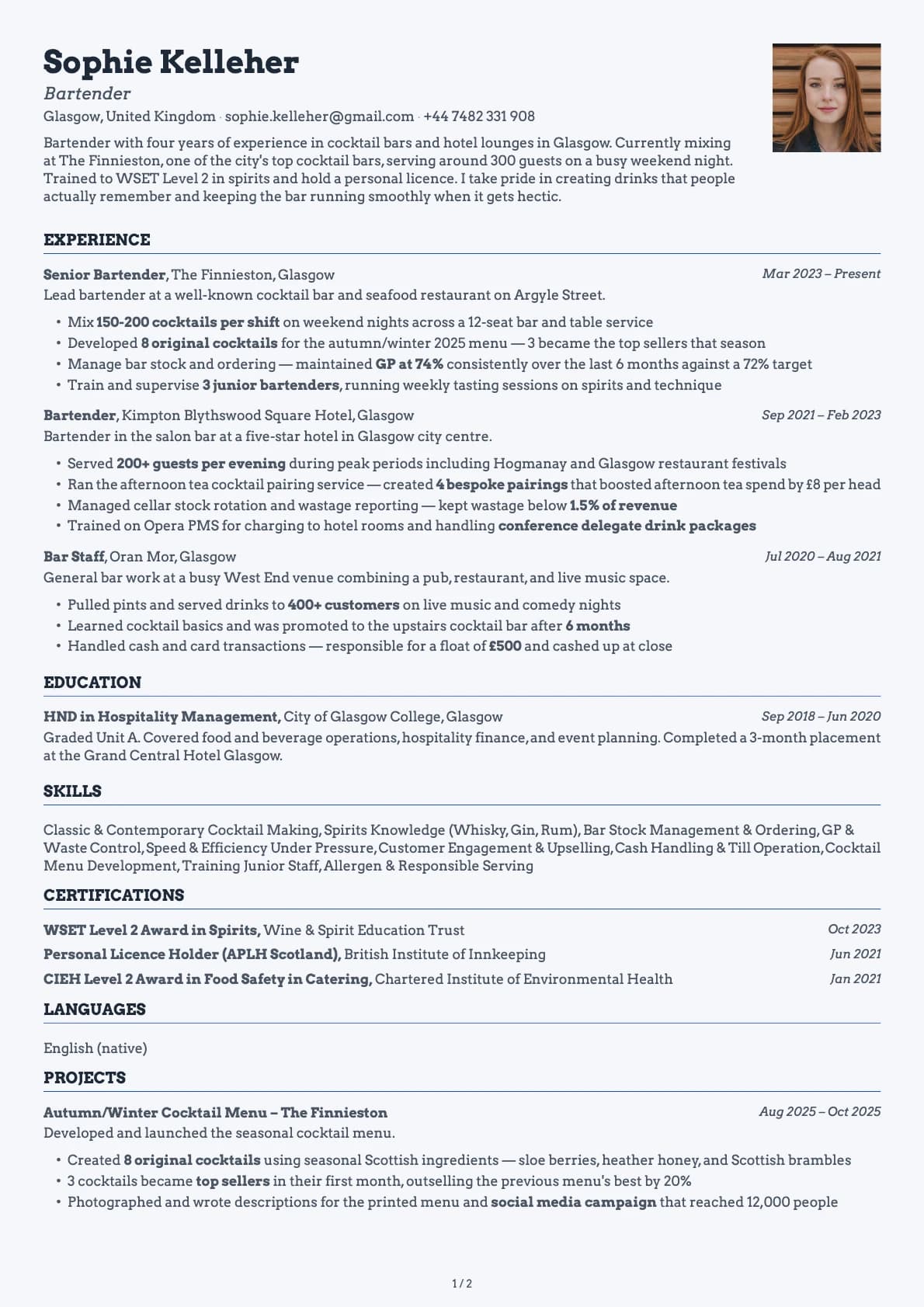
A bartender resume example from a top Glasgow cocktail bar, covering drink volumes, GP targets, menu development, and how to present hospitality.
Server / Waiter
A server and waiter resume example with cover counts, upselling results, and private event experience.
Related articles

AI Is Screening Your Resume Before Any Human Sees It
AI screens most resumes before a human ever reads them. 97.4% of Fortune 500 companies run an ATS. This is what that means for you and what you can do about it.

The Best Resume Builders in 2026, Compared Honestly
Resume.io, Zety, Enhancv, Kickresume, Teal, and Laddro compared honestly: real pricing, free tiers, mobile apps, and where each tool wins. All prices checked in September 2026.

Burnout Recovery: A Real Timeline, Not 'Take a Bubble Bath'
55% of the U.S. workforce is burned out. Recovery takes 3 to 12 months. Here's what that actually looks like, stage by stage.