Server / Waiter Resume Example
A server and waiter resume example with cover counts, upselling results, and private event experience.

Laddro Team
Free to use. No account needed to start.
Free to use. No account needed to start.
Overview
Most waiter resumes are one page of nothing. "Took orders, served food, cleared tables." Every restaurant manager knows what waiters do. They do not need your resume to explain the job. They need it to explain why you are better at it than the other fifty people who applied.
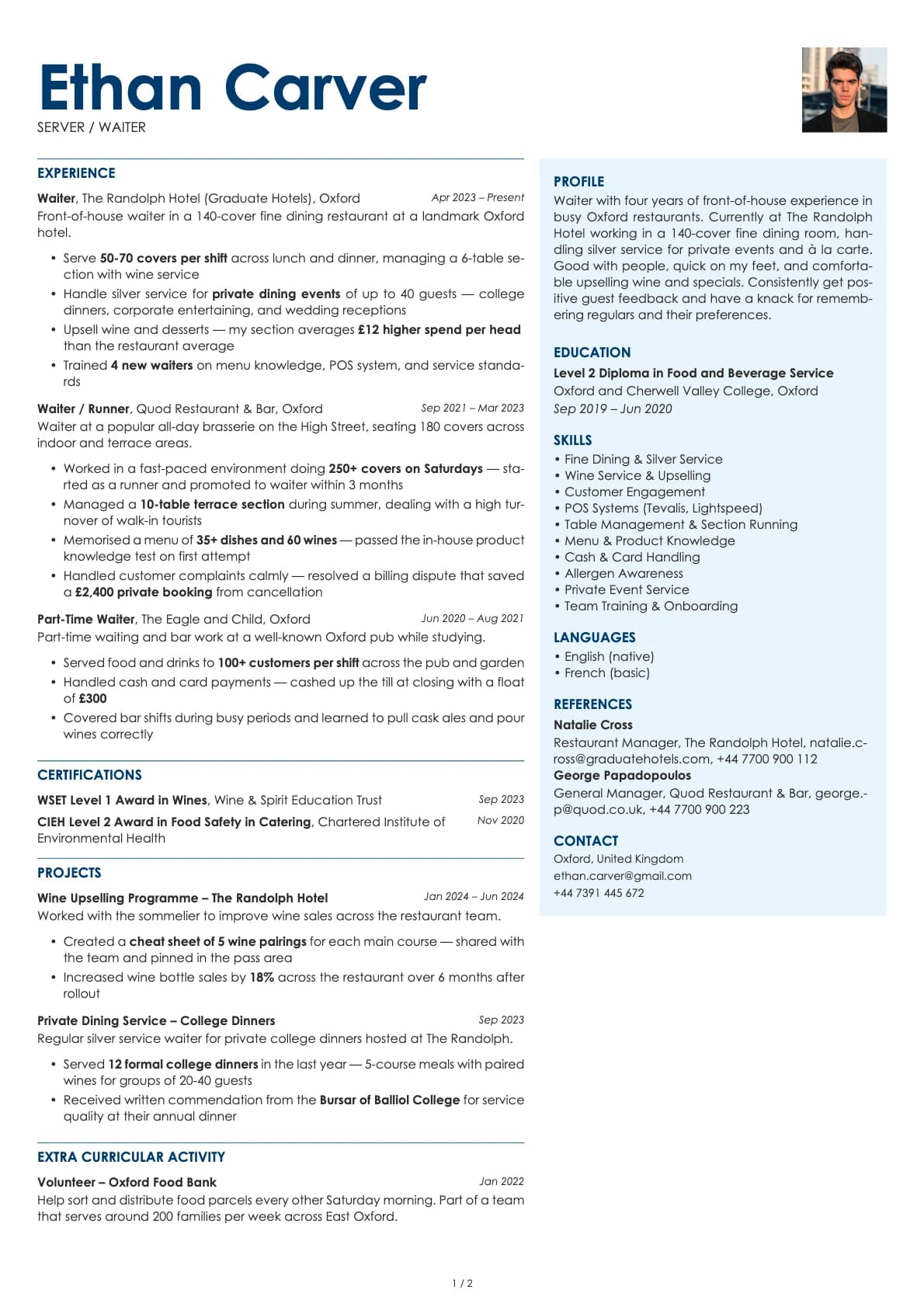
This resume belongs to Ethan Carver, a waiter in Oxford with four years of front-of-house experience. He currently works at The Randolph Hotel in a 140-cover fine dining room, handling silver service for private events and regular a la carte service. Before that, he was at Quod Restaurant (180 covers, busy brasserie) and The Eagle and Child (pub and bar work).
What makes this resume stand out is that it treats hospitality work like a real profession with real numbers. Covers per shift, spend per head, training contributions, and complaint resolution. Let us look at how.
Cover counts tell the whole story
In hospitality, covers are the universal currency. When a restaurant manager reads your resume, covers per shift tells them immediately whether you can handle their pace:
"Serve 50-70 covers per shift across lunch and dinner, managing a 6-table section with wine service"
That is a fine dining pace with wine service and a defined section. Now compare it with the Quod entry:
"Worked in a fast-paced environment doing 250+ covers on Saturdays"
Completely different environment. High-volume brasserie versus fine dining hotel. Both are valid, but they require different skills. By including the cover count, Ethan lets the manager match his experience to their venue without guessing.
For your resume: Always include covers per shift, your section size, and the type of service (a la carte, set menu, buffet, silver service).
Upselling is money you can measure
Upselling is the skill that separates an average waiter from a great one. And it is one of the few things in front-of-house work that you can put a number on:
"Upsell wine and desserts, my section averages £12 higher spend per head than the restaurant average"
That is a powerful line. It tells the manager: if you hire me, your revenue goes up. £12 per head across 50-70 covers per shift adds up fast. If you know your upselling numbers (or can estimate them from POS data), include them.
The wine upselling project is another good example:
"Created a cheat sheet of 5 wine pairings for each main course, shared with the team and pinned in the pass area"
"Increased wine bottle sales by 18% across the restaurant over 6 months after rollout"
That is not just upselling. That is improving the whole team's performance. A manager reading this sees someone who thinks about the business, not just their own section.
Private events and formal service
If you have done private dining, banquets, or formal service, highlight it. These are specialist skills:
"Handle silver service for private dining events of up to 40 guests, college dinners, corporate entertaining, and wedding receptions"
"Served 12 formal college dinners in the last year, 5-course meals with paired wines for groups of 20-40 guests"
Silver service, wine pairing, formal courses. These skills take you out of the "casual dining waiter" category and into higher-end roles. If you have experience with these, make them prominent.
Training and team contribution
If you have trained new staff, that shows leadership potential:
"Trained 4 new waiters on menu knowledge, POS system, and service standards"
From the earlier role:
"Memorised a menu of 35+ dishes and 60 wines, passed the in-house product knowledge test on first attempt"
Product knowledge matters in hospitality. A waiter who knows the menu inside out gives better recommendations, handles dietary questions confidently, and sells more. If you passed any product knowledge assessments or wine certifications (like the WSET Level 1 on this resume), include them.
Handling problems under pressure
Every restaurant has bad nights. How you handle them is what managers want to know:
"Handled customer complaints calmly, resolved a billing dispute that saved a £2,400 private booking from cancellation"
That single bullet tells a story: a high-value booking was about to walk out, and Ethan handled it. If you have resolved complaints, dealt with difficult customers, or managed a service recovery, include it with the outcome.
Certifications that matter
For hospitality, two certifications come up repeatedly: food safety (CIEH Level 2 is the standard) and wine qualifications (WSET). This resume lists both. If you have either, put them on. If you do not have a food safety certificate, get one. It is cheap, takes a day, and many employers require it.
Mistakes waiters make on resumes
Listing duties instead of achievements. "Took orders and served food" describes every waiter who ever lived. "Served 50-70 covers per shift with wine service across a 6-table section" describes you specifically.
Not mentioning the venue. "Worked at a restaurant in Oxford" is vague. Name the restaurant, describe its size and style, and give the cover count. Managers want to know what kind of environment you come from.
Ignoring the POS system. If you know Tevalis, Lightspeed, Square, or any other point-of-sale system, list it. Managers hate training people on a new POS. If you already know theirs, that is a small but real advantage.
Selling yourself short on bar experience. If you have pulled pints, made cocktails, or managed a bar during service, include it. Multi-skilled front-of-house staff are always in demand.
A closing thought
Hospitality managers hire fast and they skim resumes even faster. Put your best venue, your cover count, and your strongest number in the first three lines. If those hook them, they will read the rest. If not, no amount of detail further down will help.
Build your own version
Open this layout in the builder and swap in your own details. It takes a few minutes.
Free to use. No account needed to start.
Was this resume example helpful?
Rate this example to help us create better content for you.
4.7 average from 118 ratingsRelated resume examples
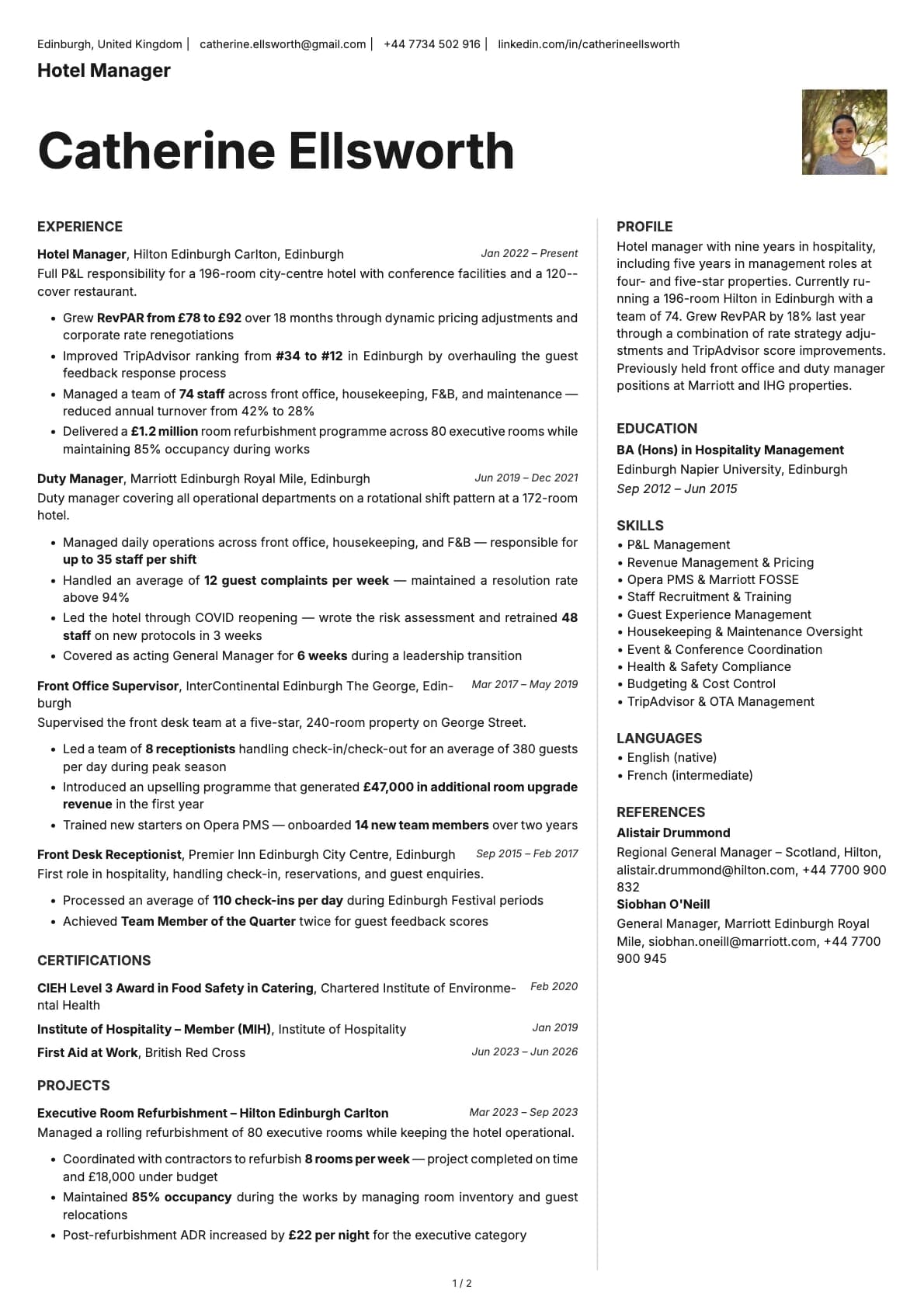
Hotel Manager
A hotel manager resume example with P&L ownership at a 196-room Hilton. See how to present RevPAR growth, team management, and guest satisfaction.
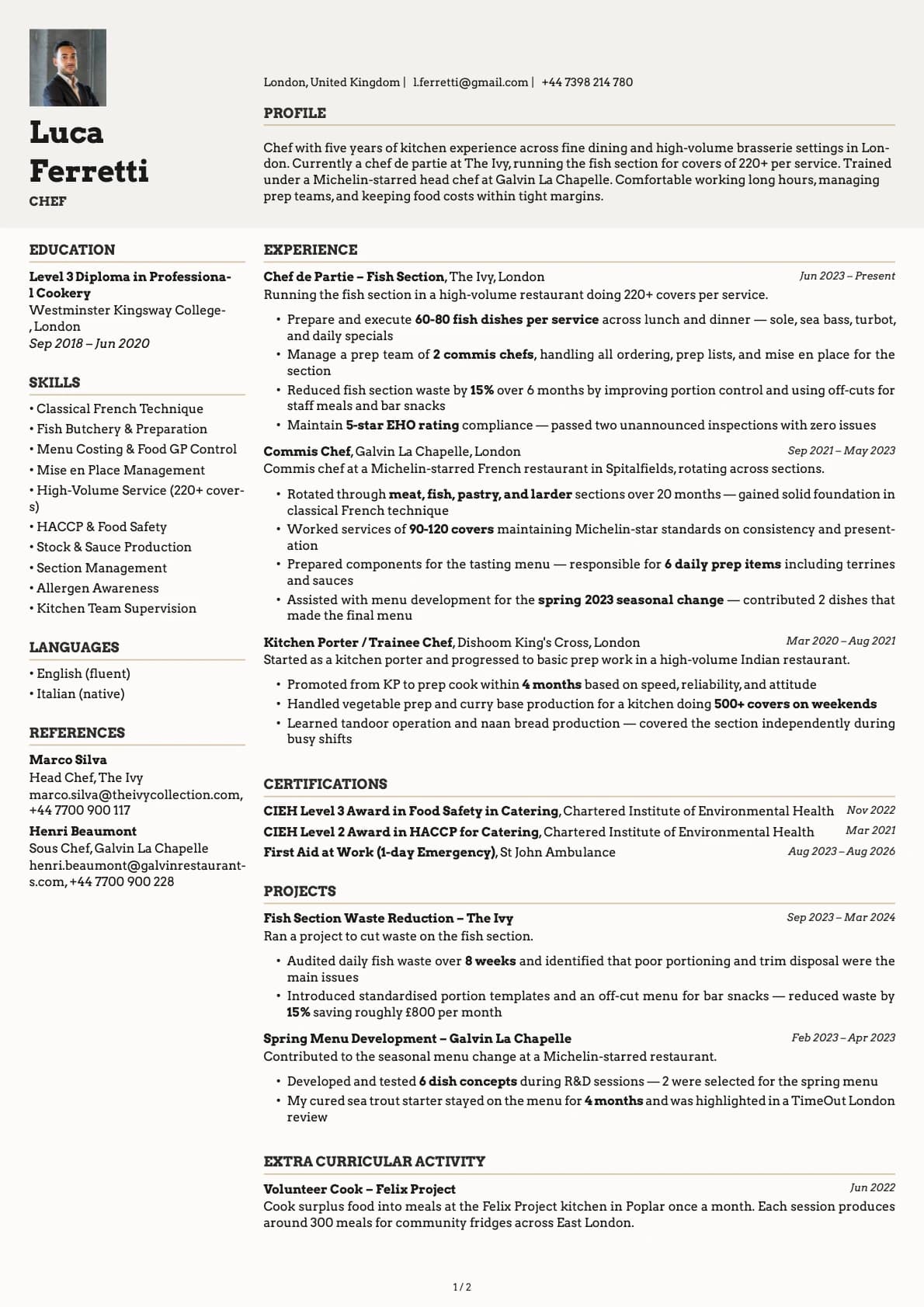
Chef
A chef resume example with fine dining and high-volume experience at The Ivy and Galvin La Chapelle.
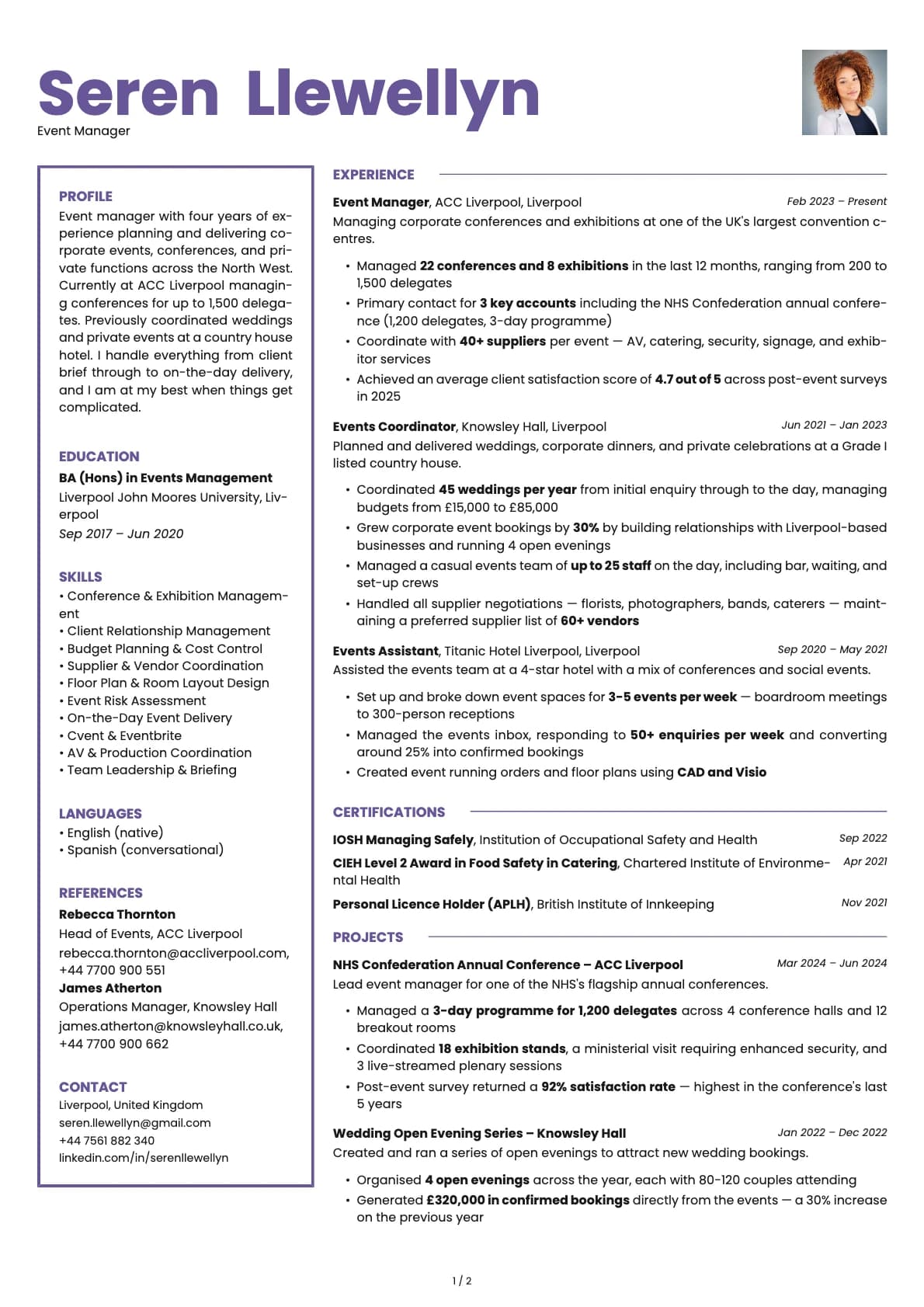
Event Manager
An event manager resume example with conference and wedding planning experience.
Bartender
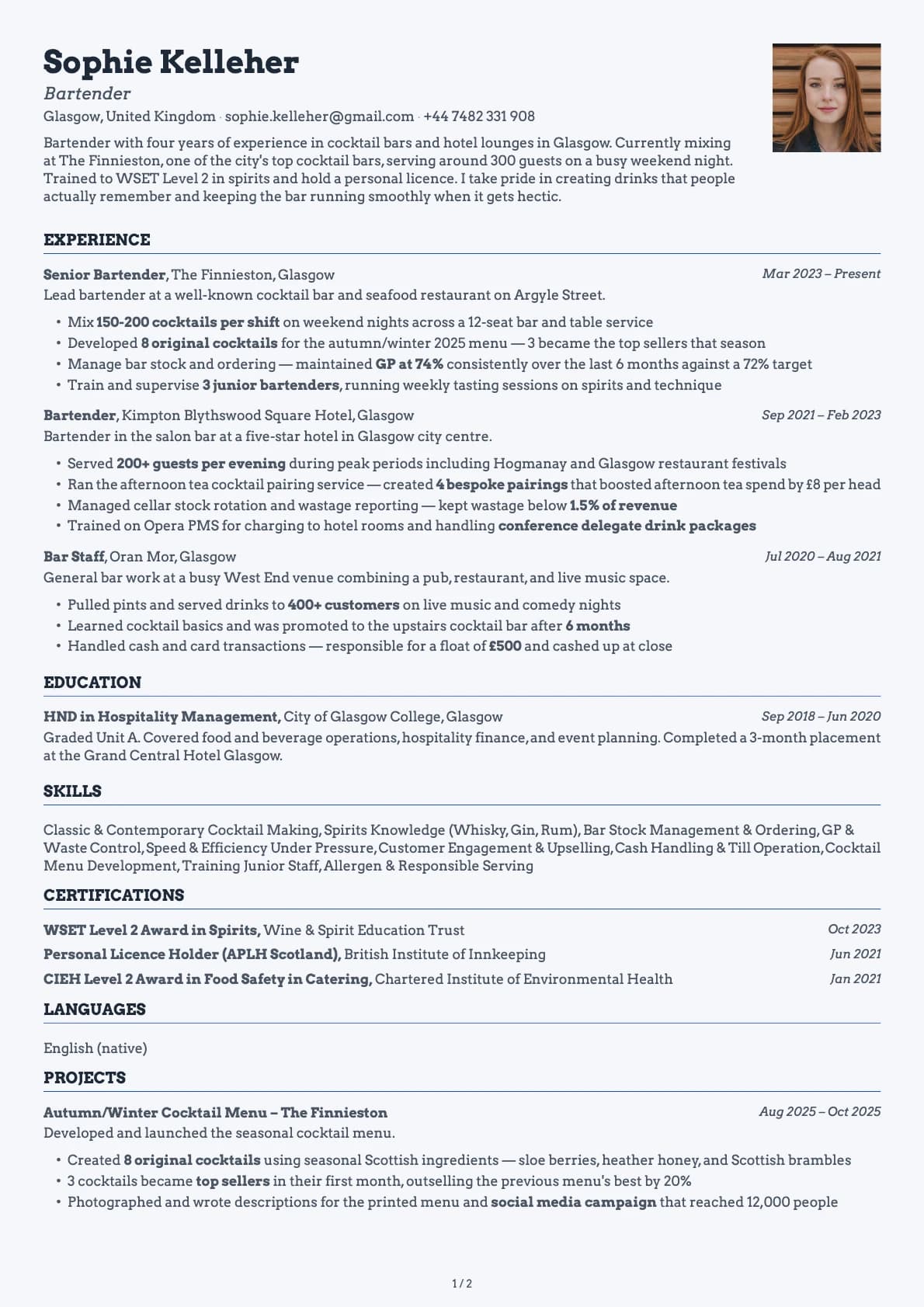
A bartender resume example from a top Glasgow cocktail bar, covering drink volumes, GP targets, menu development, and how to present hospitality.
Related articles

AI Is Screening Your Resume Before Any Human Sees It
AI screens most resumes before a human ever reads them. 97.4% of Fortune 500 companies run an ATS. This is what that means for you and what you can do about it.

The Best Resume Builders in 2026, Compared Honestly
Resume.io, Zety, Enhancv, Kickresume, Teal, and Laddro compared honestly: real pricing, free tiers, mobile apps, and where each tool wins. All prices checked in September 2026.

Burnout Recovery: A Real Timeline, Not 'Take a Bubble Bath'
55% of the U.S. workforce is burned out. Recovery takes 3 to 12 months. Here's what that actually looks like, stage by stage.